Paris Souvenir Guide: What to Bring Home (Beyond the Eiffel Tower Keychain)
The mini Eiffel Tower keychain at Trocadéro is the worst souvenir in Paris — mass-produced in Shenzhen, sold by unlicensed pavement vendors, and discarded inside three weeks of getting home. Paris is...
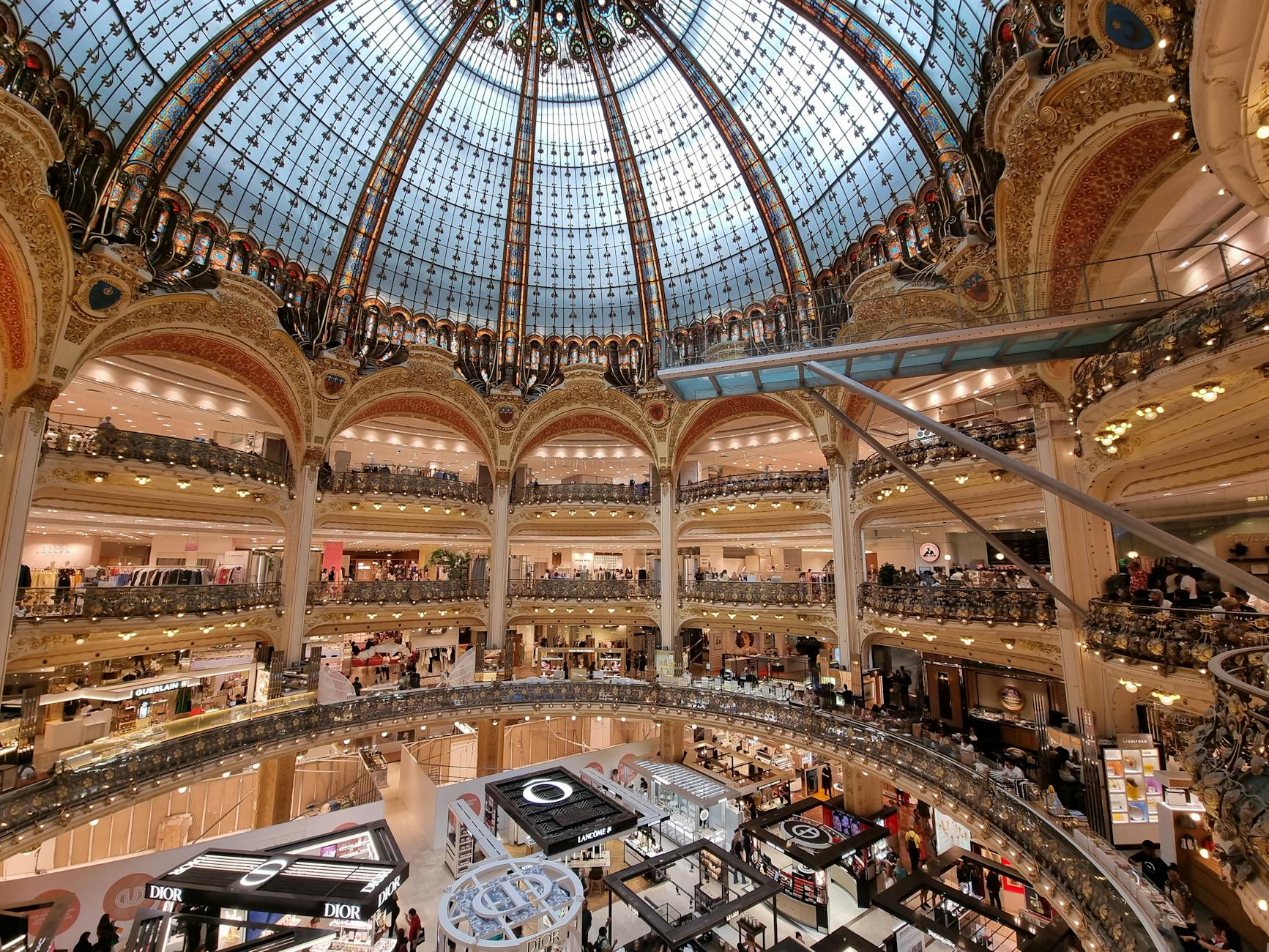

Start with the worst souvenir in Paris so we never have to mention it again: the mini Eiffel Tower keychain at Trocadéro. Molded in Shenzhen, hawked by unlicensed vendors on the pavement, in the bin within three weeks of landing. Now the good news. This is one of the great shopping cities on earth, and the honest answer to what to bring home from Paris runs more like this: macarons from Pierre Hermé, mustard pumped from a tap at Maille on Rue Royale, a green cube of Marseille soap, a niche perfume from Buly 1803, a vintage Hermès silk square dug out of the Vanves flea market, and a wedge of Bordier butter packed in dry ice from a fromager in the 6th. What follows is the real souvenir map, sorted by category — gourmet, beauty, fashion, housewares, stationery, art, wine — with addresses, price tiers, packing rules, and the customs limits that decide what actually makes it onto the plane.
Use it next to our guide to the best shopping streets, the deep dives on perfume shopping and claiming the VAT refund, our walk-through of Galeries Lafayette and Printemps, the flea markets, and the food souvenirs deep dive, and you can plan a full afternoon around any one section.
Gourmet Souvenirs: Macarons, Chocolate, Mustard, Tea
Food gives you the highest return of any souvenir category here. The unit cost is low, the reaction at home is loud, and the things are French in a way a leather wallet never manages to be. Yes, there are rules — cold chains, liquid limits, customs forms, all covered below — but the math is hard to argue with. A forty-euro spread of gourmet odds and ends will out-impress a four-hundred-euro scarf in front of anyone who isn’t a fashion editor.
Macarons: Pierre Hermé, Ladurée, Sébastien Gaudard
Pierre Hermé is the benchmark, and it isn’t close. The flagship sits at 72 Rue Bonaparte in the 6th, with a bigger location at 4 Rue Cambon just off Rue Saint-Honoré. A box of seven is around twenty-four euros, fifteen around forty-nine, and the seasonal Ispahan — rose, lychee, raspberry — is the one you taste before you decide anything else. The packaging was clearly designed as a gift, and the flat boxes shrug off a checked bag even when the handlers don’t.
Ladurée, at the original 1862 salon on 16 Rue Royale and at 75 Champs-Élysées, is the old guard: less inventive than Hermé, more dependable on the classics like pistachio, rose, and salted caramel. Eight run about twenty-eight euros, eighteen about fifty-eight. One word of warning. Walk past the airport Ladurée stalls; the in-city shops keep fresher stock and the boxes hold up better.
Sébastien Gaudard at 22 Rue des Martyrs in the 9th is the connoisseur’s choice. Smaller production, lighter shells, classic flavors and nothing else. Six for roughly eighteen euros. Time the visit with breakfast at his salon de thé up the street. On a budget? Supermarket macarons from Carrefour or Monoprix, about eight euros for twelve, are genuinely fine for office gifting and nobody will know.
Chocolate: Patrick Roger, Jean-Paul Hévin, La Maison du Chocolat
Patrick Roger holds the Meilleur Ouvrier de France title, and his dark pralines and gallery-scale chocolate sculptures more or less define the modern Paris chocolate scene. Two flagships, at 108 Boulevard Saint-Germain and 199 Rue du Faubourg Saint-Honoré. A small assortment runs thirty to forty-five euros; the single-origin tablets are around twelve. Dark chocolate also happens to be a good traveler — it survives a non-cold flight as long as you keep it out of direct sun.
Jean-Paul Hévin, at 231 Rue Saint-Honoré and 23 Avenue de la Motte-Picquet, makes the most polished ganaches in the city: thin, intense, built on named single-estate cocoa. A box of sixteen is about thirty-eight euros. La Maison du Chocolat, with the historic flagship at 225 Rue du Faubourg Saint-Honoré, is the gift-box specialist, and its brown-and-gold box reads as a serious chocolate present in any country. Figure forty to ninety euros for the standard assortments, all in travel-secure packaging.
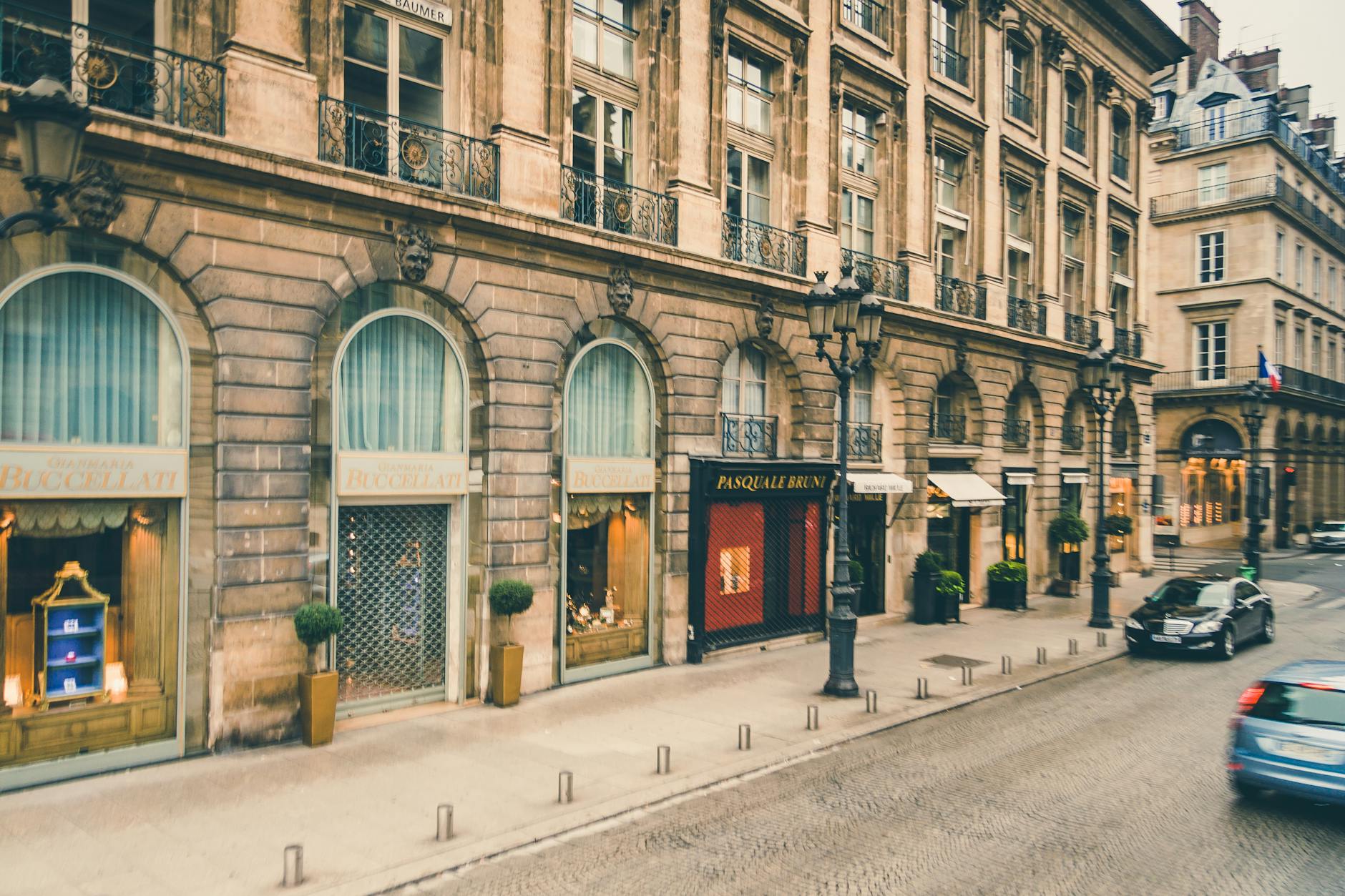
Maille Mustard on Rue Royale
Maille keeps one dedicated boutique at 6 Rue Royale, just down from Ladurée and across from the Madeleine, and the gimmick is wonderful: mustard pumped into a refillable stoneware crock from a counter tap, the way a bistro pours wine. The base white-and-blue crock is around eighteen euros, refills about fifteen, and the seasonal limited editions — black truffle, Chablis, fig — climb toward thirty-five. The crock outlives the mustard and becomes a permanent object on someone’s counter, which is the whole point. It’s carry-on safe only if sealed and under one hundred milliliters; the standard 250-gram size goes in checked baggage.
Fauchon at 11 Place de la Madeleine is the wider gourmet emporium, stocking mustards, salts, jams, foie gras, and that famous black-and-pink branded box program. Its mustard costs a few euros more than Maille, but the boxes pack better when you’re building a layered gift set. Hediard, across the square, is the older rival (founded 1854) and a touch more traditional.
Bordier Butter and Fromagerie Treasures
Jean-Yves Bordier’s Breton butter is the cult ingredient behind half the pastry kitchens in Paris: cultured, hand-paddled, sold in wax-paper wedges plain or shot through with sea salt, seaweed, or smoke. Look for it at Fromagerie Laurent Dubois (47ter Boulevard Saint-Germain) and at La Grande Épicerie inside Le Bon Marché (38 Rue de Sèvres), roughly four to seven euros for a 125-gram wedge. Pack it in checked baggage inside a foil-lined freezer bag with frozen gel packs from the shop, and it’ll cross the Atlantic intact as long as the bag stays shut.
Cheese is importable but fenced in by customs. The US allows hard, aged cheeses (over sixty days, nothing liquid) but turns away soft fresh ones; within the UK and the EU there’s no fuss. The single safest bet for a US flight is a vacuum-sealed Comté or Mimolette from Fromagerie Laurent Dubois with the aging certificate printed right on the label.
Tea: Mariage Frères and Le Palais des Thés
Mariage Frères dates to 1854 and runs two showpiece addresses that double as tea museums: the historic 30 Rue du Bourg-Tibourg in the Marais and 13 Rue des Grands-Augustins in the 6th. The signature Marco Polo blend — chocolate, vanilla, fruit — comes in the familiar black tin at twenty-eight euros per hundred grams. Wedding Imperial, Thé des Impressionnistes, and Sakura Imperial round out the gift-grade picks, and the tins are reusable, weatherproof, and flat to pack.
Le Palais des Thés, with its flagship at 64 Rue Vieille-du-Temple, plays the modern foil: lighter look, more single-origin transparency, prices a notch lower at twenty to twenty-five euros per hundred grams. Both ship sealed metal tins that survive a checked bag at any temperature, so this is genuinely a no-stress category.
Fleur de Sel, Honey, and Old-School Confections
Fleur de sel from Guérande in Brittany and from the Île de Ré turns up in little wooden boxes at La Grande Épicerie and at neighborhood épiceries all over the city, around six to twelve euros for a hundred and fifty grams. You can spot the real thing by the rough crystals and the faint gray cast; the wooden box does the gift-wrapping for you. Clears customs everywhere.
Maison du Miel at 24 Rue Vignon, just behind the Madeleine, has sold nothing but honey since 1898 — French regional varietals (lavender from Provence, chestnut from Corsica, thyme from the Pyrénées) lined up in identical jars, about nine to fourteen euros for 250 grams. Marquise de Sévigné, with its historic shop at 32 Place de la Madeleine, sells violet bonbons, caramels, and pralines in art-deco tins that pack flat, fifteen to thirty euros apiece. Both shops reward a slow ten minutes.
French Pharmacy and Niche Perfume
If you weigh value against luggage weight, French pharmacy skincare wins the whole guide. The Embryolisse Lait-Crème Concentré tube that runs twenty-eight dollars at a New York Sephora costs around twelve euros at any French pharmacy, and that ratio holds across Avene, Bioderma, Nuxe, Caudalie, La Roche-Posay, Klorane, and Vichy. Push your total past a hundred euros at one pharmacy, add the VAT refund, and the gap only widens.
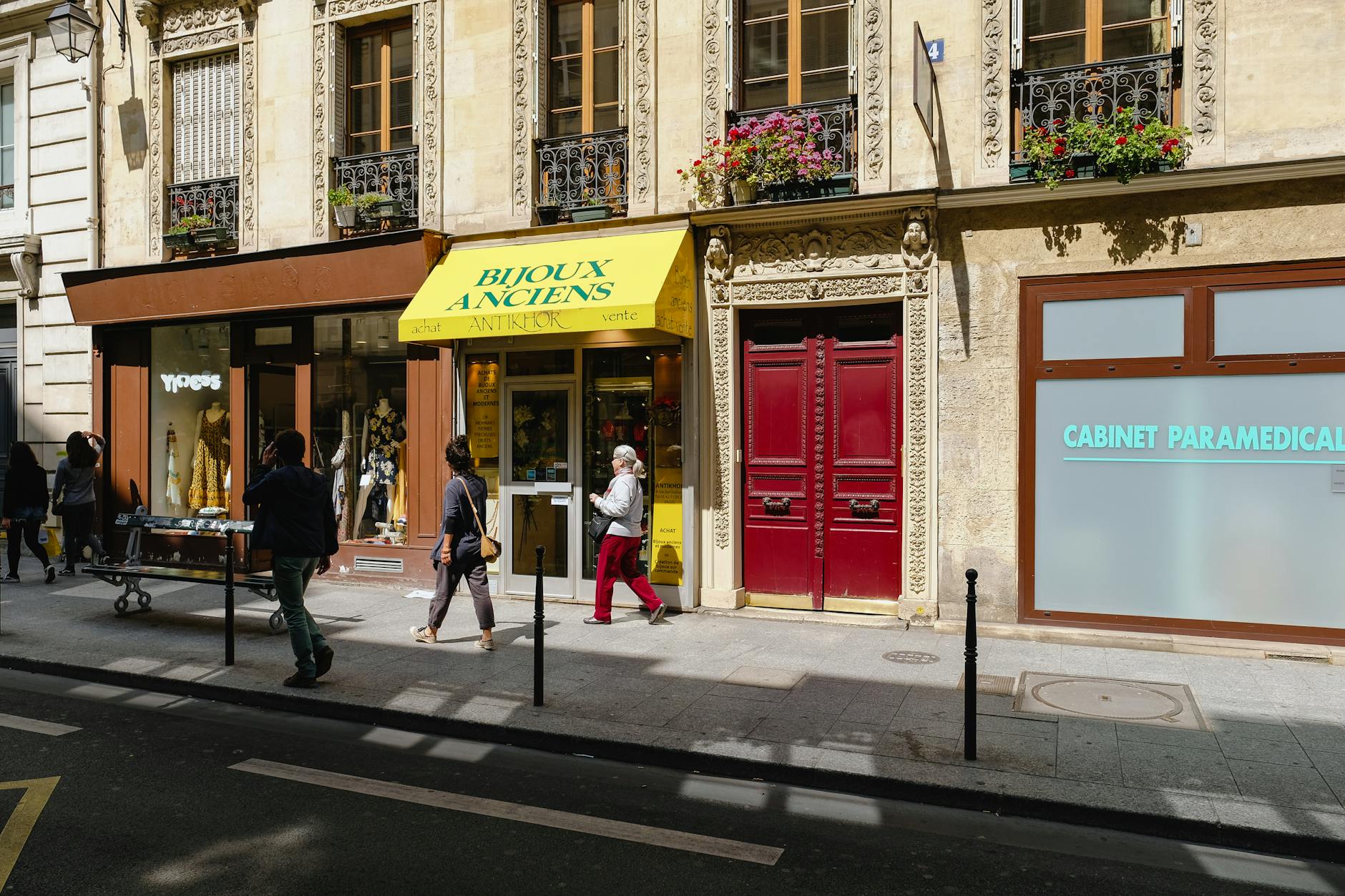
City Pharma at 26 Rue du Four
City Pharma at 26 Rue du Four in the 6th, just off Boulevard Saint-Germain, is the destination pharmacy. Three floors, a basket handed to you at the door, English-speaking staff, and prices roughly thirty to forty percent under a standard neighborhood pharmacy. To set your expectations: Bioderma Sensibio H2O (500ml) lands around eleven euros, Avene Thermal Water spray (300ml) around nine, Embryolisse Lait-Crème (75ml) around twelve, Nuxe Huile Prodigieuse (100ml) around twenty, and Caudalie Beauty Elixir (100ml) around thirty.
Other solid bets: Pharmacie Monge at 1 Place Monge in the 5th (less of a scrum, similar prices), Pharmacie Saint Sulpice at 28 Rue du Vieux Colombier, and the Pharmacie Lafayette branches dotted around town for reliable mid-tier pricing. Steer clear of the pharmacies in the hotel districts near the Champs-Élysées and in the Marais, where markups run twenty to thirty percent over City Pharma. And keep your passport handy for the VAT refund once you clear a hundred euros.
Niche Perfume: Diptyque, Frederic Malle, MFK, Serge Lutens, Buly 1803
Diptyque’s 1961 original sits at 34 Boulevard Saint-Germain, selling Eau Capitale, Philosykos, Tam Dao, and Do Son in 75ml flacons for about one hundred forty euros, and the oval candles for around seventy-two. Those 190-gram candles — Baies, Figuier, Roses — are probably the single most-shipped Paris beauty souvenir, full stop. Bubble-wrap them inside a checked bag; the glass is fragile but the boxes are built for the trip.
Maison Francis Kurkdjian, at 5 Rue d’Alger and inside Galeries Lafayette, is the contemporary luxury yardstick, with Baccarat Rouge 540, Oud Satin Mood, and Grand Soir leading the line at around three hundred forty euros for 70ml. Frédéric Malle at 37 Rue de Grenelle in the 7th runs the editions-perfumeurs idea — a curated stable of noses, no house brand — with Portrait of a Lady, Carnal Flower, and Musc Ravageur the ones to smell first, roughly two hundred ten to three hundred euros for 50ml.
Serge Lutens, tucked into the Palais Royal at 142 Galerie de Valois, is the goth-aesthete pick: black walls, sculptural bottles, dense woody orientals like Ambre Sultan and Chergui, around one hundred eighty euros for 50ml. And then Officine Universelle Buly 1803, at 6 Rue Bonaparte and 45 Rue de Sévigné, the most photogenic perfume stop in the city, where the labels are calligraphed by hand in the shop alongside virgin cologne waters, vegetal pomades, and tortoise-shell combs. The waters run about eighty-five euros. Diptyque, MFK, and Buly all do the VAT refund and ship to most countries.
Savon de Marseille and Old-World Soap
Savon de Marseille is the boxy seventy-two-percent olive-oil soap stamped with its maker’s name, sold by weight at La Compagnie de Provence (15 Rue de Buci, 6th) and at the open market on Place Monge. The classic green cube is around six euros for three hundred grams. Stack six in a linen bag and the whole gift costs twenty-five euros and weighs under two kilos. La Compagnie also carries liquid Marseille soap, hand creams, and scented cube variants. All of it clears customs anywhere as solid cosmetics.
Fashion: Scarves, Berets, Breton Tops, Espadrilles
Fashion needs a sharper filter than food or beauty. The wrong scarf reads as costume; the wrong striped shirt reads as a Halloween prop. The shortlist below sticks to pieces actual Parisians wear, made by the actual French houses, in cuts and colors that travel well past the city limits.
Silk Scarves: Hermès and Vintage at Flea Markets
The Hermès carré is the top of the Paris fashion food chain: ninety centimeters of silk twill in a signature print, edges rolled by hand, woven in Lyon. New, at the flagship on 24 Rue du Faubourg Saint-Honoré, the standard carré is four hundred seventy euros. Vintage, hunted down at the Saint-Ouen markets (Vernaison, Dauphine) or at Vanves on a weekend morning, the same 1970s and 1980s scarves go for one hundred fifty to two hundred fifty euros in mint condition. The vintage route is the connoisseur’s move every time: rarer prints, more character, half the price.
Maison Fabre, at 128 Galerie de Valois in the Palais Royal, has worked gloves since 1924, its family workshop in Millau — the glove capital of France — having once supplied Grace Kelly and Catherine Deneuve. Hand-stitched lambskin gloves run two hundred to three hundred euros. This is a serious, gift-grade object that lasts thirty years if you treat it right, and the Palais Royal shop is the only one in Paris.
Berets, Breton Tops, and Espadrilles
Laulhère at 19 Rue de Castiglione is the last French béret maker still producing in France, founded in 1840 in the Béarn. A standard wool béret in the Hoquy or Béarn models runs sixty to eighty-five euros. Whatever you do, skip the felt souvenir-shop berets near Sacré-Coeur. They’re imported and they shed.
For Breton stripes, two brands are the real thing. Saint James (the largest Paris flagship is 66 Rue de Rennes) is the heritage label, founded 1889 and supplier to the French Navy; Armor Lux (52 Rue du Bac and 7 Rue de la Trémille) is the slightly cheaper alternative. The classic Meridien II long-sleeve mariniere is eighty to one hundred euros at Saint James, sixty to seventy at Armor Lux. The cotton is heavier and the cut more flattering than anything sold near the monuments.
Espadrilles from Castaner, also stocked at multi-brand shops like Le Bon Marché, run sixty to one hundred twenty euros for the classic jute-soled flats. Sézane, at the original “L’Appartement” concept store on 1 Rue Saint-Fiacre, sells the trend-led Paris-girl wardrobe — cotton blouses, knit cardigans, plain denim — in the seventy-to-one-hundred-eighty-euro band. And for the most reliable baby gift in the city, head to Petit Bateau at 26 Rue Vavin in the 6th for the universal French children’s wardrobe of cotton bodysuits and striped tees.
Housewares: Cookware, Ceramics, Candles, Linens
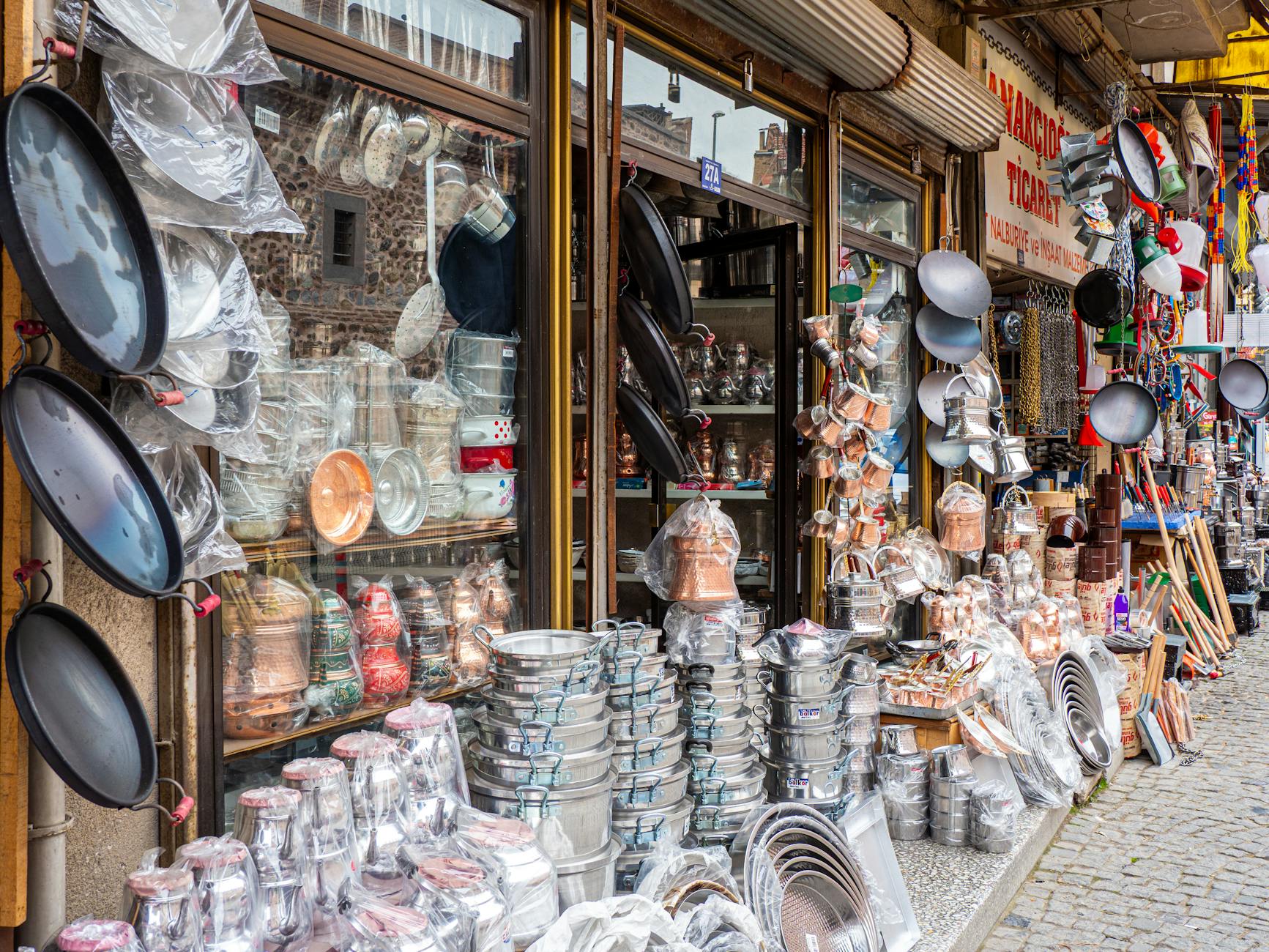
Housewares are heavy but they last, so the question shifts from value to baggage allowance and how well you can pad the thing. The category splits two ways: pieces that genuinely upgrade daily life at home, like Le Creuset and Sabre flatware, and decorative pieces that anchor a whole room, like Astier de Villatte plates and Cire Trudon candles.
Le Creuset, Sabre, and French Cookware
Le Creuset sells the same cast-iron cocottes and Dutch ovens you’d find in the US, but the Paris flagship at 110 Avenue des Champs-Élysées carries French-exclusive colors and seasonal editions you won’t see at home. A 24cm round cocotte runs around two hundred fifty to three hundred fifty euros depending on color, roughly fifteen to twenty-five percent below US retail, and the VAT refund stretches that further. It’s heavy. Pack it in checked baggage with real padding and make peace with the fact that it’s eating your weight allowance.
Sabre at 4 Rue des Quatre-Vents in the 6th makes the colored resin-handled flatware that sets every chic Paris table. A six-piece place setting is around fifty euros, a sixteen-place set around three hundred. Bistrot is the entry pattern; Bamboo and Old-Fashioned lean more decorative. Light, unbreakable, ideal for the checked bag.
Astier de Villatte Ceramics
Astier de Villatte at 173 Rue Saint-Honoré is the cult ceramics studio: black Italian terracotta, hand-formed, dipped in a milky white glaze, fired at the 11th-arrondissement studio in the workshop of artist Aristide Najean. Plates run sixty-five to one hundred sixty euros each. The boutique itself is worth the trip, all antique cabinets and a candle-making workshop visible from the floor, and the brand also sells incense, candles, and books set in Ina Saltz typography. Bury ceramics inside clothing in the middle of a checked bag, packed so tight nothing can shift.
Candles: Diptyque, Cire Trudon, Astier de Villatte
Diptyque candles, covered above on the perfume side, are the safe pick at seventy-two euros for the 190-gram classic. Cire Trudon at 78 Rue de Seine in the 6th is the elder statesman — founded 1643, once casting the candles for Versailles under Louis XIV — with a more historical look and a heavier scent throw. The classic 270-gram glass runs around one hundred euros; Ernesto, Cyrnos, Spiritus Sancti, and Abd El Kader are the signatures. The flagship is a retail experience in itself, with bronze busts, antique wax-casting molds, and unscented dripping pillars displayed like sculpture.
French Linens
Merci at 111 Boulevard Beaumarchais in the 3rd, the concept store with the little red Fiat parked out front, sells linen sheets, tablecloths, and napkins from French and European mills in the seventy-to-three-hundred-euro range. Le Bon Marché (24 Rue de Sèvres) and La Grande Épicerie carry the same kind of thing with broader choice. A six-piece pure-linen napkin set runs around eighty euros. The packing case for textiles makes itself: nothing breaks, and they fill the dead corners of a checked bag.
Stationery and Books
Stationery is the most underrated category on this list: light, cheap, photogenic, and almost impossible to find at equivalent quality outside France. It covers fine paper, notebooks, calligraphy supplies, and books with real cultural specificity.
Melédies Graphiques and G. Lalo
Mélodies Graphiques at 10 Rue du Pont Louis-Philippe in the Marais is the calligraphy specialist — Italian nibs, inks, sealing wax, brass stamps, and some of the loveliest paper in the city. Spend an hour and you walk out with a thirty-euro starter kit that will outshine a hundred-euro fashion item on any writer’s desk. Next door at 9 Rue du Pont Louis-Philippe, Papier Plus handles the cloth-bound notebooks and archival photo albums in the same family of taste. Budget about forty-five minutes for each.
G. Lalo at 9 Rue du Pont aux Choux is the historic papeterie, founded 1919, turning out woven-cotton writing paper, with the Vérgé de France line as its signature laid stock. Twenty sheets and ten envelopes run around fourteen euros. The right gift for anyone who still writes thank-you notes.
Smythson, Papier Tigre, and Hermès Notebooks
Smythson at 4 Rue Cambon is the British leather house better known abroad, but the Paris shop sells the Panama notebook line at European retail — around one hundred forty euros for the classic, cheaper than in the US. Papier Tigre at 5 Rue des Filles du Calvaire is the contemporary Paris-designed brand, with printed notebooks, planner pages, and origami kits in the twelve-to-thirty-five-euro range: affordable, photogenic, flat to pack.
Hermès sells the Le Carnet d’adresses refillable leather notebook at the flagship on 24 Rue du Faubourg Saint-Honoré — a small box-calf format around four hundred fifty euros, paper refill blocks around forty. It sits in the same investment-souvenir bracket as a silk square. For anyone still loyal to a paper planner, this is a thirty-year object.
Shakespeare and Company Bookstore Stamp
Shakespeare and Company at 37 Rue de la Bûcherie is the English-language bookshop facing Notre-Dame, opened by George Whitman in 1951 in this spot and carrying forward the name of Sylvia Beach. Every book you buy gets the shop’s octagonal stamp inside the cover. The cheapest Penguin Classic in the basement is around twelve euros, so buy something you’ll actually read, take the stamp, and the souvenir becomes a permanent personal artifact. The bookmark and tote, around fifteen euros, are the lighter fallbacks.
Art and Museum Gift Shop Picks
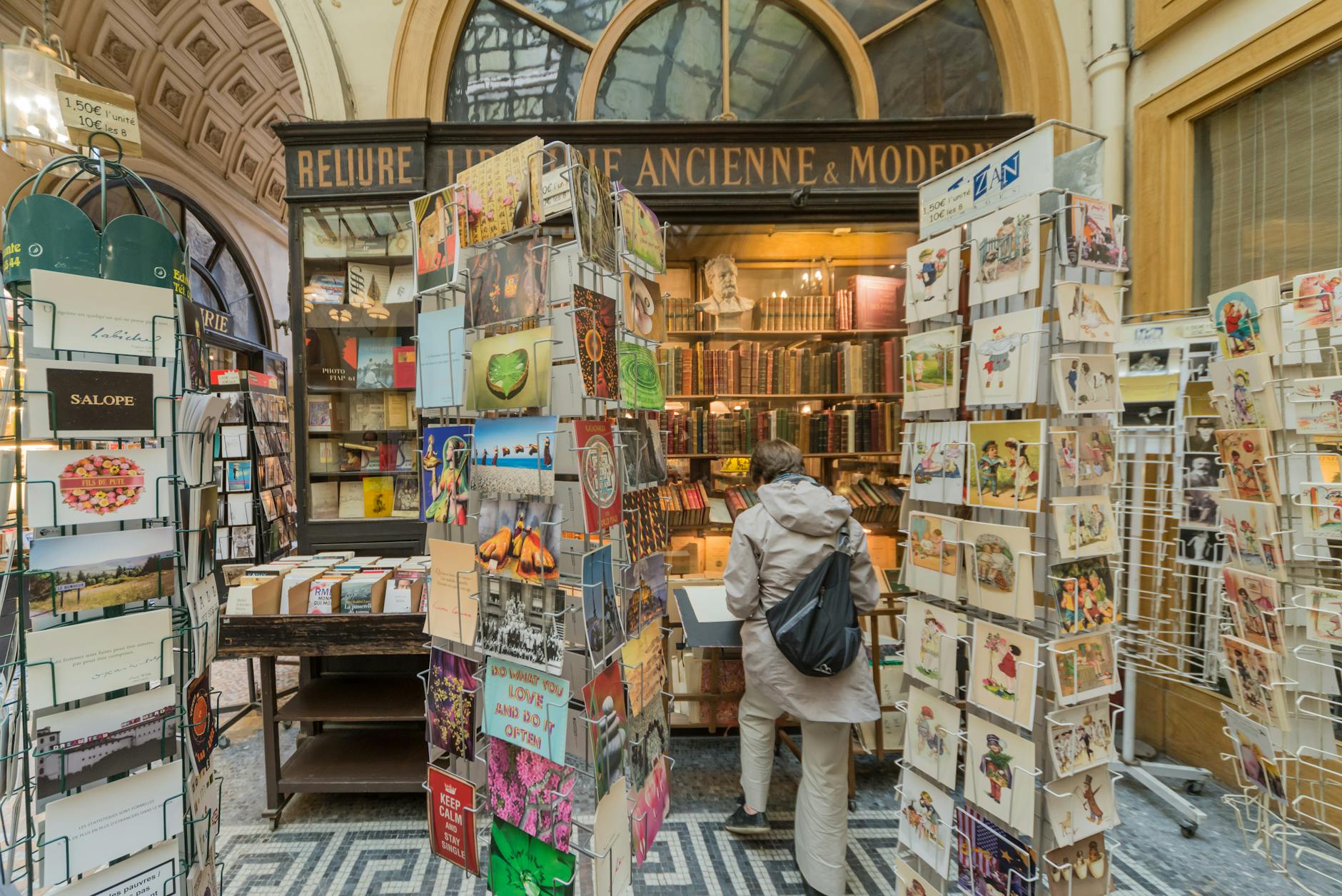
Museum gift shops are an art-history shortcut: high-quality print reproductions, exhibition catalogues, and licensed merchandise that maps straight onto each collection. The five big ones below all reward a separate visit, and every one is open without a museum ticket.
The Louvre’s Carrousel boutique, under the inverted pyramid and reachable from Rue de Rivoli without an entry ticket, sells the expected Mona Lisa merchandise plus serious art books and the official Louvre Editions print line (forty to one hundred fifty euros for museum-quality fine-art posters). The Musée d’Orsay shop at 1 Rue de la Légion d’Honneur leans hard into Impressionist licensing — Van Gogh, Monet, and Renoir on every surface, plus exhibition-grade poster reproductions. The Centre Pompidou shop is the contemporary one: real design objects, art books, and product collaborations with working artists.
Galerie Frémaux at 7 Rue du Pont Louis-Philippe — yes, the Mélodies Graphiques street again — deals in affordable original prints and engravings: etchings from the 1850s to the 1920s for forty to three hundred euros, signed contemporary lithographs from two hundred. It’s the best place in the city to buy a real piece of art for under two hundred euros. Frame it at home and your souvenir doubles as wall decor for the next thirty years.
Wine, Champagne, and Spirits
Wine and spirits carry the tightest customs limits of anything here. The US allows one liter duty-free per adult; the UK permits eighteen liters of wine plus four of spirits per adult from the EU; intra-EU is unrestricted. Plan your buying against the flask allowance you actually have in the cabin or the hold, not the one you wish you had.
Wine: Nicolas and Lavinia
Nicolas has sold wine in Paris since 1822 and runs around fifty branches across town. The entry-level Petites Récoltes line is eight to fifteen euros a bottle; the serious Bordeaux and Burgundy bottlings climb to fifty and beyond, up toward two hundred. The central branches at 12 Rue de Rivoli and 31 Place de la Madeleine have English-speaking staff.
Lavinia at 3-5 Boulevard de la Madeleine is the wine megastore: three floors, six thousand references, an in-shop bar, and a tasting program. It’s the best address in Paris for a serious collector’s bottle. For something smaller and more curated, Caves Taillevent at 1 bis Rue Royale, just down from Maille, fields a tight French selection and a team that knows it cold.
Champagne and French Spirits
Champagne by the case from Lavinia or Nicolas. A bottle of Charles Heidsieck Brut Réserve is fifty-five euros, a Krug Grande Cuvée one hundred eighty, and grower-Champagne picks like Larmandier-Bernier or Pierre Péters sit at thirty-five to seventy. Slide each bottle into a Wine Skin sleeve in checked baggage; that trick has carried bottles across hundreds of Atlantic flights.
Chartreuse, the green or yellow herbal liqueur made by Carthusian monks, is the iconic French monastic spirit at thirty to eighty euros a bottle depending on age. Suze is the gentian-root aperitif at around eighteen; Lillet, Blanc or Rosé, is the wine-based aperitif at fifteen to twenty-two; Cognac (the Hennessy, Rémy, and Martell standards, plus boutique houses like Frapin) runs forty to two hundred fifty depending on age. Everything except the boutique single-cask cognacs fits inside the usual US single-liter duty-free limit per adult.
Tactical: Tourist Traps, Customs, Shipping
Real Paris souvenirs come with real Paris addresses. The rules below sort the bad spots from the good and cover the unglamorous part: getting the haul home.
Avoiding Tourist Traps Near Monuments
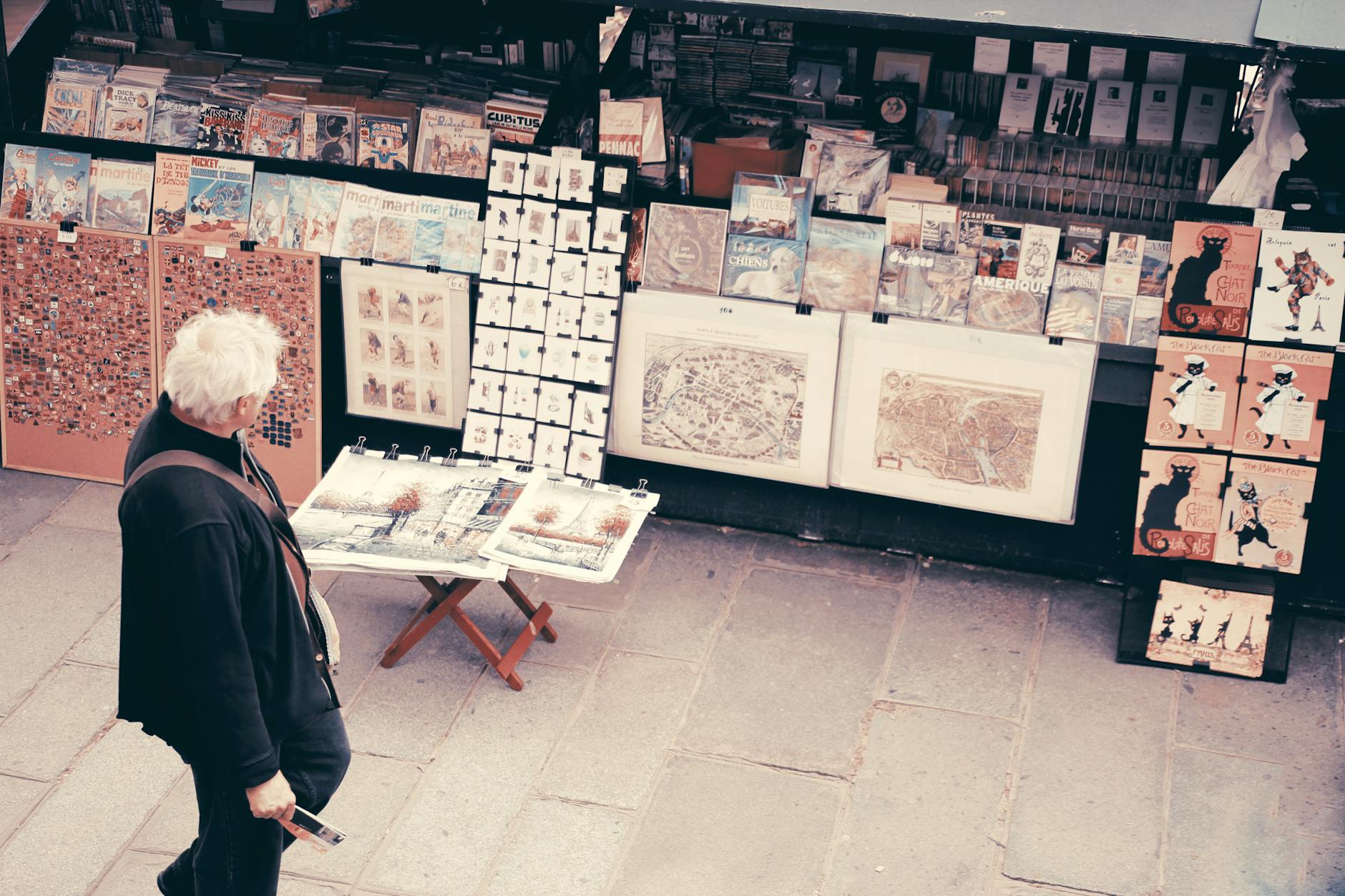
The pavement stands at Trocadéro, Champ de Mars, the Sacré-Coeur steps, the Notre-Dame parvis, and the Champs-Élysées deal in keychains, snow globes, magnets, and printed T-shirts that aren’t made in France and that no Parisian would ever gift. The proper-looking shops within two blocks of those monuments stock the same merchandise at a markup. Walk five blocks in any direction, into the residential streets of the 6th, 7th, 9th, or the Marais, and the inventory flips to genuine French goods at fair prices.
Customs Limits Entering US, UK, and EU
US travelers: an eight-hundred-dollar personal exemption duty-free, one liter of alcohol per adult, no soft cheese, fresh meat, or fresh fruit. Aged hard cheeses over sixty days — Comté, Mimolette, Beaufort, hard Pécorino — are fine, as are sealed candies, chocolates, jams, mustards, teas, honey, and dry pasta. When in doubt, declare it; the worst case for an honest declaration is confiscation, not a penalty.
UK travelers, post-Brexit: one liter of spirits or two liters of fortified wine, plus four liters of still wine per adult, and a three-hundred-ninety-pound total allowance. Cheese, charcuterie, and dairy are now restricted, so check the current gov.uk guidance before you load up. For intra-EU trips (France to Germany, Italy, the Netherlands, Spain), there are no quantity limits on personal-use goods; the only real limit is what fits in the bag. Any liquid over a hundred milliliters has to travel in the hold unless it’s duty-free sealed.
Shipping: La Poste, FedEx, and DHL
La Poste runs Colissimo international parcel service from any post office — a five-kilo box to the US is around eighty euros and lands in five to seven days. The big offices near tourist areas (52 Rue du Louvre, open 24 hours; 21 Rue Clément Marot near the Champs-Élysées) sell flat-rate Colissimo boxes you fill right at the counter.
FedEx (drop-off points across central Paris, including 87 Avenue Maréchal de Lattre de Tassigny) and DHL (84 Avenue de Wagram) handle the valuable, time-sensitive stuff. A five-kilo express to the US is around two hundred euros, arrives in two to three days, and most hotels can arrange door pickup for about thirty euros more. Ship the high-value perfumes, ceramics, and bulky linens; keep food, soaps, and small items in the checked bag.
CDG Duty-Free: Worth It or Not?
Charles de Gaulle duty-free stocks the usual global luxury roster — Chanel, Dior, Hermès, Cartier — plus a Paris corner with macarons, Champagne, and a handful of perfumes. Pricing usually matches in-city VAT-refund net pricing, occasionally dipping below it for cigarettes and alcohol. The genuine advantage at CDG is the post-security alcohol allowance: duty-free liquor bought here is exempt from the cabin liquid limits, so the bottle rides on with you in its sealed STEB bag.
Skip the airport for pharmacy items (cheaper in the city even before the refund), niche perfumes (a thinner selection than the flagships), and gourmet (no match for the Galeries Lafayette food hall). Use it for a last-minute alcohol bottle, cigarettes if you carry them, and impulse buys that stay inside the eight-hundred-dollar US allowance.
What NOT to Buy in Paris
This list saves more money and luggage space than the positive one adds. Cross every item off without a second thought.
- Mini Eiffel Tower keychains, snow globes, “I Love Paris” T-shirts, magnets — all imported, all in the bin within a month.
- Pavement-stand “Mona Lisa” canvases — Chinese-printed mass-market, French in no meaningful sense.
- Berets sold at Sacré-Coeur and Trocadéro — not French-made, and the felt sheds within five wears.
- Cheap painted Eiffel Tower prints — the same prints go for double inside the city and cheaper online from the same printers.
- The Champs-Élysées Sephora — identical global stock, no discount, just a longer line.
- Designer-bag “deals” from street vendors — always counterfeit, and US customs confiscates with no refund.
- Hotel-minibar Champagne to carry home — three to four times retail.
- Branded H&M Paris tees — same supply chain as any other H&M, no Paris connection past the print.
Sample Souvenir Hauls by Budget
Three sample hauls at three price tiers, each one covering eight to twelve gift recipients across categories.
One Hundred Euro Haul
Box of seven macarons from Pierre Hermé (twenty-four euros), a Maille mustard crock from Rue Royale (eighteen), a fleur de sel wooden box (eight), a small Marquise de Sévigné caramels tin (fifteen), an Embryolisse 75ml tube (twelve), Bioderma Sensibio 500ml (eleven), and Mariage Frères Marco Polo 100g (twenty-eight). Eight separate gifts, one hundred sixteen euros all in, fits a single corner of a cabin case.
Three Hundred Euro Haul
Take the hundred-euro haul and add a Diptyque Baies 190g candle (seventy-two), a Saint James Meridien II navy striped top (ninety-five), two Patrick Roger single-origin dark tablets (twenty-four), a G. Lalo paper set (fourteen), and a Buly 1803 hand pomade (forty-five). Eleven gifts, three hundred seventy euros, fills half a checked bag.
Eight Hundred Euro Haul
Take the three-hundred haul and add a vintage Hermès silk square from Vanves (two hundred), an Astier de Villatte small plate (eighty), Maison Fabre lambskin gloves (two hundred forty), a Le Palais des Thés 100g tin (twenty), and an MFK Baccarat Rouge 540 5ml travel spray (forty). Fourteen gifts, eight hundred fifty euros, which means either one checked bag given over entirely to souvenirs or one shipped Colissimo box of housewares plus a carry-on of the fragile things.
Frequently Asked Questions
What is the single best Paris souvenir under fifty euros?
A Maille mustard crock from 6 Rue Royale plus a box of seven Pierre Hermé macarons from 72 Rue Bonaparte, around forty-two euros together. Unmistakably French, photogenic on the recipient’s counter, and the crock keeps earning its place in the kitchen long after the mustard is gone.
Can I bring French cheese back to the US?
Hard, aged cheeses over sixty days — Comté, Mimolette, Beaufort, hard Pécorino — yes. Soft cheeses like Brie, Camembert, and fresh chèvre, no. Have it vacuum-sealed at the fromagerie, declare it on the customs form, and keep the aging certificate visible. Fromagerie Laurent Dubois at 47ter Boulevard Saint-Germain does US export packaging all the time.
Where do real Parisians shop for everyday souvenir-style gifts?
Monoprix for macarons, mustard, and chocolate at supermarket prices; La Grande Épicerie inside Le Bon Marché for gourmet gift baskets; Merci on Boulevard Beaumarchais for design objects; and the Vanves flea market on weekend mornings for vintage. Never the souvenir stands near the monuments.
Is the Galeries Lafayette food hall worth visiting?
It is. Galeries Lafayette Le Gourmet at 35 Boulevard Haussmann pulls two hundred-plus gourmet brands under one roof, with Pierre Hermé, Ladurée, Fauchon, Bordier, Mariage Frères, and most of the regional French producers all sold side by side — ideal when you’ve only got a half-day window. Our Galeries Lafayette and Printemps guide maps the full layout.
How do I claim VAT refund on souvenir purchases?
Spend over a hundred euros at one store in a single day, ask for the détaxe form at checkout (passport required), and validate it at the Pablo electronic kiosks at CDG or Orly before you check in. A twelve-to-fifteen-percent refund lands back on your card within four to eight weeks. Full walkthrough in our tax-free shopping guide.
Are flea markets safe for tourists?
Yes, both Vanves (small, friendly, weekend mornings only) and the covered markets at Saint-Ouen (Vernaison, Dauphine, Serpette). Keep your phone and wallet in interior pockets; pickpocketing is the only real risk and it’s opportunistic, not targeted. Bring cash for negotiating, though most dealers also take cards. Our Paris flea markets guide has the market-by-market breakdown.
More to explore
Use these to round out your trip: