Navigating Paris with a Stroller: Metro, Streets & Accessibility Tips
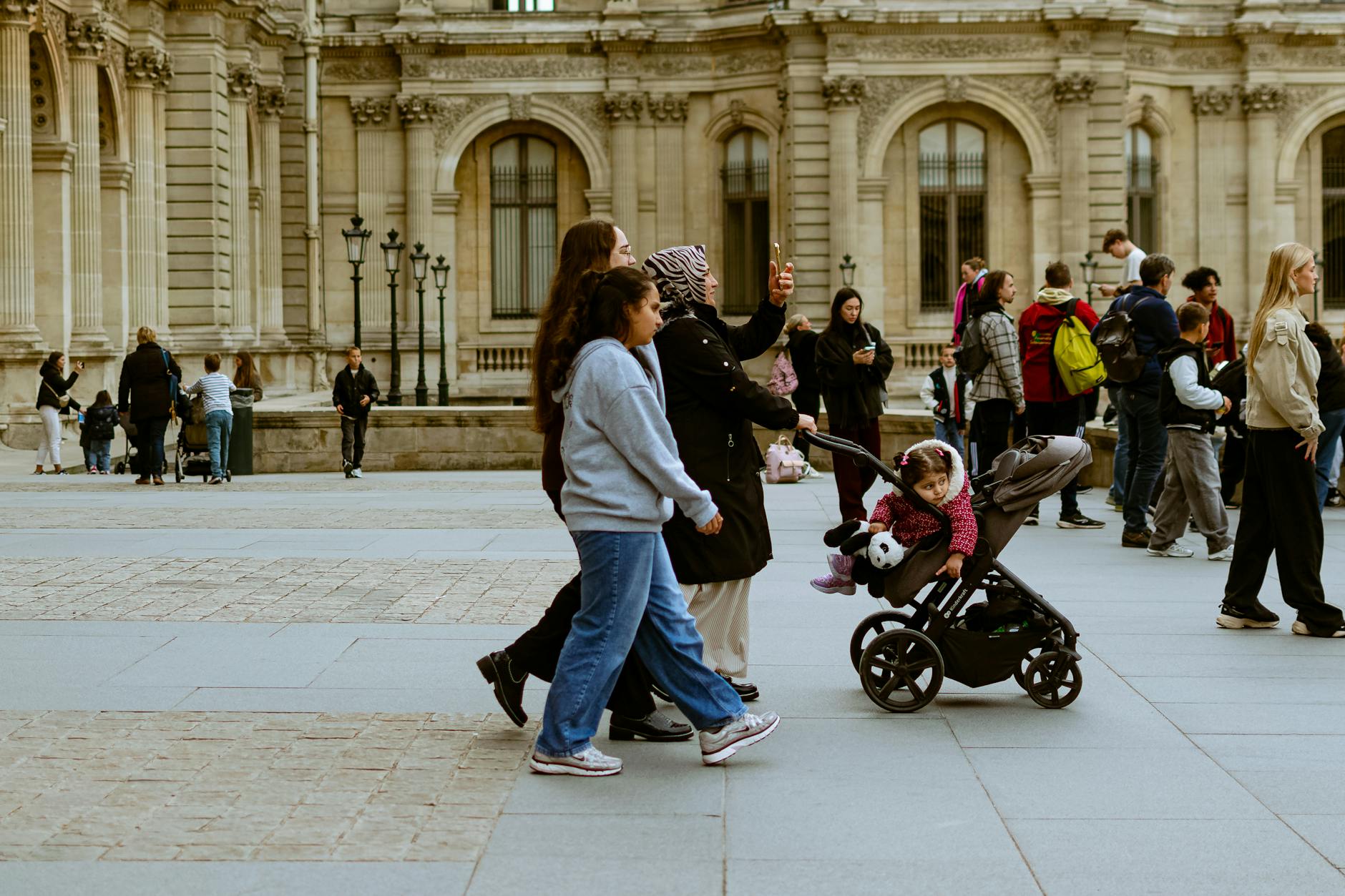
Few cities reward a pram-pushing parent like this one: a cobbled Marais lane at dawn, a golden-hour bridge over the Seine, the Champ de Mars lawn at sunset with the Eiffel Tower glowing behind a sleeping toddler. Plotting a genuinely stroller friendly paris route, though, is also one of the harder logistical puzzles in Europe. Roughly 90% of the Metro is not step-free: only Line 14, plus selected stations on Lines 1, 4 and 13, have elevators. Everything else is stairs, long and narrow and frequently without a wheel ramp. And the cobblestones of the Marais, Saint-Germain, the Latin Quarter and Montmartre will chew through cheap stroller wheels and your lower back in a single afternoon. What follows is the practical playbook every visiting family needs: which neighborhoods to push through, why the bus is your real Metro substitute, the few accessible stations worth memorizing, foldable strollers that actually work here, RER airport transfers with a baby, where the ramps and elevators hide, and four full day plans you can finish without ever lifting your wheels.
The Honest Paris Stroller Reality
Before you buy a single Metro ticket, make peace with the underlying fact: Paris was built for people on foot, not for parents on wheels. The transit network went in largely between 1900 and 1935, when accessibility simply wasn’t a design concern. The result moves two million riders a day with real elegance and punishes anyone with a stroller, a suitcase, or a mobility issue. Knowing that going in changes how you plan, where you stay, and what you pack.
The Four Realities You Need to Accept
- About 90% of Metro stations are stair-only. Many have stairs both into the station and again between platforms. A single trip can mean four flights of stairs.
- Cobblestones in the Marais and Saint-Germain are unforgiving. The picturesque pavers you see in photographs translate to teeth-rattling jolts for any baby under six months and constant strain on small stroller wheels.
- The bus network is the real stroller-friendly transit alternative. Nearly every Paris bus is low-floor with a dedicated stroller bay — and you ride above ground with a view.
- Distances are walkable. Central Paris is roughly five kilometers across, meaning most major sights are within a thirty- to forty-minute push of one another. Walking plus smart planning beats the Metro for most stroller days.
Here’s the good news buried in the hard truth: once those four facts are second nature, Paris turns out to be genuinely manageable with a baby. Families who land expecting London-style step-free Tube access have a miserable first day. Families who land with the right stroller, a bus map and a hotel in the 7th have the trip of their lives. The difference is preparation, not luck. For the wider family-planning picture, start with our Paris with kids guide, and for under-threes specifically see Paris with toddlers.
The Best Stroller-Friendly Neighborhoods
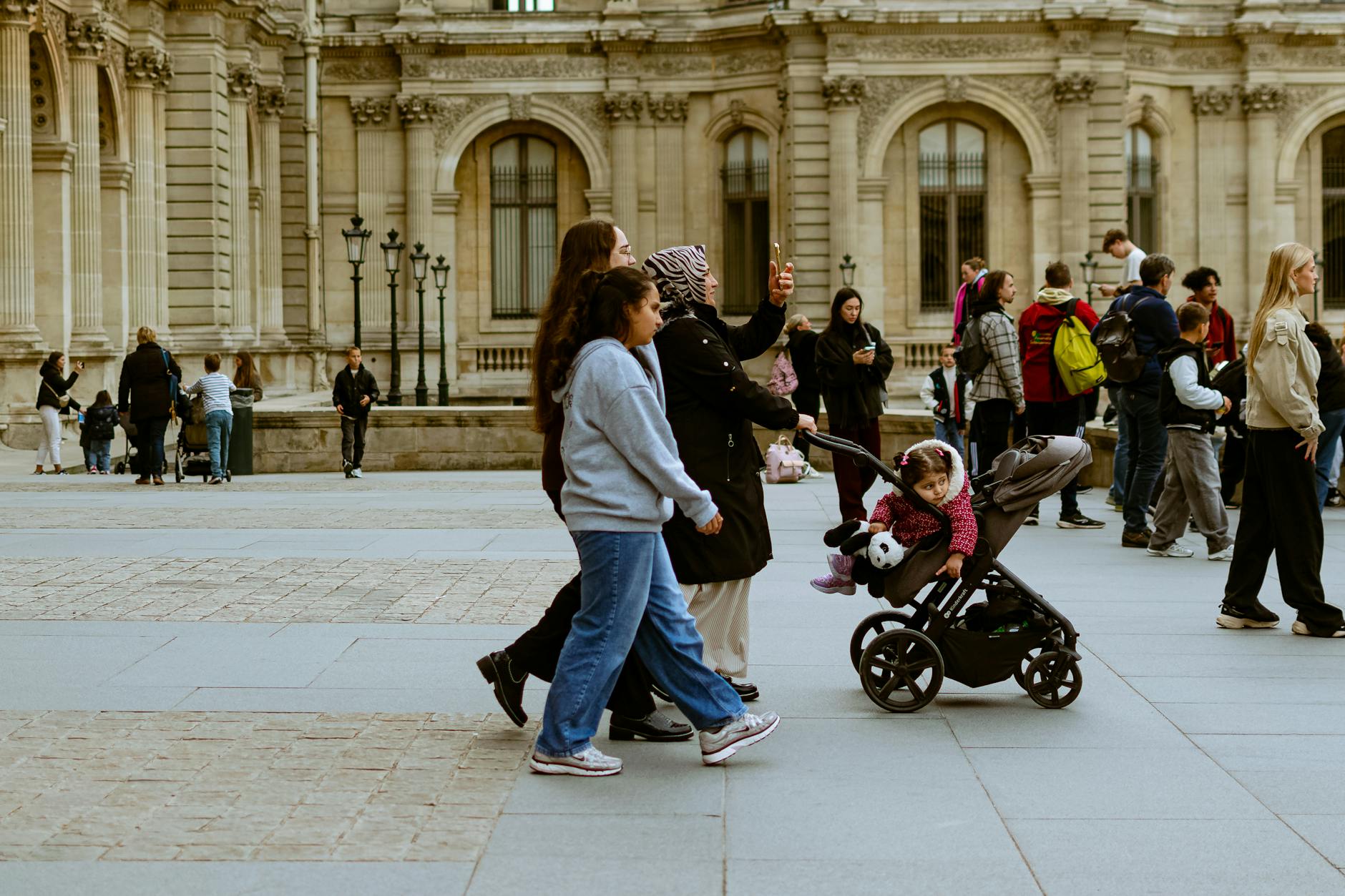
No decision matters more than where you base yourself. A hotel on a cobbled lane in the 4th means you start every morning bumping over uneven stone; a hotel on a wide Haussmannian boulevard in the 7th means smooth pavement from the door. Below are the five neighborhoods that reliably deliver level streets, wide sidewalks, curb cuts and minimal Metro dependence, plus the three to avoid as a base, even though you’ll absolutely want to visit them on foot.
Five Neighborhoods That Work for Stroller Families
- 7th arrondissement (Eiffel Tower & Invalides): Wide Haussmannian sidewalks, mostly level streets, a gentle slope down to the Seine, and generous park space at the Champ de Mars and Esplanade des Invalides. Rue Cler is a pedestrian market street that is pure stroller bliss. This is the single best base for families.
- 8th arrondissement (Champs-Élysées): Some of the widest pavements in the city, built for parade-watching crowds. There’s a slight slope from Concorde up to the Arc de Triomphe, but it’s never steep. Excellent for a long pram-nap walk.
- 1st arrondissement (Tuileries & Louvre): The Jardin des Tuileries offers paved gravel paths, plentiful benches, ice cream stands and a carousel, flat throughout. Nearby Rue de Rivoli has covered arcades that stay dry on rainy days.
- 16th arrondissement (Trocadéro & Passy): Quiet residential streets, wide sidewalks, and the Bois de Boulogne on the western edge for full days outdoors. Trocadéro itself has paved esplanade space with the best Eiffel views in town.
- 17th arrondissement (Batignolles): Modernized and less touristy, with a brand-new park at Martin Luther King, well-kept sidewalks, family-focused cafes and a slower neighborhood rhythm. Locals raise their kids here for a reason.
Three Beautiful Neighborhoods to Avoid as a Stroller Base
- Marais (3rd & 4th): Magical, historic, full of cobblestones. Wonderful to visit for two hours; brutal to navigate every morning before coffee.
- Montmartre (18th): Hills, stairs, more hills, more stairs. The funicular helps but only goes one short stretch. Push a stroller here exactly once and you will understand.
- Latin Quarter (5th): Narrow medieval streets, uneven pavement, tiny sidewalks shared with restaurant terraces. Great for solo travelers; tough for wheels.
A useful rule of thumb: if a neighborhood’s charm is that it looks the way it did in 1650, the streets will reflect that. If its charm is wide boulevards and uniform facades, Baron Haussmann rebuilt it in the 1860s, and his wide pavements happen to be perfect for strollers a century and a half on.
Metro Accessibility Reality
The Paris Metro is one of the densest urban rail networks on the planet: sixteen lines, more than 300 stations, a train every two minutes through the day. On accessibility, it’s also a relic. The original 1900 stations predate elevators as standard transit kit, and retrofitting them is structurally hard, since many sit directly beneath Haussmann-era buildings with no room to sink new shafts. What you get is a tiered reality: a handful of lines work for strollers, and most don’t.
Line-by-Line Stroller Accessibility
- Line 14 (purple): Fully step-free at every station, top to bottom. Opened in 1998 as a showcase of modern French transit design. Now extended south to Orly Airport. This is the only line you can plan around with full confidence.
- Line 1 (yellow): Mostly accessible after a recent retrofit campaign. La Défense, Esplanade de la Défense, Charles de Gaulle — Étoile, and several central stations have elevators. Eastern segment past Bastille is mixed.
- Line 4 (purple): The newer southern stations (Mairie de Montrouge, Bagneux) are fully accessible. Northern central stations like Gare du Nord and Châtelet remain old and stair-heavy.
- Line 13 (light blue): Some accessibility on the newer northern branches, much less in the center.
- Lines 2, 3, 5, 6, 7, 8, 9, 10, 11, 12: Largely stair-only with rare exceptions. Treat these as stair lines and budget accordingly.
Before you head down into any station, check the Bonjour RATP app on your phone; it shows live elevator status for every accessible station. Elevators do break, and reaching a step-free station only to find its one lift out of service, with a sleeping baby in a fully reclined stroller, is the kind of small Parisian heartbreak that can sink an afternoon. The app is free, in English, and refreshes constantly. For full Metro navigation see our Paris Metro guide.
Bus Network: The Stroller Solution
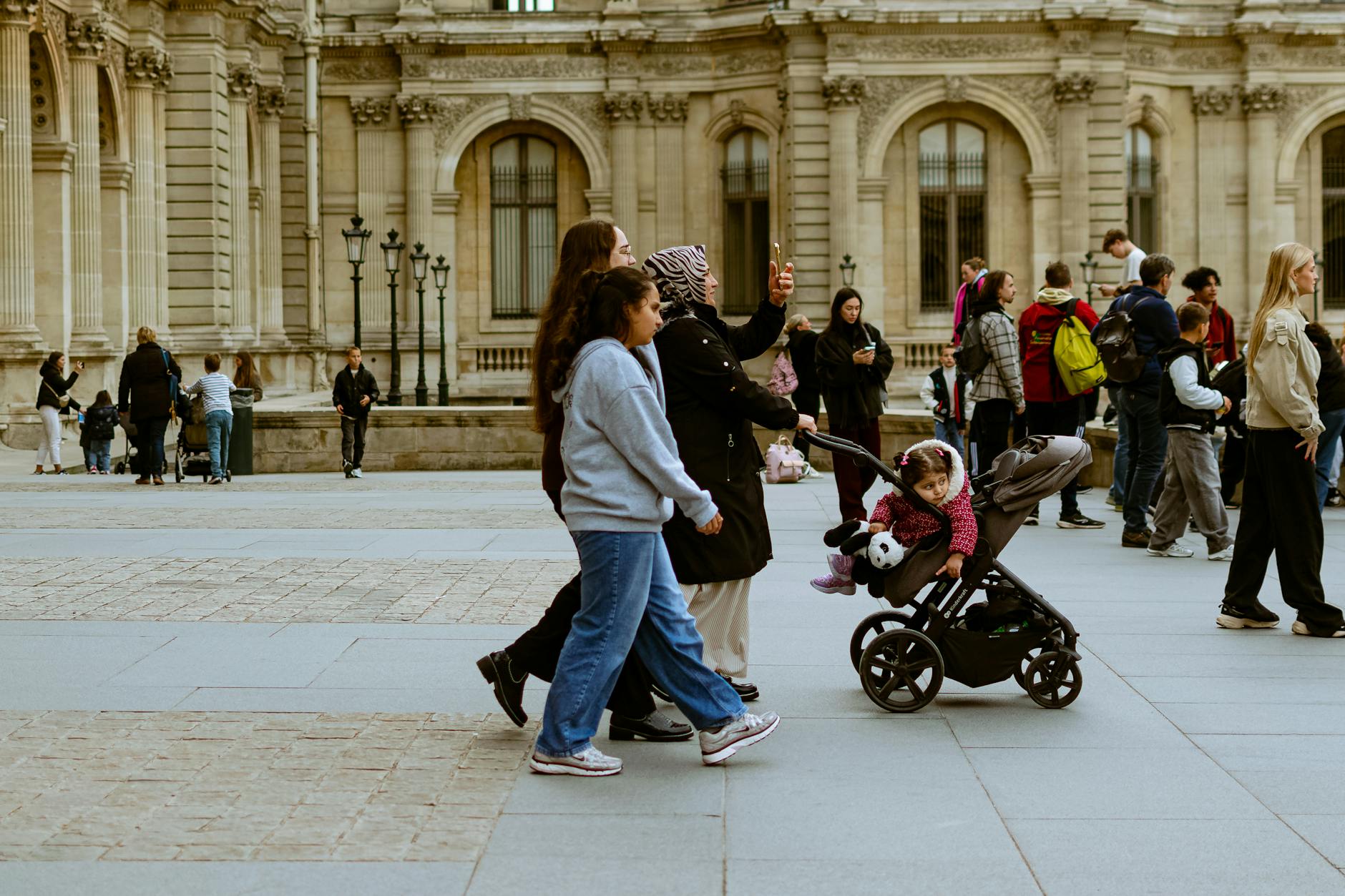
If you take one thing from this guide, take this: take the bus. The Paris bus network is the unsung hero of family travel here. Nearly the whole fleet is low-floor, with a fold-out ramp the driver deploys on request and a marked stroller bay by the middle door. You board at street level, never lift a wheel, and ride above ground watching the city roll past, which is itself a show your child will enjoy far more than a dark tunnel. The same €2.15 single ticket as the Metro buys ninety minutes of bus-to-bus transfers.
Four Bus Routes Every Stroller Family Should Know
- Bus 82 (Luxembourg ↔ Eiffel Tower via Invalides): The single most-recommended stroller bus in Paris. Connects two of the best family destinations in the city through quiet streets with frequent stops.
- Bus 24 (Saint-Lazare ↔ École Vétérinaire via the Seine quays): Hugs the river through the heart of monumental Paris — Concorde, Musée d’Orsay, Notre-Dame views — making it the most scenic ride for the price of a regular ticket.
- Bus 72 (Pont de Saint-Cloud ↔ Hôtel de Ville): The Left Bank counterpart to the 24, running along the southern quays with constant Seine views.
- Bus 96 (Gare Montparnasse ↔ Porte des Lilas): Cuts directly through the Marais and Saint-Germain — the best way to see those neighborhoods without pushing your stroller across cobblestones.
One practical tip: with a stroller, board through the middle door. The driver will spot you and lower the ramp automatically, so there’s no need to go in at the front to validate. Touch your Navigo Easy card or paper ticket to the small reader inside, park the stroller in the marked bay with the brake on, and you’re set. Locals shift aside without being asked. For general transit logistics see our Paris transport guide.
RER Airport Transfer with a Stroller
Your first impression of Paris is whatever happens between landing and your hotel room, and with a baby in tow it’s no moment to economize blindly. The cheapest option on paper is rarely the cheapest in jet-lagged misery, and the choice between the RER train, Metro Line 14 and a flat-rate taxi has real consequences when you’re pushing a stroller, dragging two suitcases and hunting for an elevator that may or may not exist.
The Three Realistic Options Compared
- RER B from Charles de Gaulle (CDG): About thirty-five minutes to central Paris and roughly €11.80 per adult. Most CDG and central RER stations have elevators, but the transfer at Châtelet-Les Halles — the world’s busiest underground station — is a labyrinthine multi-level corridor system that is genuinely difficult with a stroller and luggage.
- Metro Line 14 to Orly Airport: Opened in 2024 as the first fully step-free direct rail link between a Paris airport and the center. Twenty-five minutes from Orly to Châtelet, around €10.30, every station accessible. The clear winner if you are flying into Orly.
- Licensed taxi flat rate: €56 from CDG to Right Bank, €65 to Left Bank; €36 from Orly to Right Bank, €44 to Left Bank. Door-to-door, the stroller folds into the trunk, the baby naps in the seat. For a family of three or four, this is the same total cost as the train and dramatically less stressful.
For most stroller-equipped families arriving with luggage, the licensed flat-rate taxi is the right call on arrival day. Save the public-transit experiments for day two, once you’ve slept, found your bearings, and aren’t carrying everything you packed. Full details and booking tips are in our Paris airport transfer guide.
Recommended Strollers for Paris
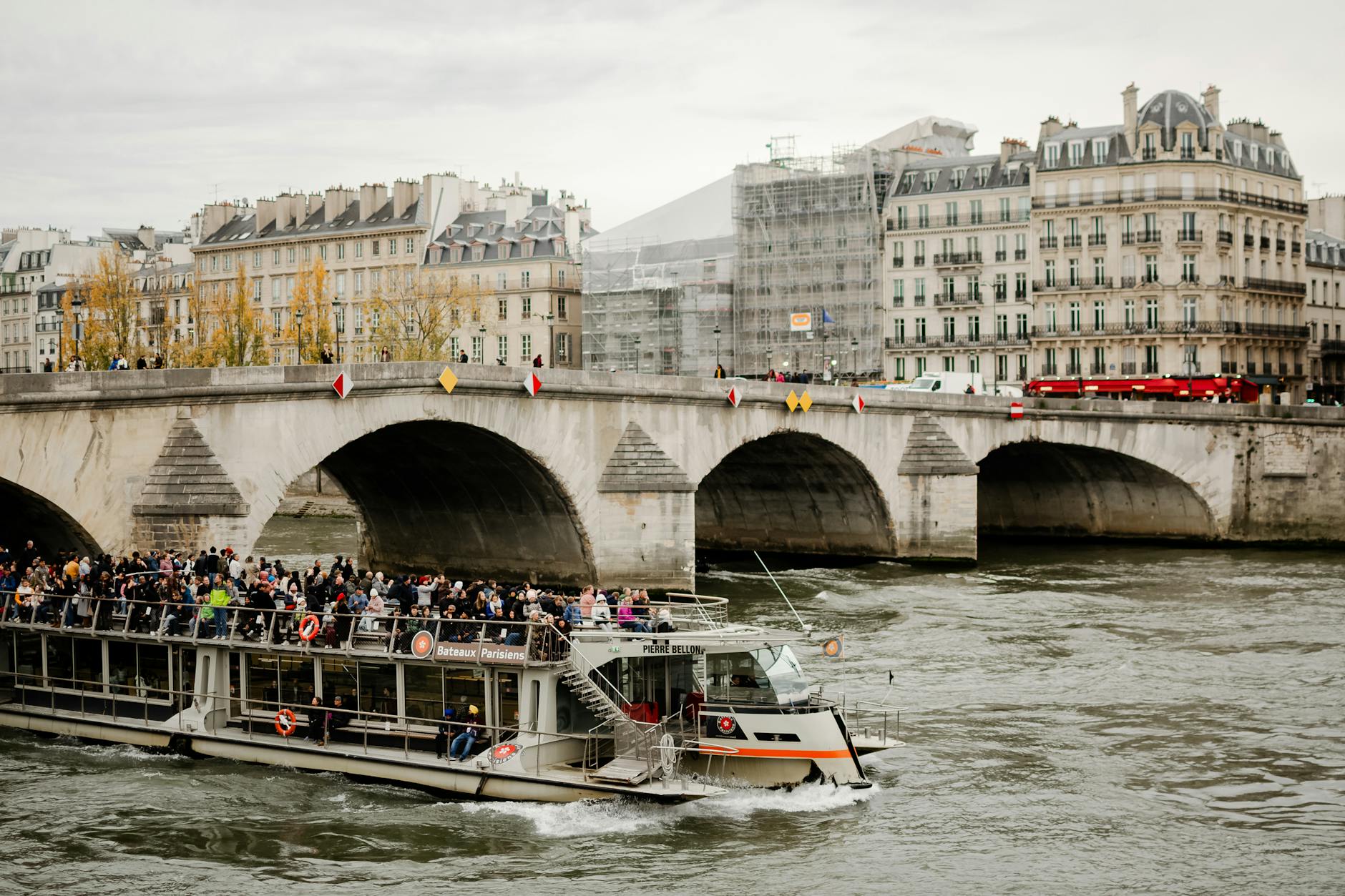
If you’re buying a stroller specifically for this trip, or deciding which of yours to bring, the math is simple: smaller is almost always better. Paris restaurants are tight, Metro elevators run smaller than American ones, taxi trunks are modest, and at some point you’ll have to fold the thing, on a bus, in a cafe, or to carry it down a flight of stairs at an inaccessible station. The strollers locals in the 7th and 16th actually push are not the ones parked in suburban American driveways.
The Four Travel Strollers That Work in Paris
- Babyzen YOYO+: The gold standard for Paris travel. Fits in an airplane overhead bin, folds one-handed, weighs under six kilos, with wheels just large enough to handle cobblestones. You will see hundreds of them on a single afternoon in the 7th.
- Bugaboo Butterfly: Direct competitor to the YOYO with similar travel-size footprint and a slightly more padded seat. Excellent suspension for cobblestones.
- Joolz Aer: Dutch design, ultra-light, premium feel. Slightly pricier but folds beautifully and has a generous canopy for Paris sun.
- Maclaren Quest: The affordable umbrella stroller that has been crossing Europe for decades. Less plush than the others but reliably folds flat and survives baggage handlers.
Strollers to Leave at Home
- Large jogging strollers: Will not fit through most restaurant doors, will not enter Metro turnstiles, will not fold to a manageable size on a bus.
- Side-by-side double strollers: Wider than most Paris sidewalk space and impossible to wedge into the smaller Metro elevators. If you have twins or two close-in-age children, choose a tandem (front-to-back) instead.
- Travel systems with detachable car seats: You will not use the car seat in Paris — taxis here legally do not require them — and the combined bulk is not worth it.
Where to Rent Strollers in Paris
If you’d rather not fly a stroller across the Atlantic, or simply didn’t bring one, renting in Paris is easy. Travel-size models run roughly €7 to €12 a day, sometimes less for week-long bookings, and most rental services deliver to your hotel before you even arrive.
Three Reliable Rental Paths
- Hotel concierge request: Mid-range and luxury hotels almost always have a stroller or two on hand for guests — ask at booking, not at check-in. They are usually basic umbrella models, free or for a small fee.
- Baby Equipment Rental Paris: The largest dedicated baby gear rental company in the city. Delivers to hotels and apartments, offers YOYO and Bugaboo models, plus high chairs, travel cribs, and car seats as a bundle.
- Apart-hotels and family-focused rentals: Brands like Citadines and Adagio sometimes include a stroller for stays of three nights or more — check at booking. Airbnb hosts in family-targeted listings often have one in a closet you can request.
Restaurants and Cafes for Strollers
Eating out with a baby in Paris works differently than in most American or northern European cities. There’s no Disneyfied family-restaurant culture here; instead, French children are expected to behave at grown-up restaurants from a young age, and most cafes will take a stroller if they have the floor space. The trick is matching the room: a wide brasserie or a covered terrace works, while a thirty-seat bistro carved out of a seventeenth-century basement does not.
Where High Chairs and Stroller Space Are Reliable
- Classic Parisian brasseries: Big rooms with banquettes — Bouillon Pigalle, Bouillon République, Bouillon Chartier. High chairs available, generous floor space, lively atmosphere that absorbs baby noise.
- The Big Mamma group: East Mamma, Pink Mamma, Ober Mamma. Italian, loud, lively, family-friendly by design with explicit kid menus and reliable high chairs.
- Wide sidewalk terrace cafes: Le Petit Cler on the pedestrian Rue Cler is a long-running favorite for stroller parking right next to your table. Café Charlot near the Marais offers wide outdoor seating away from cobblestones.
- Café Marly: Under the Louvre arcades looking onto the Pyramid — wide colonnaded aisles, level floor, room for any stroller. Pricey but spectacular for one meal.
Where to Skip on a Stroller Day
- Michelin-starred restaurants: Tight tables, formal service flow, no room for a stroller next to you. Hire a sitter for that one big dinner instead.
- Tiny historic bistros: The thirty-seat rooms with charm are exactly where a stroller will block the only aisle. Save them for adults-only meals.
- Crowded counter-only spots: Wine bars and small natural-wine spots are wonderful but rarely have stroller space.
For a longer curated list of family-tested rooms, see our family restaurants in Paris guide.
Stroller-Friendly Day Plans
The four full-day itineraries below are road-tested for stroller families. Each one minimizes Metro use, sticks to level streets, builds in a picnic-friendly stop, and ends within an easy push of central hotel neighborhoods. Mix and match across your stay.
Day Plan A: Eiffel Tower & Champ de Mars Picnic
Start on Rue Cler with a market breakfast at Le Petit Cler. Push two blocks south to the Champ de Mars and spend the morning on the lawn, with carousels, ice cream carts and the Eiffel Tower looming behind you. Lunch is a picnic on the grass, cheese and baguette from the Rue Cler shops. In the afternoon, walk down to the Seine, cross Pont de Bir-Hakeim, and loop back via the Trocadéro esplanade. Zero Metro, zero cobblestones, maximum postcards.
Day Plan B: Tuileries & Louvre Exterior
Enter the Jardin des Tuileries at Place de la Concorde. Paved gravel paths, fountains, a carousel, ducks, ice cream stands: this is the Central Park of Paris for stroller parents. Picnic at the Bassin Octogonal. In the afternoon, walk through to the Louvre Pyramid courtyard and admire it from outside (skip the museum interior with a baby unless you have timed tickets and a carrier), then carry on under the Rivoli arcades for rainy-day cover.
Day Plan C: Bois de Boulogne Full Day
The western forest park is paved throughout, with wide alleys, lakes, rowboats, and the Jardin d’Acclimatation amusement park at its northern end, a hundred-year-old family attraction with a small train, gentle rides, a petting farm and trees in every direction. Bus 244 runs right into the park. Bring a picnic or eat at one of the lakeside cafes. See our Paris parks for children guide for the full layout.
Day Plan D: Champs-Élysées & Parc Monceau
Start at Concorde and push slowly up the Champs-Élysées along the wide pavements (the southern side has better shade), then turn off onto Avenue de Friedland and carry on to Parc Monceau in the 8th. The park is small, elegant, paved and gated, safe to let an older sibling run while a baby naps. Finish with afternoon coffee at one of the cafes along Boulevard Malesherbes. All level, all wide sidewalks.
Best Free Bathrooms for Diaper Changing
Public bathrooms in Paris are getting better but remain patchy. The free standalone sanisettes on the street are clean but cramped and no friend to a stroller-plus-changing operation. Far better to know where the proper free family rooms hide, almost always in big department stores and major museums, almost always free, almost always empty.
Reliable Changing Stops Across Central Paris
- Galeries Lafayette Haussmann: A dedicated family room on an upper floor with multiple changing tables, a feeding chair, microwave, and warm-water sink. Probably the best in the city.
- BHV Marais: Family room near the children’s clothing department with changing tables and a quiet feeding nook.
- Le Bon Marché (Left Bank): Smaller but excellent family changing space; the cafe upstairs welcomes strollers.
- Major museums: The Louvre, Musée d’Orsay, Centre Pompidou, and Musée du Quai Branly all have changing tables in their accessible restrooms. Ask any guard.
- McDonald’s and major chains: Reliable, free, often have a changing table in the accessible stall. Useful as an emergency stop in any neighborhood.
- Mall food courts: Westfield Forum des Halles and Beaugrenelle both have proper family bathrooms on the upper levels.
Carrying a Stroller Down Metro Stairs (When Needed)
Sooner or later on a Paris trip with a baby, you’ll face a flight of Metro stairs with no elevator and no good alternative. It happens. Here’s how locals handle it without drama.
- Fold first if you can: If the baby will tolerate being briefly held, fold the stroller, carry it under one arm, and walk the child down with the other hand. This is by far the safest method.
- If folding is impossible: Tilt the stroller back onto the rear wheels, lower it one step at a time facing forward, never backward. Backward feels safer but you cannot see the steps. Forward keeps the baby’s weight against the seat back.
- Ask for help: A polite «Bonjour, vous pouvez m’aider, s’il vous plaît?» works almost every time. Parisians have a reputation for being aloof; in practice, anyone under fifty will offer to grab the front of your stroller without hesitation.
- Look for wheel ramps: Some older stations have narrow metal channels running along the stair edges — built decades ago for delivery carts. Your stroller wheels fit perfectly and you can roll down while holding the handle.
Cobblestone Reality
Cobblestones (pavés in French) are uneven granite blocks set in sand. They’re beautiful, historic, and the natural enemy of stroller wheels. The saving grace is that most of the cobblestone in Paris clusters in specific neighborhoods you can choose to visit on foot rather than push through.
Where the Cobblestones Are
- Marais (3rd, 4th): Almost every side street. Rue des Rosiers, Rue Vieille-du-Temple, Rue des Francs-Bourgeois — all cobbled.
- Saint-Germain-des-Prés (6th): Around the church and the smaller streets toward the river.
- Latin Quarter (5th): Rue Mouffetard, the streets behind the Panthéon, the medieval lanes by Saint-Séverin.
- Montmartre (18th): Most lanes uphill from Place des Abbesses, all of the area immediately around Sacré-Cœur.
- Île Saint-Louis: Charming and entirely cobbled.
How to Push Cobblestones with Less Pain
- Larger wheels handle better. The YOYO and similar travel strollers have just enough wheel diameter to clear most pavés smoothly; the cheapest umbrella strollers will bounce.
- Air-filled tires are the gold standard but rare on travel models. If your stroller has hard plastic wheels, slow down and accept the vibration.
- Cobblestones are slippery when wet. A light rain on granite turns the Marais into an ice rink for stroller wheels. Slow your pace and lean slightly back.
- Watch for cart-wheel channels. Some older Marais and Saint-Germain streets have narrow strips of smooth stone running down the center of the cobbles — built for medieval delivery carts. Your stroller wheels fit perfectly. Walk down the middle of the street and they will guide you.
What to Pack in the Stroller Pocket
A well-stocked stroller is a self-contained survival kit. The under-seat basket and rear pocket should carry everything you need for a six- to eight-hour day in the city without having to find a pharmacy.
- Wet wipes (two packs — one for hands, one for everything else)
- Diapers (count the hours, add two for safety)
- Full change of clothes (Paris weather turns; spilled hot chocolate is universal)
- Light blanket or muslin (sun shade, picnic cover, emergency swaddle)
- Two pacifiers (one will be lost; the other is the spare)
- Sealed snacks (crackers, fruit pouches, rice cakes — Paris pharmacies stock all the major brands)
- Small backpack with two water bottles and a small thermos for warm milk
- Rain cover (the stroller-shaped clear plastic kind — lifesaver in spring and autumn)
- Sunscreen and a hat for shoulder seasons
- A printed map of accessible Metro stations near your hotel
Common Mistakes
Watch enough families try, fail and finally succeed with strollers in Paris and the same patterns keep surfacing. Sidestep these and you’ll spare yourself days of frustration.
- Bringing an oversized stroller. The full-size travel system that works at home will not work here. Borrow, rent, or buy a travel-size model before you fly.
- Choosing a stair-only Metro line by accident. Always check the line and station accessibility on the Bonjour RATP app before descending. A wrong choice means thirty minutes of stair-carrying.
- Relying on Line 1 east of Bastille. The western half of Line 1 is mostly accessible; the eastern segment toward Château de Vincennes has more stair-only stations than you might expect.
- Booking a hotel in the Marais because it looks romantic. See above. Stay in the 7th, visit the Marais on foot, return to your hotel that night without resentment.
- Skipping the bus. Stroller families who treat the bus as their default transit and the Metro as the exception have dramatically better days than the reverse.
- Trying to do too much in one day. Two major sights plus a long picnic is a successful Paris day with a baby. Three or four is a forced march that no one enjoys.
Frequently Asked Questions
Can I take a stroller on the Paris Metro for free?
Yes. Strollers do not require their own ticket, and children under four ride free. Children four to nine ride at half price on a demi-tarif ticket. The challenge is not the fare but the stairs, so budget time and energy accordingly.
Should I bring a stroller or a baby carrier to Paris?
Both, if you can. A travel-size stroller for long flat days in the 7th or the Tuileries; a soft carrier like an Ergobaby or BabyBjorn for Montmartre, the Marais, museum interiors and any Metro day. Many experienced family travelers default to the carrier on Metro days and the stroller on park days.
Are Paris buses really easier than the Metro with a stroller?
Yes, by a wide margin. Nearly all Paris buses are low-floor with a fold-out ramp and a marked stroller bay, so you never lift a wheel. The ride is slower than the Metro, but you also get to watch the city go by.
What is the best Paris arrondissement to stay in with a baby?
The 7th, hands down, especially around Rue Cler and the Champ de Mars. Wide sidewalks, level streets, family-friendly restaurants, the Eiffel Tower at the end of every block, and easy bus access to the rest of the city. The 8th and 16th are strong runners-up.
Do Paris restaurants have high chairs?
Brasseries and the Big Mamma group almost always do; small bistros and Michelin-starred rooms rarely. Always call ahead or ask at reservation, and bring a portable hook-on chair or fabric booster if you’re eating out a lot. See our family restaurants in Paris guide for specific recommendations.
Is it safe to leave a stroller outside a shop or cafe?
Bring it inside if the room is wide enough, which most cafes are. For a quick errand at a boulangerie, leaving an empty folded stroller in the doorway is normal and safe in the central arrondissements. Never leave anything valuable in the pockets — phones, wallets, cameras — even for a minute.
Can I take a stroller into Paris museums?
Most major museums allow strollers, though some popular galleries (the Louvre’s Mona Lisa room, the Musee d’Orsay at peak hour) will ask you to switch to a baby carrier during crowded periods. Strollers are checked free at the cloakroom of every national museum if you’d rather leave them at the entrance.
What if it rains all day in Paris with a baby?
Rivoli arcades for a covered stroller walk; Galeries Lafayette and Le Bon Marché for shopping under cover; the Musée en Herbe and Cité des Sciences in La Villette for interactive indoor museums; the Aquarium de Paris at Trocadéro for a half-day escape. A rain cover for your stroller is more useful in Paris than a child-size umbrella.
Paris with a stroller is hard work for a day and pure joy after that. Learn which neighborhoods reward your wheels and which to enjoy on foot, which buses to ride instead of the Metro, and which restaurants will greet you and your baby with a high chair and a smile. Pick the right hotel, pack the right stroller, take the bus, and the logistically demanding city turns into the romantic one you came for, right down to the last bridge at sunset with a small sleeping passenger tucked inside the canopy.
Round out your trip
Use these to round out your trip: