Christmas in Paris: Markets, Lights & Festive Events Guide
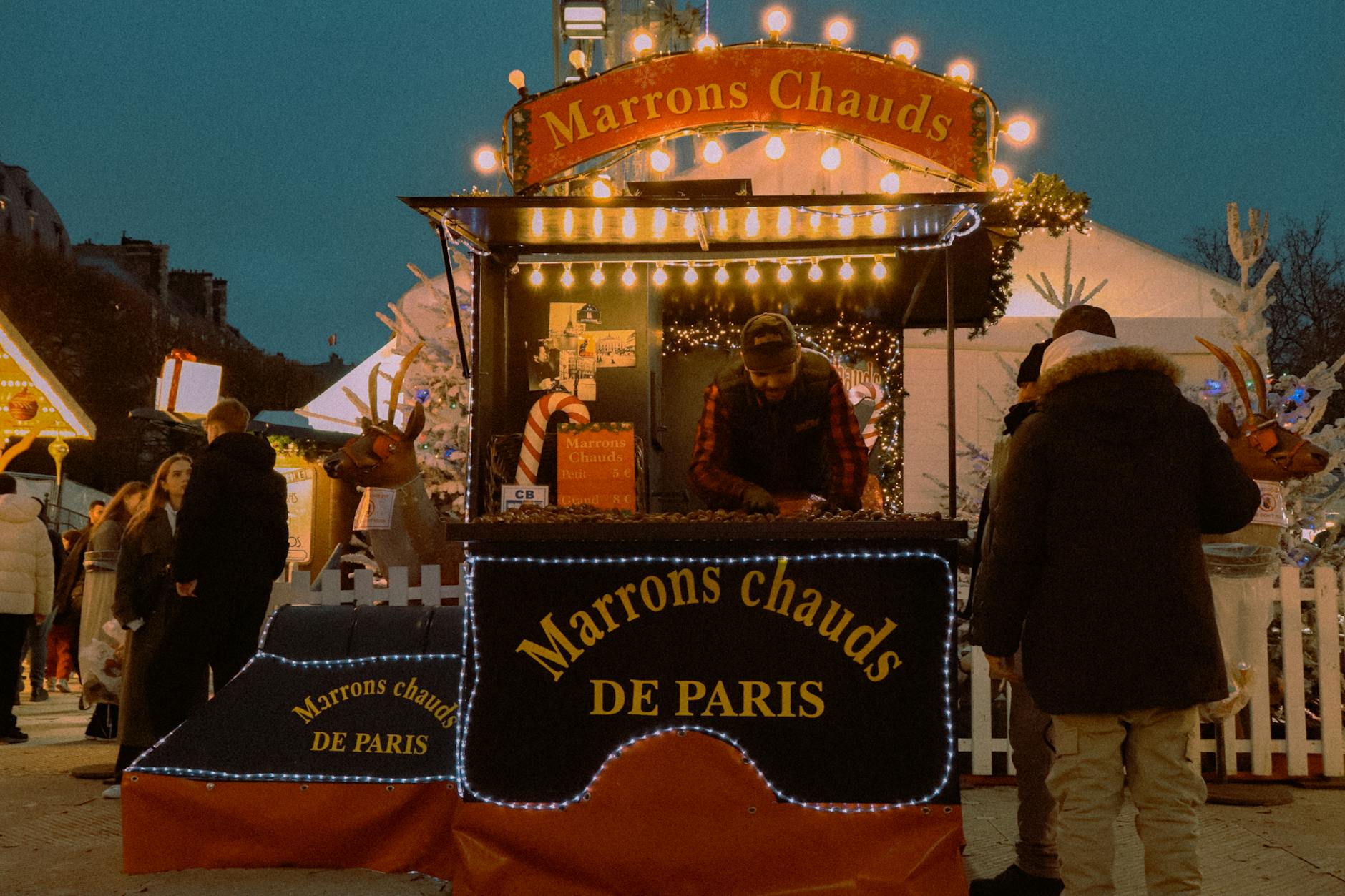
For about five weeks, Paris rewires itself. The Champs-Elysees lights up from mid-November to early January, the Tuileries fills with a Christmas village complete with a Ferris wheel and ice rink that runs until 7 January, the department stores wage open war over who has the best window, and the city stuffs its churches with concerts, its restaurants with set menus, and the Grand Palais with what may be the largest indoor pop-up ice rink on earth. This christmas in paris markets lights events guide runs through the markets worth your time (Tuileries, Notre-Dame, Saint-Germain-des-Pres, La Defense, and the Alsatian one at Gare de l’Est), the best illumination walks, the windows, the skating, and how to plan a trip between late November and early January without freezing or overpaying.
Read it next to our pillar guide on the best time to visit and our New Year’s Eve guide. For the window-display details, see our department stores guide, and for the full December lineup, the events calendar.
Christmas markets — the major venues
There are more than 100 Christmas markets scattered across the squares, parks, and avenues of Paris, which is far too many to do, and most of them are forgettable. The five worth building a day around are the Tuileries, Notre-Dame, Saint-Germain-des-Pres, La Defense, and the Alsatian market at Gare de l’Est.
Tuileries Christmas Village (Magie de Noel) — the biggest and best-known of the lot. It sprawls across the Tuileries between the Concorde and the Louvre with a Ferris wheel, an ice rink, a 60-meter observation tower, sixty wooden chalets selling crafts and mulled wine and Christmas food, a children’s carousel, and ten thousand light fittings strung through the garden. Open daily 11 am to 11:45 pm, mid-November to 7 January. Free to enter; you pay per ride and per chalet. Metro Concorde or Tuileries.
Notre-Dame Christmas Market — thirty-five chalets on the parvis of Notre-Dame and along the Square Jean XXIII, selling crafts, Alsatian food, mulled wine, and regional French cheese and wine. Opens 29 November, closes 25 December. It’s smaller than the Tuileries village, but it sits right in front of the restored cathedral, and that setting beats anything else in the city. Metro Cite or Saint-Michel.
Saint-Germain-des-Pres — built around the church on Place Saint-Germain, forty chalets leaning toward artisan crafts, regional food, and wine. Smaller and more refined than the Tuileries circus, with family programming on weekends. Late November to early January. Metro Saint-Germain-des-Pres.
Alsatian Christmas Market at Gare de l’Est — the most authentic regional market in town. The Alsatian Christmas-market tradition actually predates the German one, and this market does its best to bottle the Strasbourg and Colmar atmosphere: vin chaud, bretzels, choucroute, baeckeoffe, Alsatian wines. It sits right outside the station, so it pairs neatly with a long-weekend hop to Strasbourg or Colmar by TGV (under 2 hours).
La Defense Christmas Market — the largest by chalet count, around 350 of them, spread across the Parvis de la Defense with French and international crafts and food and a good showing of small French producers. Free to enter, with the modern skyline and the Grande Arche looming behind it. Late November to late December. Metro La Defense.
Champs-Elysees illuminations and Place Vendome
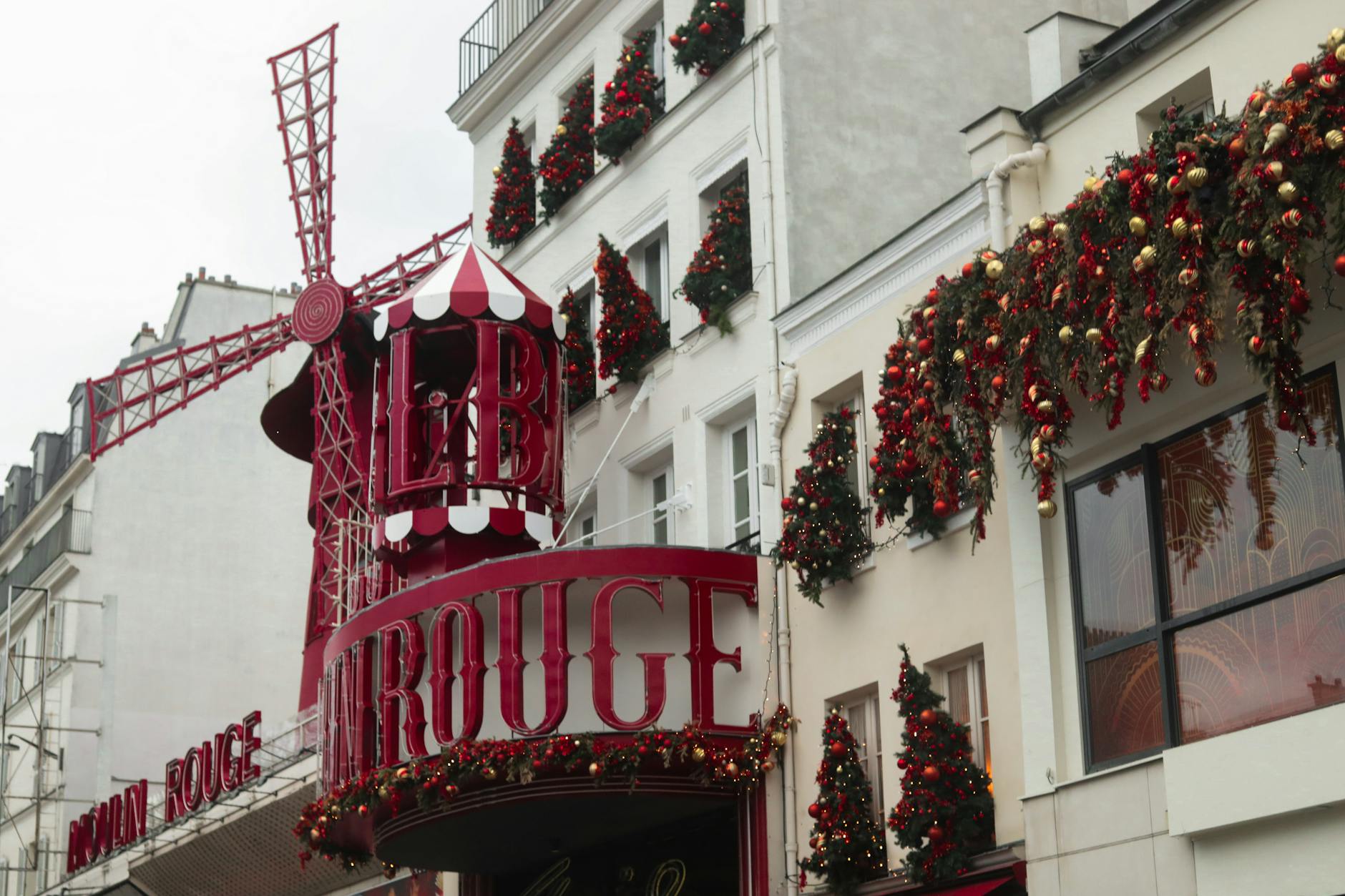
The Champs-Elysees lights are the most-photographed Christmas display in Paris, and they earn it. The whole avenue from the Arc de Triomphe to the Place de la Concorde is lit, the tree-line shifting between warm and cool tones in moving patterns. The mayor flips the switch in mid-November, usually the third or fourth Sunday, with a short public ceremony and live music. The lights run 5 pm to midnight daily, 1 am on Fridays and Saturdays, through early January.
Place Vendome — elegant lighting across the square, with the jewellers (Cartier, Van Cleef, Chaumet, Boucheron) dressing their facades and windows. The shot everyone takes is the central column at night with the perimeter lit up around it.
Avenue Montaigne — the luxury fashion strip, where Dior, Chanel, Louis Vuitton, and the rest decorate their boutiques. Quieter than the Champs-Elysees, with windows just as elaborate.
Bercy Village — the old wine warehouses turned shopping village in the 12th. Cobbled streets under white lights, with free outdoor concerts running through December.
Montmartre — the hill (Place du Tertre, the streets around the Sacre-Coeur) goes for white lights and traditional displays. This is village Christmas, not avenue Christmas, and it’s the better choice if the Champs-Elysees crowds aren’t your thing.
Hotel de Ville — the city hall mounts a Christmas installation out front, with light projections on the facade and a tree.
Department store windows — the iconic display
The grand stores treat their Christmas windows as a competition, and it shows. The displays go up in mid-November and stay through early January, by which point the sidewalks in front of them are wall-to-wall families on weekends.
Galeries Lafayette Haussmann — the headline act. The theme changes each year (recent ones have run from fairy-tale to whimsical to contemporary), and the boulevard Haussmann windows are animated mechanical scenes, full of moving figures. Inside, the 43-meter Belle Epoque dome is hung with a giant Christmas tree suspended over the central rotunda, which is about as photographed as any indoor decoration gets, anywhere.
Printemps Haussmann — the next-door rival on the same boulevard. New theme every year, every bit as elaborate.
BHV Marais — the Marais store, strong on the children-and-family tradition.
Le Bon Marche — the Left Bank store, a touch more grown-up and less family-focused than the Haussmann pair. The seventh-floor restaurant runs Christmas afternoon teas worth booking.
La Samaritaine — the recently reopened store on the right bank, where the historic building and the sleek modern interior make for a striking display.
If you only do one thing here, walk the boulevard Haussmann from Printemps to Galeries Lafayette (five minutes) and compare the two side by side. Go on a weekday morning. Weekend afternoons are a scrum.
Ice skating in Paris
Paris puts up a handful of rinks for the season, indoor and out. The ones to know:
Grand Palais des Glaces — the seasonal rink inside the Grand Palais, billed as the largest indoor pop-up ice rink in the world. The 3,000-square-meter sheet of ice sits under the glass-and-steel roof, with giant disco balls and themed lighting overhead. Open December into early January. Sessions are timed at 90 minutes; tickets 18-25 euros adult, 14-18 euros child, skate rental included. The late slots (8 pm to 2 am) bring in a DJ. Book online ahead. The good times sell out.
Tuileries Christmas Village ice rink — a smaller outdoor rink inside the market. The village is free; the rink charges a small fee for skate rental (8-12 euros for 90 minutes).
Hotel de Ville rink — in some years the city sets up a free outdoor rink in front of the city hall. It comes and goes, so check the Paris.fr cultural-events page for the current season.
Place Vendome rink — a smaller luxury rink that surfaces on the square some years. Free to use; rent skates from the jewellers’ pop-up concession.
Christmas concerts in churches
December fills the churches with concerts, hundreds of them across the city. The venues that matter:
Sainte-Chapelle — the best room for this in Paris, full stop. The thirteenth-century chapel’s stained glass and Gothic interior do something to Vivaldi, Bach, and the Christmas repertoire that no concert hall can. Tickets 32-45 euros; performances daily through December. Book online.
Eglise de la Madeleine — the neoclassical church in the 8th, big enough inside for full orchestral programmes (Bach Christmas Oratorio, Handel’s Messiah, Vivaldi Gloria). Tickets 25-50 euros.
Saint-Eustache — the great Renaissance church beside Les Halles. The historic Cavaille-Coll organ and the resident choir put on major Christmas concerts. Tickets 20-40 euros.
Notre-Dame — concerts resumed after the restoration in late 2024. The famous event is the Christmas Eve midnight mass, by far the most-attended. No ticket, but you’ll need to arrive two to three hours early to get in.
Eglise Saint-Sulpice — the Left Bank’s great church, whose famous organ (played by Marcel Dupre and Charles-Marie Widor) programmes Christmas recitals.
Christmas food and restaurants
The Paris Christmas table runs from late November to early January, and a few things define it.
Vin chaud (mulled wine) — on sale at every market chalet for 4-6 euros a cup. The Alsatian-style vin chaud is the default; some chalets do hippocras (mulled red with honey and spices) or vin chaud blanc (the white version).
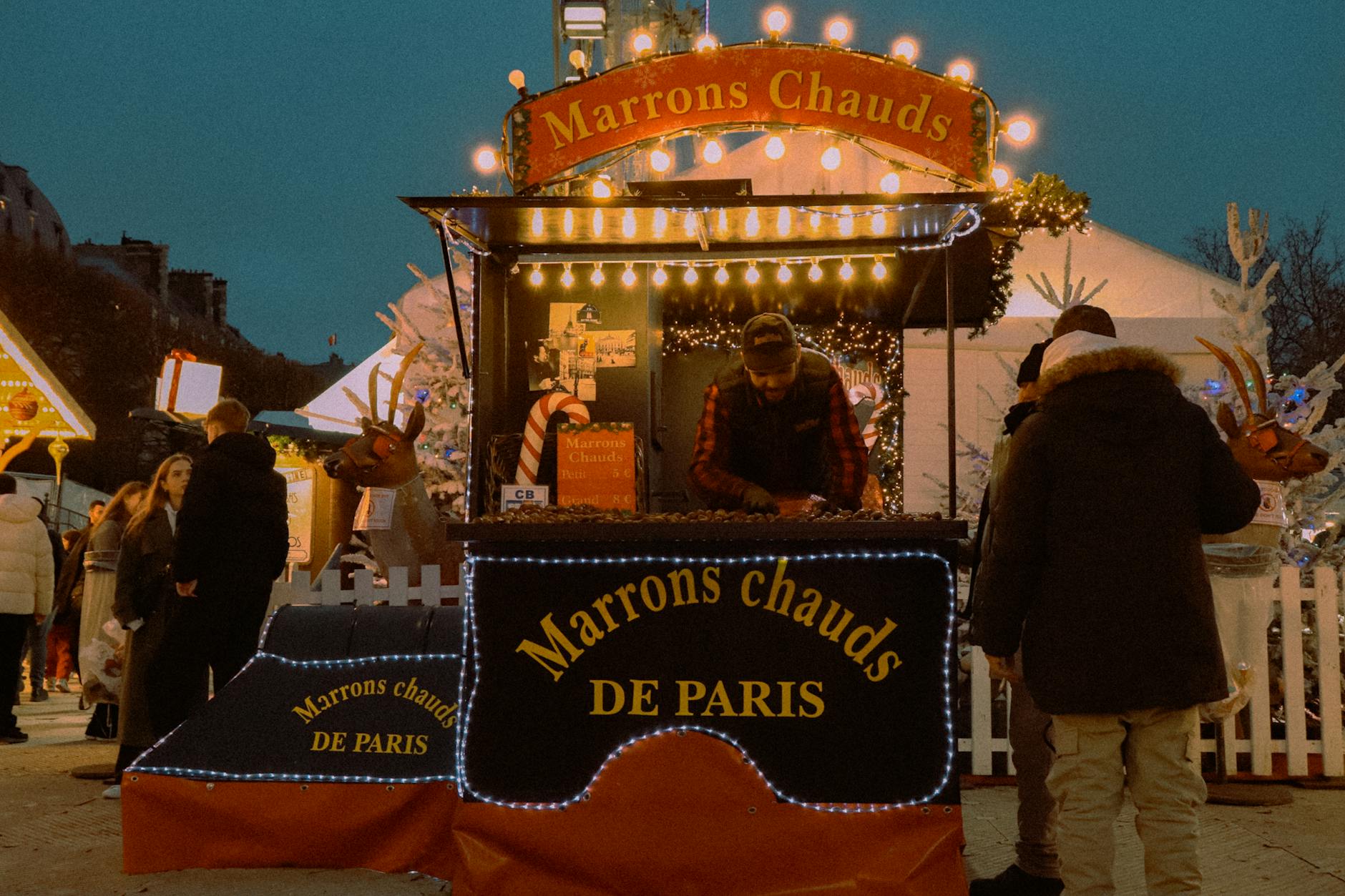
Marrons grilles (roasted chestnuts) — the charcoal braziers turn up on the big shopping streets and at the market gates, 4-6 euros a cone. That smell drifting down the street is half of what makes a Paris December feel like one.
Buche de Noel (Christmas log cake) — the traditional French Christmas dessert. The classic is rolled sponge with buttercream, dressed up to look like a Yule log; the haute-patisserie versions (Pierre Herme, Cedric Grolet, Yann Couvreur, La Patisserie des Reves) are sculptural showpieces. Order one or two weeks out from the big names.
Christmas Eve and Christmas Day restaurants — the Reveillon de Noel dinner on the 24th and Christmas Day lunch both come as long multi-course set menus. The brasseries (Bofinger, Brasserie Lipp, La Coupole, Le Train Bleu, Le Bistrot Paul Bert) take bookings from October for these dates, and a lot of high-end kitchens run gala menus at 200-500 euros a head.
Plenty of small bistros simply shut — the 24th, 25th, and often the 31st and 1 January are closure days for many independents. The brasseries attached to hotels, the chains (Bouillon Chartier, Les Editeurs), and the tourist-area places stay open. Check before you build a meal around any one spot.
Christmas Eve at Notre-Dame
The Christmas Eve midnight mass at Notre-Dame is one of the great Paris nights of the year, religious or otherwise. Since the cathedral reopened in December 2024, it draws an even bigger crowd than it used to. Entry is free, but you’ll need to get there two to three hours early (so around 9 pm for a midnight service) to be let in before the place fills. The mass runs in French with sections in Latin, and the music brings together the choir and the restored organ.
Practical notes: dress warm, because the cathedral is cold, and leave the big bags and umbrellas behind, since there’s a security check at the door. Photography during the mass is frowned on rather than banned. And honestly, the best moment comes after, when the crowd thins out around 1:30 am and the cathedral stands nearly empty.
Day-by-day Christmas itinerary — three days in Paris in December
Day 1 (arrival): get in, settle, and head out in the late afternoon to walk the Champs-Elysees lights from the Arc de Triomphe down to the Place de la Concorde (45 minutes with photo stops). Dinner at a brasserie near the Concorde, Maxim’s if you want the full theatrical version, Bouillon Chartier if you don’t want the bill, then a nightcap at a hotel bar.
Day 2 (markets): start at the Tuileries Christmas Village (give it 2-3 hours, Ferris wheel included). Lunch at the village or a bistro near the Concorde. Afternoon at the Notre-Dame Christmas Market and the cathedral parvis, then a late-afternoon wander through Le Marais. In the evening, the Place Vendome for the jeweller lights, and dinner at a Marais bistro (Chez Janou, Robert et Louise, or Le Petit Marche).
Day 3 (windows and skating): morning at Galeries Lafayette and Printemps for the windows and the in-store decorations. Lunch in the Haussmann area. Afternoon skating at the Grand Palais des Glaces (book the slot ahead). Evening at a Sainte-Chapelle or Madeleine concert, then a late dinner at a brasserie that stays open afterward.
Extending the trip to include New Year’s Eve
A lot of December visitors stretch the trip to 31 December. The free centerpiece is the Champs-Elysees fireworks at the Arc de Triomphe and the video-mapping show, and the city center closes to traffic from late afternoon. Our dedicated New Year’s Eve Paris guide has the whole programme.
One warning: 31 December and 1 January sell out to capacity at restaurants, hotels, and the big attractions. Book everything six to eight weeks ahead. Restaurants pile on gala-night premiums, so budget 200-500 euros a person at the established places. The Metro runs all night on the 31st (historically free between 5 pm and noon on 1 January, though that varies, so check the current year).
Weather and what to wear
December in Paris averages 3-8 Celsius by day, and it gets colder as the month goes on. Daylight is at its shortest, sunrise around 8:30 am, sunset around 4:55 pm. Since the illuminations effectively start at 5 pm, the city is dark by the time you sit down to dinner.
Pack a real winter coat, wool or down, not a light jacket. Add a scarf (non-negotiable), gloves, a hat, warm socks, waterproof leather shoes or boots, and layers underneath. December rain is mostly light but stubborn, so bring the umbrella.
And be honest with yourself about the markets. Standing outside browsing chalets for 90 minutes at 4 Celsius asks a lot more of your clothing than ducking into a museum does. Layer hard, and if you run cold, bring hand warmers.
Crowds, prices, and practical advice
Crowds spike in the last two weeks of the month. The 18th of December to the 5th of January is the busiest stretch by far. The first half of December is much calmer, and the cheapest window of all is 1-15 December.
Hotels follow the same curve, steeply. The 1st to the 15th is among the cheapest of the year, roughly November pricing; 20 December to 5 January is among the priciest, closer to July. There’s real money in choosing your dates well here.
Christmas Day itself is the quietest tourist day of all. A lot of museums close (the Louvre, Orsay, and Pompidou shut on 25 December; Versailles closes 25 December and 1 January), and most restaurants are dark apart from hotels and tourist-area brasseries. Plan the 25th around the Champs-Elysees walk, a visit to whichever churches are open, and a long brasserie lunch.
The 26th is the recovery day. Museums reopen, restaurants reopen, attractions go back to normal hours. The week between then and New Year’s Eve runs busy at the headline sights.
Frequently asked questions
When does the Paris Christmas season start?
The Champs-Elysees lights come on in mid-November, usually the third or fourth Sunday. The Tuileries Christmas Village and the Notre-Dame market open in late November. By 1 December the full programme is up and running, and it carries through to 6 or 7 January, when the Tuileries village closes.
Are the Christmas markets free to enter?
Yes, every major market is free to enter. You pay for the rides, the food, and the crafts at the chalets. Budget 20-40 euros a person for a proper visit with food, mulled wine, and a ride or two.
Is everything closed on Christmas Day?
A lot is. Many museums and restaurants close on 25 December, and some museums stay shut on the 26th too. The Christmas markets keep going, and brasseries and hotel restaurants stay open with gala-day menus. Confirm openings for your exact dates before you commit.
Should I visit in early December or later in the month?
Early December (1-15) is much cheaper and quieter, with the full Christmas programme already in place. Late December (16-31) brings the bigger atmosphere and the New Year build-up, but at premium prices. First-timers usually go late for the energy; people who’ve done it before tend to pick early December for the comfort.
Is there a Christmas market like Strasbourg?
The closest thing in Paris is the Alsatian market at Gare de l’Est. For the real Strasbourg experience (its market dates to 1570 and is reckoned the oldest and grandest in France), it’s a 2-hour TGV ride, and plenty of visitors pair the two cities into one December trip.
Final thoughts
For five weeks, the markets, the lights, the windows, the concerts, and the food turn Paris into a genuinely different city, and it’s worth seeing at least once. Go early December for the cheapest, calmest version; go in the last two weeks for the full spectacle and the New Year’s Eve crescendo; and if you have the time, add a TGV run to Strasbourg or Colmar to see where the tradition really comes from. Book your dates around the price curve, not against it, and pack the warm coat. The Champs-Elysees under the lights and the Tuileries village against the Louvre will still be the two images you take home.
Plan the rest of your trip
Use these to round out your trip: