Charles de Gaulle Airport: Terminals, Transfers and Survival Tips
Terminal 2 isn't a terminal, and other things worth knowing before you land.
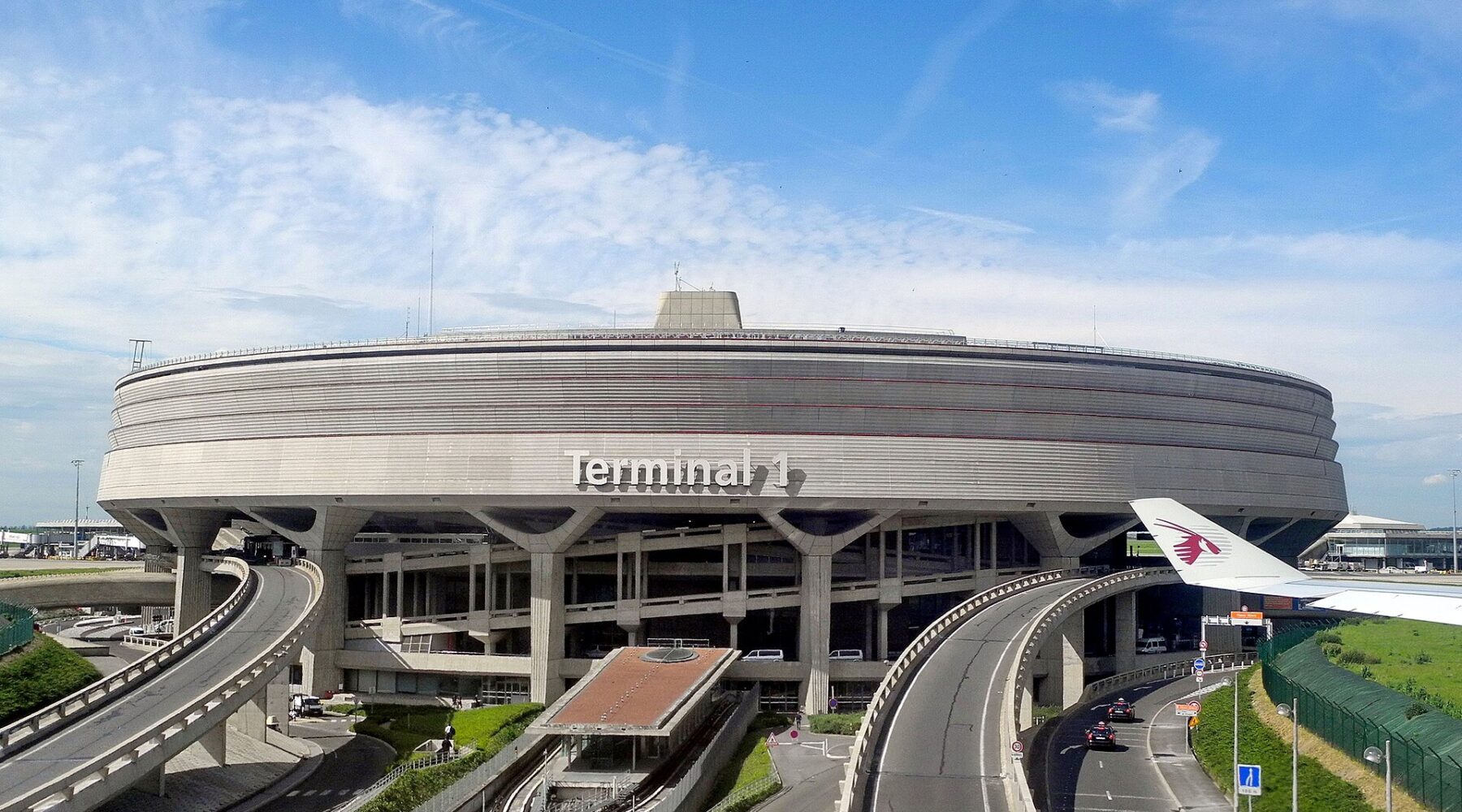
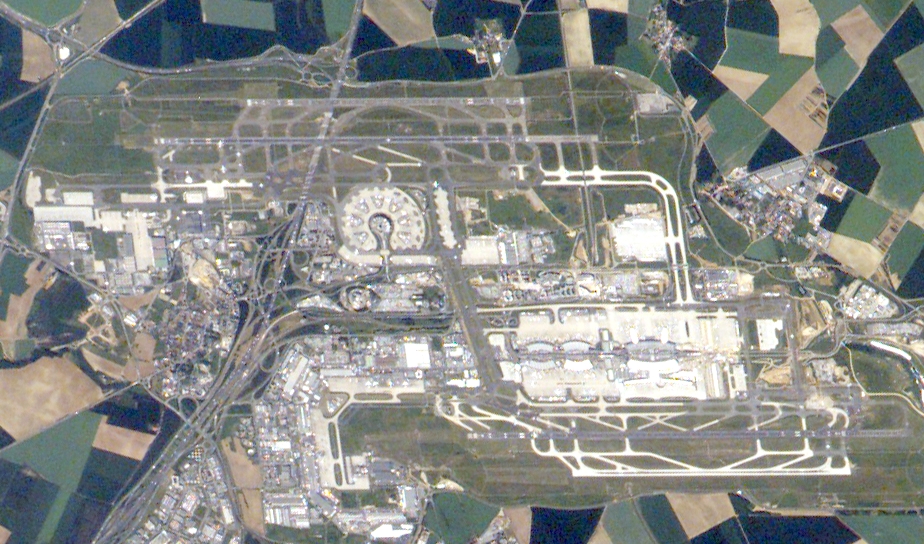
The first thing to understand about Charles de Gaulle is that Terminal 2 isn’t a terminal. It’s a string of separate halls, lettered A to G, spread along the airport’s central loop, and walking from one end to the other can take longer than the train into Paris. Add Terminal 1, a round concrete drum from the 1970s that looks like a spaceship and navigates like a maze, and Terminal 3, which is barely more than a shed, and you can see why first-time visitors find the place bewildering. The Charles de Gaulle airport terminals make perfect sense once you know how they fit together, though, and a little preparation turns France’s biggest airport from an ordeal into a slightly long walk.
This guide explains which terminal you need, how to get between them, the fastest and cheapest ways into Paris, what to expect at passport control and security, where to sleep, eat and leave your bags, and what’s changing in 2027, when the terminals get new names and the CDG Express finally opens. Prices and details were checked in September and early October 2026; treat them as the right order of magnitude and check before you travel.
Charles de Gaulle at a glance
| Details | |
|---|---|
| Location | About 25 km north-east of central Paris, at Roissy-en-France; locals simply call it Roissy |
| Terminals | Terminal 1; Terminal 2 (halls 2A to 2G); Terminal 3 |
| Main airlines | Air France and its SkyTeam partners, Star Alliance and oneworld airlines, and nearly every long-haul carrier serving Paris |
| Train stations | Aéroport Charles de Gaulle 1 (for Terminals 1 and 3) and Aéroport Charles de Gaulle 2 TGV (in the middle of Terminal 2) |
| Between terminals | CDGVAL driverless shuttle, free |
| Into Paris by public transport | RER B on the €14 airport ticket, or the Express 9517 bus via Saint-Denis–Pleyel |
| Taxi flat fare | €56 to the Right Bank, €65 to the Left Bank |
| Coming in 2027 | CDG Express to Gare de l’Est from 28 March; new terminal names from March |
Fares checked September–October 2026. If you’re still deciding between airports, our guide to the three Paris airports compares Charles de Gaulle with Orly and Beauvais.
Which terminal is your flight?
Your booking confirmation or boarding pass will tell you, and it’s worth checking again on the day, because allocations change. As a rule of thumb, airlines are grouped by alliance:
| Terminal | Who uses it | Getting there by train |
|---|---|---|
| Terminal 1 | Star Alliance airlines and a mix of other foreign carriers | RER to Aéroport CDG 1, then CDGVAL |
| 2A | Airlines including American Airlines, Cathay Pacific, Malaysia Airlines and Qantas | RER or TGV to Aéroport CDG 2, then walk |
| 2B | Airlines including Royal Air Maroc and Finnair | RER or TGV to Aéroport CDG 2, then walk |
| 2C and 2D | A mix of European and other airlines | Walk from the CDG 2 station |
| 2E | One of Air France’s two main halls, split into halls K, L and M; your boarding pass shows which | Walk from the CDG 2 station |
| 2F | Air France’s other main hall, separate from 2E; check your boarding pass | Walk from the CDG 2 station |
| 2G | Smaller regional flights | Shuttle bus from Terminal 2 |
| Terminal 3 | Charter and some low-cost flights | RER to Aéroport CDG 1, then a short walk |
The 2027 renaming. The airport has announced that in March 2027, to coincide with the opening of the CDG Express, its eleven terminal names will be replaced by a simpler system numbered 1 to 7. If you’re flying after that, go by whatever your boarding pass and the airport signs say, and don’t rely on old advice (including, eventually, this table).
Terminal 1: the concrete camembert
Terminal 1 opened in 1974 and was designed by the architect Paul Andreu, and it remains one of the most striking airport buildings in the world: a giant ring of raw concrete with a hollow centre, crossed by escalators running through transparent tubes. Generations of travellers have nicknamed it the camembert. It has been renovated in recent years, but the basic layout is unchanged, and it takes some getting used to.
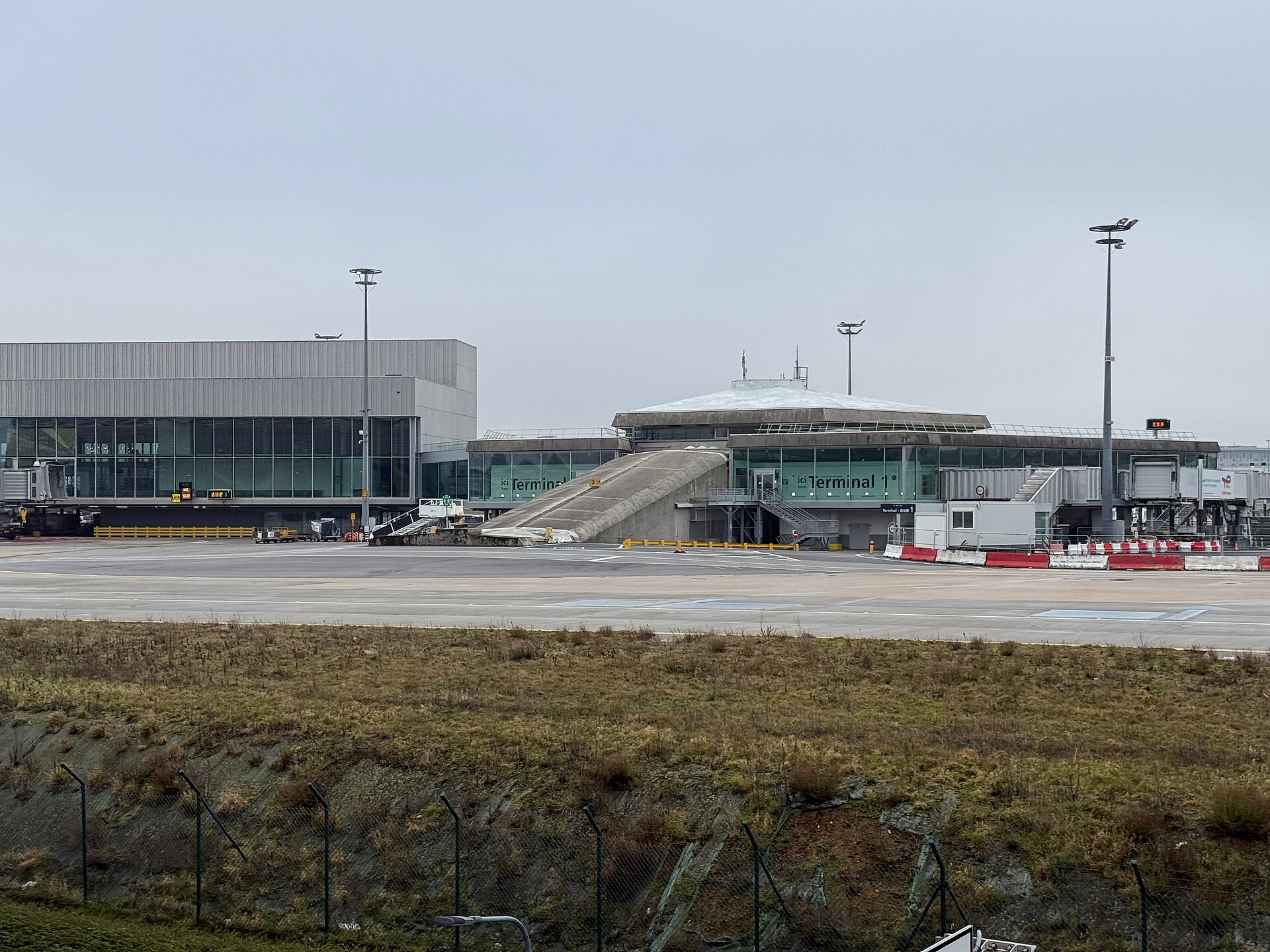
Check-in, arrivals and the shops are arranged around the ring on different levels, and the gates are in satellites around the outside, reached by underground walkways with moving walkways. Check your gate number before you go through security, allow for the walk, and don’t dawdle in the central area if boarding time is close. The tube escalators are the moment everyone remembers: if you’re arriving, enjoy the ride up through the middle of the building, which still feels like the future as imagined in 1974.
Terminal 2: a terminal in seven parts
Terminal 2 is the biggest of the airport’s three terminals. Its halls were built in stages from the early 1980s onwards and are strung out in a long line on either side of the railway station, which sits directly beneath the terminal in the middle of the complex, with the Sheraton hotel on the station level. From the station, halls 2C, 2D, 2E and 2F are a walk of five to fifteen minutes; 2A and 2B are further, and 2G is far enough away to need a bus. Follow the overhead signs, which are clear, and leave more time than you think you need.
2B, 2C and 2D
The older halls on the western side of Terminal 2 handle a mix of European and international airlines, among them Royal Air Maroc and Finnair in 2B and British Airways in 2C. Facilities here are more basic than in 2E and 2F, and the walk from the station is longer, so add ten minutes to your plans.
2E: One of Air France’s main halls
Hall 2E is the newest and grandest part of Charles de Gaulle, one of Air France’s two main halls. It’s split into three boarding areas, K, L and M; hall K is next to the check-in area, while L and M are reached after security by an automated airside train. Hall M in particular is enormous, with luxury shops, restaurants and lounges, and Terminal 2E is also home to the YOTELAIR cabin hotel for passengers departing from it. Allow time for the train and the walk to your gate, which can be a long one.
2F: Air France’s other main hall
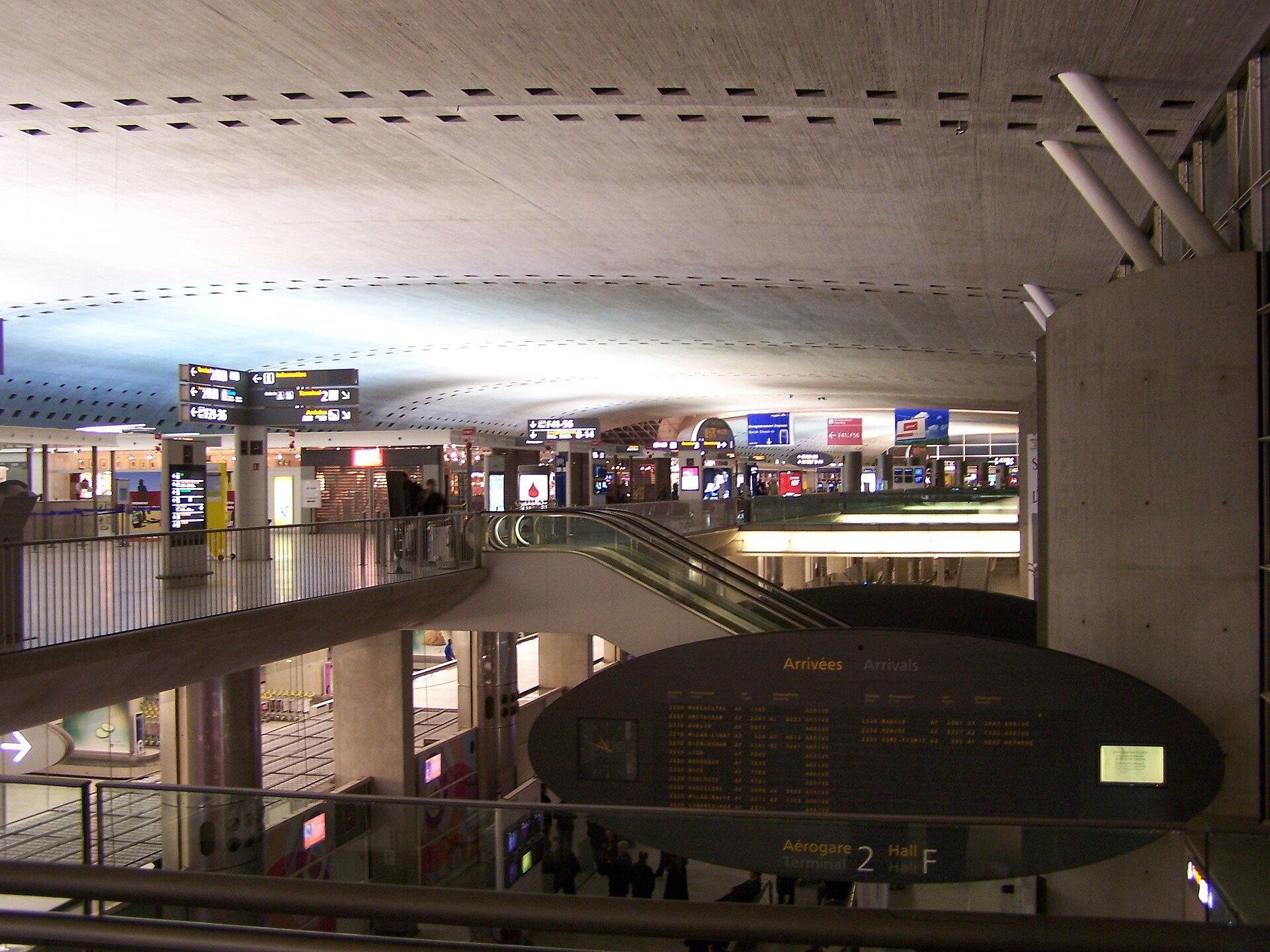
Hall 2F, opposite 2E, is Air France’s other main hall, and the walk from the station is short. Flights within the Schengen area have no passport control, so they are usually quicker to get through. If you’re connecting from a long-haul flight to a Schengen flight, though, you’ll go through passport control on the way, which is where most of the connection time goes.
2G: the outlier
Hall 2G, east of the main complex, handles smaller regional flights and is reached by the free N2 shuttle bus from 2F. The wait and the ride eat into your connection time, which catches people out. If your boarding pass says 2G, treat it as a separate terminal.
Terminal 3
Terminal 3 is a single, plain building near the Roissypôle business and hotel district, used by charter flights and some low-cost airlines. It’s a short walk from the Aéroport Charles de Gaulle 1 RER station, and the CDGVAL shuttle stops nearby. Facilities are limited, so eat before you go through security, and don’t confuse it with Terminal 1, which has a similar-sounding station name.
Getting between terminals
The CDGVAL is the free driverless shuttle train that connects Terminal 1, the Roissypôle area (with the RER station for Terminals 1 and 3), a long-stay car park and Terminal 2. Trains run every few minutes through the day, and the ride from one end to the other takes about eight minutes. It’s well signposted, step-free and doesn’t need a ticket.
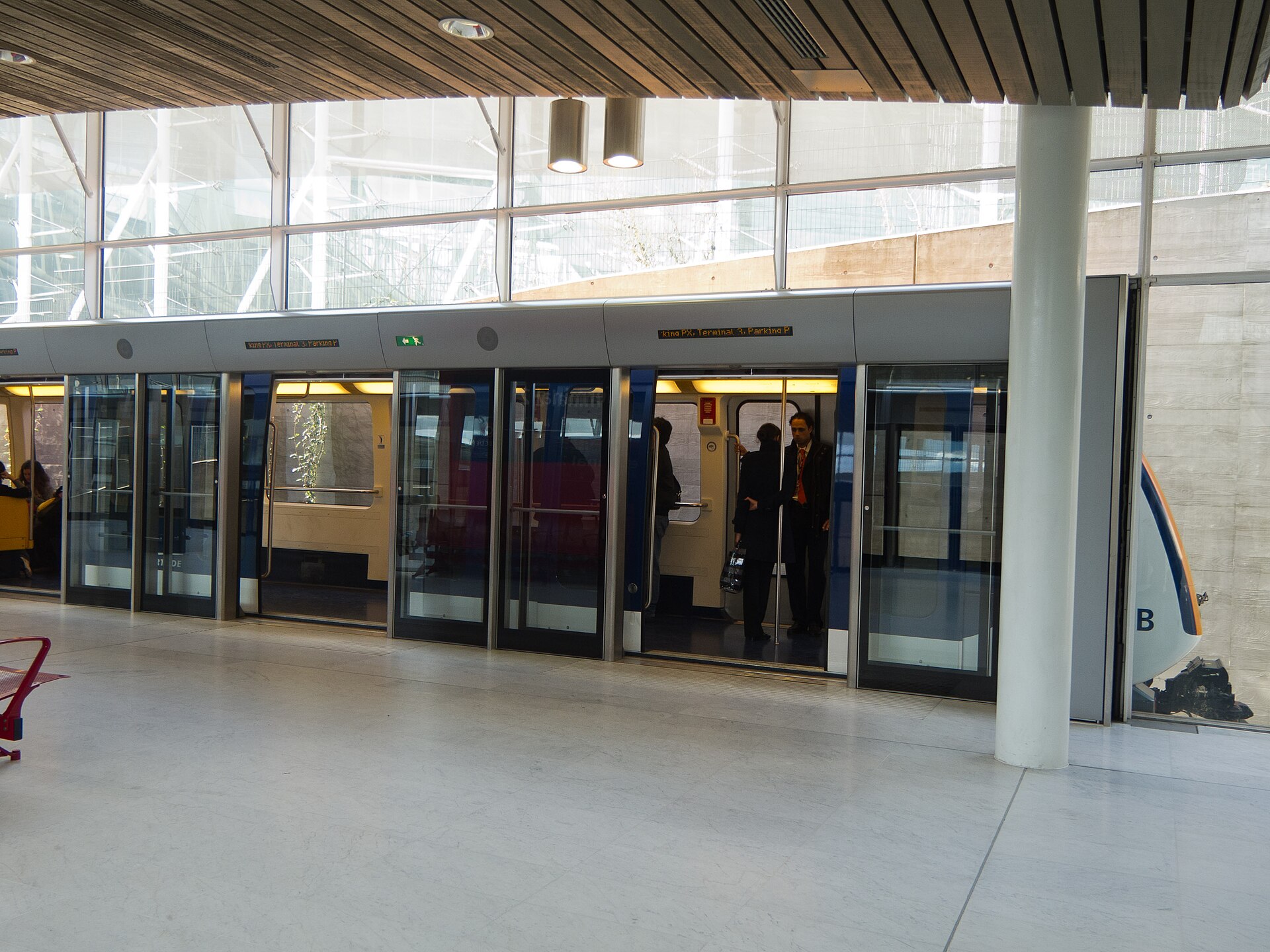
Within Terminal 2, halls 2A to 2F are connected to one another, while 2G stands apart and is reached by bus. Airside connections between halls are handled by transfer buses and, in 2E, by the internal train between halls K, L and M. If you’re connecting between flights, follow the Correspondances (connecting flights) signs rather than the exit, and you won’t need to collect your bags or clear security again unless you’re on separate tickets. The time to allow depends heavily on whether you change terminal and cross passport control; on separate tickets, allow at least three hours.
Getting into Paris
Charles de Gaulle has more ways into the city than any other Paris airport. Here’s how they compare.
| Option | Time to central Paris | Cost | Best for |
|---|---|---|---|
| RER B | About 30 minutes to Gare du Nord, 35–40 to Châtelet | €14 | Speed and budget, if you’re travelling light |
| Taxi | 45–60 minutes, much longer at rush hour | €56 Right Bank, €65 Left Bank | Families, groups, heavy luggage, late arrivals |
| Ride-hailing | As taxi | Varies; surges at busy times | App users, if the price is right |
| TGV | Not to Paris; a short hop to Disneyland and on to French cities | Varies | Skipping Paris altogether |
| CDG Express (from 28 March 2027) | 20 minutes to Gare de l’Est | €25 | Speed and comfort, once it opens |
RER B
The RER B is the default choice: frequent, fast and covered by the €14 airport ticket, and Bonjour RATP’s page for that ticket lists where you can buy it. Trains from both airport stations run through Gare du Nord, Châtelet–Les Halles, Saint-Michel–Notre-Dame and Luxembourg, so you can often reach your hotel with one change or none. The downsides are real, though. The trains are suburban commuter stock with little luggage space, they get crowded at rush hour, the stations in central Paris involve long corridors and stairs, and the line is notorious for pickpockets. Keep bags in front of you, keep your phone out of your back pocket, and be wary of anyone offering to help with your ticket at the machines. Our guide to avoiding pickpockets in Paris has the details.
Keep your ticket until you leave the station at the other end; you’ll need it to get through the exit gates. Going back to the airport, check that your train shows Aéroport Charles de Gaulle 2 TGV as its destination, because some RER B trains heading north go to Mitry-Claye instead.
Taxis and ride-hailing
Licensed Paris taxis charge a fixed €56 to the Right Bank or €65 to the Left Bank from the official ranks outside arrivals. The maths is worth doing: for four people, the Right Bank taxi costs exactly the same as four airport tickets, and it takes you to the door. Ignore anyone in the arrivals hall offering a taxi; they’re unlicensed and will overcharge. Uber and Bolt work too: the app shows your fare and directs you to its pick-up point, and there’s no flat fare, though Uber’s Reserve option lets you lock in a price ahead. Our guide to taxis and Uber in Paris compares them, and our Paris airport transfer guide covers every option, including night buses.
TGV
The TGV station in Terminal 2 is one of Charles de Gaulle’s great advantages. High-speed trains run directly to Marne-la-Vallée–Chessy for Disneyland Paris in about ten minutes, and to cities across France, including Lille, Lyon, Bordeaux and Marseille, without going into Paris. If you’re heading straight on, it can save you half a day. Our guides to trains from Paris and the Paris to Lyon train cover the main routes.
The CDG Express
The long-awaited CDG Express, a dedicated non-stop rail link between Gare de l’Est and Terminal 2, is due to open on 28 March 2027. The announced plan is a train every 15 minutes between 5am and midnight, a 20-minute journey, and a fare of €25 one way, reduced to €16.50 for Navigo pass holders, with under-16s travelling free with an adult. It will be the most comfortable way into the city, but at nearly twice the RER fare, the RER B will still make sense for anyone staying near its stations.
Arriving at Charles de Gaulle
Passport control and the Entry/Exit System
If you’re arriving from outside the Schengen area, the first stop is passport control, and at Charles de Gaulle it can be slow. Non-EU visitors on short stays also go through the EU’s Entry/Exit System (EES), which began rolling out on 12 October 2025 and has been fully operational since 10 April 2026; it records your fingerprints and photograph on your first entry, with exemptions for some travellers. Automated PARAFE gates speed things up for eligible passport holders. Don’t book anything tight for your first hours in Paris. The EU’s ETIAS authorisation isn’t running yet, and the EU will announce its start date several months ahead; our guide to Paris visa requirements explains who will need it.
Bags, customs and meeting people
After passport control, follow the signs to baggage reclaim, then through customs (the green channel if you have nothing to declare). If someone is collecting you, agree on a terminal, a hall and an exit number, because “Terminal 2” alone is not a meeting place. If your bag doesn’t appear, report it at the baggage services desk in the reclaim hall before you leave; once you’ve walked out through customs, you can’t get back in.
Phones, money and Wi-Fi
Charles de Gaulle has free Wi-Fi throughout, enough to download a transport app, book a ride or install an eSIM; our guide to SIM cards, eSIMs and Wi-Fi in Paris covers the options. If you need cash, use a bank cash machine (distributeur) rather than the airport exchange desks, whose rates are poor. Our Paris money guide explains cards, cash and fees.
Departing from Charles de Gaulle
How early to arrive
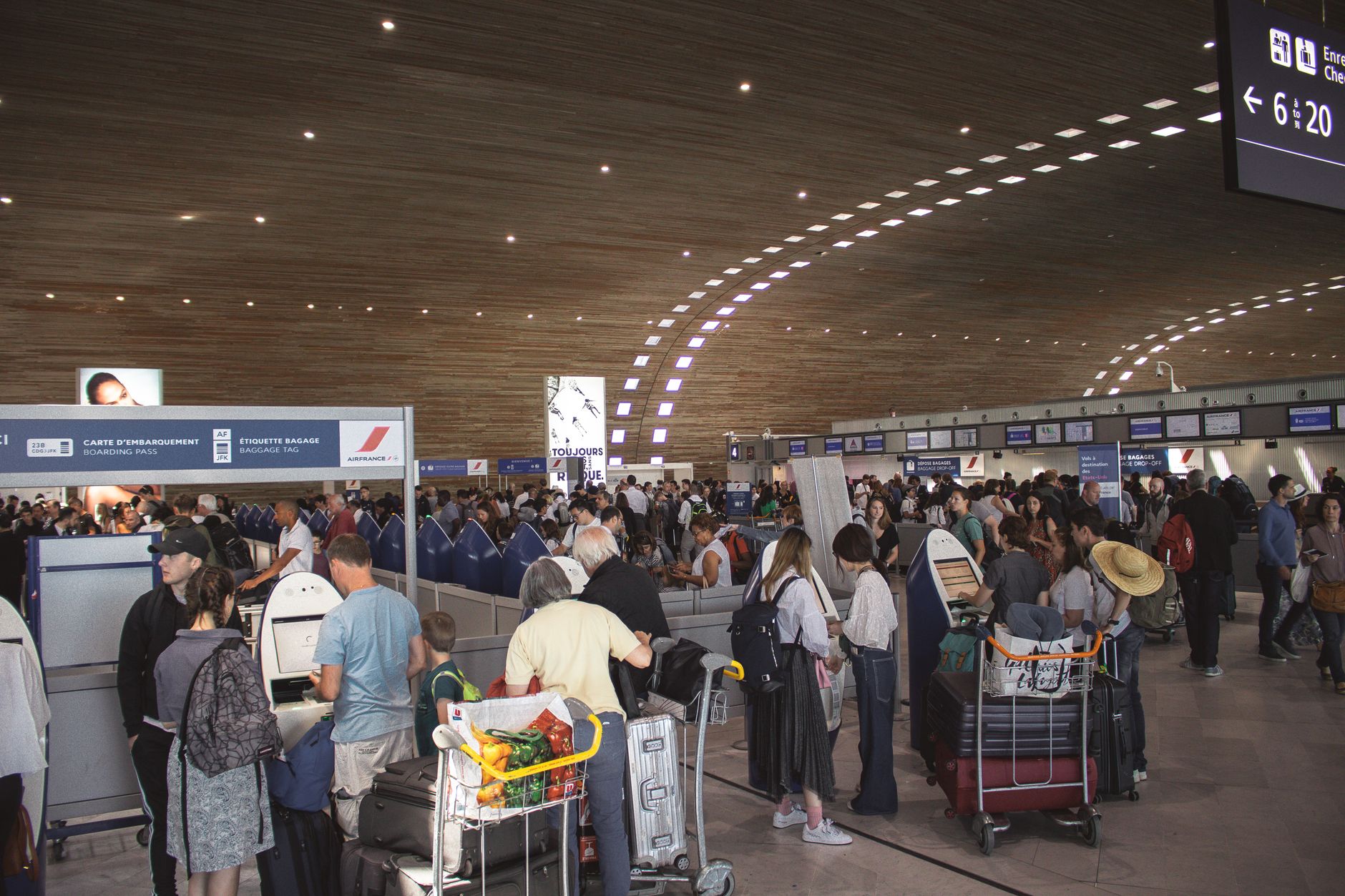
Allow three hours before a long-haul flight and two hours before a European one, plus the time it takes to reach the airport. That sounds cautious until you’ve seen the check-in queues in Terminal 2 at the start of the French summer holidays, or the security lines in the early-morning departure bank. If you have only hand luggage and have checked in online, you can cut it finer for a Schengen flight, but not by much.
Getting back to the airport
Plan the journey out as carefully as the one in. On the RER B, board at Gare du Nord, Châtelet–Les Halles or Saint-Michel and check the platform screen: only trains showing Aéroport Charles de Gaulle 2 TGV go to the airport, stopping at Aéroport Charles de Gaulle 1 on the way; the other branch of the line ends at Mitry-Claye. Get off at CDG 1 for Terminals 1 and 3, and stay on to the end for Terminal 2. By road, the journey time depends on the traffic, so leave a wide margin at rush hour. The flat fare stays the same however long the drive takes, which at least takes the sting out of the traffic. For a dawn flight, book a taxi the evening before, through your hotel or the G7 app.
Tax refunds
If you’re a non-EU resident and have shopped in Paris with a tax-free form, validate it at a PABLO kiosk in your terminal before you check in, as customs may want to see the goods. Our guide to tax-free shopping in Paris explains the rules and the minimum spend.
Security, shops and food
Security at Charles de Gaulle follows the usual European rules on liquids and electronics; pack them so you can get them out quickly. Airside, the newer halls, especially 2E’s hall M, have big duty-free shops, luxury boutiques and branches of French food and wine shops, all priced for a captive audience. Eating at the airport is expensive and mostly mediocre, so if you have time, eat in Paris before you leave, or pick something up from a bakery before you head out. Bring an empty water bottle to fill once you’re through security.
Sleeping at or near the airport
For a dawn departure or a late arrival, staying at the airport can save you a very early taxi or a stressful night journey.
- Sheraton Paris Charles de Gaulle: built into Terminal 2 at 2C, on the level of the TGV and RER station. You can be at check-in within minutes. It’s the most convenient bed at the airport, and priced accordingly.
- YOTELAIR: compact cabins inside Terminal 2E, airside, bookable by the hour or the night. It’s only accessible to passengers with a boarding pass for a flight departing from 2E, which makes it ideal for long Air France connections and useless for anyone else.
- Roissypôle hotels: a cluster of large chain hotels in the business district between the terminals, a free CDGVAL ride from every terminal. They’re cheaper than the Sheraton and still close.
- Hotels in the surrounding towns: cheaper again, but they depend on hotel shuttle buses, which may not run at the hour you need. Check before you book.
Some travellers sleep in the terminal itself between flights. It’s possible but not comfortable: the public areas are bright, noisy and cold at night, and seating is not designed for lying down. If you’re tempted to save the price of a room, a long layover may be better spent going into Paris for a few hours if your passport and your timing allow it.
Left luggage and other services
- Left luggage: Bagages du Monde runs a staffed left-luggage office in Terminal 2, charging by bag and by time; check current prices before you rely on it. If you’re spending a day in the city, our guide to luggage storage in Paris lists cheaper options in town.
- Wi-Fi: free and unlimited throughout the airport.
- Cash machines: in every terminal; use them rather than the exchange desks.
- Pharmacies and medical help: pharmacies in the main terminals, and emergency medical services on site. In an emergency, call 112.
- Charging: sockets and charging points in many of the waiting areas.
Driving, parking and car hire
Car-hire firms have desks at Charles de Gaulle: Avis, for example, has counters at arrivals in Terminals 1 and 2, with its 2E/2F cars in the central car park between those halls. Collecting a car here makes sense if you’re heading straight out to Normandy, Champagne or the Loire, and almost no sense if you’re spending the next few days in Paris, where traffic is slow, parking is scarce and expensive, and you won’t need a car at all. If you’re combining the two, see Paris first and pick the car up on the way out; our guide to the best day trips from Paris shows which ones are easier by car.
If you’re driving to the airport yourself, the official car parks range from short-stay parking beside each terminal to cheaper long-stay car parks linked to the terminals by the CDGVAL, and booking online in advance is usually much cheaper than turning up. Allow time for the shuttle from the long-stay car parks, and remember that the drop-off lanes outside the terminals are for stopping, not waiting.
Charles de Gaulle with children or reduced mobility
With children, the biggest challenges are the distances and the queues. Most airlines let you keep a pushchair until the aircraft door, and families with small children are often directed to priority lanes at security; ask if you don’t see one. Several halls have children’s play areas airside. For getting into Paris, the taxi flat fare is usually a better deal than it looks, and far easier than the RER B with a pushchair and suitcases; our guide to Paris with kids covers the rest of the trip.
Passengers with reduced mobility are entitled to free assistance under EU rules, from arrival at the airport to the aircraft seat and back. Request it through your airline at least 48 hours before you travel, and allow extra time at Charles de Gaulle, where distances between halls and terminals are long.
When things go wrong
Charles de Gaulle handles enormous volumes, and when weather, strikes or technical problems disrupt it, they disrupt it on a large scale. Know your rights before you need them. Under EU rules, if your flight from Paris (or into Paris on an EU airline) is cancelled or delayed by three hours or more on arrival for reasons within the airline’s control, you may be entitled to compensation of €250 to €600 depending on the distance, as well as meals, refreshments and, if needed, a hotel while you wait. Air traffic control strikes and bad weather usually count as extraordinary circumstances, which rule out compensation but not the duty of care.
If you miss a connection on a single booking, the airline must rebook you. On separate tickets, you’re on your own, which is why we suggest at least three hours between self-connecting flights at Charles de Gaulle. A good travel insurance policy covers some of the gaps; see our Paris travel insurance guide.
Survival tips
- Check your terminal twice: once when you book, once on the day. Terminal 2 has seven halls and they’re far apart.
- Treat 2G as a separate terminal, because the bus adds time.
- Know where you’ll buy your €14 ticket before you land, so the machine queues don’t catch you out, and keep it until you exit at the other end.
- Do the taxi maths. With three or four people and luggage, the flat fare beats the RER.
- Never take a taxi from a tout. Licensed taxis queue at the official rank.
- Watch your bags on the RER B, especially at Gare du Nord and around the ticket machines.
- Use the CDGVAL to get between Terminal 1, Terminal 3 and Terminal 2; it’s free and quick.
- Arrive three hours before long-haul flights, more at the start of school holidays.
- Keep a snack and an empty water bottle; the airside prices are steep.
- From March 2027, check the new terminal names on your boarding pass rather than trusting old guides.
Frequently asked questions
How many terminals does Charles de Gaulle airport have?
Three: Terminal 1, Terminal 2 and Terminal 3. Terminal 2 is divided into separate halls, 2A to 2G, which work almost like terminals in their own right, so check which one your flight uses. The airport plans to rename its terminals with numbers 1 to 7 in March 2027.
Which terminal does Air France use at CDG?
Terminal 2, mainly halls 2E and 2F; your boarding pass shows which. Smaller regional flights use 2G. Since summer 2026, almost all Air France flights from Paris use Charles de Gaulle.
How do I get between terminals at Charles de Gaulle?
Take the CDGVAL, a free driverless shuttle linking Terminal 1, the Roissypôle area for Terminal 3, and Terminal 2. Within Terminal 2 you can walk between halls, and a shuttle bus serves 2G.
How long does it take to get from CDG to central Paris?
On the RER B, which costs €14, the time depends on your stop, so check a route planner for yours. A taxi charges a flat fare of €56 or €65, and the drive takes as long as the traffic allows.
Is the RER B from Charles de Gaulle safe?
Yes, but it’s crowded at peak times and known for pickpockets. Keep your bags in front of you and your valuables zipped away, ignore people offering help at the ticket machines, and consider a taxi if you’re arriving late at night with a lot of luggage.
Is there a hotel inside Charles de Gaulle airport?
Yes. The Sheraton is built into Terminal 2 at 2C, by the train station, and YOTELAIR has cabins in the secure transit area of Terminal 2E, open only to passengers with a 2E boarding pass. More hotels are at Roissypôle, a free CDGVAL ride from the terminals.
How early should I get to Charles de Gaulle?
Three hours before a long-haul flight and two hours before a European one, plus your journey time. Add more at the start and end of the French school holidays.
When does the CDG Express open?
It’s due to open on 28 March 2027, running between Gare de l’Est and Terminal 2 in 20 minutes, every 15 minutes, for €25 one way.
Related Paris Guides
- Paris Airports Compared: CDG, Orly and Beauvais
- Paris Airport Transfers
- Taxis and Uber in Paris
- Disneyland Paris Guide
- Trains From Paris
- Paris Visa Requirements
- Avoiding Pickpockets in Paris
- Paris Metro Tickets and the Navigo Pass
Photo Credits
Terminal 1: Roissy aérogard 1 by Royonx, CC0, via Wikimedia Commons.
Charles de Gaulle from above: Charlesdegaulleairportaerial, Public domain, via Wikimedia Commons.
The CDGVAL shuttle: CDGVAL – Aeroport-Charles-De-Gaulle IMG 0047 by Poudou99, CC BY-SA 4.0, via Wikimedia Commons.
Terminal 2F: CDG2 terminal 2F(2) by Kevin PERROTTET, CC BY 2.5, via Wikimedia Commons.
Terminal 1 satellite gates: Satellite T Terminal 1 Aéroport Charles Gaulle – Mauregard (FR77) – 2026-01-31 – 1 by Chabe01, CC BY-SA 4.0, via Wikimedia Commons.