Best Things to Do in Paris at Night: After-Dark Adventures
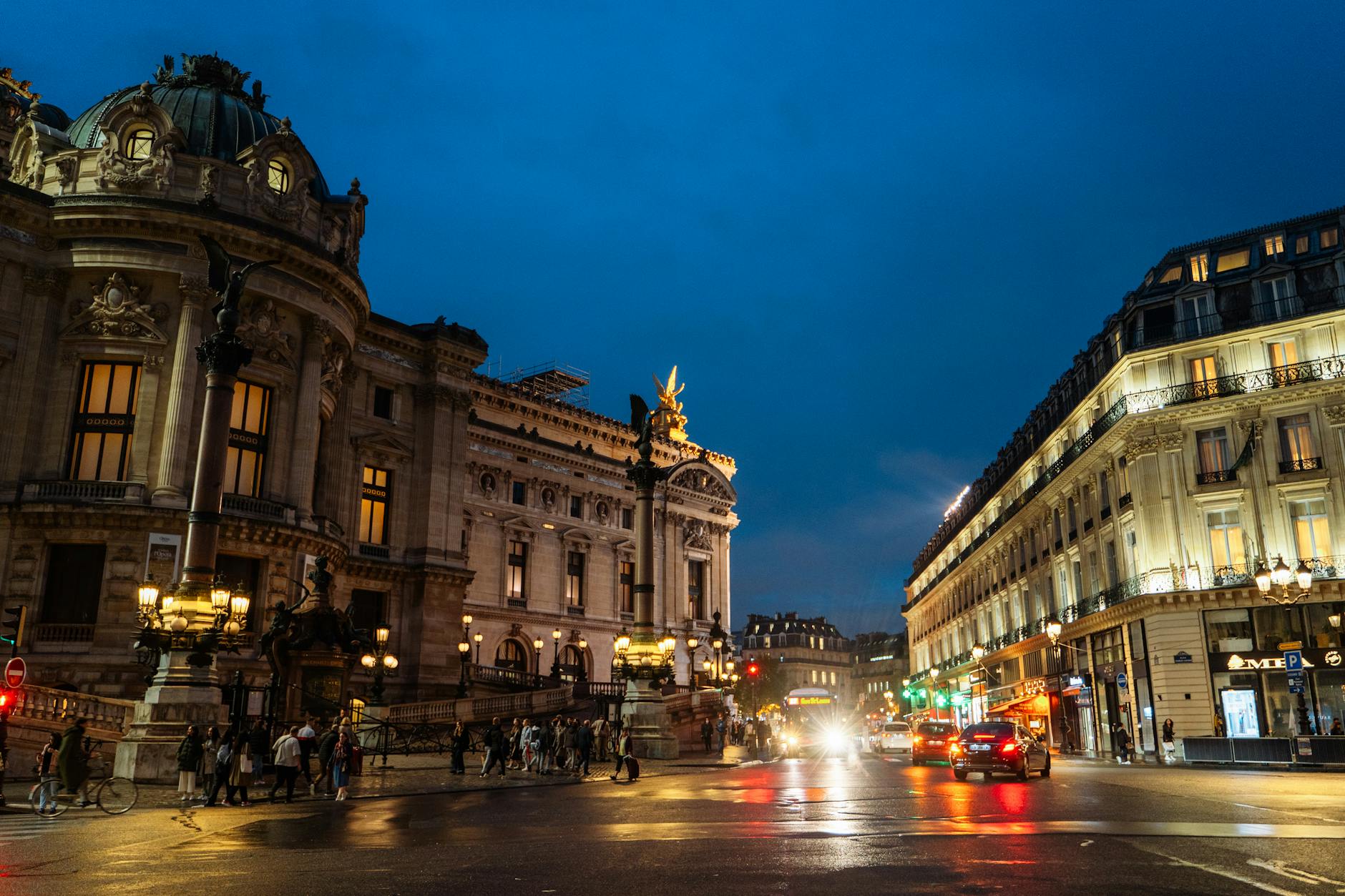
Nobody tells you that the best things to do in Paris at night happen in the same streets you walked all day. The city doesn’t become a different place after sunset. Its center of gravity just slides over: away from monuments and toward bistros, away from ticket queues and toward terraces. The Louvre closes and the pyramid lights up. The Eiffel Tower’s daytime lines empty out, and then, at the top of every hour from 9pm, twenty thousand bulbs go off like someone uncorked the sky. Restaurants that had no room for you at 7pm find a corner table at 10. Locals materialize. Couples colonize the bridges. Cabaret sequins catch the streetlight on Boulevard de Clichy. And the Seine goes black and slow, flecked with cruise-boat reflections, while the city finally shows you the version of itself it actually lives in.
What follows is the after-dark stuff worth building an evening around: the Eiffel sparkle and where to stand for it, Seine cruises and which one suits your mood, the bars and jazz cellars locals genuinely use, cabaret bookings and dress codes, brasseries that feed you past midnight, romantic walks, things to do with kids before bedtime, the honest safety picture, and how to get home once the Metro has clocked out. Think of it as the night companion to our broader things to do in Paris guide.
The Best 9 Things to Do in Paris After Dark (Quick List)
One night and no time to dither? These are the nine experiences that reliably top both first-timer and repeat-visitor lists. They run the full range, from free and famous (the Eiffel sparkle) to pricey and theatrical (a Moulin Rouge dinner show), and you can chain several together in one evening if you’re willing to walk a bit or grab a taxi between stops.
- Watch the Eiffel Tower sparkle. Twenty thousand flashbulbs fire for five minutes at the top of every hour, 9pm to 1am (until 11pm in winter). Best from the Champ de Mars or Trocadéro. Free.
- Take an illuminated monuments stroll. Start at Notre-Dame, cross Île Saint-Louis, follow the quais to the Louvre pyramid and Place de la Concorde. Roughly an hour, all lit, all free.
- Cruise the Seine after dark. One-hour open-boat trips from €15, dinner cruises from €100. The bridges and bouquinistes look like a different city from water level.
- Find a jazz bar in Saint-Germain or Les Halles. Caveau de la Huchette swings nightly until 4am. Sunset Sunside and Duc des Lombards on Rue des Lombards handle the modern programming.
- Eat late at a bouillon or brasserie. Bouillon Pigalle until midnight, Brasserie Lipp until 1am, Au Pied de Cochon all night long.
- Catch sunset over the city from Sacré-Cœur. The Montmartre steps fill an hour before dusk. Bring a bottle.
- Photograph the Eiffel Tower from Trocadéro. The postcard angle, sparkle in frame. Watch your bag for pickpockets.
- See a cabaret. Moulin Rouge for the original cancan, Crazy Horse for choreographed nude-light art, Paradis Latin for a smaller neighborhood feel.
- Walk the Champs-Élysées at night. The trees stay lit year-round. Concorde to the Arc de Triomphe takes about thirty minutes and dumps you at the world’s most photographed roundabout.
The rest of this guide takes each of these apart in detail, then adds the quieter after-dark moves locals slot into a night out: the skyline deck atop Tour Montparnasse, late-opening bookstores, the lit kinetic sculptures at Place Stravinsky.
The Eiffel Tower at Night: Sparkle, Climb, or View From Below?
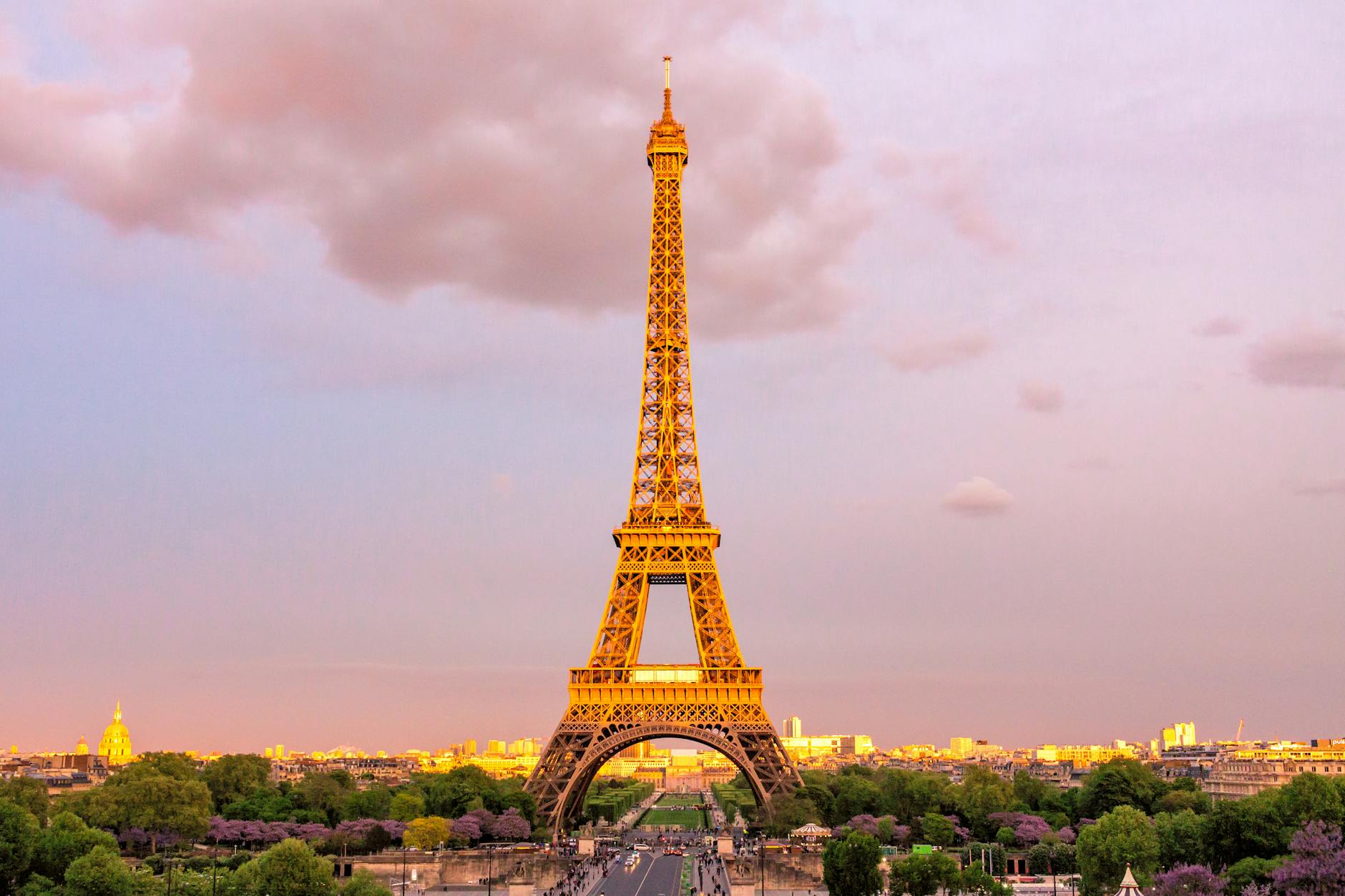
Nothing else says Paris at night quite the way the Eiffel Tower does, and the tower actually runs two light shows at once. From sunset to 1am it glows a steady warm gold. That’s the baseline lighting Pierre Bideau designed in 1985. On top of it comes the sparkle (officially the scintillement), when the tower’s twenty thousand mounted flashbulbs fire at the top of every hour for exactly five minutes. The sparkle runs hourly from 9pm to 1am from late spring through early autumn, and from 8pm or 9pm to 11pm in winter, when it stops earlier and the gold lighting cuts at 11:45pm.
There are three ways to take it in: from below, from the tower itself, or from a distance. From below is both the cheapest and the most cinematic. Lie on the Champ de Mars lawn on the southeast side and you’re directly under the iron lacework with the sparkle bouncing off the grass; arrive forty-five minutes before the hour to claim a comfortable spot. The Trocadéro plaza across the river is the classic postcard angle, the tower framed between the wings of the Palais de Chaillot. It’s the most photographed view in the city, which also makes it the densest concentration of pickpockets after dark, so zip your bag and keep your phone in a front pocket. For something quieter, walk to Pont de Bir-Hakeim, the double-deck bridge from Inception, and shoot a side angle through the Art Nouveau ironwork.
Climbing at night is worth doing. The elevator to the summit costs €31, and once you’re up there the city’s grid spreads out for miles; from the top platform you can even watch the rotating beam of the lighthouse on the tower sweeping over the rooftops. Last summit entry is around 10:30pm during summer-extended hours and 9:30pm the rest of the year, and night slots sell out faster than daytime ones, so book online a week ahead. The second floor by stairs (704 steps) is €14 and stays open later than people expect, though the staircase shuts before the elevator does.
Want the inverse view, the Eiffel in the skyline rather than under your feet? Go to the 56th-floor observation deck of Tour Montparnasse. It’s open until 11pm (last entry 10:30pm), tickets are €23, and you get both indoor windows and a rooftop terrace. This is the best skyline panorama in Paris for one simple reason: it’s the only one with the Eiffel Tower in the frame. The complaint Parisians have always made about Tour Montparnasse, that it wrecks the skyline, turns into its main selling point up here. Stand on the thing and you can’t see it. One more option: a Bateaux Mouches dinner cruise (more on those below) catches the Eiffel from water level on its return leg, and with a little luck the sparkle goes off as you pass underneath.
Seine River Cruises at Night
A Seine night cruise is the laziest genuinely excellent thing you can do in Paris. You sit, the city glides past, and you take in Notre-Dame, the Louvre, the Conciergerie, the Musée d’Orsay, the Eiffel Tower, the Grand Palais, all lit and all seen from the angle they were built to be seen from, which is the river. Two tiers, basically: the standard one-hour sightseeing cruise at around €15–19, and the dinner cruise running roughly €100–200. We break down the difference and our recommended booking approach in the dedicated Seine river cruise guide.
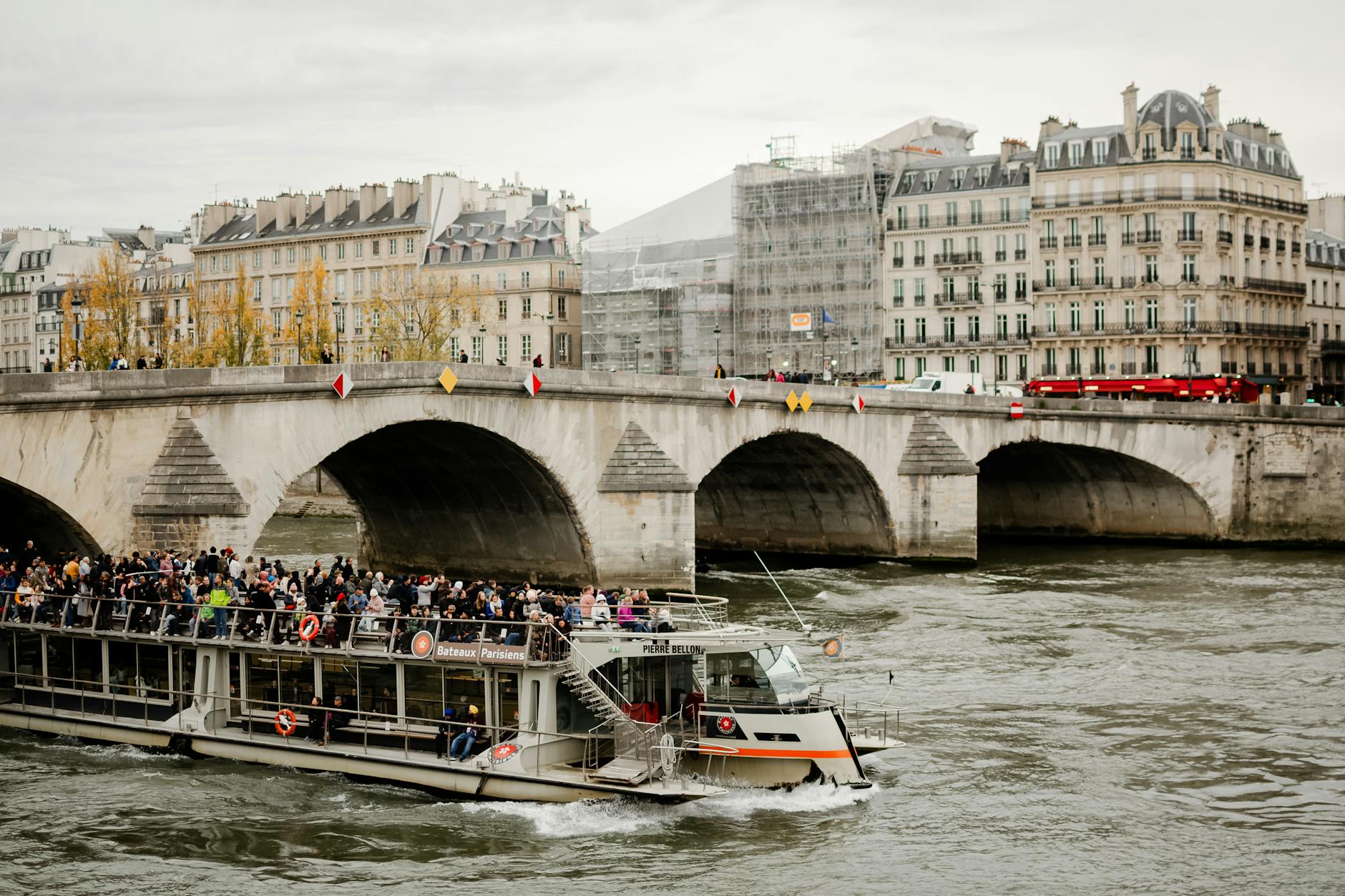
For sightseeing-only night cruises, four operators run the show. Vedettes du Pont-Neuf does one-hour tours for €15 from the tip of Île de la Cité, with a last summer departure around 9:30pm; these are the smallest boats and often the best atmosphere. Bateaux Mouches, the most famous, leaves Pont de l’Alma every thirty minutes for a 70-minute loop at €15–19 on big glassed-in boats that still feel pleasantly old-school. Bateaux Parisiens departs from the base of the Eiffel Tower at similar prices, with audio guides in fifteen languages. Vedettes de Paris, also from the Eiffel base, runs a one-hour Champagne option (€25–35), which is really just a sightseeing cruise with a glass in your hand.
Dinner cruises are their own animal. Bateaux Mouches Excellence at €100–160 is the dependable mid-tier workhorse. Bateaux Parisiens Le Diamant at €140–200 steps up the food and the table service. Yachts de Paris Don Juan II, €200 and up, is the one that’s actually gastronomic: chef-driven, smaller capacity, no microphone, none of that bus-tour-on-water feel. Here’s the catch most guides leave out. Dinner cruises board around 8:15pm and return around 10:30pm, which means you’re usually still mid-course inside the boat when the 10pm sparkle happens. If you want the sparkle from the water, book a sightseeing-only cruise that leaves at 9:30pm and times its route to pass the tower on the hour.
Best Bars & Cocktail Lounges by Neighborhood
Paris is deep into a long cocktail revival. Not as long-running as London’s, not as showy as New York’s, but real, with serious bartenders, tightly edited menus, and a handful of bars that keep landing on the World’s 50 Best list. The scene clusters in five or six neighborhoods, and the one you pick shapes the whole night: literary in Saint-Germain, dressy on the Champs-Élysées, scrappy and inventive in the Marais, sleazy-in-the-good-way in Pigalle. Most bars close around 2am on weeknights and 4am on Friday and Saturday.
Saint-Germain (6th)
Saint-Germain coasts on its literary CV (Sartre, Hemingway, the old cafes), but its cocktail bars are quietly first-rate. Castor Club on Rue Hautefeuille is a tiny, low-ceilinged speakeasy with a velvet downstairs and a rotating, well-disciplined list; book ahead, because it holds maybe forty people total. Prescription Cocktail Club, out of the Experimental Group stable, is bigger, more polished, and pulls a buzzy after-dinner crowd. Upstairs at Terence Conran’s old Alcazar, La Mezzanine de l’Alcazar is more design-led and works well for a mixed group that doesn’t want to commit to a hardcore cocktail den.
Marais (3rd/4th)
Little Red Door on Rue Charlot is the headliner, a fixture on the World’s 50 Best list, with menus built around concepts (recent ones organized by emotion, by tarot card, by meditation) and one of the warmest teams in town. Le Mary Celeste nearby pours excellent natural wine and shucks good oysters alongside its cocktails. Sherry Butt is where the whisky-and-rum nerds go. And Candelaria, hidden behind a working taqueria on Rue de Saintonge, is the 2011 speakeasy that arguably kicked off the modern Paris cocktail era, and it’s still drawing crowds.
South Pigalle / SoPi (9th)
The neighborhood once known mainly for the Moulin Rouge and the strip clubs along Boulevard de Clichy has become, over the past decade, the most exciting bar zone in the city. Lulu White on Rue Frochot takes absinthe seriously: green-fairy drips, New Orleans Sazeracs, a proper cellar mood. A few doors down, Dirty Dick is a tiki bar built inside a former hostess bar, rum-forward and theatrical, deliberately tacky in the best possible way.
Latin Quarter (5th)
Curio Parlor, another Experimental Group room, is a small Victorian-curiosity-themed bar that punches well above its weight. Le Coq nearby is more of a neighborhood hang. Walk a bit further north toward Canal Saint-Martin and you hit Le Comptoir Général, a sprawling jungle-themed venue that drifts into bar-club territory and is absurdly photogenic.
Champs-Élysées Area (8th)
This is the dress-up tier. Bar Hemingway at the Ritz is the legend; Colin Field turned it into one of the world’s great hotel bars, and even after his retirement the room and the precision hold. Cocktails run €30–45, the place seats maybe thirty, and while a tie isn’t required, you’ll wish you’d worn one. Le Bar 8 at the Mandarin Oriental on Rue Saint-Honoré is sleeker and more contemporary. Les Ambassadeurs at the Crillon, recently restored, is the most theatrically beautiful hotel bar in Paris.
Eiffel / 16th
Bar Botaniste at the Shangri-La is the destination here, with botanically-themed cocktails in a glassed-in room that makes you forget you’re a five-minute walk from the most famous tower on earth. Bar 228 at Le Meurice brings live jazz on selected nights and a clubby, leather-bound feel.
Live Jazz, Music & Dancing
Paris has been a jazz town since 1917, when the U.S. Army’s 369th Regiment Band brought it ashore, and through the 1950s it was briefly the most important jazz capital in the world after New York. That history left behind a string of working clubs that still book live music every single night. The cluster on Rue des Lombards in the 1st is the easiest to walk, with three top rooms inside a hundred meters, but the Latin Quarter cellars and the 10th-arrondissement halls matter just as much.
Caveau de la Huchette, at 5 Rue de la Huchette in the Latin Quarter, is the swing-era cellar most visitors hit first. It opened in 1946, was the Paris base of Lionel Hampton and Sidney Bechet, and turns up in La La Land. There’s live jazz, swing, blues, or boogie every night until 2am on weeknights and 4am on weekends, with a cover of €15 weekday and €17 weekend (cash). The drinks aren’t the point. The dancing is. Sunset Sunside, at 60 Rue des Lombards, is the contemporary-jazz heavyweight, two stages stacked vertically (Sunside on the ground floor, Sunset in the cellar), serious programming, €20–30 covers. Duc des Lombards, four doors down at 42, books top international acts and is the most intimate of the three. Le Petit Journal Saint-Michel in the 5th holds the line on traditional New Orleans jazz.
Beyond the central core, New Morning at 7–9 Rue des Petites-Écuries in the 10th has been booking international acts across jazz, world music, and Afrobeat since 1981; check the calendar first, because the programming swings widely. La Bellevilloise in the 20th is part club, part jazz hall, part world-music venue, with a famous Sunday jazz brunch. If you’d rather dance than sit, the anchor venues are Le Silencio, David Lynch’s members-and-reservation club below Rue Montmartre; Rex Club, the electronic institution going since 1988, a five-minute walk from Bonne Nouvelle metro; and Concrete, the techno barge moored at Quai de la Rapée, famous for all-weekend after-hours sessions. Pace yourself.
Cabaret Shows: Moulin Rouge, Crazy Horse, Lido
Paris cabaret has outlasted two world wars, the arrival of cinema, the arrival of the internet, and Las Vegas. Four houses dominate, each with its own personality, and choosing between them really comes down to what kind of night you’re after.
The Moulin Rouge at 82 Boulevard de Clichy is the original. Founded in 1889, it invented the modern cancan, and its current revue, Féerie, has been running with refreshes since 1999. Sixty dancers, a thousand costumes, two shows a night at 9pm and 11pm. Show-only seats run €87–220 depending on placement; show-plus-dinner packages €220–450. Book one to three weeks ahead in shoulder season and a month ahead in summer. Dress code is smart-casual: no shorts, no sportswear, no flip-flops. Yes, the room skews touristy, but the production values are genuinely world-class, and the venue itself, red windmill and all, is the experience.
The Crazy Horse Paris at 12 Avenue George V, founded in 1951, is a completely different proposition. Where the Moulin Rouge is feathers and ensembles, the Crazy Horse trades in what the house calls “the art of the nude”: small, near-identically-built dancers, choreographed light projections that paint patterns onto bare skin, no plot, lots of intimate visual virtuosity. The run-time is shorter, around 1h45m, and the room is smaller and more theatrical. Show only is €85–160; show plus Champagne, €115–200. It tends to win out for date nights and for repeat visitors who already did the Moulin Rouge once.
The Lido, the third great Champs-Élysées house, closed in March 2022 and reopened as Lido 2 Paris, staging new musical revues including Adagio since fall 2025. The reboot leans more toward contemporary musical theatre than feathered cabaret, and reactions have been split, so read recent reviews before you commit. Tickets €85–200. Then there’s Paradis Latin at 28 Rue du Cardinal Lemoine in the 5th, the smaller neighborhood option. Gustave Eiffel designed the building in 1889, the room holds about 700 (less than half the Moulin Rouge), and the mood is warmer. Tickets €90–200. Of the four, this is the one Parisians are most likely to point a friend toward.
Romantic Night Walks
Paris was built for walking and lit for romance, and its single best free experience is a slow night walk from one illuminated landmark to the next. For a deeper itinerary, see our romantic Paris guide. Here are the five walks that work every time.
- Île Saint-Louis, full lap. About 25 minutes from Pont Saint-Louis, looping the island with Notre-Dame lit up behind you. Berthillon ice cream if any kiosk is open, otherwise the bakery at the bridge end.
- Pont Alexandre III, mid-bridge. The most ornate bridge in Paris, its gilded statues lit at night. From the middle you get the Eiffel sparkle upstream and Les Invalides downstream.
- Champs-Élysées, Concorde to the Arc. About 30 minutes uphill, the plane trees uplit year-round and the shop windows still glowing. You cross the Rond-Point gardens halfway.
- Place Vendôme at midnight. Shuttered jewelry houses, flawless lighting, nobody around. Five minutes; pair it with a cocktail at the Ritz a few steps off the square.
- Quai Saint-Bernard sculpture garden. The open-air sculpture garden along the Seine in the 5th, lit and surprisingly peaceful after dark.
- The Trocadéro–Bir-Hakeim–Eiffel triangle. The photographer’s classic circuit, three angles on the same tower in about 45 minutes.
Late Dining: Where Paris Eats After 10pm
Here’s a classic visitor mistake: rolling up at 10pm starving, only to learn that most Paris bistros wind down kitchen service around 10:30. The fix is the brasserie, an institution that exists precisely to feed you late. Brasseries started as Alsatian beer halls and historically served at any hour, because they fed actors leaving the theater, journalists filing past deadline, and travelers off late trains. That habit stuck. Below are the seven places that will reliably give you a midnight-or-later table.
| Restaurant | Address | Last Seating | Notes |
|---|---|---|---|
| Bouillon Pigalle | 22 Bd de Clichy, 18th | ~midnight | 3-course €15–20; long queue, no reservations |
| Bouillon Chartier | 7 Rue du Faubourg Montmartre, 9th | midnight | 1896 historic dining room; tourist-friendly; cheap |
| Brasserie Lipp | 151 Bd Saint-Germain, 6th | 1am | Literary classic; Alsatian; jacket appreciated |
| L’Avenue | 41 Avenue Montaigne, 8th | 2am | Fashion-crowd canteen; pricey; book ahead |
| Au Pied de Cochon | 6 Rue Coquillière, 1st | 24/7 | Open all night; classic onion soup at 4am |
| La Maison de l’Aubrac | 37 Rue Marbeuf, 8th | 7am | Steakhouse open until breakfast |
| Le Procope | 13 Rue de l’Ancienne Comédie, 6th | 1am | 1686, oldest cafe in Paris; classical French |
The two bouillons are the real deal. Bouillons began in the 1850s as workers’ canteens slinging cheap broth (bouillon), and the modern Bouillon Pigalle revival has rebooted the format wholesale: traditional French plates like oeuf mayonnaise, blanquette de veau, and île flottante for genuinely cheap money, in a beautiful room, served until midnight. Expect to queue 30 to 90 minutes, because they don’t take reservations. Over by Les Halles, Au Pied de Cochon has been ladling onion soup at 4am since 1947 and is the obligatory last stop after a long night. La Maison de l’Aubrac is the real 7am steakhouse, a claim that sounds ridiculous until you walk in at 5am and find it three-quarters full.
Illuminated Monuments to Walk By at Night
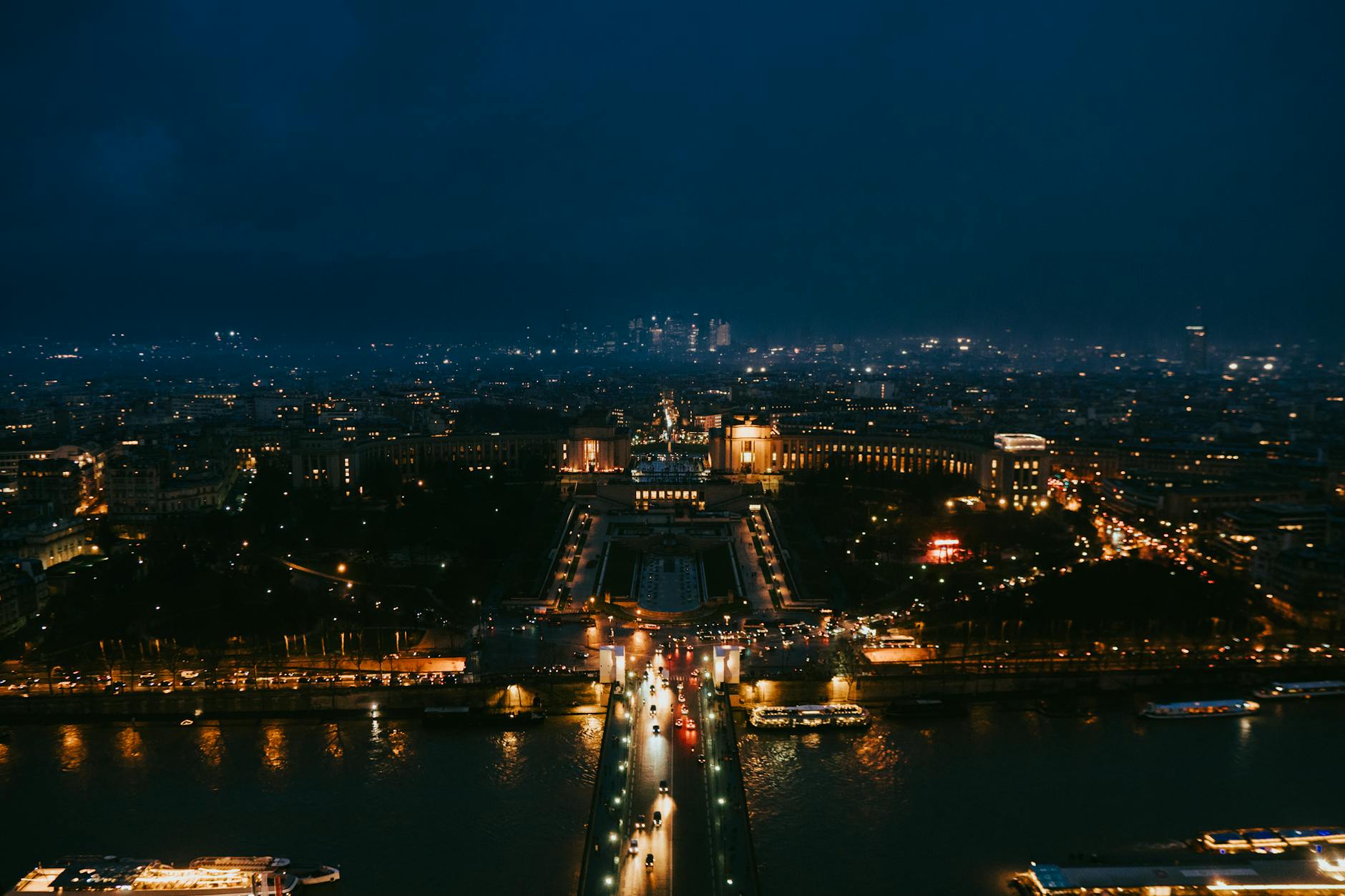
The master lighting designer Pierre Bideau shaped Paris’s monument lighting through the 1980s and 90s, and he made it warm, low, and architectural rather than the floodlit-stadium glare most cities reach for. The payoff is that walking past the city’s great buildings at night feels nothing like seeing them by day. It’s softer, more theatrical, far less crowded.
- Notre-Dame de Paris parvis. Reopened in December 2024 after the post-fire restoration, the cathedral’s west façade is the most spectacular night-lit Gothic anywhere.
- Hôtel de Ville. The Renaissance-revival city hall, fully uplit, with a fountain plaza out front.
- Louvre pyramid. Lit until midnight; the courtyard stays open and free to walk through after the museum closes.
- Place de la Concorde. The Egyptian obelisk and twin fountains, now restored, look their best after dark.
- Arc de Triomphe. The rooftop terrace stays open into the evening (closing around 10:30pm in summer, earlier in winter), and the view down the Champs-Élysées from up there after dark is non-negotiable.
- Sacré-Cœur Basilica. The steps out front give you the best free panorama in Paris, and the basilica itself stays lit until late.
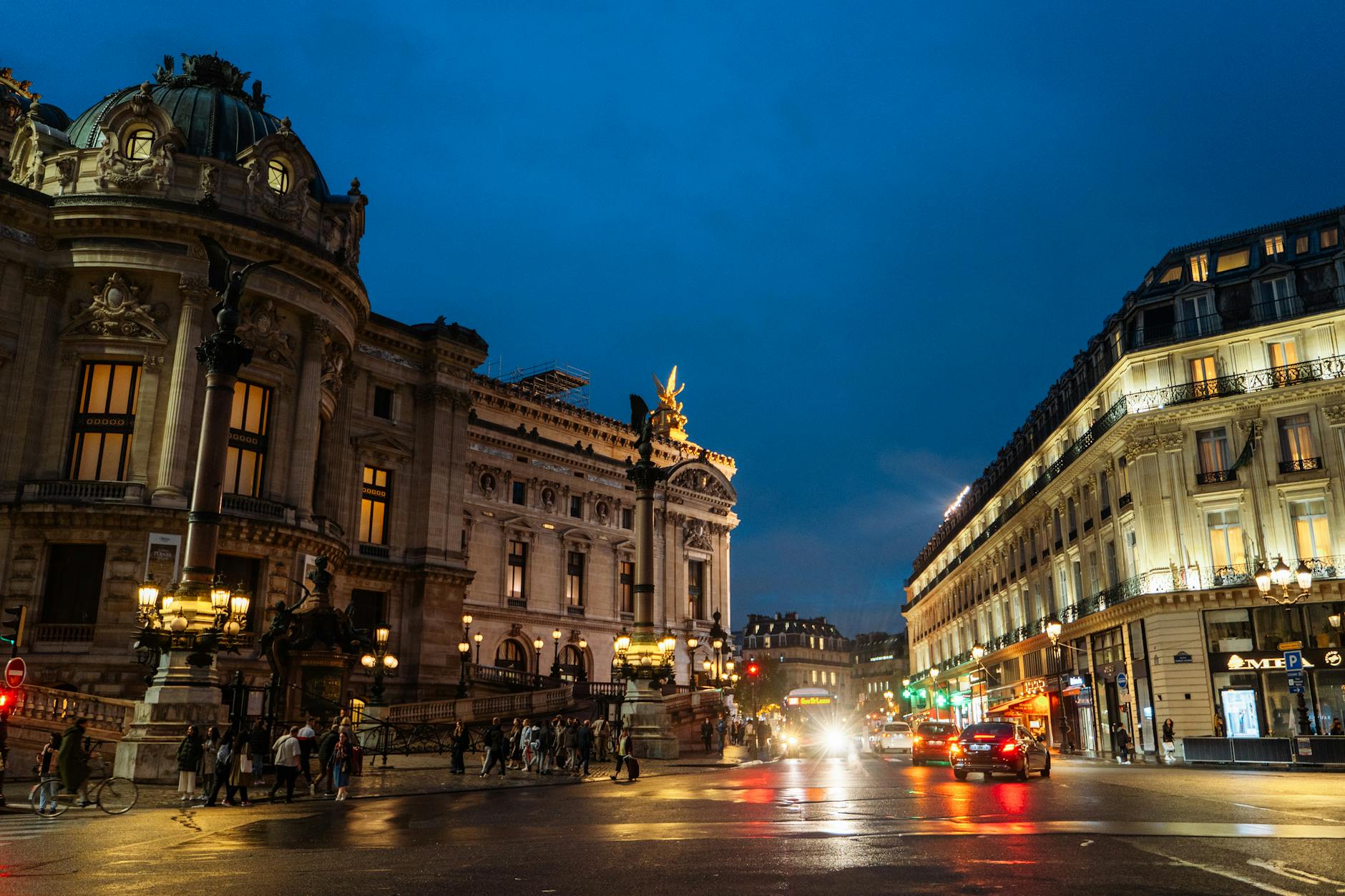
- Opéra Garnier. Charles Garnier’s 1875 façade is one of the most ornate buildings in the city, and the lighting brings out every last cherub.
- Pont Alexandre III. The gilded sculptures, the lamp posts, the bridge itself, all of it working together.
Family-Friendly After-Dark Activities
Paris isn’t Las Vegas, and its after-dark life isn’t built around children. But plan the early evening right and you’ll find some genuinely magical kid moments. For the full treatment, see our Paris with kids guide. The headline one is the Eiffel sparkle from the Champ de Mars lawn: bring a picnic blanket, settle in for the 9pm or 10pm show, and watch the kids’ faces when twenty thousand bulbs go off overhead. It’s the nearest thing to free fireworks the city offers.
The city’s historic carrousels, scattered everywhere, are at their best at dusk; try the ones at Hôtel de Ville, Trocadéro, or below Sacré-Cœur, all of which run into the early evening. Disneyland Paris is a 35-minute RER A ride out to Marne-la-Vallée and runs evening fireworks (currently the Disney Tales of Magic castle projection show) most nights of the year. Paris Plages, the city’s riverside summer beach festival, takes over the Seine quais and the Bassin de la Villette from mid-July through early September with sand, deck chairs, riverside swimming pools, and free games running until midnight. Place Stravinsky, beside the Pompidou, has Niki de Saint Phalle’s lit kinetic sculpture-fountain, which toddlers find hypnotic. And Cinéma en Plein Air at Parc de la Villette screens free open-air films from mid-July to mid-August, starting at sunset, with grass to lie on and a picnic to bring.
Solo & LGBTQ+ Friendly After-Dark Spots
The Marais (3rd and 4th) has been the heart of LGBTQ+ Paris since the 1980s, with welcoming nightlife clustered around Rue des Archives, Rue Sainte-Croix-de-la-Bretonnerie, and Rue du Temple. Le Cox and Open Café are the long-running standards on Rue des Archives. 3W Kafé on Rue des Écouffes is the city’s anchor lesbian bar. Raidd and Freedj handle the late dancing. The neighborhood is genuinely mixed and easy: same-sex couples hold hands without a second glance, and solo travelers are never made to feel like a spare part.
For solo travelers in general, the friendliest bars are the ones with proper bar seating where you can read or strike up a conversation: Little Red Door, Candelaria, Lulu White, Castor Club, and Le Carmen (the former Bizet apartment in the 9th, now a moodily-lit cocktail spot). L’Entrée des Artistes on Rue de Crussol is another good bet: tall bar, no pressure to drink in volume, regulars who actually say hello.
Safety After Dark in Paris
On balance, Paris is a safe city to walk at night, especially the central tourist arrondissements (1st through 8th), which stay busy with foot traffic until 1am or 2am almost every night. Pickpocketing is the real risk, and it follows the crowds. The worst spots are the Trocadéro plaza during the Eiffel sparkle, the Champs-Élysées near the Arc de Triomphe at peak hours, the Pont Saint-Louis bridge musicians at 11pm, and Metro line 1 between Concorde and Bastille. Keep your phone in a front pocket, zip your bag, and never leave a phone face-up on a cafe table. For a fuller breakdown of where to stay and walk, see our safe-areas guide.
A few specific cautions. Steer clear of Gare du Nord and the blocks around it late at night; the area draws loitering and the occasional aggressive encounter, and it’s the one neighborhood where central-Paris standards just don’t hold. Châtelet-Les Halles after midnight is more drunk-scuffles-by-McDonald’s than actual danger, but it isn’t pleasant. The main Pigalle strip on Boulevard de Clichy is well-lit, well-trafficked, and fine; the side streets off it are hit-and-miss. On transport, here’s the thing that catches people out: the Metro stops running around 12:40am Sunday through Thursday and around 1:40am Friday and Saturday. After that, take a licensed taxi (G7 or Taxi Bleu via app), or a rideshare (Uber, Bolt, and FreeNow are all reliable). The Noctilien night-bus network covers the whole city overnight and is safe, with real-time next-bus times on the stop displays.
Practical Night Logistics
A handful of hard practicalities to plan around. The Metro’s last train leaves the terminuses at 12:40am Sunday through Thursday and 1:40am Friday and Saturday, which means trains stop reaching central stations around 1:15am and 2:15am respectively. If you’re cutting it close, check the station’s posted last-train times. Once the Metro’s done, the Noctilien night buses run all night, with frequent service on the central N01 and N02 loops. Rideshare is everywhere: Uber, Bolt, and FreeNow all operate, with Bolt usually a touch cheaper. For taxis, grab a marked one from a stand or pre-book G7. And Velib bikes run 24 hours, which makes them an excellent way to cross town when surge pricing kicks in.
On timing: most bistros end kitchen service between 10:30pm and 11:30pm, while brasseries serve until 1am or later (see the late-dining section above). Bars close around 2am Sunday through Thursday and 4am Friday and Saturday. The Eiffel Tower’s last summit elevator runs at 10:30pm during summer-extended hours and 9:30pm the rest of the year, with last entry to the lower levels at 11pm in summer and 10pm in winter. Most museums shut by 6pm, but two stay open late and are worth planning around: the Louvre is open until 9:45pm on Fridays, and the Musée d’Orsay until 9:45pm on Thursdays. Those late sessions run noticeably emptier than daytime, and regulars treat them as one of the best-kept secrets in the city.
To weave nighttime into the rest of your trip, start with our overall things to do in Paris guide, then branch out to the cluster siblings: free things to do, unique experiences, rainy day activities, walking tours, Seine cruises, best Paris tours, photo spots, winter activities, and summer activities.
Frequently Asked Questions
What time does the Eiffel Tower sparkle?
From spring through autumn, the Eiffel Tower sparkles for five minutes at the top of every hour from 9pm to 1am, with the final sparkle at 1am and the continuous gold lighting cutting off at 1:45am. In winter the schedule shortens: it sparkles from 8pm or 9pm to 11pm, with the last one at 11pm. The sparkle itself is twenty thousand camera-flash bulbs mounted on the structure, firing in sequence, while the warm gold baseline lighting runs underneath the whole time. Best viewing: the Champ de Mars lawn, the Trocadéro plaza, or Pont de Bir-Hakeim.
Is Paris safe to walk at night?
Broadly, yes, in central Paris (the 1st through 8th, plus the Marais and the Latin Quarter). The main risk is pickpocketing in tourist-dense areas, not violent crime. Avoid Gare du Nord and the streets right around it late at night. Stick to lit, populated streets, take a rideshare or taxi after midnight rather than the night bus if you’re unsure of an area, and keep valuables out of your back pockets. Solo women can and do walk central Paris at midnight without trouble.
What’s the best Seine night cruise?
For a one-hour sightseeing-only cruise, Vedettes du Pont-Neuf (smaller boats, €15, departing Île de la Cité) is the locals’ pick. Bateaux Mouches is the best-known and leaves every 30 minutes from Pont de l’Alma. For dinner cruises, Yachts de Paris’s Don Juan II is the genuinely gastronomic choice (€200+); Bateaux Parisiens Le Diamant (€140–200) is the polished mid-tier; Bateaux Mouches Excellence (€100–160) is the workhorse. One thing to know: dinner cruises usually miss the 10pm Eiffel sparkle, so if you want the sparkle from the water, take a 9:30pm sightseeing cruise instead.
Can you visit the Eiffel Tower at night?
You can, and for many people the night visit is the one to do. Last summit-elevator entry is 10:30pm during summer-extended hours and 9:30pm the rest of the year, with lower-level access running a little later. Summit tickets are €31 (elevator), second-floor tickets €26 (elevator) or €14 (704 stairs). Book online a week ahead for night slots, which go faster than daytime ones. From the top you can watch the rotating lighthouse beam sweep over the city, one of the most underappreciated sights in Paris.
Where do locals go for nightlife in Paris?
For drinks: South Pigalle (Lulu White, Dirty Dick), the Marais (Little Red Door, Candelaria, Le Mary Celeste), and Saint-Germain (Castor Club, Prescription Cocktail Club). For dinner and late drinks: Canal Saint-Martin and the surrounding 10th and 11th. For dancing: Rex Club, Concrete, La Bellevilloise. For jazz: Sunset Sunside and Duc des Lombards on Rue des Lombards. Locals mostly skip the Champs-Élysées bars and the venues directly on Boulevard de Clichy, the Moulin Rouge itself excepted.
Is Moulin Rouge worth it?
For first-timers, yes. The production values are world-class, the cancan is the original, and the venue itself is iconic. The honest caveats: the room leans heavily touristy (locals don’t go often), the dinner in the dinner-and-show packages is uneven, and the show is French but English-friendly rather than language-driven. Show-only tickets at €87–220 are the best value, so skip the dinner and eat at a brasserie before or after. If you’d prefer a smaller, more intimate cabaret, Paradis Latin or Crazy Horse is the better call.
What’s there to do in Paris after midnight?
After midnight Paris narrows but doesn’t close. Late-night brasseries (Au Pied de Cochon, La Maison de l’Aubrac, L’Avenue, Le Procope) take tables until 1am or later, and Au Pied de Cochon and La Maison de l’Aubrac stay open all night. Cocktail bars run until 2am on weekdays and 4am on weekends. Caveau de la Huchette plays jazz until 4am on weekends. Rex Club, Concrete, and Le Silencio keep their dance floors going until dawn. The Arc de Triomphe terrace closes around 10:30pm, but walking the lit monuments (the Louvre pyramid, Pont Alexandre III, Place de la Concorde) is free and fine until 2am or 3am.
Are Paris bars open late?
Most close around 2am Sunday through Thursday and 4am Friday and Saturday. A handful of late-license bars and clubs run until dawn or beyond, notably Rex Club, Concrete (the techno barge at Quai de la Rapée), and Le Silencio. Bouillon-style restaurants and brasseries serve food and wine to about midnight or 1am. After 4am your options thin out to the few all-night brasseries (Au Pied de Cochon, La Maison de l’Aubrac), the after-hours club scene, and the 24-hour bakeries firing up for the breakfast shift around 6am.
A Note on Booking
For the capacity-limited stuff (cabaret shows, the Eiffel summit, dinner cruises, bookable restaurants), reserve one to three weeks ahead in shoulder season and three to six weeks ahead in summer. For the drop-in stuff (walking the lit monuments, the bouillons, the jazz cellars, the Champ de Mars sparkle crowd), just turn up. Paris after dark is generous to people who plan a little and even more generous to people who wander. Pick a base, give yourself permission to walk longer than you meant to, and let the city’s nightly shift in gravity pull you along.
Plan the rest of your trip
Use these to round out your trip: