Notre-Dame Cathedral Paris: Reopening Guide & What to Expect in 2026
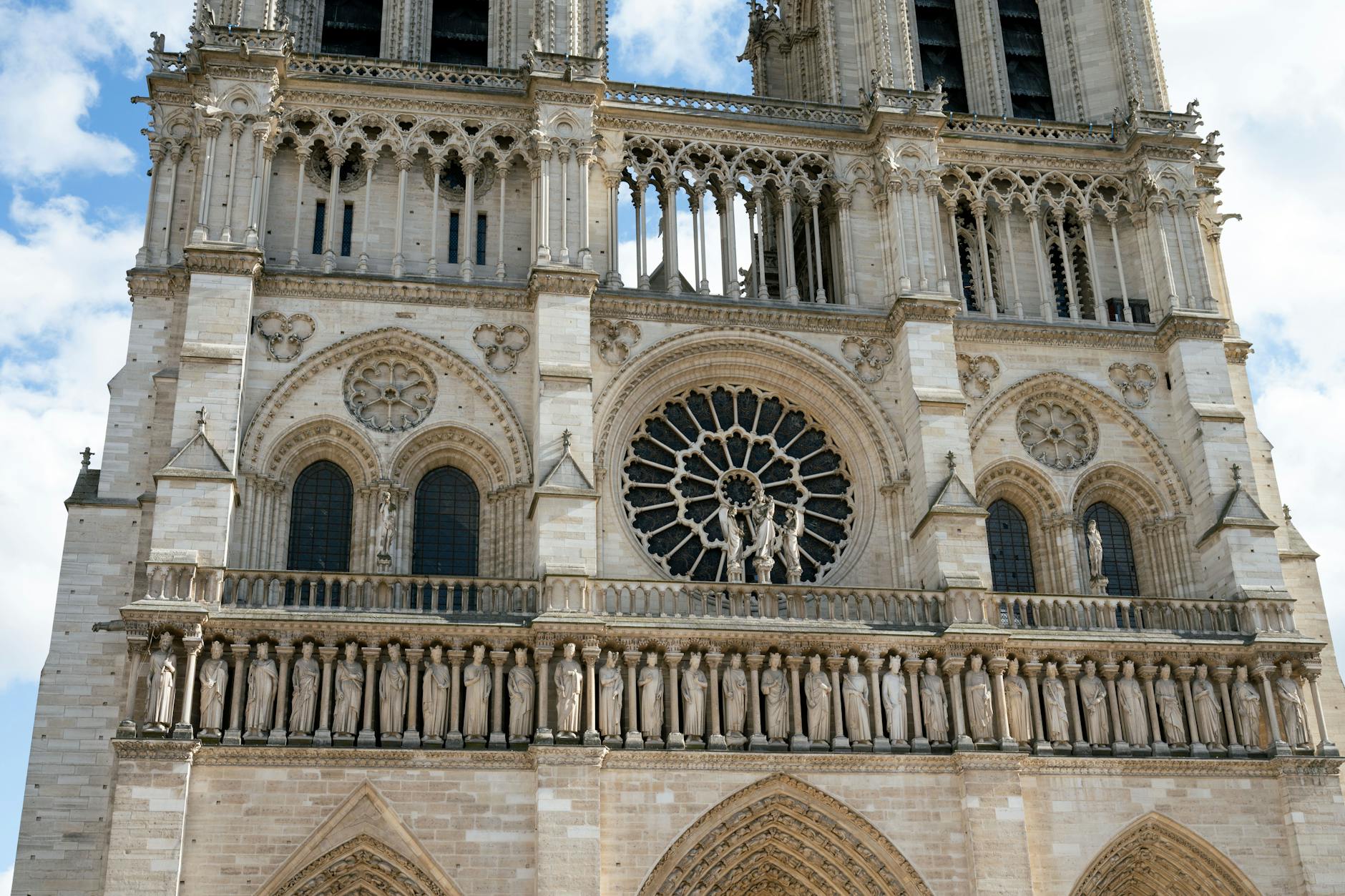
For five years, the most famous church in France was a building site behind a blue fence. Notre-Dame cathedral Paris reopened on December 8, 2024, and the change since the April 15, 2019 fire is hard to overstate. That fire took the spire and almost the entire wooden roof, including la forêt, the 13th-century timber lattice that craftsmen nicknamed “the forest.” Putting it back cost €700 million and took 2,000 craftspeople: charpentiers, sculpteurs sur pierre, vitraillistes, maîtres verriers, géomètres. What they handed back is essentially the cathedral’s 19th-century self, only cleaner and brighter than anyone alive has seen it. This guide walks you through visiting it now: how to grab a free timed-entry slot, what looks different inside, where the tower climb and the Crypte Archéologique stand, and the bridges that give you the best photo of the Île de la Cité. Honestly, 2026 is the easiest and most rewarding moment to visit Notre-Dame in a century.
This guide is one stop inside our wider Paris attractions guide. Geographically and spiritually, Notre-Dame is the middle of everything: kilometre zero, the point from which every distance in France is measured, is set into the parvis right in front of the doors. Stay in the city long enough and you walk across it whether you planned to or not.
Notre-Dame Post-Reopening: What’s Different in 2026
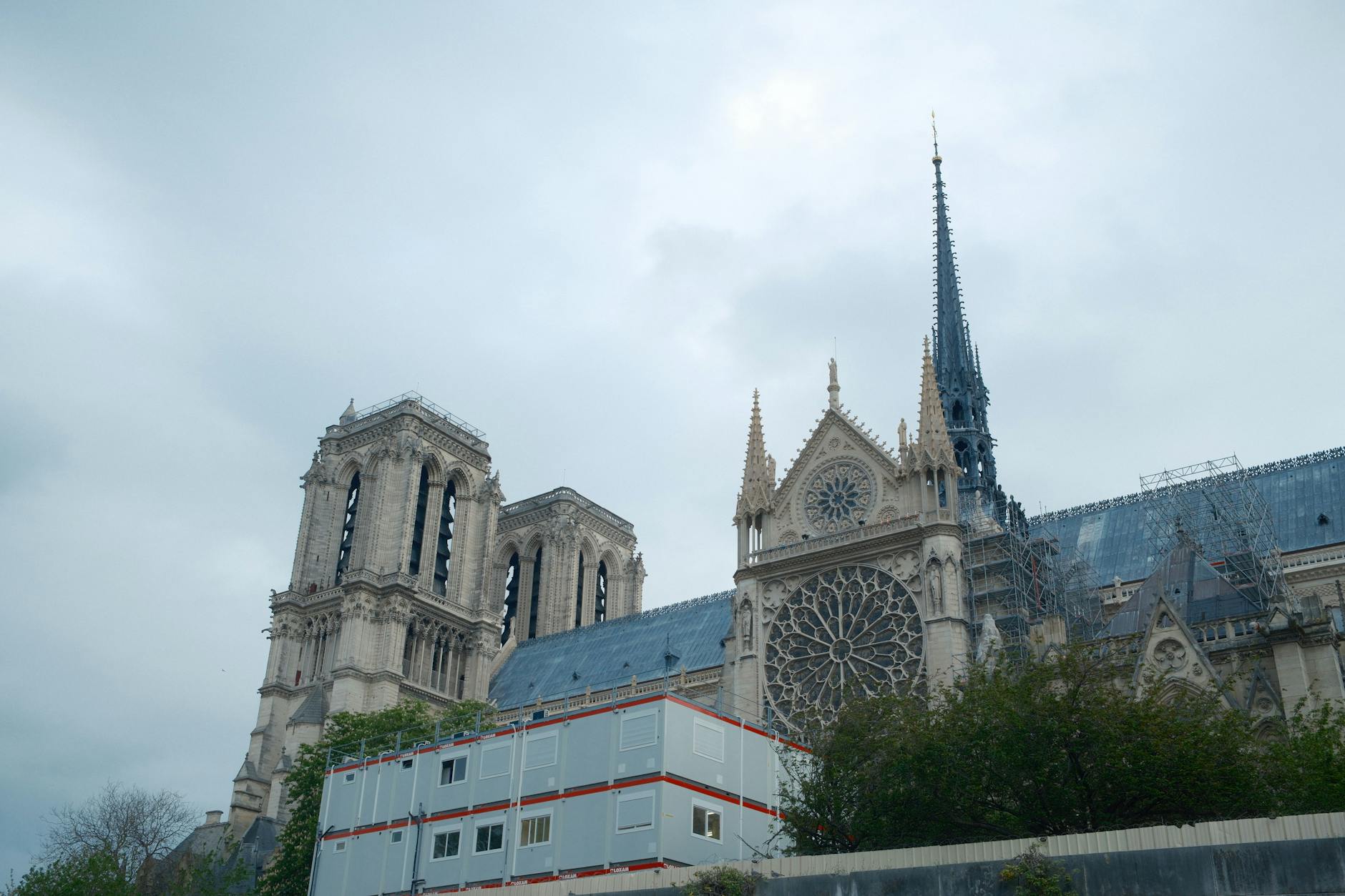
The public doors opened on December 8, 2024, the day after the inaugural Mass and state ceremony on December 7. Anyone who saw Paris between April 2019 and late 2024 got the construction version: a boarded-up parvis, bare front towers, scaffolding piled over the apse, and that thick blue fence ringing the whole island. None of it is there anymore. The cathedral is open, free to enter, and it does not match the photos in older guidebooks.
What hits returning visitors first is the light. Centuries of soot, candle smoke and coal dust had stained the limestone a dark grey-brown, and most people never realised how much that dimmed the place until restorers scrubbed every interior surface. The walls are now their original pale gold Lutétien limestone. The 13th-century vault paint, deep blue scattered with gold stars, is back above the choir. The 18th-century gilding on the choir screen and side chapels catches the eye again, and the stained glass was cleaned one pane at a time. Come on a sunny morning and the nave fills with coloured light from windows you used to only half-notice.
The new oak spire went up in December 2023, a faithful copy of Viollet-le-Duc’s 96-metre design from 1859. It carries the original golden cockerel weather-vane, which fell during the fire and turned up intact in the rubble, now refilled with fresh relics: a fragment of the Crown of Thorns, relics of Saint Geneviève and Saint Denis, and a parchment listing all 2,000 restoration workers by name. From the parvis the silhouette is indistinguishable from pre-fire photographs. Only the new lead sheathing gives it away, catching a fresher gleam than the rest.
Inside, Pierre Bernard’s new liturgical furnishings, unveiled at the reopening, replaced the entire pre-fire set: a bronze altar, a bronze ambo, a bronze baptistery, a bronze cathedra (the bishop’s chair), and a reliquary for the Crown of Thorns. They are unmistakably contemporary, yet they settle in next to the medieval stone better than you would expect. Locals are split on them. Most visitors, though, find them far less jarring in person than they looked in the press photos.
Then there is the organ. Eight thousand pipes, the second-largest instrument in France after Saint-Sulpice, taken apart entirely, cleaned of the lead dust the fire spread everywhere, and rebuilt. The work wrapped up in November 2024, and the organ was blessed at the reopening. You can catch it at Mass, at vespers, and at the free organ recitals on the first Friday of every month.
One thing has not come back: the tower climb. As of early 2026 you cannot go up the north or south tower, see the Gallery of Chimeras, or visit the Emmanuel Bell. The Centre des Monuments Nationaux is aiming for a mid-2026 reopening. There is a full section on this below, including what to expect once access returns.
The last big change is the most useful one for a visit: a free timed-reservation system. You can still simply walk up, but the queue routinely runs 60 to 90 minutes in summer. Booking a slot through the official “Notre-Dame de Paris” app or notredamedeparis.fr takes about 30 seconds and sends you down a separate lane that barely stops moving. If you remember one tip for 2026, make it that one.
The Fire and the Restoration: A Brief Story
It started at 6:18 p.m. on Monday, April 15, 2019, the first day of Holy Week, when fire alarms went off inside Notre-Dame. A roof renovation was underway, and investigators eventually settled on two likely causes: an electrical short or a discarded cigarette in the work zone. No definitive verdict was ever published. By the time firefighters reached the attic, the medieval timber forêt was already burning hard. At 7:50 p.m. the spire toppled on live television, punched through the stone vault, and set the choir alight. Parisians lined the Seine and the bridges and sang hymns into the night.
A handful of decisions saved the building. The 400 sapeurs-pompiers of the Brigade des sapeurs-pompiers de Paris fought from inside the towers and chose to defend the north belfry over the spire, a call that almost certainly stopped a total collapse. The stone vault mostly held and caught most of the molten lead pouring off the roof. The two great front towers, the west facade, and all three medieval rose windows came through intact. What was lost was the wooden “forêt” (more than 1,300 oak beams, some over 800 years old), the 19th-century spire, and the lead roof, which melted straight onto the cathedral floor.
The money came almost immediately. Within a week, pledges topped €840 million, with the Pinault, Arnault and Bettencourt-Meyers families putting in more than €500 million between them. President Emmanuel Macron promised the cathedral would reopen in five years, a deadline most experts wrote off as fantasy. They were wrong.
Roughly 250 companies and 2,000 craftspeople did the work. Charpentiers cut traditional mortise-and-tenon joints with hand axes. Vitraillistes restored stained glass pane by pane in workshops scattered across France. Sculpteurs sur pierre carved replacement gargoyles and finials. About 8,000 oak trees, most of them donated from state forests, were felled to rebuild the forêt as it had stood in the 13th century. The new truss is structurally identical to the medieval one; only the metal connectors are modern.
The reopening on December 7 and 8, 2024 was the biggest French state occasion in decades. Macron spoke inside the nave, the Archbishop of Paris re-consecrated the cathedral, and the great organ was woken with a liturgical dialogue. More than 40 heads of state showed up, among them U.S. President-elect Donald Trump, Ukrainian President Volodymyr Zelenskyy, and most of Europe’s royals and government leaders. The next day the doors opened to everyone else.
How to Visit: Free Entry, Reservations, and Hours
Notre-Dame is still exactly what it has always been: a working Catholic cathedral. The nave is free and you need no ticket to go in. What changed is sheer volume, with 30,000-plus people on a busy summer day, and that crush is the whole reason the timed-reservation system exists.
| Visit element | 2026 status | Cost | Reservation |
|---|---|---|---|
| Nave / interior | Open | Free | Optional but strongly recommended |
| Tower climb | Closed (reopens mid-2026) | €13 (when open) | Required when reopened |
| Treasury | Open | €10 | On-site, not required |
| Crypte Archéologique | Open Tue–Sun | €9 | Optional |
| Mass attendance | Open to all | Free | Major feast days only |
Reservations: grab a free timed slot through the official “Notre-Dame de Paris” app or notredamedeparis.fr. Slots open up to two days ahead, with more batches dropped the morning of your visit. If a date reads as full, refresh it around 8 a.m. local time. A reservation puts you in a dedicated lane that usually clears in under 10 minutes.
Walk-up queue: still here for anyone without a slot. Reckon on 60 to 90 minutes in summer and 30 to 45 in winter and shoulder season. It forms on the parvis and zig-zags toward the south tower entrance.
Hours: roughly 7:45 a.m. to 7 p.m. Monday through Friday, and 8:15 a.m. to 7:30 p.m. on Saturday and Sunday. The cathedral closes to non-worshippers for short stretches during Mass, though you are welcome to join the service. Feast days can shift the schedule, so check the official site the day before.
Best times to go: the 8 a.m. opening, when the place is nearly empty and the morning light is soft. Failing that, the final hour before closing is excellent; the warm evening light through the south transept around 6:30 p.m. in summer is the kind of thing people travel for. Steer clear of weekend midday and any major Catholic feast day, unless attending Mass is the point.
Tower climb: closed as of early 2026. When it reopens, expect €13 with timed entry run by the Centre des Monuments Nationaux through monuments-nationaux.fr. The target is mid-2026.
Crypte Archéologique: the underground archaeological crypt beneath the parvis is a separate site run by Paris Musées. Entry is €9 (free on the first Sunday of the month and for under-18 EU residents), and it has fully reopened. More on it below.
What to See Inside Notre-Dame: Highlights Tour
Give yourself 45 to 75 minutes inside for the highlights, more if you add the Treasury. The natural route is the pilgrim one: down the right (south) aisle, around the ambulatory behind the choir, and back up the left (north) aisle. Here is what to look for, in the order you will meet it.
The Nave
You come in under the west rose window into a vaulted space 35 metres high, the piece of medieval engineering that more or less invented Gothic architecture. Look up. The restored blue paint with gold stars across the high vaults recreates the 13th-century decoration that turned up under later layers. The pointed arches and the thin colonettes pull your eye straight up, which is exactly what the original builders were after.
Crown of Thorns
The cathedral’s most precious relic came home in 2024 after sitting out the restoration safely at the Louvre. The Crown of Thorns, said to be the wreath placed on Christ’s head during the Passion, is venerated publicly on the first Friday of every month at 3 p.m., every Friday during Lent, and on Good Friday. The rest of the time it stays in the Treasury.
Rose Windows
All three monumental rose windows survived the fire: the West Rose (c. 1220s), the North Rose (c. 1250s) and the South Rose (c. 1260s). For photos, the South Rose wins. At solar noon on a clear day, light pours through 84 separate panels and throws red and blue across the south transept floor. The North Rose, with its Old Testament prophets and the Virgin, is the best preserved of the three and holds the most original 13th-century glass anywhere in France.
The Great Organ
Mounted above the west door, the grand orgue runs 8,000 pipes across five keyboards and ranks second in France only to Saint-Sulpice. Restoration finished in November 2024 after every pipe was cleaned of lead dust by hand. Olivier Latry is still one of the titular organists. You will hear the instrument at every Mass and at the first-Friday recitals each month.
The Choir and Stone Screen
The choir goes back to the 13th century, wrapped in a 14th-century stone screen carved with scenes from the Gospels. The Renaissance choir stalls and the marble pavement were brought back to their pre-fire state. Take the ambulatory behind the high altar slowly. The small-scale carvings on the screen are easy to walk past, but they pay you back for stopping.
The Pieta of Nicolas Coustou
Behind the high altar stands the 17th-century Pietà by Nicolas Coustou, finished in 1723, commissioned by Louis XIII as part of his vow to dedicate France to the Virgin Mary. Coustou’s kneeling statues of Louis XIII and Louis XIV flank it. The marble came through the fire untouched.
Treasury
The Treasury (Trésor) is a separate room off the south side of the choir, €10 to enter, and well worth it. Inside: the Crown of Thorns reliquary (a contemporary piece by Sylvain Dubuisson), a fragment of the True Cross, the Holy Nail, sacred vessels, episcopal vestments, and a small display of post-fire restoration objects, including the original golden cockerel that sat atop the spire.
Choir Pulpit
The restored 19th-century pulpit is a Viollet-le-Duc piece, finely cut stone reached by a winding staircase. It came through the fire untouched.
Stained Glass Beyond the Roses
Most people give the three rose windows all their attention and miss the rest. Look at the lancet windows along the north aisle. A few of them hold 13th-century original glass, and you can pick it out from the later replacements by its deeper, more irregular blue.
New Liturgical Furnishings
Pierre Bernard’s bronze altar, ambo, baptistery, and cathedra were unveiled at the December 2024 reopening and sit at the crossing of the transept. Critics predicted a clash before they went in. In the room, the warm dark bronze reads as deliberately modern but understated, and it sits more gently with the building than the slick studio photos led anyone to believe.
Mass and Services: How to Attend
Notre-Dame is the cathedral of the Archdiocese of Paris, and full liturgy started up again the moment it reopened. You are welcome at Mass no matter your faith; you just take a quiet seat in the nave or the choir-side pews. Ordinary weekday and Sunday Masses need no ticket and no reservation.
- Weekday Mass (Monday–Friday): 9 a.m., 12 noon, 6:15 p.m.
- Saturday Mass: 12 noon and 6:30 p.m. anticipated Sunday Mass.
- Sunday Mass: 8:30 a.m. (low), 10 a.m. (Latin with Gregorian chant), 11:30 a.m. (sung), 6:30 p.m.
- Vespers: sung evening prayer at 5:45 p.m. daily.
- Confessions: available daily; check the schedule posted near the south transept.
Turn up 15 minutes early for Mass if you want a seat. The 10 a.m. Sunday Latin Mass with Gregorian chant is the atmospheric one, and the favourite among non-French speakers, because the Latin liturgy stays familiar no matter your language. The cathedral choir, the Maîtrise de Notre-Dame, sings at the 11:30 a.m. Sunday Mass.
For the big feast days, Christmas Eve Midnight Mass, the Easter Vigil, Pentecost, the Assumption on August 15, and All Saints’ Day, you have to reserve a seat in advance through the cathedral website, and those fill within hours of release.
There is also a sacred concert season worth knowing about. The organ recitals on the first Friday evening of each month are free and need no reservation. Choral concerts during Advent and Lent are ticketed through the Musique Sacrée à Notre-Dame de Paris association.
The Tower Climb: Status and What to Expect When It Reopens
The tower climb has been shut without a break since the 2019 fire. The Centre des Monuments Nationaux (CMN) runs the towers as a separate ticketed monument, and it has pointed to a mid-2026 reopening, though the exact date keeps slipping. Look at monuments-nationaux.fr for the official word before you count on going up.
When it is open, the climb is one of the best things you can do in Paris. It is a 422-step spiral staircase up the north tower to a platform 70 metres high. Tickets will run €13 (the pre-fire price) with timed entry, and there should also be a €25 combination ticket bundling the Notre-Dame towers with Sainte-Chapelle and the Conciergerie through Paris Musées.
The payoffs on the way up: the Gallery of Chimeras, the walkway where Quasimodo crouched in Hugo’s Notre-Dame de Paris (1831). The chimeras are 19th-century additions by Viollet-le-Duc rather than medieval, but you would know them anywhere. Then the Emmanuel Bell in the south tower, cast in 1681, weighing 13 tonnes, and still rung by hand on major feast days. And finally the open platform, with the Île de la Cité, the Seine, and the rooftops of central Paris laid out below.
Worth knowing before you commit: the tower climb is not wheelchair accessible. The staircase is narrow, steep, and elevator-free. Children should be over 6 and fine with heights and tight spaces.
Crypte Archéologique: The Hidden Layer Below
Under the parvis, the square in front of the west facade, sits a 2,000-square-metre archaeological crypt that most visitors stroll right over. Entry is €9 (free for under-18 EU residents and on the first Sunday of the month), open Tuesday to Sunday, 10 a.m. to 6 p.m., closed Mondays.
The crypt holds layered ruins turned up during 1965 excavations for a parking garage: the Gallo-Roman city wall of Lutetia (1st century), Merovingian-era foundations, medieval house cellars from the early Christian quarter, 18th-century cellars from the Enfants-Trouvés orphanage, and the 19th-century sewers Haussmann laid. Nowhere else in Paris lets you walk through 2,000 years of foundations in one unbroken archaeological space.
Budget 30 to 45 minutes. The site is compact, the lighting low and atmospheric, and the signage runs in both French and English. The Crypte Archéologique pairs especially well with the Musée Carnavalet over in the Marais if you want to take Paris history in chronological order.
Best Photo Spots & Vantage Points
You can photograph Notre-Dame from almost anywhere, but a few spots beat the rest reliably. Most are a five-minute walk apart, and with a cruise ticket you can also shoot it from the water.
- Pont de l’Archevêché (south side) — the classic angle on the apse and flying buttresses. Best in late-afternoon light.
- Square Jean-XXIII (directly behind the cathedral) — a small public garden with a rare ground-level rear view, free and rarely crowded.
- Pont de la Tournelle (south, further east) — the bridge carries a statue of Sainte Geneviève facing the cathedral, and you get the postcard side angle from here.
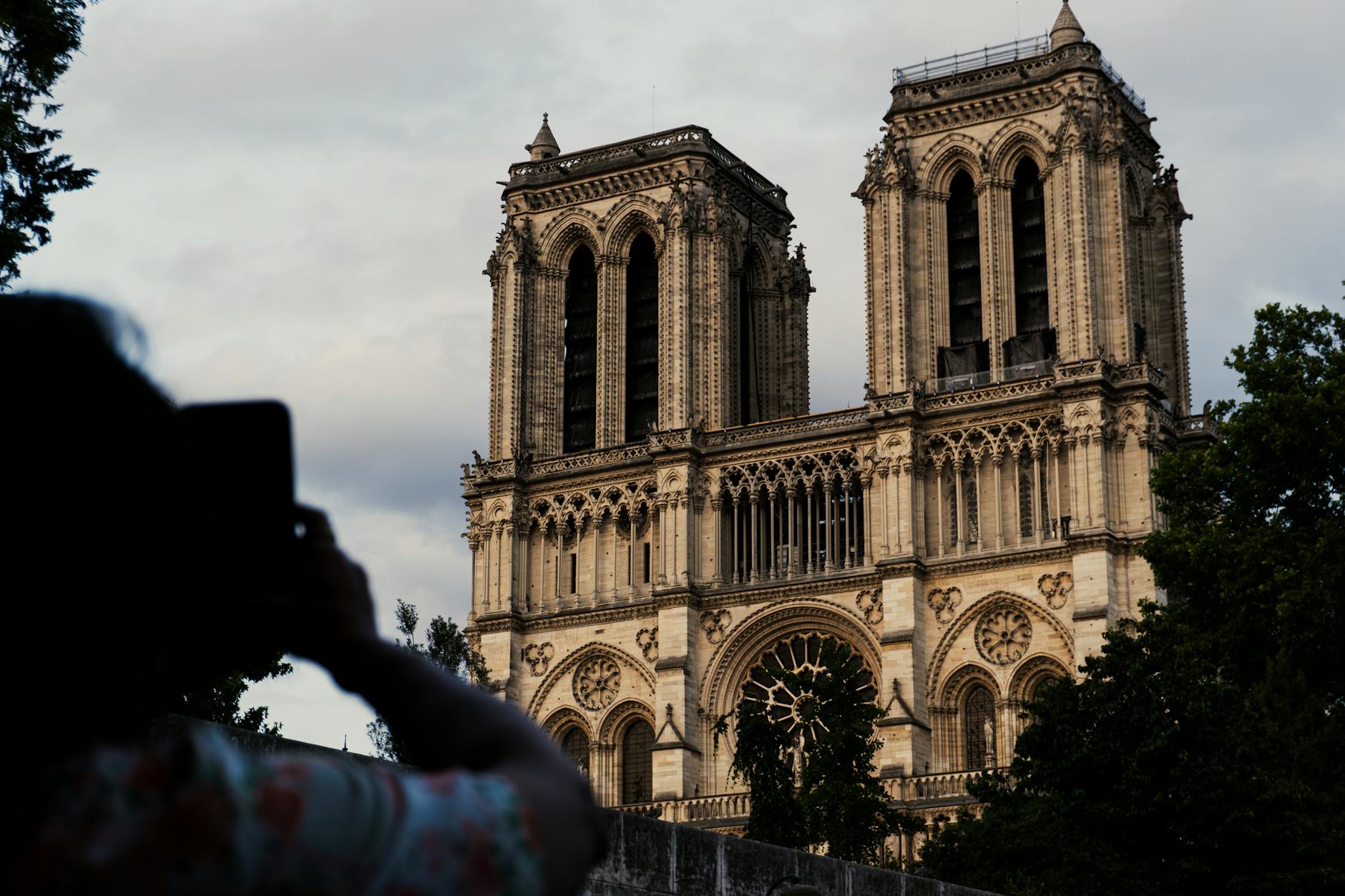
- Pont au Double (north side) — the frontal towers view, the easiest classic shot for a first visit.
- Quai de Montebello (Left Bank, opposite the front) — the broad south panorama, river in the foreground.
- Pont Saint-Michel — a west-angle composition with the Latin Quarter rooftops layering in behind.
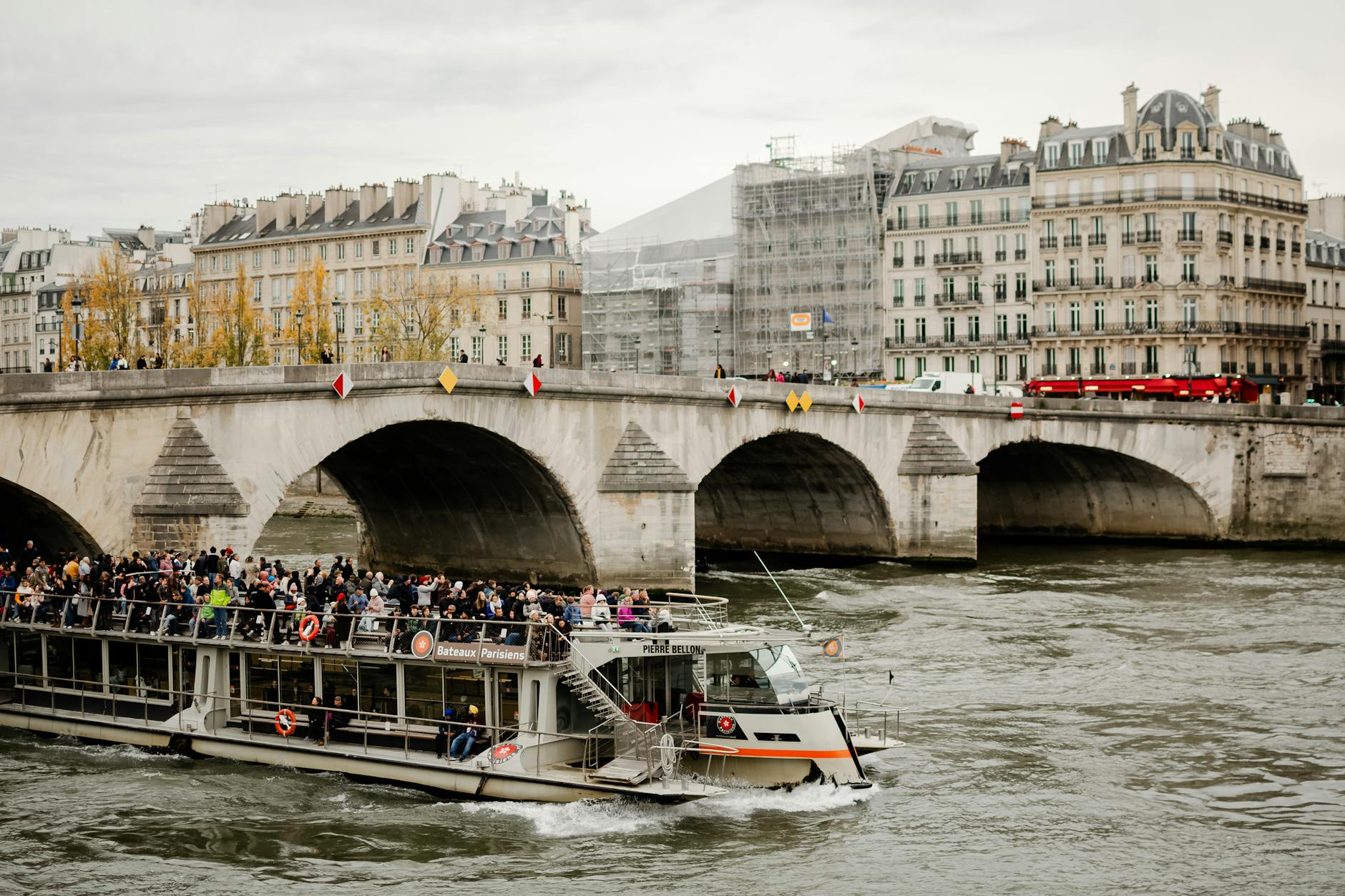
- From the river on a Seine river cruise — water-level angles you simply cannot get any other way.
- Square du Vert-Galant — the tip of the Île de la Cité, looking back upstream toward the cathedral at sunset.
One tip on light: the golden hour starts about 90 minutes before sunset, and the limestone across the west facade goes warm gold. The blue hour, roughly 30 minutes after sunset, is when the exterior floodlights come on and the deep blue sky plays off the lit stone. For vantage points across the rest of the city, see our Paris photo spots guide.
Before the fire, the best photo location in the entire city was the tower platform itself, looking out over the Seine. Once the towers reopen in mid-2026, it goes straight back on that list. Until then, work the bridges.
Notre-Dame’s History: 850+ Years
Building started in 1163 under Bishop Maurice de Sully, on the site of an earlier Romanesque cathedral, which itself sat over a 4th-century Christian basilica that had replaced a Gallo-Roman temple to Jupiter. Pope Alexander III was present when the first stone was laid. The nave was largely done by 1200, the west facade and towers by 1245, and the cathedral substantially finished by 1260, with smaller works dragging on into the 14th century.
On December 2, 1804, Pope Pius VII consecrated Napoleon Bonaparte as Emperor of the French inside Notre-Dame, the scene Jacques-Louis David later spread across an entire wall of the Louvre. It is probably the single most consequential ceremony the building has ever hosted. It also marked the cathedral’s return to use after the French Revolution had stripped its statues, beheaded the 28 kings on the west facade (Revolutionary mobs took them for kings of France rather than kings of Judah), and briefly turned the place into a Temple of Reason.
By the 1830s the cathedral was falling apart. Victor Hugo’s 1831 novel Notre-Dame de Paris (you may know it as The Hunchback of Notre-Dame) set off a national restoration campaign. Architect Eugène Viollet-le-Duc ran the work from 1844 to 1864, adding the spire, carving the gargoyles and chimeras of the upper galleries, restoring the west facade statues, and shoring up the flying buttresses. Most of what people photograph as “medieval Notre-Dame” is actually a 19th-century Gothic Revival reconstruction laid over genuine 12th- and 13th-century structure.
On August 26, 1944, General Charles de Gaulle attended a Mass of thanksgiving inside Notre-Dame the day after the Liberation of Paris. Sniper fire reportedly broke out in the cathedral, and de Gaulle refused to duck. In the decades since, the building has held state funerals (Charles de Gaulle, Georges Pompidou, François Mitterrand), papal visits, and Catholic World Youth Day events.
And then April 15, 2019. It was the most consequential thing to happen to the building since the 1804 coronation. The reopening on December 8, 2024 closed that chapter and started another: the first Notre-Dame of the 21st century.
What’s Around Notre-Dame: Île de la Cité & Île Saint-Louis
Notre-Dame stands on the Île de la Cité, the original Paris, the small Seine island where the Parisii tribe settled in the 3rd century BC and the Romans built Lutetia. You can cover most of it, plus the neighbouring Île Saint-Louis, in a single afternoon. Here is a half-day loop to tack onto your cathedral visit.
- Sainte-Chapelle — a 5-minute walk west, €13 (€19 combo with the Conciergerie). The 13th-century stained-glass chapel Louis IX built to house the Crown of Thorns before it moved to Notre-Dame.
- Conciergerie — right beside Sainte-Chapelle, €13. The medieval royal palace that became a Revolutionary prison; Marie Antoinette was held in a cell here before her execution.
- Mémorial des Martyrs de la Déportation — at the tip of the Île directly behind Notre-Dame, free. A deliberately claustrophobic Holocaust memorial to the 200,000 French deportees who died in Nazi camps.
- Square Jean XXIII — the gardens right behind the cathedral, free, with the best rear view.
- Square du Vert-Galant — the western tip of the Île de la Cité, a small park at river level under the Pont Neuf, a classic Paris sunset spot.
- Île Saint-Louis — the next island over, smaller and quieter. Berthillon (#31 Rue Saint-Louis-en-l’Île) is the legendary ice-cream maker, and the island is a parade of 17th-century hôtels particuliers (private mansions).
- Pont Saint-Louis — the pedestrian bridge between the two islands, where there are nearly always street musicians.
- Shakespeare and Company — 37 Rue de la Bûcherie, just over the south bridge. The English-language bookshop that has anchored the Left Bank since 1951.
- Café Saint-Régis — 6 Rue Jean-du-Bellay on the Île Saint-Louis. A reliable corner café that locals actually use, and a sensible lunch stop after the cathedral.
For how the Right Bank and Left Bank fit together around these islands, see our Paris neighborhoods guide.
Practical Tips & Etiquette
This is an active cathedral, not a museum, and the bar for visitor behaviour sits higher than at most Paris monuments. The essentials:
- Dress modestly. Shoulders and knees covered. In summer that means no shorts, tank tops, or short skirts. A scarf or light shawl solves it.
- Stay quiet. Whisper inside the nave, and say nothing at all during Mass.
- No photography during Mass. Outside services it is allowed, but no flash and no tripods.
- Bag check. Every bag goes through X-ray at the entrance. Large suitcases and oversized backpacks are not allowed.
- Wheelchair access. The nave is fully accessible via a ramp at the south entrance. The tower climb is not.
- Restrooms. There is a small WC inside near the entrance, plus free public toilets behind the cathedral in Square Jean XXIII.
- Candles. €2 suggested donation per votive candle, with stands in several of the side chapels.
- Donations. Welcome but never required. Entry is free and will stay that way.
Frequently Asked Questions
Is Notre-Dame open to visitors in 2026?
Yes. Notre-Dame reopened to the public on December 8, 2024 and is open daily to visitors and worshippers in 2026. The interior, the Treasury, and the Crypte Archéologique are all fully open. The one thing still closed is the tower climb, due back mid-2026.
Do you need a ticket to enter Notre-Dame?
No. The nave is free and no ticket is required. That said, a free timed reservation through the “Notre-Dame de Paris” app or notredamedeparis.fr is strongly recommended, because it puts you in a separate priority lane and spares you the usual 60 to 90 minute walk-up queue. You can book up to two days ahead, with more slots released the morning of your visit.
Can you climb the Notre-Dame towers in 2026?
Not yet. The tower climb has been closed since the 2019 fire and is still closed as of early 2026. The Centre des Monuments Nationaux has signalled a mid-2026 reopening, with entry likely €13 and timed reservations through monuments-nationaux.fr. Check the official site for the latest date before you assume you can go up.
How long does it take to visit Notre-Dame?
Allow 45 to 75 minutes for the nave, side chapels, ambulatory and rose windows. Add 30 minutes for the Treasury (€10), and another 30 to 45 for the Crypte Archéologique under the parvis. All three together come to roughly 2 to 2.5 hours. Tack on at least 30 minutes for the walk-up queue if you have no reservation.
When did Notre-Dame reopen after the fire?
December 8, 2024, exactly 5 years and 7 months after the April 15, 2019 fire. The state inaugural ceremony took place on December 7 with President Emmanuel Macron and more than 40 heads of state present, and the doors opened to the public the next day.
What was destroyed in the Notre-Dame fire?
The April 15, 2019 fire destroyed the 96-metre 19th-century oak-and-lead spire (by Viollet-le-Duc), most of the medieval timber roof frame known as la forêt (more than 1,300 oak beams, some 800-plus years old), and the lead roof itself, which melted onto the stone vault below. The three great rose windows, the two front towers, the great organ, and most of the medieval stone structure were saved by firefighters. The Crown of Thorns and most of the Treasury were evacuated during the fire.
Can you attend Mass at Notre-Dame?
Yes, and you are welcome regardless of religious affiliation. Daily Masses run at 9 a.m., noon, and 6:15 p.m. Monday to Friday. Sunday Masses are at 8:30 a.m., 10 a.m. (Latin with Gregorian chant), 11:30 a.m. (sung), and 6:30 p.m. Vespers is sung at 5:45 p.m. daily. For Christmas Eve, the Easter Vigil, and other major feasts you must reserve a seat ahead through the cathedral website.
Is Notre-Dame wheelchair accessible?
The nave is fully wheelchair accessible via a ramp at the south side entrance, and the main floor is level throughout. The Treasury is accessible too. The Crypte Archéologique is partially accessible with assistance. The tower climb is not accessible at all; it is a 422-step spiral staircase with no elevator.
Plan the Rest of Your Paris Visit
Notre-Dame is one of nine major landmarks in our Paris landmarks guide. The obvious pairing is the nearby Sainte-Chapelle and Conciergerie, which together make a complete Île de la Cité morning. Elsewhere in the city, see our guides to the Eiffel Tower, the Louvre, Sacré-Coeur and Montmartre, the Arc de Triomphe, the Panthéon, the Paris Catacombs, Versailles, and Disneyland Paris. For a stranger take on the city, try our unique things to do in Paris guide. And for the view that no bridge can match, book a Seine river cruise at dusk: the cathedral floodlit from the water is the kind of Paris memory that sticks.
Plan the rest of your trip
Use these to round out your trip: