Père Lachaise Cemetery: Graves to Find and How to Navigate It
Seventy thousand tombs on a hill, and a route that finds the ones you came for without the climb.
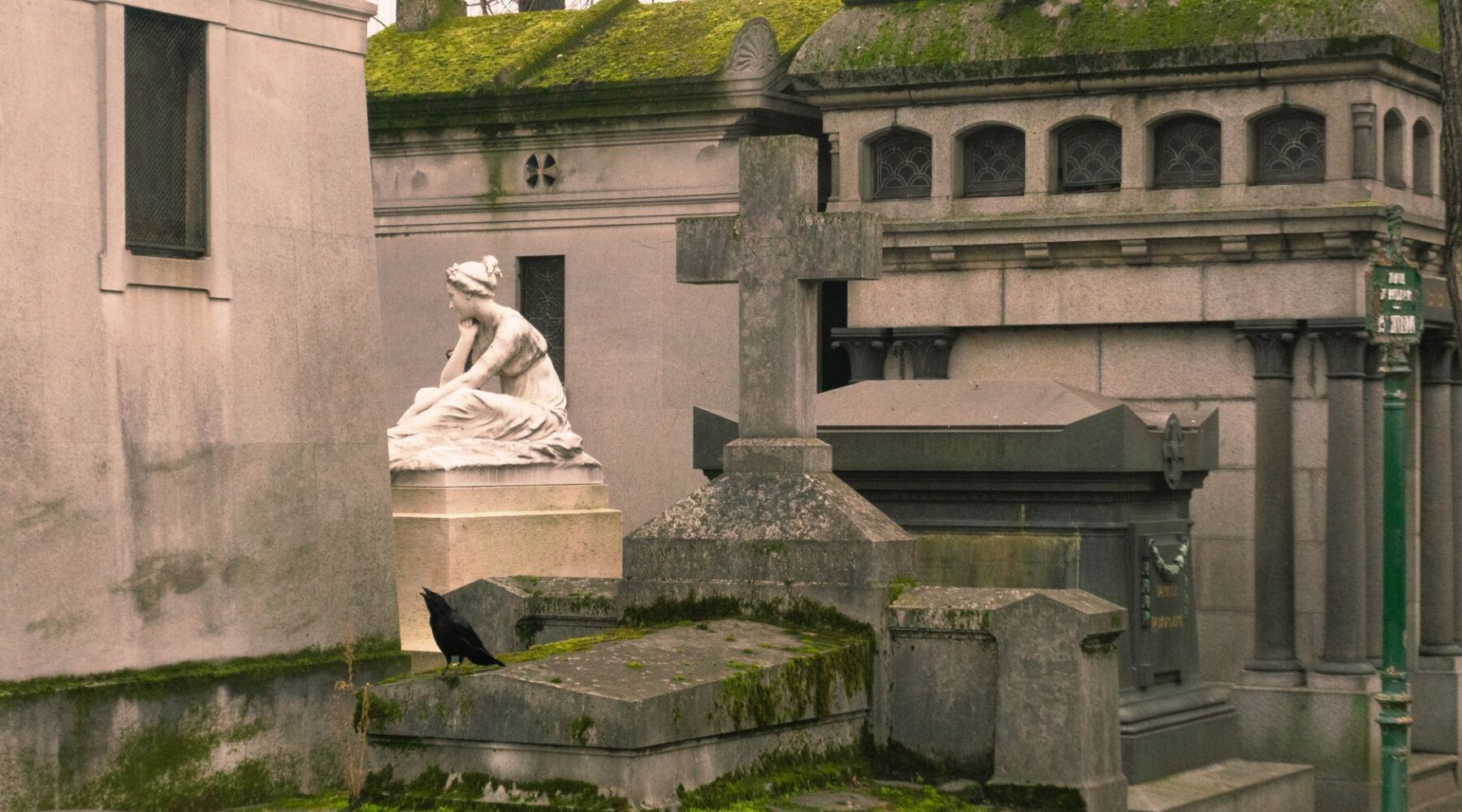
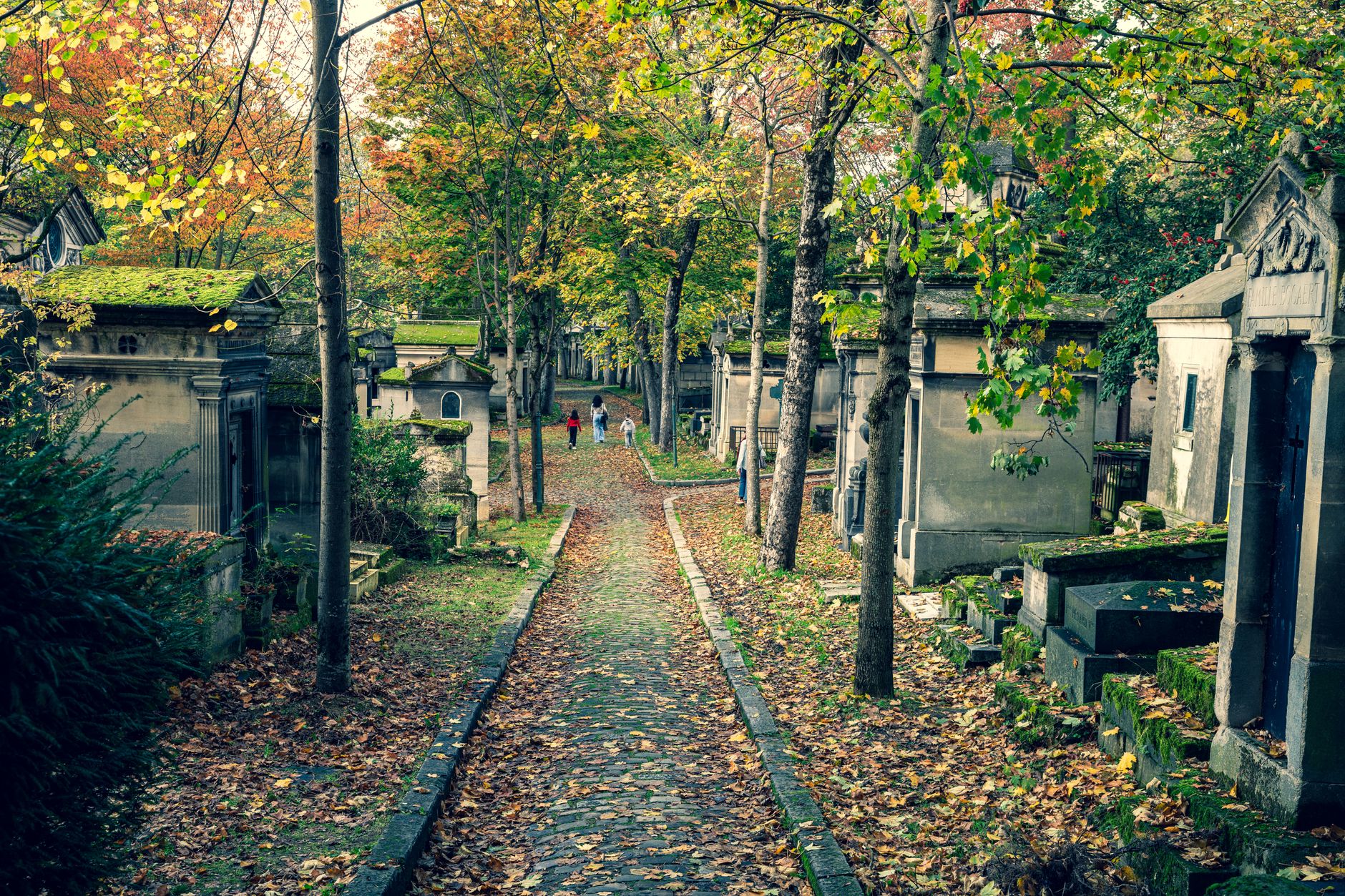
Père Lachaise is not a flat lawn of headstones. It’s a steep, wooded hillside of cobbled lanes, moss-green chapels, broken columns and weeping stone angels, with cats sunning themselves on the tombs of marshals and poets. People come for Jim Morrison and Oscar Wilde and end up wandering for three hours without finding either, which is not a bad outcome. This pere lachaise cemetery guide will help you do better than that: which graves are worth tracking down and exactly where they are, a route that avoids the worst of the uphill climbing, and how to visit respectfully in a cemetery where funerals still take place every week.
Below you’ll find the practical basics, a short history, the famous graves by division number, two walking routes, the memorials that most visitors walk straight past, and our honest view of which “must-see” graves are a disappointment. Hours were checked with the City of Paris in September 2026. Entry is free.
Père Lachaise at a glance
| What | Details |
|---|---|
| Entry | Free, every day of the year |
| Hours, mid-March to early November | Monday–Friday 8am–6pm; Saturday 8.30am–6pm; Sunday and public holidays 9am–6pm |
| Hours, winter | Same opening times, closing at 5.30pm |
| Main entrance | Boulevard de Ménilmontant, opposite the Rue de la Roquette |
| Metro | Philippe Auguste (2) for the main gate; Père Lachaise (2, 3) for the western side; Gambetta (3) for the top gate |
| Size | About 44 hectares, divided into 97 numbered divisions |
| Time needed | 2 hours for the headline graves; half a day to explore |
| Arrondissement | 20th |
The last entry is shortly before closing time, and wardens start moving people towards the gates about 15 minutes ahead. Hours can change for weather or official ceremonies, so check the posted times at the gate.
A short history: the cemetery that needed celebrities
By the end of the 18th century, the parish cemeteries in the centre of Paris were overflowing and unsanitary; the bones from several of them ended up in the tunnels we now call the Catacombs. Napoleon’s administration ordered new cemeteries to be built outside the city, and the first to open, in 1804, was the Cimetière de l’Est on a hillside east of Paris. The land had once belonged to the Jesuits, and the house there had been used by François d’Aix de La Chaise, known as Père La Chaise, the confessor of Louis XIV. The name stuck.
At first, nobody wanted to be buried there. It was a long way from the city and had no religious associations. So, in a piece of early 19th-century marketing, the authorities moved in some famous residents: the remains attributed to the playwright Molière and the fabulist Jean de La Fontaine, and then the medieval lovers Abélard and Héloïse, all transferred with great ceremony. It worked. Within a few decades Père Lachaise was the most fashionable place in Paris to spend eternity, and the cemetery had to be expanded several times.
Today it holds around 70,000 burial plots and a columbarium, and it’s the most visited cemetery in the world, with millions of visitors a year. It’s still a working cemetery, though new plots are very rare and usually go to families who already own one.
Before you go: how to navigate
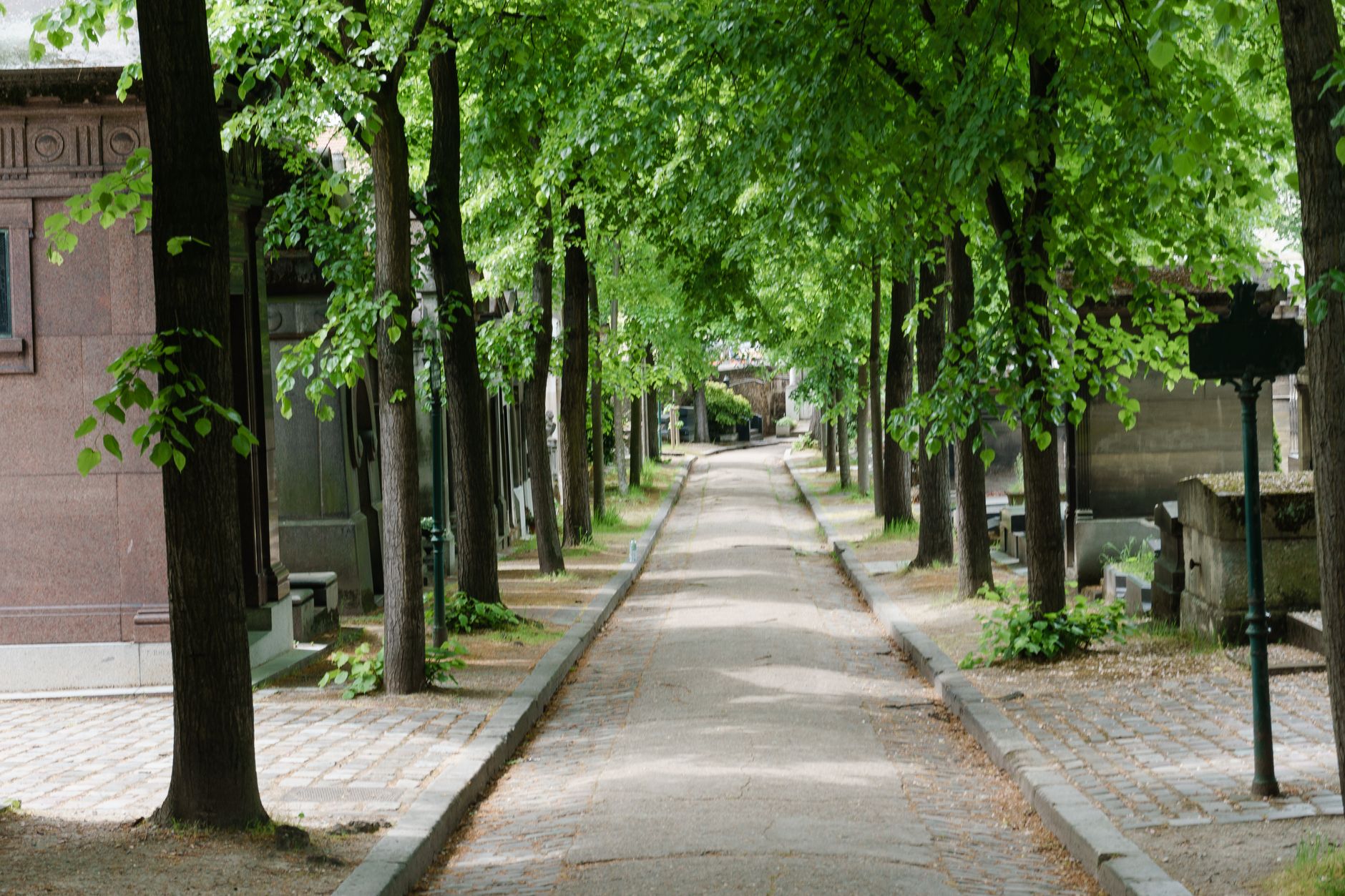
Père Lachaise is confusing. The layout follows the hill rather than a grid, lanes curve and fork, and many tombs are hidden two or three rows back from the path. A little preparation makes a big difference.
Understand the divisions
The cemetery is split into 97 numbered divisions. Every grave list, map and guide refers to them, and at many junctions you’ll find small signs giving the division numbers and the names of the avenues. Once you know that Chopin is in division 11 and Oscar Wilde in division 89, you can navigate from sign to sign rather than trying to follow a map in detail.
Get a map
Maps of the cemetery are posted on boards at the main entrances, and the City of Paris publishes one online. Download or screenshot a map before you arrive rather than relying on mobile data: signal can be weak among the trees and the tall tombs. Several free apps and websites also show grave locations on a map with GPS, which is the easiest way to find the smaller graves.
Choose your entrance carefully
The cemetery slopes steeply up from the main gate on the Boulevard de Ménilmontant (west) towards the Gambetta gate (east). If you want to avoid walking uphill, take the Metro to Gambetta, enter at the top and work your way down, finishing at the main gate. If you’re coming from the Marais or Bastille, the main gate is the natural start, but expect a climb.
Wear proper shoes
The lanes are cobbled, uneven and steep in places, and there are stairs in the older divisions. After rain, the cobbles and fallen leaves are slippery. It’s not a place for heels or flip-flops.
The famous graves and where to find them
Here are the graves most people come for, grouped by where they sit in the cemetery. Division numbers were checked in September 2026.
| Who | Known for | Division |
|---|---|---|
| Jim Morrison | Singer of The Doors | 6 |
| Abélard and Héloïse | Medieval lovers and scholars | 7 |
| Frédéric Chopin | Composer and pianist | 11 |
| Théodore Géricault | Painter of The Raft of the Medusa | 12 |
| Gioacchino Rossini (cenotaph), Baron Haussmann, Colette | Composer; planner of modern Paris; novelist | 4 |
| Camille Corot | Landscape painter | 24 |
| Molière and Jean de La Fontaine | Playwright; author of the Fables | 25 |
| Sarah Bernhardt, Yves Montand and Simone Signoret, Allan Kardec | Actress; actor and singer, actress; founder of Spiritism | 44 |
| Honoré de Balzac | Novelist | 48 |
| Eugène Delacroix | Painter | 49 |
| Georges Seurat | Pointillist painter | 66 |
| Georges Bizet | Composer of Carmen | 68 |
| Mur des Fédérés | Communards’ Wall | 76 |
| Marcel Proust | Novelist | 85 |
| Guillaume Apollinaire | Poet | 86 |
| Columbarium: Isadora Duncan, Richard Wright, a plaque for Maria Callas | Dancer; novelist; opera singer | 87 |
| Oscar Wilde | Writer and wit | 89 |
| Victor Noir | Journalist, and a famous bronze effigy | 92 |
| Gertrude Stein and Alice B. Toklas | Writer and her partner | 94 |
| Amedeo Modigliani | Painter | 96 |
| Édith Piaf | Singer | 97 |
Jim Morrison (division 6)
The singer of The Doors died in Paris in 1971, aged 27, and his grave has been a place of pilgrimage ever since. For decades it was covered in graffiti, bottles and candles, and the surrounding tombs were defaced so often that neighbouring families complained. Today the grave is fenced off with barriers a short distance away, and there is sometimes a guard. The marker itself is a plain flat stone with a small bronze plaque bearing a Greek inscription that roughly translates as “true to his own spirit”.
Honest verdict: for most people this is the most underwhelming stop in the cemetery. You’ll look at a modest slab from behind a barrier, among a crowd. If you’re a fan, go. If you’re not, don’t make it the centre of your visit.
Frédéric Chopin (division 11)
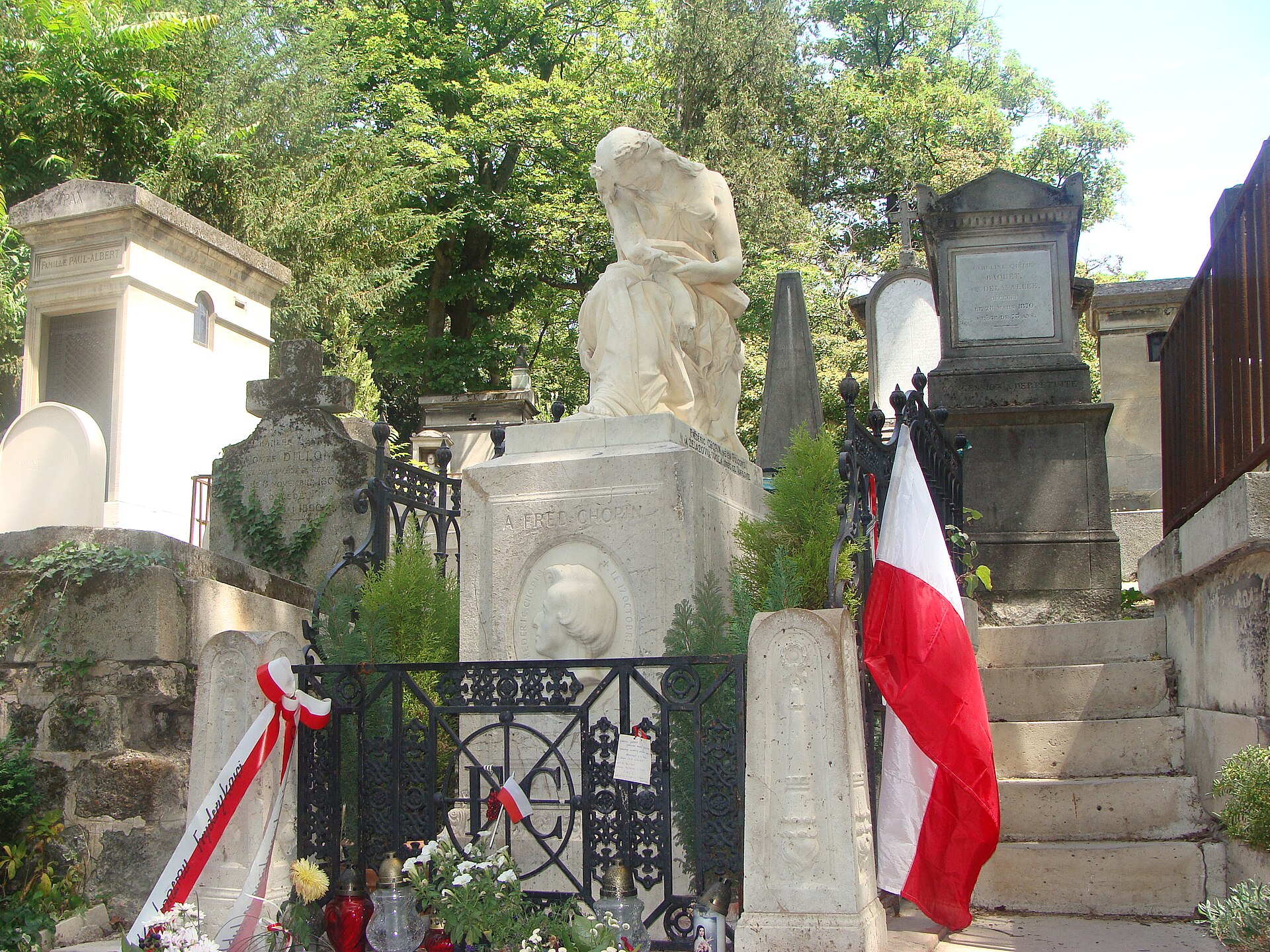
Chopin’s grave is one of the most beautiful in the cemetery, and always covered with fresh flowers, often in the red and white of the Polish flag. A marble muse of music weeps above a medallion portrait of the composer. His body is buried here, but at his request his heart was taken back to Warsaw, where it rests in the Church of the Holy Cross.
Abélard and Héloïse (division 7)
Not far from Morrison, a small Gothic Revival canopy shelters the tomb of Peter Abélard and Héloïse, the 12th-century philosopher and his brilliant student, whose love affair ended in scandal and in Abélard’s castration by Héloïse’s uncle. They spent the rest of their lives apart in religious orders, writing letters to each other that are still read today. Their supposed remains were brought here in 1817, and lovers have left notes at the tomb ever since.
Molière and La Fontaine (division 25)
The two tombs that launched the cemetery’s popularity stand close together. Whether the bones actually belong to Molière and La Fontaine is doubtful, but it doesn’t seem to matter to anyone.
Oscar Wilde (division 89)
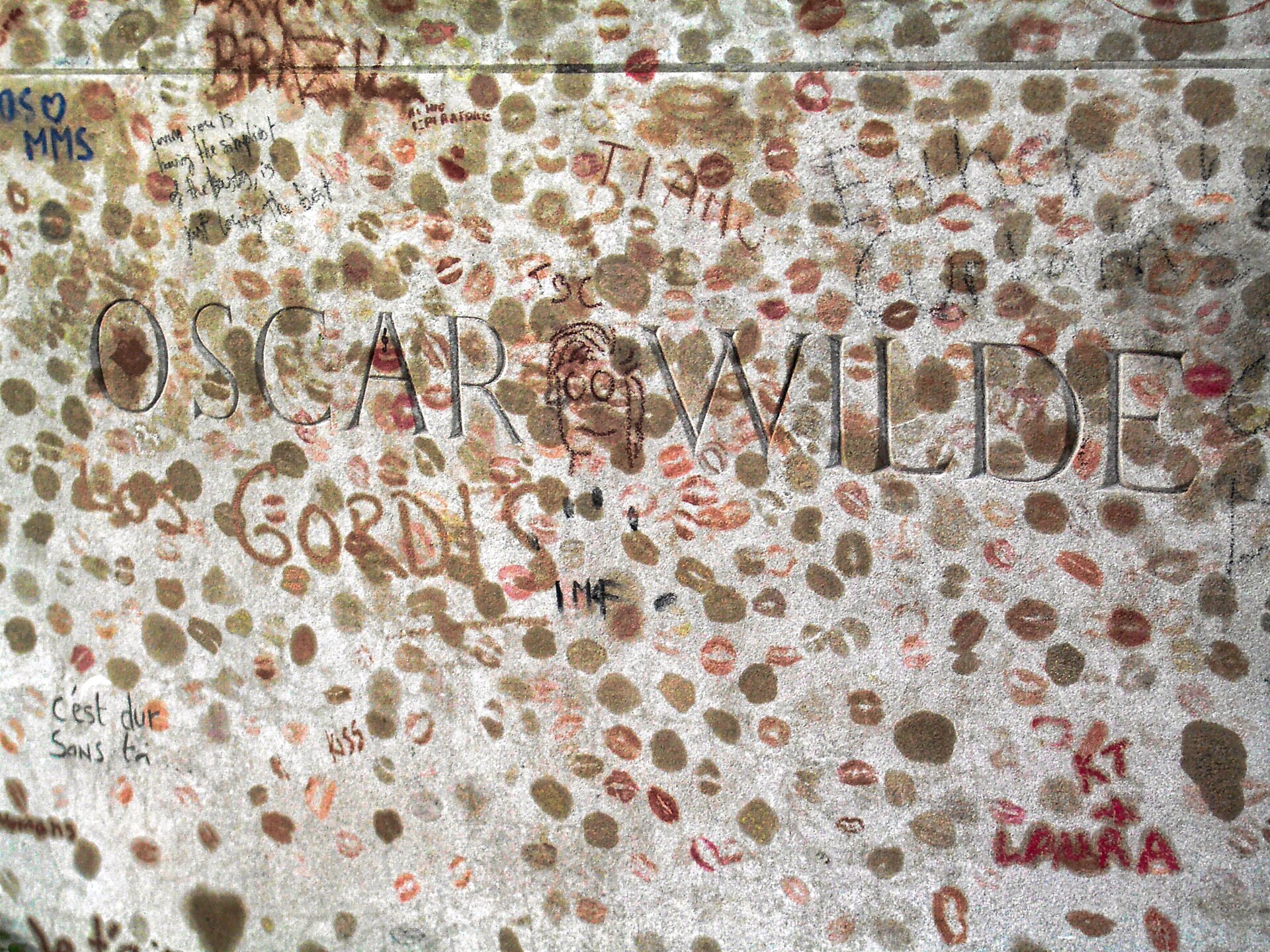
Wilde died in poverty in a Paris hotel in 1900 and was moved to Père Lachaise in 1909. His tomb is a remarkable modernist sculpture by Jacob Epstein, a winged figure flying forward in the manner of an Assyrian carving. For years fans covered the stone in lipstick kisses, and the grease damaged it. In 2011 the tomb was cleaned and a glass screen was put around its base to protect it. People still leave kisses on the glass.
Tip: Wilde is in the eastern, upper part of the cemetery, close to the Gambetta gate. It’s a good first stop if you enter from the top.
Édith Piaf (division 97)
The “Little Sparrow” is buried in a simple black family tomb with her father and her young daughter, in the far eastern corner of the cemetery near the Gambetta gate. It’s modest, always covered with flowers, and rarely crowded. Piaf was born in Belleville, just north of here; see our guide to Belleville and Oberkampf for the neighbourhood.
Marcel Proust (division 85)
The author of In Search of Lost Time lies under a plain black marble slab in the family tomb. It’s easy to walk past; look for the small crowd and the madeleines people occasionally leave.
Balzac and Delacroix (divisions 48 and 49)
Two giants of 19th-century French culture are neighbours in the middle of the cemetery: Honoré de Balzac, with a bronze bust on his tomb, and Eugène Delacroix, whose tomb is a sober black sarcophagus modelled on classical examples. Balzac set scenes of Le Père Goriot here, looking down over Paris from the hillside.
Gertrude Stein and Alice B. Toklas (division 94)
The American writer and art collector, who hosted Picasso, Matisse and Hemingway at her Paris salon, shares a simple grave with her partner. Toklas’s name is carved on the back of the headstone.
Amedeo Modigliani (division 96)
The Italian painter died of tuberculosis in 1920; his partner Jeanne Hébuterne, eight months pregnant, took her own life the next day. They are buried together in a small, very moving grave in the eastern part of the cemetery.
Victor Noir (division 92)
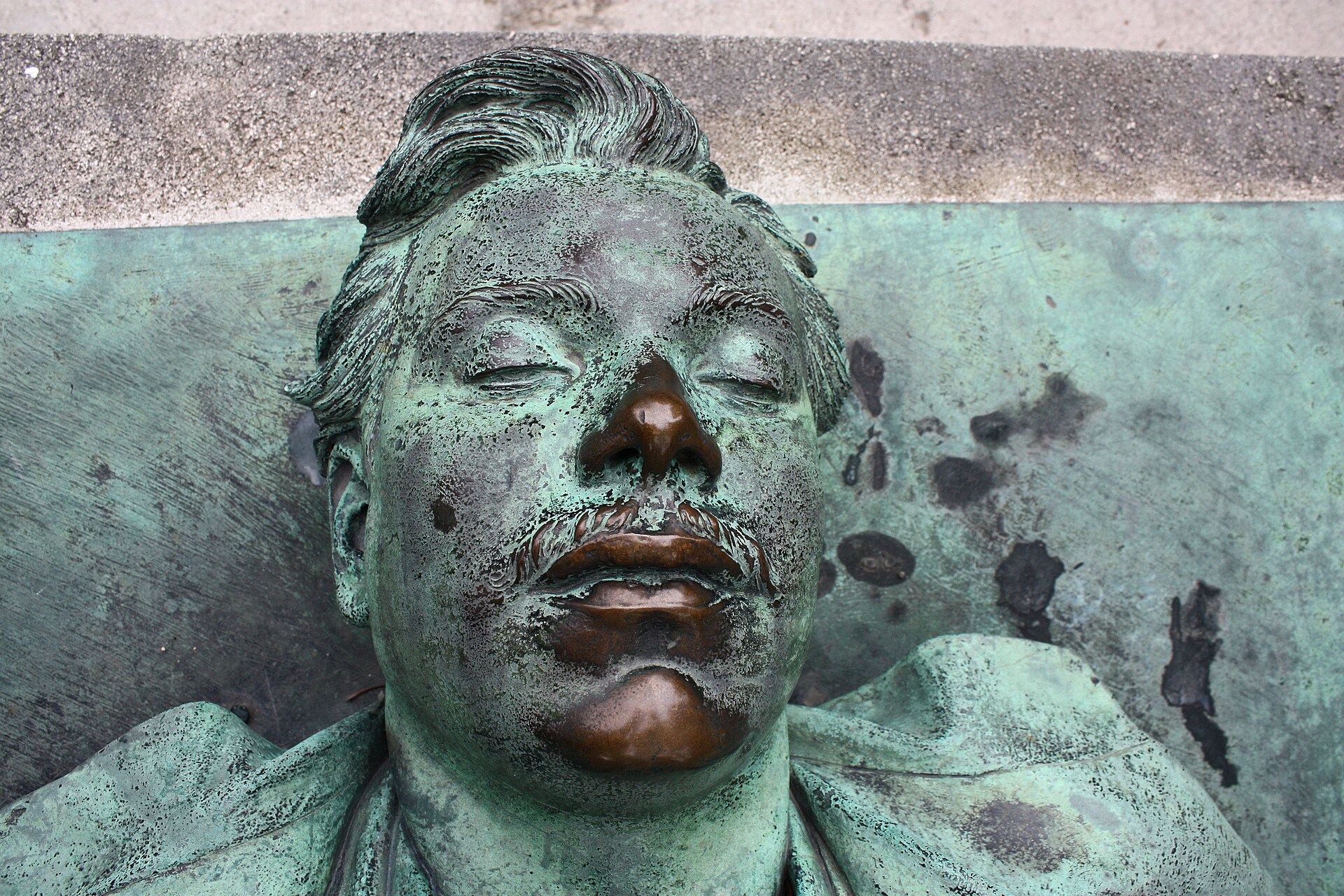
Victor Noir was a young journalist shot dead in 1870 by Prince Pierre Bonaparte, cousin of the Emperor, and his funeral became a republican protest. His tomb features a life-size bronze by Jules Dalou showing him lying where he fell. A folk belief grew up that rubbing certain parts of the statue improves fertility and love life, and those parts have been polished to a bright shine. The cemetery once fenced the statue off, and then removed the fence after protests.
The Columbarium (division 87)
Built at the end of the 19th century alongside the crematorium, the columbarium is a large domed building surrounded by galleries of niches holding ashes. Among them are the dancer Isadora Duncan and the American novelist Richard Wright, author of Native Son. Maria Callas’s ashes were placed here, then later scattered over the Aegean Sea; a plaque in her name remains. It’s quiet and slightly eerie, and many visitors never find it.
More graves worth a detour
Once the big names are ticked off, some of the most rewarding stops are the ones with fewer people around them.
- Théodore Géricault (division 12): the painter reclines on his tomb holding a palette, and a bronze relief of The Raft of the Medusa, his masterpiece in the Louvre, is set into the base.
- Allan Kardec (division 44): the founder of Spiritism lies under a granite dolmen that is never without fresh flowers, left by followers from France and, above all, Brazil. It is one of the most visited graves in the cemetery, and one of the least known to tourists.
- Yves Montand and Simone Signoret (division 44): one of France’s most famous screen couples, buried together a few steps from Sarah Bernhardt.
- Guillaume Apollinaire (division 86): a rough upright granite stone, carved with one of his calligrams in the shape of a heart.
- Georges Seurat (division 66) and Camille Corot (division 24): modest family graves for two painters whose work fills whole rooms at the Musée d’Orsay.
- Georges Bizet (division 68): the composer of Carmen, marked by a bronze bust.
- Division 4: an unlikely trio of neighbours, with Baron Haussmann, who rebuilt Paris, the novelist Colette, and the empty original tomb of Rossini, whose body was moved to Florence in 1887.
Memorials worth stopping for
The Mur des Fédérés (division 76)
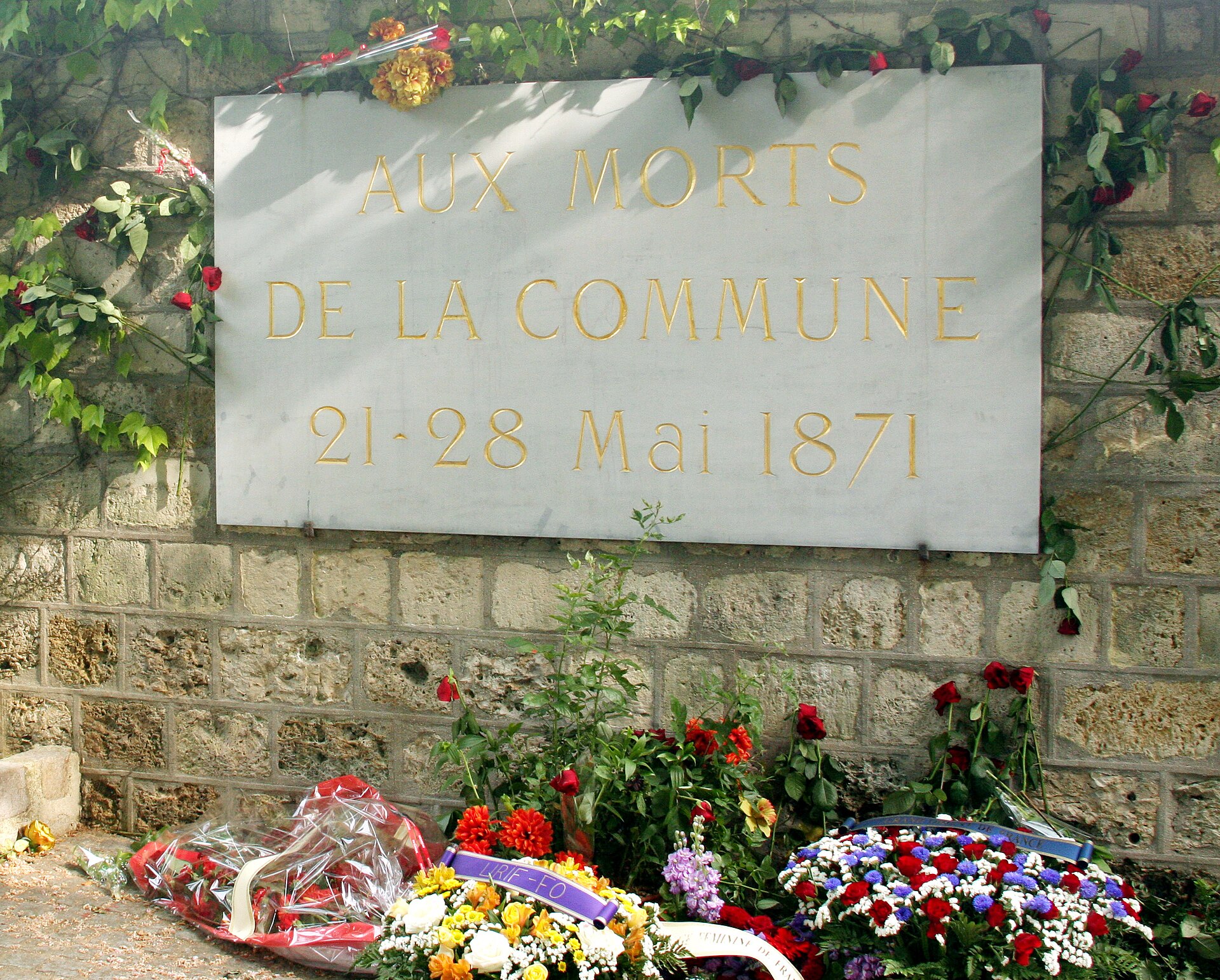
In the south-eastern corner of the cemetery, a plain stretch of boundary wall carries a plaque reading Aux morts de la Commune, 21–28 mai 1871. In the final days of the Paris Commune, the insurgents who had held the city were cornered among these tombs, and on 28 May 1871, 147 of them were shot against this wall by government troops and buried in a trench at its foot. The wall became a rallying point for the French left, and every year in late May marchers still bring flowers.
The Deportation memorials
Along the paths near the Mur des Fédérés stands a series of powerful memorials to the French men, women and children deported to Nazi concentration camps, one for each camp: Auschwitz, Buchenwald, Dachau, Mauthausen, Ravensbrück and others. Several are striking works of sculpture, and together they form one of the most affecting places in Paris. Many visitors hurrying from Piaf to Wilde walk straight past them. Don’t.
The Monument aux Morts
At the end of the main avenue from the Boulevard de Ménilmontant gate, Albert Bartholomé’s large Monument to the Dead shows a procession of figures moving towards a dark doorway. Completed at the end of the 19th century, it’s the first major monument you see as you enter.
Two routes through the cemetery
Route 1: the headline graves, downhill (about 2 hours)
Take Metro Line 3 to Gambetta and enter by the Porte Gambetta at the top of the cemetery.
- Oscar Wilde (division 89), a few minutes from the gate.
- Gertrude Stein (94) and Modigliani (96), nearby to the east.
- Édith Piaf (97) and the Deportation memorials, in the eastern corner.
- The Mur des Fédérés (76) along the boundary wall.
- The Columbarium (87) and Apollinaire (86).
- Proust (85), then head west and downhill.
- Balzac (48) and Delacroix (49).
- Chopin (11).
- Jim Morrison (6) and Abélard and Héloïse (7).
- Finish with the Monument aux Morts and exit by the main gate on the Boulevard de Ménilmontant.
From here, it’s a 15-minute walk down the Rue de la Roquette towards Bastille, or take Metro Line 2 from Philippe Auguste.
Route 2: art and atmosphere (about 1.5 hours)
For people less interested in celebrity than in the cemetery’s romantic, overgrown character, stick to the older divisions in the western half. Enter by the main gate, walk up past the Monument aux Morts and explore divisions 4 to 30 and 48 to 57 at random, taking the smaller side lanes. This is where you’ll find the most elaborate 19th-century chapels, sculptures and ironwork, as well as Chopin, Géricault, Corot, Molière and La Fontaine. It’s hillier, but in autumn, with the leaves on the cobbles and mist in the trees, it’s one of the most beautiful walks in Paris.
How to visit respectfully
Père Lachaise is a tourist attraction, but it’s also a working cemetery where families visit graves and funerals take place. A few simple rules:
- Keep your voice down, and give a wide berth to any funeral or family gathering. Don’t photograph mourners.
- Don’t climb on, sit on or lean against tombs. Many are fragile and privately owned.
- Don’t leave graffiti, bottles or rubbish. Flowers are fine; a small note is tolerated at the famous graves.
- No picnics. Père Lachaise isn’t a park, whatever its trees suggest. Eat before or after in the neighbourhood.
- No lipstick kisses on Wilde’s tomb. The cleaning cost thousands of euros.
- Cycling and dogs are not allowed.
Guided tours
Père Lachaise is hard to navigate and full of stories, so a guided walk can be worth it, especially on a first visit. Several companies run English-language walking tours of around two hours, focusing on the famous graves and the history of the cemetery. The City of Paris also organises tours in French, and occasional themed visits. Prices vary; check current rates when you book. Our guides to the best Paris tours and walking tours compare the options.
If you’d rather go alone, the route above, a downloaded map and an hour of reading on the stories behind the graves will serve you well.
When to visit
- Autumn is the best season: golden leaves, low light, mist on some mornings and fewer tourists. Our guide to Paris in autumn has more for the season.
- Early morning on a weekday is the quietest time, especially at Morrison’s and Wilde’s graves.
- Spring brings blossom and fresh green growth over the old stone.
- Summer is pleasant under the trees, but the famous graves are crowded, especially in the afternoon.
- Winter is stark and atmospheric, with bare branches over the tombs, but the cemetery closes at 5.30pm.
- 1 November, All Saints’ Day, when French families visit graves, is busy with mourners; visit respectfully or choose another day.
- Late May brings the annual commemorations at the Mur des Fédérés.
Practical information
Getting there
- Metro Philippe Auguste (Line 2): a three-minute walk to the main gate on the Boulevard de Ménilmontant.
- Metro Père Lachaise (Lines 2 and 3): close to the western side of the cemetery and its side gate.
- Metro Gambetta (Line 3): for the top gate and the downhill route.
- Bus: several lines stop along the Boulevard de Ménilmontant and at Gambetta.
For tickets and lines, see our Paris Metro guide.
Facilities
There are a small number of public toilets inside the cemetery, including near the main entrance and near the Gambetta gate; they’re not always open and can be basic. There’s nowhere to buy food or drink inside, so bring water, especially in summer when the climb is hot work. The cemetery’s conservation office near the main entrance can help with finding a particular grave.
Accessibility
Père Lachaise is difficult for wheelchair users and people with limited mobility. The main avenues are paved and manageable, but the cemetery is hilly, many lanes are cobbled and steep, and some graves are reached only by steps. The main avenues from the Gambetta gate are the least demanding way to see some of the famous graves.
Combine with a visit to
- Belleville and Ménilmontant: street art, cheap and excellent Asian food, and the view from the Parc de Belleville. See our Belleville and Oberkampf guide.
- The Marais: a 25-minute walk west via the Rue de la Roquette and Bastille. See our Marais guide.
- The Oberkampf bars for an evening drink after the cemetery closes.
- Other Paris cemeteries: Montmartre, where Degas and Dalida are buried, is covered in our Montmartre guide, and Montparnasse holds Sartre, de Beauvoir and Baudelaire.
For more of the city’s green spaces, see our guide to Paris parks and gardens, and for more of the strange and memorable, unique things to do in Paris.
Is Père Lachaise worth visiting?
Yes. Even if you have no interest in famous graves, it’s one of the most beautiful and atmospheric places in Paris: a hillside of stone, ivy and trees that feels like a city in miniature, with its own streets, neighbourhoods and history. It’s free, rarely feels crowded outside the handful of celebrity graves, and it tells the story of France in a way no museum does, from Molière to the Commune to the deportations.
Just go with the right expectations. You won’t find everyone on your list, some famous graves are plain, and Morrison’s is barely visible behind its barrier. Pick five or six graves that matter to you, allow time to get lost between them, and let the cemetery do the rest.
Frequently asked questions
Is Père Lachaise free to visit?
Yes. Entry to Père Lachaise Cemetery is free every day of the year. Guided tours are paid.
What are Père Lachaise’s opening hours?
From mid-March to early November, it opens at 8am Monday to Friday, 8.30am on Saturday and 9am on Sundays and public holidays, and closes at 6pm. In winter, the opening times are the same and it closes at 5.30pm. Checked September 2026.
Where is Jim Morrison’s grave in Père Lachaise?
In division 6, in the western part of the cemetery, not far from the main entrance and close to Abélard and Héloïse in division 7. The grave is behind barriers and often has a small crowd around it.
Where is Oscar Wilde buried in Père Lachaise?
In division 89, in the upper, eastern part of the cemetery, a short walk from the Gambetta gate. His tomb is a large winged sculpture by Jacob Epstein, protected at its base by a glass screen.
Which entrance should I use at Père Lachaise?
Enter by the Gambetta gate at the top (Metro Gambetta, Line 3) if you want to walk mostly downhill. Use the main gate on the Boulevard de Ménilmontant (Metro Philippe Auguste, Line 2) if you’re coming from the Marais or Bastille.
How long do you need at Père Lachaise?
Two hours will cover the main famous graves on a planned route. Allow half a day if you want to explore the older divisions and the memorials properly.
Can you take photos at Père Lachaise?
Yes, photography for personal use is allowed. Be discreet around families visiting graves, never photograph funerals or mourners, and don’t climb on tombs for a better angle.
Who is the most famous person buried at Père Lachaise?
By number of visitors, probably Jim Morrison, Oscar Wilde, Édith Piaf and Frédéric Chopin. By historical weight, the list includes Molière, Balzac, Delacroix and Proust, among many others.
Related Paris Guides
- Paris Parks and Gardens: The Complete Guide
- Belleville and Oberkampf Guide
- The Marais Guide
- The Paris Catacombs Guide
- Unique Things to Do in Paris
- Paris Walking Tours
- Free Things to Do in Paris
- Paris in Autumn
Photo Credits
Chopin’s tomb: Pere Lachaise Cemetery – Tomb of Frederic Chopin, Paris, 2011 by DIMSFIKAS, CC BY-SA 3.0, via Wikimedia Commons.
Lipstick on Oscar Wilde’s tomb: Grave of Oscar Wilde and Robert Baldwin Ross (28306420169) by VillageHero from Ulm, Germany, CC BY-SA 2.0, via Wikimedia Commons.
Victor Noir’s effigy: Grave of Victor Noir – head by istolethetv, CC BY 2.0, via Wikimedia Commons.
The Mur des Fédérés: Commune2011 by Dayofmayofday, CC0, via Wikimedia Commons.