Arc de Triomphe: Visiting Guide, Climbing Tips & History
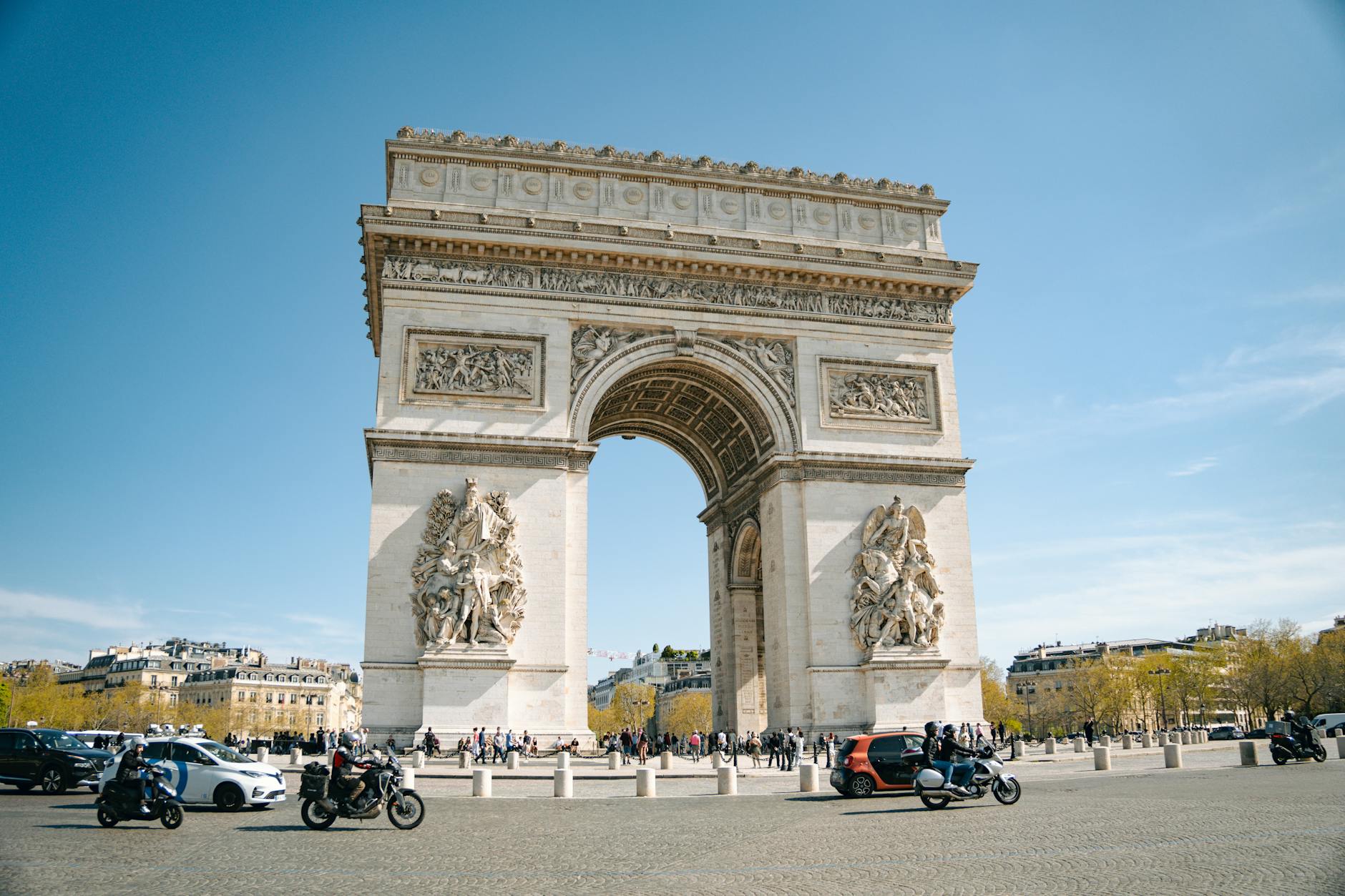
Most people photograph the arc de triomphe from the pavement, point a camera up at 50 metres of carved stone, and walk off down the Champs-Élysées. They miss the whole reason to come. Climb to the rooftop terrace and you get the one view in central Paris that puts the Eiffel Tower in full side profile against the city behind it, with the Champs-Élysées running straight back to the Louvre on the other side. This is the second-most-visited monument in the city after the Eiffel Tower, and it sits at the dead center of the historic axis that starts at the Louvre Pyramid and runs eight kilometres in a perfectly straight line out to La Défense, a sightline Paris took three centuries to assemble. Below you will find what you actually need: tickets and the safe access tunnel, the climb (284 steps, no elevator past the first floor), the Tomb of the Unknown Soldier and its nightly flame ritual, the sunset timing that matters, and the 12-avenue star that only makes sense from above. By the end you will know when to arrive, which entrance to take, what the rooftop view really contains, and why this is the best climb-to-payoff ratio in Paris. For the wider context, start with our Paris attractions guide.
Arc de Triomphe at a Glance: Key 2026 Stats
The arch is bigger in person than the photographs suggest, it predates the Eiffel Tower by half a century, and since 2024 it runs on a timed-entry ticketing system that has tightened a fair bit. Here are the numbers that shape every decision you will make about visiting. Each one gets unpacked in its own section further down, so treat this as the cheat sheet.
- Dimensions: 50 metres tall, 45 wide, 22 deep. It held the title of largest triumphal arch in the world until North Korea’s Arch of Triumph (1982) pipped it by a few metres.
- Commissioned: 1806 by Napoleon Bonaparte, to mark his Austerlitz victory of December 1805.
- Completed: 1836 under King Louis-Philippe. That is 30 years of building across two Empires and two monarchies.
- Annual visitors: roughly 1.5 million climb to the rooftop each year. Many millions more simply pass beneath it.
- Tickets in 2026: €16 adult; €12 youth EU 18-25; FREE for under-18s worldwide; FREE for EU residents aged 18-25.
- Climb: 284 steps up a spiral staircase to the roof. The elevator only reaches the first floor.
- Location: the center of Place Charles de Gaulle, long known as Place de l’Étoile, “the Star,” for the 12 avenues that radiate out from it.
- Tomb of the Unknown Soldier: installed November 11, 1920; the eternal flame lit November 11, 1923 and burning ever since.
- Daily flame ceremony: 6:30pm, every single evening of the year, free at street level.
- Time needed: 60-90 minutes for the full visit, climb and rooftop included.
How to Get to the Arc de Triomphe Safely
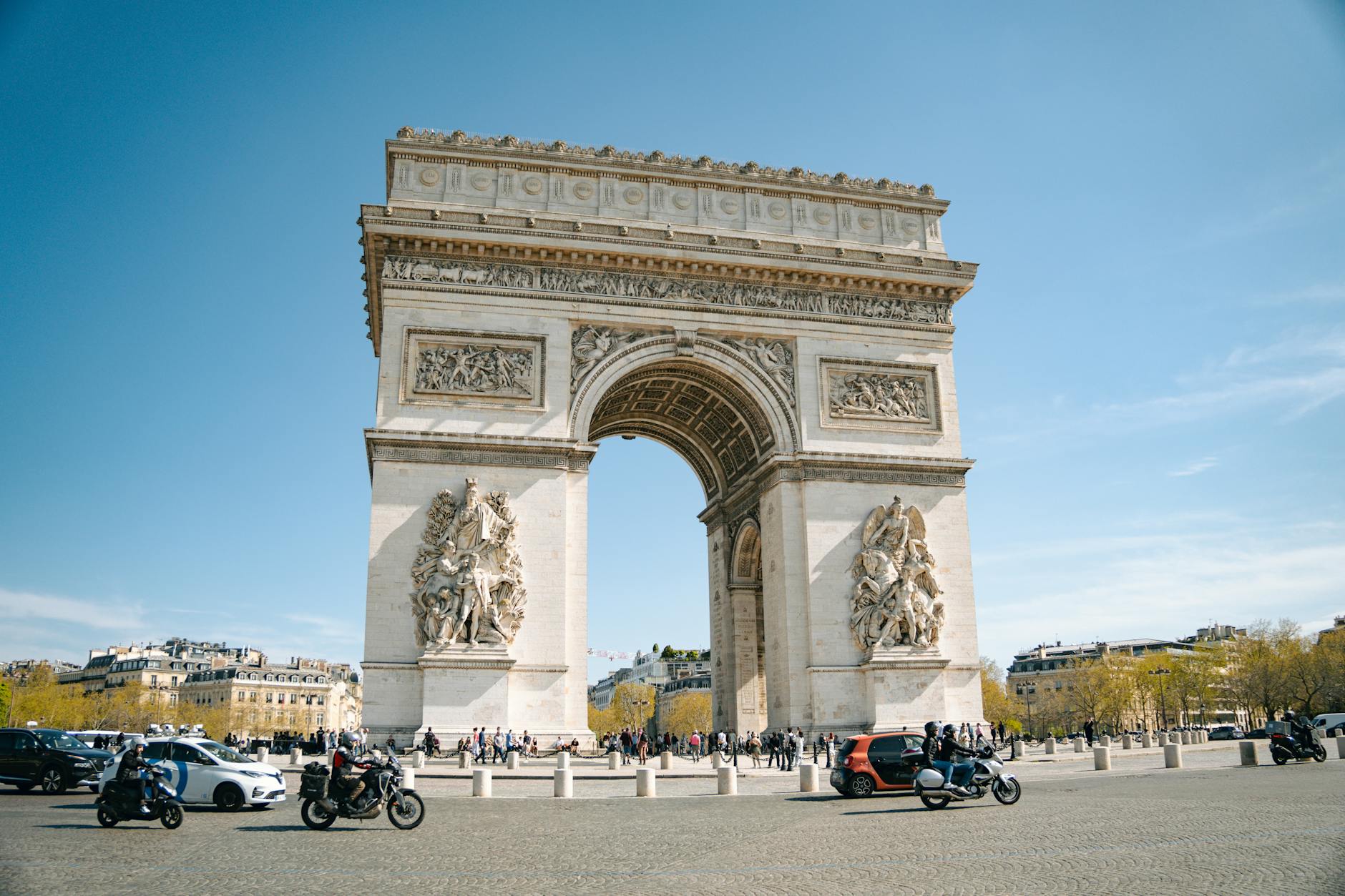
One instruction matters more than anything else in this guide: do not try to cross the roundabout on foot. The 12 avenues feed into one of the fastest, busiest traffic circles in Europe. Cars come in from every direction at every speed, the lane markings inside are basically a suggestion, and pedestrians are flat-out banned from the circle. Tourists who chance the gaps in traffic get hit here several times a year, every year. If the police spot you trying, they will wave you straight back.
The way in is the pedestrian tunnel. Two underground passages run beneath the roundabout, one from Avenue de la Grande Armée on the west side, the other from Avenue des Champs-Élysées on the east. Both come up at the base of the monument on the circular paved plaza. The entrance sits right outside the Metro station and is signposted in several languages. Reaching the plaza and seeing the Tomb of the Unknown Soldier at ground level costs nothing; the rooftop is the only part that needs a ticket.
By Metro, the stop you want is Charles de Gaulle-Étoile, on Lines 1, 2, 6 and RER A. The station has a tangle of exits, but the one marked “Arc de Triomphe” comes up directly at the tunnel mouth, so you never touch a road. Walking up from Place de la Concorde instead? Keep to the right-hand pavement of the Champs-Élysées, cross Avenue Foch at the standard pedestrian signals, and watch for the staircase down to the passage just before the roundabout starts.
On accessibility: an elevator runs from tunnel level up to the ground floor, where the Tomb of the Unknown Soldier sits, and then on to the first observation level with the small museum and bookshop. Above the first floor, the only way up is the 284-step spiral, and there is no elevator to the roof. Wheelchair access to the first floor is free, and staff will work the elevator for you if you ask at the ground-level ticket office.
Tickets in 2026: Every Option
In 2024 the operator, the Centre des Monuments Nationaux, brought in mandatory timed-entry slots, and the prices have held into 2026. Knowing which category you fall into below saves you both money and a queue.
| Ticket type | Price 2026 | Notes |
|---|---|---|
| Adult standard | €16 | Includes rooftop access |
| Youth EU 18-25 | €12 | EU residency required, ID checked |
| Under 18 worldwide | FREE | Photo ID with date of birth required |
| EU resident 18-25 | FREE | Passport or residence card required |
| First Sunday of month | FREE | November to March only |
| July 14 (Bastille Day) | FREE | Long queues; arrive at 10am opening |
| Audio guide rental | €4 | 45 minutes, 8 languages |
| Paris Museum Pass 2-day | €70 | Arc included; covers 50+ sites |
| Paris Museum Pass 4-day | €85 | Best value for multi-day stays |
| Paris Museum Pass 6-day | €105 | Best for 5+ monument visits |
Opening hours run 10am to 10:30pm in summer (April through September) and 10am to 10:30pm in winter (October through March), last admission 45 minutes before close. That late summer slot near closing is, frankly, the best ticket the place sells: you go up in golden hour, watch the sun drop from the roof, and linger long enough to catch the Eiffel Tower’s hourly sparkle at 9pm or 10pm with the whole Champs-Élysées lit up beneath you.
Where to buy. The official site is arc-de-triomphe.fr, which has run timed entry since 2024, with slots released about 90 days ahead. Prefer a third party? Get Your Guide and Tiqets resell the identical ticket with a small markup, around €20-25 all in, in exchange for a slicker checkout and pre-picked time slots, which is genuinely handy in peak summer. You can also buy at the ground-floor office with cash or card, but budget 30-90 minutes in the queue from June through August. One thing to skip outright: the bundled bus-tour tickets pushed by street touts on the Champs-Élysées. They run double the official price and save you no time whatsoever.
If you are hitting three or more major monuments on the same trip, the Paris Museum Pass is the smart play. It covers the Arc, the Louvre, Versailles, Sainte-Chapelle, the Conciergerie, the Musée d’Orsay and around fifty other sites; our Louvre museum guide and Versailles guide walk through how to chain them together. One catch: even with the Pass you still have to book a timed slot online for the Arc. The Pass covers the fee, not the reservation.
The Climb: 284 Steps and What to Expect
The arch works as four stacked levels, and getting between them is half the fun. From the tunnel, an elevator or a short flight of stairs lands you at ground level, where the Tomb of the Unknown Soldier sits under the central vault. The real climb starts here. You wind up 50 vertical metres through a tight stone spiral coiled inside one of the pillars, the same staircase the masons used back in the 1830s. Past the first floor, there is no elevator, full stop.
Count on 284 steps from the ground to the rooftop terrace, which most people manage in 8-15 minutes depending on how fit they are. The staircase runs one-way up to the first floor, so once you start there is no graceful retreat against the people coming down. Each level gives you a place to catch your breath. The first floor (also where the elevator stops) holds a small museum with rotating exhibits on how the arch was built and the military history behind it, a bookshop stocking English and French titles, and a little café doing coffee, pastries and bottled drinks. The restrooms here are the only ones in the monument apart from the ground floor.
A second spiral lifts you from the first floor through the attic museum, a quieter room of historic photographs and architectural plans, and out onto the rooftop terrace. That last step is one of the better reveals in Paris: you come up the final few stairs inside a stone shaft and suddenly the whole city opens around you, 50 metres down on every side. Give the terrace 20 minutes minimum. Plenty of people stay an hour.
A few honest warnings. The climb is not for everyone: skip it if you have serious knee or hip trouble, bad vertigo, or kids under 5, who tend to struggle on the tall steps. The stone staircase is narrow and dim, even if it is lit, and there is no chair lift. In winter, bring a layer. The summit is fully exposed and the wind bites up there even on days that feel still at street level. If you have mobility needs, the first-floor view is still worth your time. It sits above the surrounding traffic and gives you a partial sweep of the Champs-Élysées.
The Rooftop View: What You’ll See
The rooftop is why most people climb, and it pays back every step. The terrace runs about 30 metres by 20, big enough to walk a full lap and get your bearings off the cardinal-direction signs at each corner. The thing that stops everyone is the 12-avenue star directly below: avenues fanning out in flawless symmetry, a piece of city planning Baron Haussmann ordered in 1854 that is still the cleanest example of radial street design in any major city anywhere.
Face east-southeast and the Champs-Élysées falls away in a straight, tree-lined run for two kilometres to Place de la Concorde, where you can pick out the pink granite Luxor obelisk. Past Concorde, the Tuileries Gardens, the Louvre Pyramid and the Louvre’s facade fill in the foreground of what the French call the Grande Axe historique, the historical axis. Now turn a full 180 degrees and look west: the axis carries on another 4 kilometres past the arch to the glass-and-steel Grande Arche of La Défense, a deliberate modern echo of this one, finished in 1989. Louvre to La Défense, that whole spine, runs 8 kilometres dead straight.
Now the southwest, and the reason photographers come up here at all. The Eiffel Tower rises in dramatic side profile, and this is the only spot in central Paris where you catch it full-side from height. The Eiffel Tower’s own decks face out across the city and never include the tower itself in the shot. So if you want one frame holding the Champs-Élysées, Place de la Concorde, the Louvre and the Eiffel Tower together, the Arc roof is where you take it, and nowhere else. Our Paris photo spots guide covers the rest of the city’s angles.
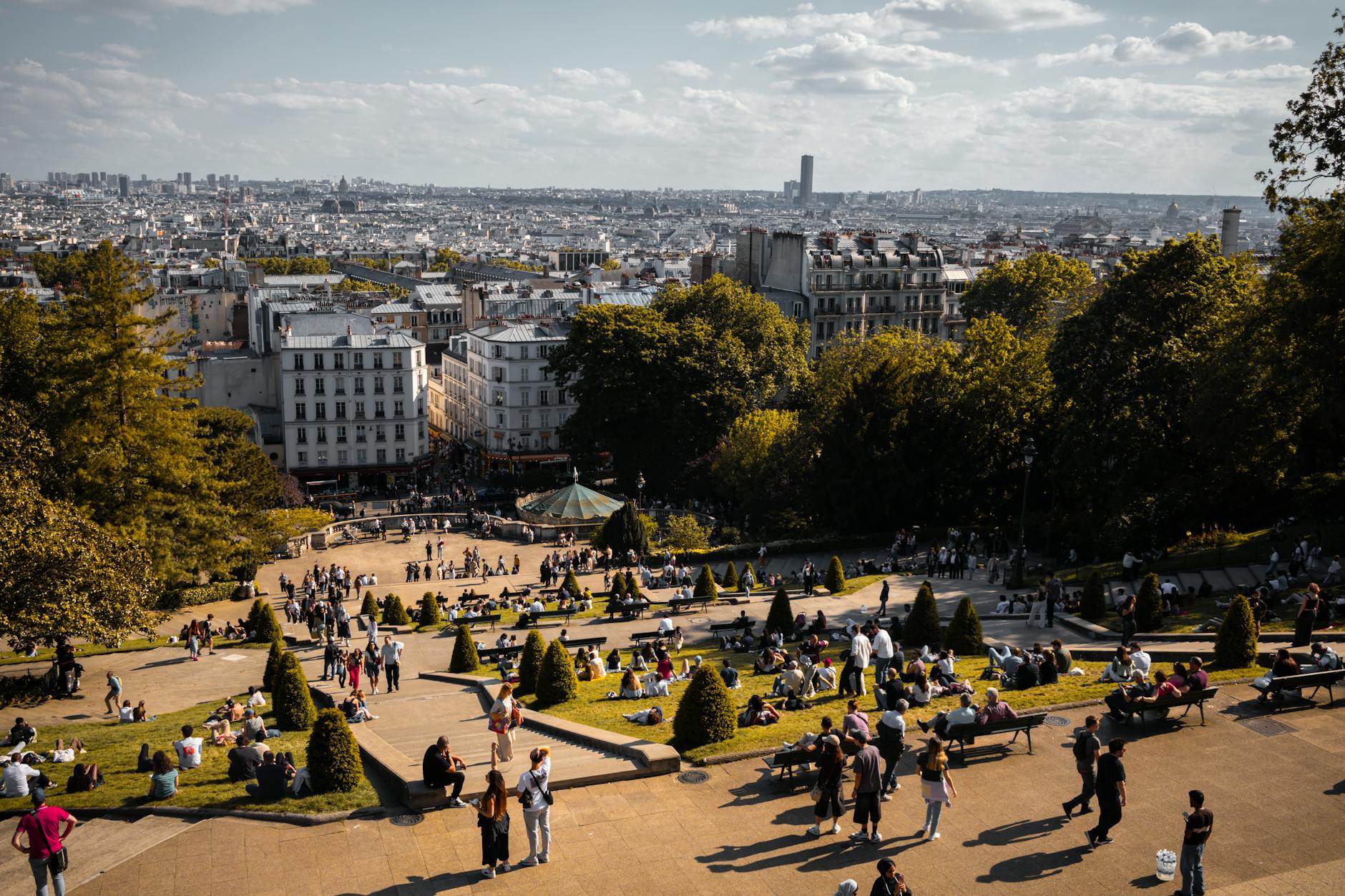
What else you can pick out: Sacré-Coeur stands clear to the north on the Montmartre hill (our Sacré-Coeur Montmartre guide covers that visit). To the south, the dark slab of Tour Montparnasse dominates. Notre-Dame is trickier to find but shows up to the south-southeast on a clear day, as does the gold dome of Les Invalides, where Napoleon lies. For photos, get up here 60 minutes before sunset so the sun sits behind your camera as you shoot east down the avenue.
Tomb of the Unknown Soldier & Daily Flame Ceremony
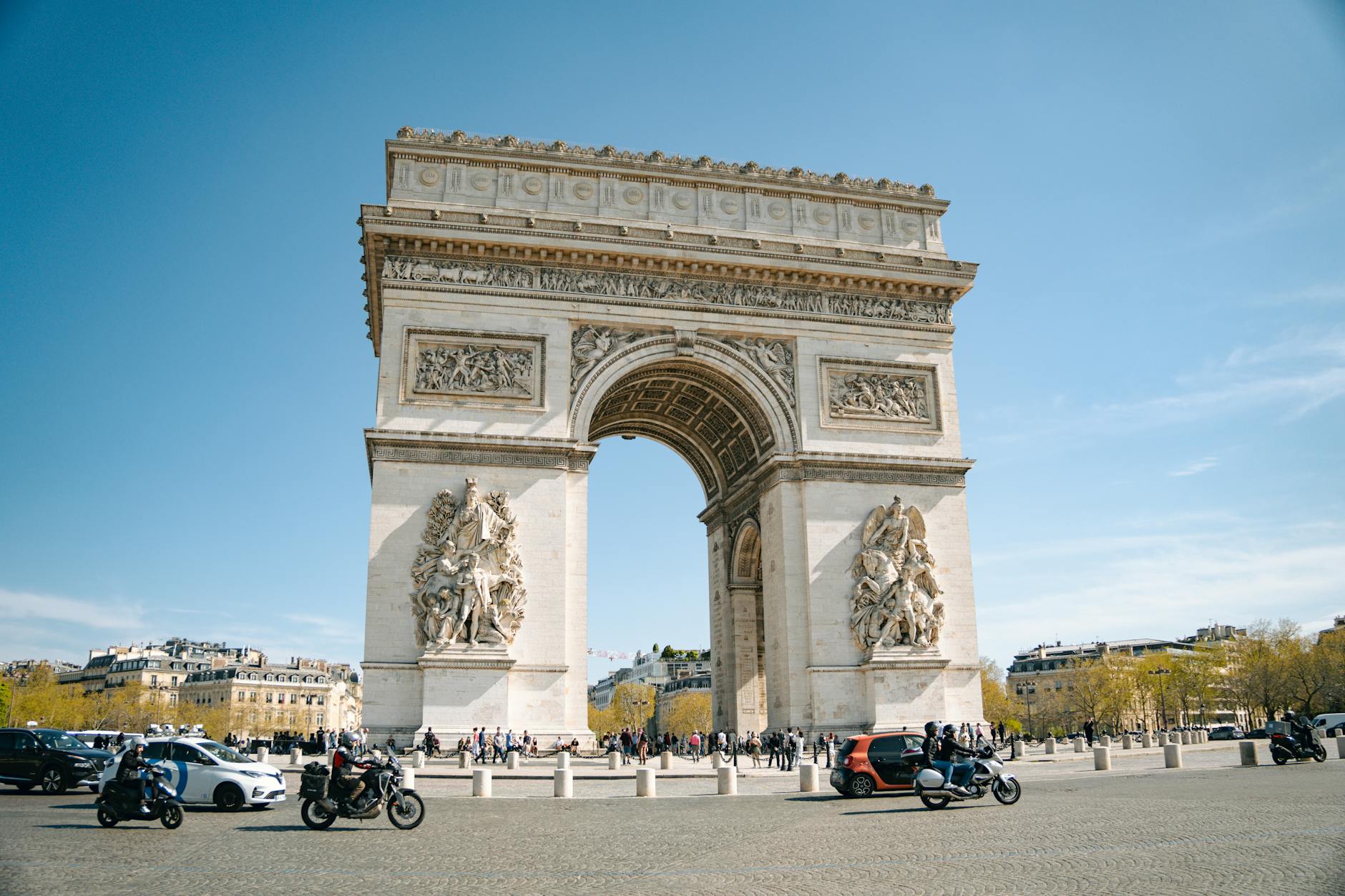
Set flush into the stone floor under the central vault is the Tomb of the French Unknown Soldier. The remains belong to an unidentified French infantryman, disinterred from one of the Verdun battlefields and laid here on November 11, 1920, the second anniversary of the WWI armistice. Choosing an unnamed soldier was the whole point. He stands in for every French serviceman whose body was never identified or sent home, and through that anonymity, for every soldier of every conflict whose family got no body to bury.
Above the tomb burns La Flamme du Souvenir, the eternal flame, first lit on November 11, 1923. It has burned without a break ever since, save one brief moment in 1998 when a protester smothered it and it was relit within minutes. Keeping it alight is the work of the Comité de la Flamme sous l’Arc de Triomphe, a coalition of veterans’ associations who staff the site in shifts, around the clock, every day of the year. They are the reason it has never gone out.
The 6:30pm relighting is the most overlooked free thing in central Paris. Every evening of the year, rain or snow or August swelter, a small ritual plays out at the tomb. Delegates from one of the veterans’ associations arrive in formal dress, the flame is symbolically revived with a long ceremonial sword, a bugler plays, the tricolor goes up, and on some nights there are short readings. The whole thing runs 15-20 minutes, it is free, and you just walk up through the pedestrian tunnel and stand behind the rope barrier. Hardly any tourists know about it. On a typical night the crowd is under fifty people.
Two annual ceremonies scale the daily ritual up. On November 11 (Armistice Day), the President of France presides over a major commemoration, the public turns out in force, and the rooftop closes for security. On July 14 (Bastille Day), the military parade down the Champs-Élysées ends at the arch with a formal salute. This tomb is the most visible memorial in a cenotaph tradition that went global from here: London’s Cenotaph (1920) and Washington’s Tomb of the Unknown Soldier at Arlington (1921) both followed the Paris lead. As for etiquette: stay quiet near the tomb, no flash photography, and never stand on or touch the flame surround.
Sculptures & Reliefs on the Arc
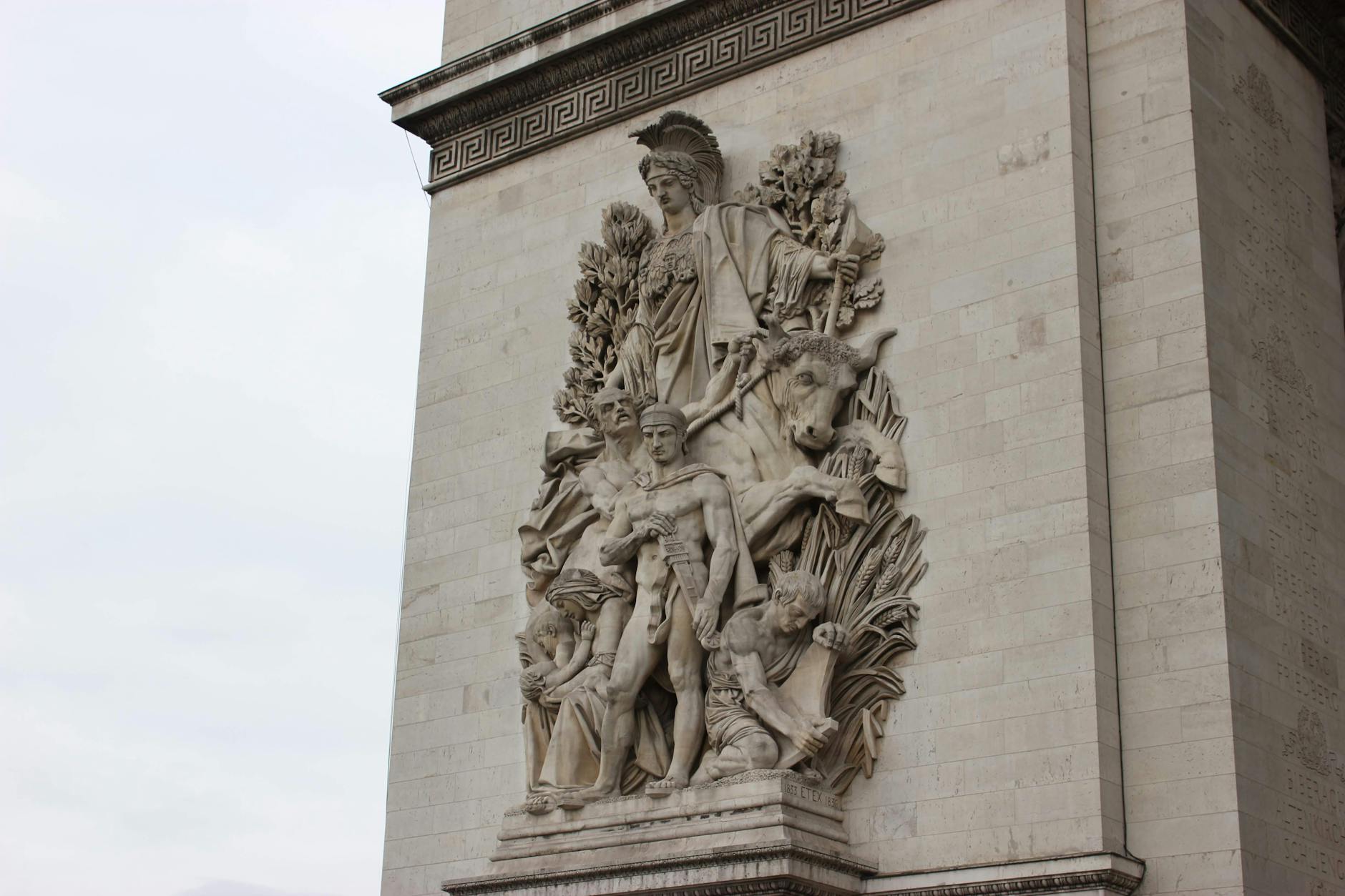
Look closely and the arch reads as one of the great open-air sculpture galleries in France, not just a slab of carved stone. Four major high-reliefs sit on the lower pillars, one per cardinal direction, and between them they tell the story of the French armies from 1792 to 1815. The famous one is La Marseillaise, also called “The Departure of the Volunteers of 1792,” by François Rude, on the east face of the right-hand pillar as you stand on the Champs-Élysées side. A winged Liberty soars over the volunteers, mouth wide in a battle cry. It is the most reproduced sculpture in 19th-century France, turning up on stamps, coins, even the sheet music of the national anthem.
The other three majors are The Triumph of 1810 by Jean-Pierre Cortot, marking the Treaty of Schönbrunn, and Resistance of 1814 and Peace of 1815 by Antoine Étex, marking the French resistance to and eventual settlement of the wars of the Sixth Coalition. Read together, they wrap the arch in a chronological arc from revolutionary fervor to imperial peace, all of it legible from the ground if you take a slow lap of the base.
Higher up, more than thirty smaller bas-relief panels run along the attic and friezes: individual battles, allegorical figures, victory processions. Inside the vault, the walls carry the names of 660 generals of the French Revolutionary and Napoleonic Wars, and here is the detail worth knowing, if a name is underlined, that general died in battle. Above them, 158 battle names are cut into the upper attic in stone capitals. Do the full perimeter once before you climb. You will spot details from the rooftop afterward that you would otherwise walk straight past.
The arch’s most recent chapter of art history was the Christo and Jeanne-Claude wrap, finished in September 2021 after Christo’s death in 2020. For 16 days the entire monument disappeared under 25,000 square metres of silvery-blue recyclable polypropylene and 3,000 metres of red rope, a posthumous version of a project the pair first sketched in 1961. It was free to see and pulled in six million visitors. Photographs of the wrapped arch now hang in the first-floor museum.
History of the Arc de Triomphe
The arch is older than almost everything else on the central skyline. Its construction dragged across 30 years, three governments and two royal restorations, and that messy timeline is exactly why the style reads more austere than ornamental. The design simply outlived the regime that ordered it.
- 1806: Napoleon Bonaparte commissions the arch for his Austerlitz victory of 1805. Architect Jean-François Thérèse Chalgrin designs it in the Roman triumphal tradition, echoing the Arch of Titus in Rome but at twice the size.
- August 15, 1806: foundations laid on Napoleon’s 37th birthday.
- 1810: Napoleon’s wedding procession to Marie-Louise of Austria passes under a temporary wood-and-plaster mock-up. The real arch is barely above ground.
- 1814-1815: work stops through Napoleon’s fall, the Hundred Days and Waterloo. The site sits as an open foundation for nearly a decade.
- 1823: King Louis XVIII restarts construction, recasting the arch as a tribute to French armies generally, not to Napoleon alone.
- 1836: completed under King Louis-Philippe, 30 years after the first spade went in.
- 1840: Napoleon’s remains, repatriated from Saint Helena, pass under the arch on the way to their final tomb at Les Invalides.
- 1885: Victor Hugo’s body lies in state under the arch overnight, attended by millions, before burial in the Panthéon (see our Panthéon Paris guide).
- 1919: the Victory Parade after the Armistice passes through the arch.
- 1920: Tomb of the Unknown Soldier installed on November 11.
- 1923: eternal flame lit on November 11.
- 1940: German occupation troops march through on June 14.
- 1944: Free French forces under General Leclerc march through during the Liberation of Paris on August 26.
- 1989: bicentennial of the French Revolution marked with major public spectacle.
- 2021: Christo and Jeanne-Claude posthumous wrap, 16 days of free public art.
Best Times to Visit (Sunrise to Sunset Comparison)
When you show up shapes the visit more than almost any other choice you make. The arch opens 10am to 10:30pm year-round, and the rooftop changes character completely across the day. Pick the slot that matches what you care about.
- 10am opening: shortest queue, soft eastern light on the Champs-Élysées facade. Best for first-timers and families with kids.
- Midday (12-3pm): brutally crowded, harsh overhead light, terrace jammed. Avoid if you possibly can.
- 5-6pm (90 minutes before sunset): golden hour kicks in and the rooftop comes alive. The most popular, most photographed slot of the day.
- 6:30pm flame ceremony: free at ground level, no ticket needed, every evening of the year.
- Last entry in summer (around 9:45pm): go up in late golden hour, watch sunset from the roof, stay for the Eiffel Tower’s 10pm sparkle with the Champs-Élysées fully lit. The best evening summer ticket in Paris.
- Winter sunset (around 4:50pm): golden hour arrives early; pair it with a Champs-Élysées Christmas market stroll (see things to do in Paris at night).
- November 11: Armistice Day, major 11am ceremony with the President, rooftop access restricted.
- July 14: Bastille Day, free entry but heavy crowds and the parade endpoint. Arrive at 10am or skip the day entirely.
What’s Around the Arc de Triomphe
The arch sits where three of western Paris’s most distinct neighborhoods meet: the chic 8th arrondissement to the east, the residential 16th to the west, and the embassy-heavy 17th to the north. Walk a few minutes in any direction and you hit shopping, dining or another attraction.
- Champs-Élysées: the 2 km tree-lined avenue running east to Place de la Concorde, all flagship stores, cafés and cinemas. See our Paris shopping guide.
- Avenue Montaigne (south of the arch): the luxury fashion corridor. Dior, Chanel, Louis Vuitton, Givenchy and Valentino all keep flagships along its 600 metres.
- Avenue Foch (west): the widest avenue in Paris at 120 metres curb to curb. Quiet, residential, lined with embassies and grand 19th-century blocks.
- Place Charles de Gaulle (Place de l’Étoile): the 12-avenue roundabout itself. Photograph it from the roof, never cross it at street level.
- Galeries Lafayette Champs-Élysées: a smaller branch of the famous department store, leaning into accessories and beauty.
- Le Drugstore Publicis: the late-night institution directly across from the arch, open until 2am with a brasserie, bookshop and pharmacy.
- Musée d’Art Moderne de la Ville de Paris: a 15-minute walk south, with a free permanent collection.
- Palais de Tokyo: contemporary art next door to the Musée d’Art Moderne, with rotating shows and a very good café.
- Trocadéro: 10 minutes’ walk south via Avenue Kléber, and the postcard Eiffel Tower view (see Eiffel Tower guide).
Practical Tips & Etiquette
A quick checklist of behavior, kit and timing to keep the visit smooth. Most of it is common sense, but a couple of items (flash photography at the tomb above all) trip up tourists every single day.
- Use the pedestrian tunnel, never the street crossing.
- Bring a light layer for the roof; it is windy year-round, even when it feels still below.
- No flash photography on the Tomb of the Unknown Soldier. The flame is a memorial, not a backdrop.
- Keep silent near the tomb. Talking is fine on the rooftop.
- Photography is allowed everywhere on the terrace; tripods are tolerated outside peak hours.
- Restrooms are on the first floor and at ground level.
- Audio guide rental (€4) comes in 8 languages: English, French, German, Spanish, Italian, Mandarin, Japanese and Portuguese.
- Buy tickets ahead in summer to dodge the 60-90 minute queue at the ground-floor office.
- Wheelchair access reaches the ground and first floors only; there is no rooftop elevator.
- Stay out of the Place Charles de Gaulle traffic at all costs; pedestrians are banned from the roundabout.
- Time needed: 60-90 minutes for the full visit, climb, rooftop, museum and Tomb included.
FAQ
How much does it cost to climb the Arc de Triomphe in 2026?
The standard adult ticket is €16 in 2026, dropping to €12 for EU residents aged 18-25, and free for under-18s worldwide and EU residents aged 18-25. The Paris Museum Pass (from €70) covers the Arc and is the better deal once you are visiting three or more major monuments on the trip. An audio guide adds €4. Visiting the Tomb of the Unknown Soldier and watching the 6:30pm flame ceremony at ground level costs nothing; only the rooftop climb is ticketed.
Is the Arc de Triomphe free for anyone?
Yes. Admission is free for under-18s worldwide, free for EU residents aged 18-25 with proof of residency, free on the first Sunday of the month from November through March, and free on July 14 (Bastille Day). The ground-floor Tomb of the Unknown Soldier is free for everyone, every day of the year; only the rooftop climb needs a paid ticket for adult non-EU visitors.
How many steps to climb the Arc de Triomphe?
284 steps from ground level to the rooftop terrace, up a tight spiral staircase. An elevator reaches the first floor, roughly a third of the way up, but above that the stairs are the only option. Most people take 8-15 minutes depending on fitness and how often they pause on the way.
Is the Arc de Triomphe worth visiting?
Yes, for two reasons above all. First, it is the only viewing platform in central Paris where you can photograph the Eiffel Tower in full side profile against a recognisable city backdrop. Second, the rooftop sits at the hinge of the 8-kilometre Grande Axe historique from the Louvre to La Défense, so you take in the whole spine of Paris in one sweep. The 284-step climb is one of the best returns on effort the city offers, and the 6:30pm flame ceremony at ground level is a free, genuinely moving 15-minute ritual that almost no tourists ever see.
Can you walk to the Arc de Triomphe from street level?
Yes, but only through the pedestrian tunnel, never across the roundabout. Two underground passages run beneath Place Charles de Gaulle, linking Avenue de la Grande Armée (west) and Avenue des Champs-Élysées (east) to the base of the arch. The entrance is right outside the Metro station Charles de Gaulle-Étoile (Lines 1, 2, 6 and RER A). Crossing the roundabout traffic on foot is both forbidden and dangerous; pedestrians are not allowed in the traffic circle under any circumstances.
What time does the Tomb of the Unknown Soldier flame ceremony happen?
The eternal flame is revived every evening at 6:30pm, year-round, whatever the weather. A different veterans’ association leads it each night, it runs 15-20 minutes, and it is free: just walk up through the pedestrian tunnel and stand behind the rope barrier near the tomb. Twice a year it expands into a larger commemoration, on November 11 (Armistice Day) and July 14 (Bastille Day), both with the President of France and the military.
Can you see the Eiffel Tower from the Arc de Triomphe?
Yes, and it is the single best reason to climb. The Eiffel Tower stands to the southwest in dramatic side profile, about 2 kilometres off. The Arc rooftop is the only public platform in central Paris where the tower appears in landscape composition with the city around it. The Eiffel Tower’s own decks look outward and never include the tower itself in the frame, so for the postcard Eiffel-plus-Paris shot, the Arc roof is the place. Come 60 minutes before sunset for the best light.
Is the Arc de Triomphe wheelchair accessible?
Partially. An elevator runs from tunnel level to the ground floor (Tomb of the Unknown Soldier) and on to the first observation level, both step-free. Wheelchair access is free and an attendant will help on request at the ground-floor ticket office. But there is no elevator past the first floor, so the rooftop terrace, 50 metres up via the 284-step spiral, is not wheelchair accessible. The first-floor view is still worth the trip, sitting above the surrounding traffic.
Plan the Rest of Your Paris Visit
The Arc de Triomphe pairs naturally with the other monuments at the western end of the central axis. Our Eiffel Tower guide covers the obvious next stop, and our Louvre museum guide handles the eastern end of that same axis. For the Île de la Cité, turn to the Notre-Dame Paris guide, the Sainte-Chapelle and Conciergerie guide, and the Paris catacombs guide. Travelling with kids? Add our Disneyland Paris guide. And for the bigger picture, browse things to do in Paris, our curated Paris walking tours, and the master Paris attractions guide.
Related reading
Use these to round out your trip: