The Pantheon Paris: History, Visiting Tips & What to See
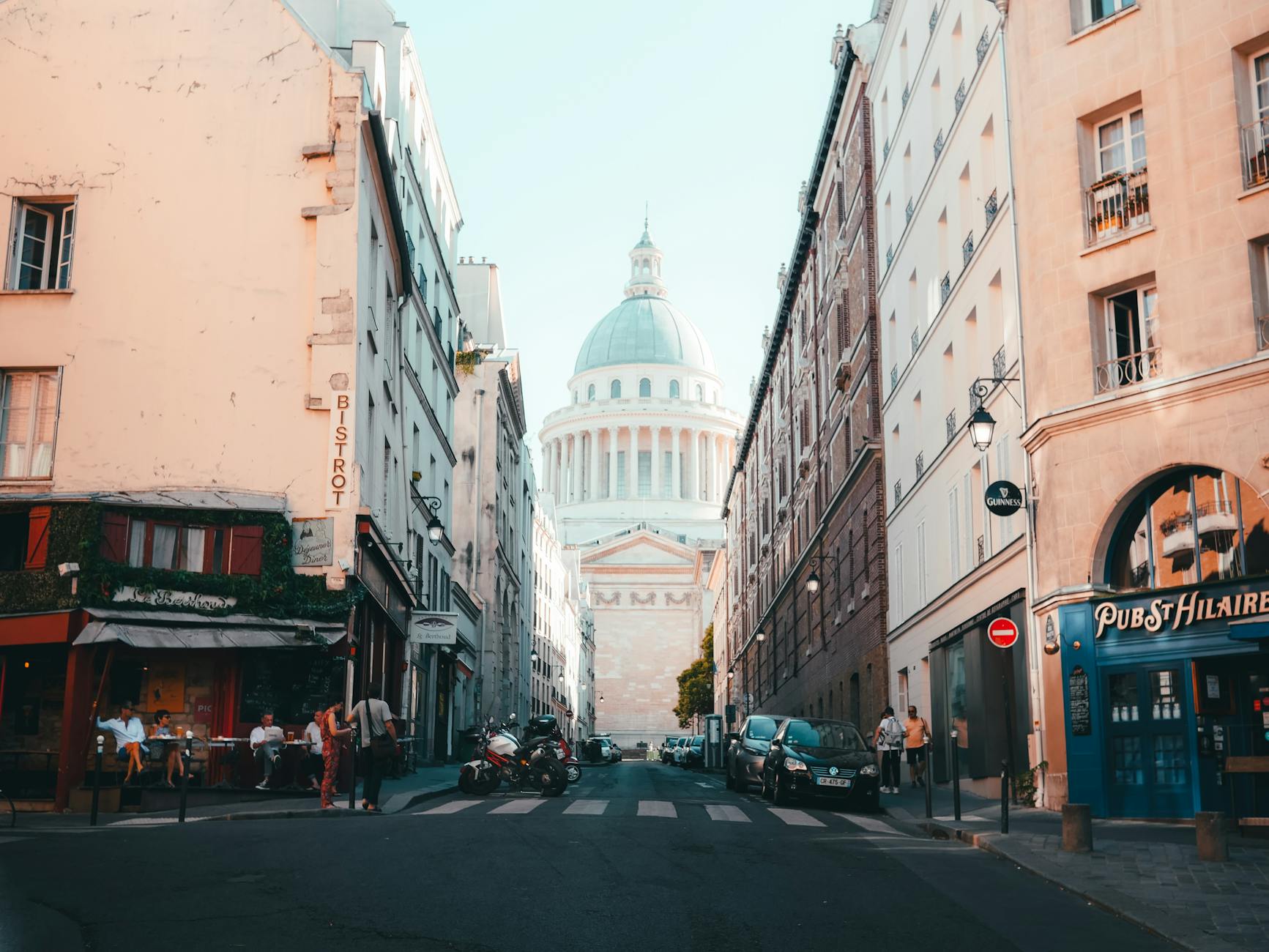
France buries its heroes here. The Pantheon Paris sits at the highest point of the Left Bank, a neoclassical mausoleum holding the country’s greatest secular figures: Voltaire, Rousseau, Victor Hugo, Marie Curie, Alexandre Dumas, Simone Veil, the Resistance fighter Missak Manouchian, and, in the most recent panthéonisation, Robert Badinter. The crypt gets the headlines, but the building has more to it than that. The 83m dome holds its own against St Paul’s in London, a Foucault pendulum still swings in the nave, and the rooftop walk (an €8 supplement) buys you one of the least-crowded great views in the city. Tickets run €13, free for under-18s and EU 18-25s, and you should budget about 90 minutes plus the dome climb.
This guide takes the building apart layer by layer: the tickets and timed-entry logistics, the five things actually worth your time in the nave and crypt, the full roll-call of the 81-plus people buried under the marble, the 206-step dome climb, the building’s farcical history of flipping between church and mausoleum, and a neighbourhood loop to hang your visit on. Maybe you’re here for the pendulum, or the dome view, or Marie Curie’s tomb. Maybe you’ve simply walked past the Pantheon a dozen times on your way to the top Paris sights of the Latin Quarter and finally want to go in. Either way, this is your working brief.
The Pantheon at a Glance
Here are the facts every first-time visitor actually asks about. Commit these to memory, then read on for the why behind them.
- Height: 84m tall to the top of the cross-less lantern
- Length: 110m long, Greek-cross floor plan
- Built: 1758-1790, 32 years of construction
- Originally: Church of Sainte-Geneviève, commissioned by Louis XV
- Converted: Secular mausoleum 1791, then back-and-forth across the 19th century
- Permanent mausoleum: since 1885 (Victor Hugo’s state funeral)
- Interments: 81+ figures in the crypt
- Annual visitors: 350,000+
- Ticket: €13 standard / FREE under 18 worldwide / FREE EU 18-25
- Closed: Tuesday
- Visit time: 90 min crypt + nave; +45 min optional dome climb
- Combined ticket with dome rooftop: €21
- Foucault pendulum: swings in the nave (replica of the 1851 original)
- Wall murals: 9 painted scenes depicting the life of Sainte-Geneviève
- Métro: Cardinal Lemoine (Line 10), Maubert-Mutualité (Line 10), or Luxembourg (RER B)
Visiting the Pantheon: Tickets, Hours, Logistics
The Pantheon is run by the Centre des Monuments Nationaux, the same outfit behind Sainte-Chapelle, the Conciergerie, and the Arc de Triomphe. That works in your favour: pricing is consistent, hours are predictable, and the audio-guide system is the one you’ll meet at every other CMN site. Two tickets matter here. The standard one covers the nave and crypt; the combined one adds the rooftop dome walk.
The Pantheon only ticket is €13 for adults. It’s FREE for anyone under 18 worldwide, and FREE for EU citizens aged 18-25, so bring photo ID that shows your nationality and date of birth. The first Sunday of every month from November through March is free for everyone too, though the queues stretch out. The Pantheon + Dome rooftop combined ticket is €21, and unless the weather is grim or you genuinely can’t manage stairs, take it: the dome climb is the single most distinctive thing you’ll do here.
Audio guides are €5 at the ground-floor desk, in English, French, Spanish, Italian, and Mandarin. They earn their keep here, because the art and inscriptions are thick with French historical references that the wall labels barely gesture at.
Opening hours split by season. April 1 through September 30, the monument runs 10am to 6:30pm. October 1 through March 31, it shuts at 6pm. Last entry is 45 minutes before close, and the dome climb closes earlier than that, so if you want to go up, arrive at least 90 minutes before closing. The Pantheon is shut every Tuesday, plus January 1, May 1, and December 25.
The Paris Museum Pass covers the Pantheon’s nave and crypt, but not the dome supplement. It’s sold as €70 for 2 days, €85 for 4 days, and €105 for 6 days, and it pays for itself fast once you’re hitting three or more covered sites. Buy tickets online at monuments-nationaux.fr (the official site) or in person at the ground-floor office, which takes cash and card.
Time needed: 90 minutes for the nave and crypt at a steady pace, plus another 45 for the dome. Block out a flat 2.5 hours for the full visit with an audio guide. The nearest Métro stops are Luxembourg (RER B), Cardinal Lemoine (Line 10), and Maubert-Mutualité (Line 10), all a 5-8 minute walk. Wheelchair access covers the ground-floor nave and the crypt below; the dome climb has no elevator, so it’s out.
| Ticket | Price | Notes |
|---|---|---|
| Pantheon only (nave + crypt) | €13 | Standard adult |
| Under 18 worldwide | FREE | Photo ID required |
| EU 18-25 | FREE | EU passport or ID |
| Pantheon + Dome rooftop | €21 | Includes 206-step climb |
| Audio guide | €5 | 5 languages |
| First Sunday Nov-Mar | FREE | Expect longer queues |
| Paris Museum Pass | €70 / €85 / €105 | 2/4/6 days, dome not included |
The 5 Things to See Inside the Pantheon
This is no sprawling museum. It’s a single vast room with a crypt underneath, and that simplicity is half the appeal. Five things make up almost the entire visit: the nave with its swinging pendulum, the painted dome above it, the side-chapel murals, the crypt below, and the bronze entrance doors. Give each a moment.
The Nave & Foucault Pendulum
Through the bronze doors you step into a 110m-long Greek-cross nave that climbs 80m to the painted dome. It feels colder and stonier than most cathedrals, and that’s by design: the architect Jacques-Germain Soufflot threw out Gothic verticality in favour of a Greek-Roman temple. Your eye goes up, then forward, then lands on the thing at the centre of the nave, the Foucault pendulum.
In 1851 the physicist Léon Foucault gave the first public demonstration of the Earth’s rotation right here, hanging a 28kg lead-coated copper sphere from the dome on a 67m brass wire. As the sphere swings, its plane of oscillation seems to rotate over the course of a day. The trick is that the pendulum isn’t turning; the Earth is turning underneath it. It was the first non-astronomical proof that the planet spins on its axis, and it made Foucault a national celebrity overnight. The original 1851 pendulum now lives at the Musée des Arts et Métiers in the 3rd arrondissement; a faithful working replica swings in the Pantheon nave, and if you stand and watch, you can see its arc creep against the floor markers minute by minute.
The Dome & Frescoes
Look straight up. The inner dome floats 83m above the floor, crowned by Antoine-Jean Gros’s 1813 ceiling painting The Apotheosis of Sainte Geneviève, which shows the patron saint of Paris rising into heaven among kings and angels. The painting outlasted every regime change of the 19th century for a simple reason: each new regime found something in it to claim. Royalists liked the king, republicans liked the patron saint, and Napoleon liked the imperial frame.
Wall Murals (the Sainte-Geneviève Cycle)
The side chapels hold three of the four sets of 19th-century wall murals by Pierre Puvis de Chavannes tracing the life of Sainte-Geneviève, the 5th-century shepherdess credited with turning Attila the Hun away from Paris by leading the city in prayer. Puvis painted them between 1874 and 1898, and they’re now reckoned his masterpiece: pale, quiet, almost fresco-like. A generation later they fed straight into the work of Picasso and Gauguin.
The Crypt
A broad stone staircase drops from the nave into the crypt, a run of underground burial chambers fanning out from a central rotunda. Every tomb is a marble sarcophagus with a wall plaque giving the dates and a short epitaph in French. It’s cool, hushed, and dim, and a lot of visitors will tell you it’s the part of the building that stays with them. Voltaire and Rousseau face each other in the entrance chamber. Marie Curie and her husband Pierre lie together in a side gallery. Victor Hugo, Alexandre Dumas, and Émile Zola share a chamber at the back. Give the crypt 30-40 minutes and walk it slowly.
The Bronze Doors
On your way in or out, stop at the bronze entrance doors by Jean-Auguste Heim, cast in 1815. They show scenes from the Book of Revelation, the four horsemen, the seven seals, the woman clothed with the sun, and they’re the last surviving trace of the building’s life as a church. Look closely at the dense relief near the central seam; you’ll miss it from a distance, but it rewards a hard look.
Who’s Buried in the Pantheon: 81+ Famous Figures
More than 81 people rest in the crypt, and the list reads like a running catalogue of who France counts as its great men and women across two and a half centuries. The call to panthéoniser someone belongs to the President personally, made after consulting the family and lining up whatever political consensus the moment allows. The upshot is a curated self-portrait of the Republic: philosophers and scientists, Resistance heroes and civil-rights pioneers, and, more and more in recent decades, the women and immigrants the original 19th-century intake left out.
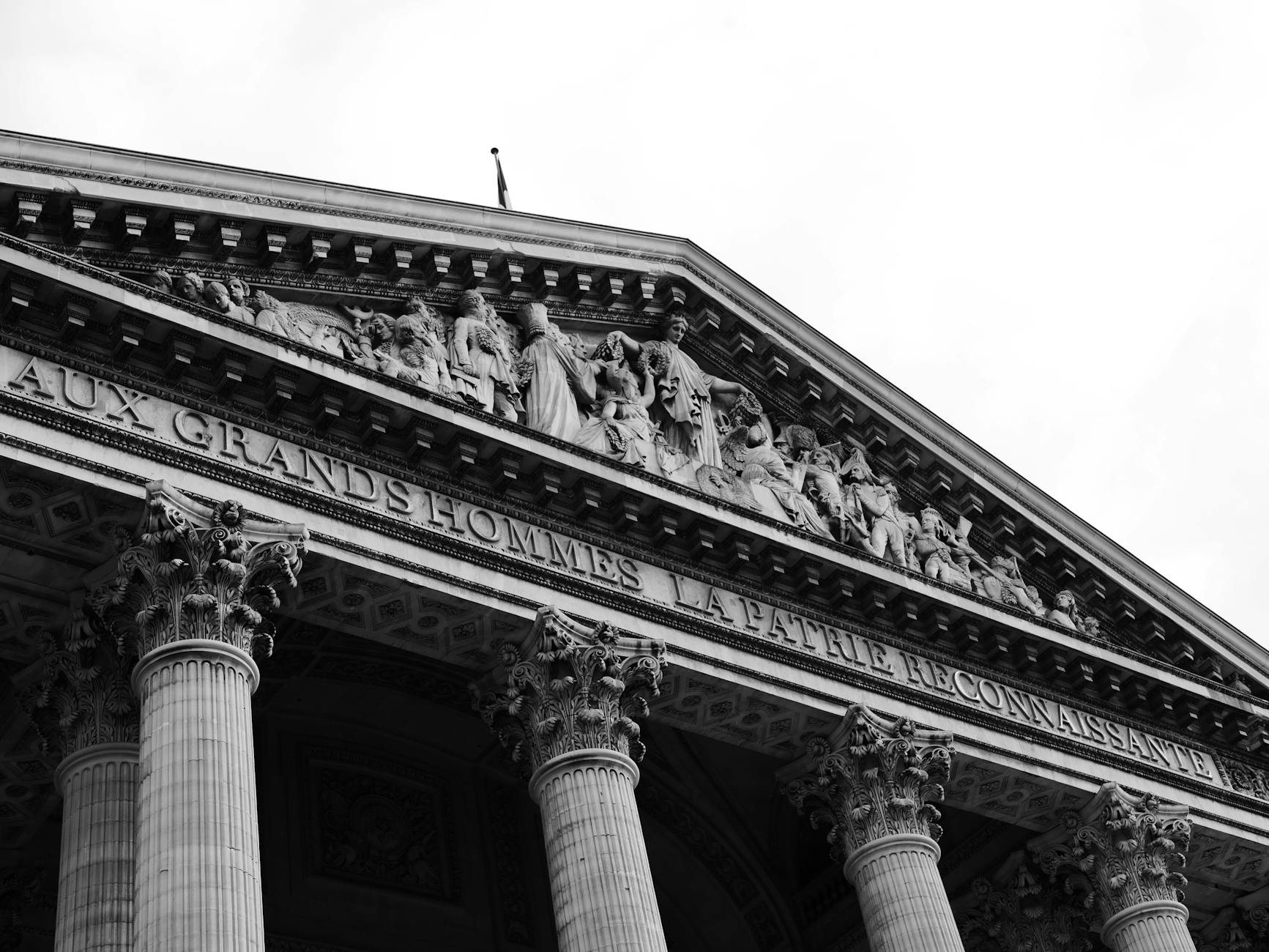
Voltaire (François-Marie Arouet) was the first one in, in April 1791. The Enlightenment philosopher had died in 1778 and been buried at the Abbey of Scellières. When the National Assembly decided to turn the not-yet-consecrated church into a secular mausoleum, his remains were carried into Paris in a torchlit procession, and his sarcophagus took the line that would become the building’s motto: Aux grands hommes, la patrie reconnaissante, “To the great men, the grateful homeland.”
Jean-Jacques Rousseau arrived in 1794, his sarcophagus set directly opposite Voltaire’s, which is a fine irony given the two spent much of their lives feuding in public. Jean Lannes, one of Napoleon’s most decorated marshals, was interred in 1810 after dying of wounds at the Battle of Aspern-Essling. Members of the Marquis de Lafayette family are here too, stitching the building’s memory back to the American and French Revolutions.
Sadi Carnot, the assassinated President of the Republic, came in 1894. Émile Zola, whose J’Accuse…! defence of Alfred Dreyfus defined a generation of intellectual nerve, was moved from the Cimetière de Montmartre in 1908. Jean Jaurès, the socialist leader assassinated on the eve of the First World War, was interred in 1924, the first figure of the political left honoured at this scale. Marcellin Berthelot, the chemist who built organic compounds from inorganic ones, was interred in 1907 with his wife Sophie, the only couple here honoured together rather than separately. Paul Painlevé, mathematician and twice prime minister, joined in 1933.
Louis Braille, who invented the raised-dot reading system used by blind people everywhere, was interred in 1952; by tradition his fingertips stayed in his hometown of Coupvray. Jean Moulin, the Resistance leader tortured to death by Klaus Barbie in 1943, was panthéonised in 1964 in one of the most famous ceremonies in modern French history. André Malraux delivered the speech, “Entre ici, Jean Moulin…,” that French schoolchildren still memorise. Malraux himself, the novelist turned De Gaulle’s culture minister, was interred in 1996.
Marie Curie was interred in 1995 beside her husband Pierre, the first woman panthéonised for her own science rather than as someone’s wife. She is still the only person to win Nobel Prizes in two different sciences, physics in 1903 and chemistry in 1911, and her remains are faintly radioactive even now, which is why her lead-lined coffin sits inside a second protective casing. Alexandre Dumas, who wrote The Three Musketeers and The Count of Monte Cristo, was interred in 2002, his sarcophagus draped in the blue velvet of his musketeers.
Aimé Césaire, the Caribbean poet and anti-colonial thinker who coined négritude, got a memorial plaque in 2011 rather than a tomb, since he chose to be buried in Martinique. Simone Veil, the Holocaust survivor and women’s rights champion who as Health Minister legalised abortion in France in 1974, was interred in 2018 with her husband Antoine. Maurice Genevoix, whose memoirs of First World War trench life shaped French collective memory, was interred in 2020.
Joséphine Baker, the American-born entertainer who became a French citizen, served the Resistance as a Free French spy in the Second World War, and campaigned for American civil rights afterward, was interred in 2021, only the sixth woman among the 81-plus figures honoured. Her cenotaph is in the entrance chamber, as she chose to be buried in Monaco. Missak Manouchian and his wife Mélinée, Armenian-French Resistance fighters whose immigrant unit of the Francs-Tireurs et Partisans was wiped out by the Nazis in 1944, were interred in February 2024, the first immigrants honoured at the Pantheon. Robert Badinter, the Justice Minister who abolished the French death penalty in 1981, was panthéonised in October 2025, the most recent arrival in the crypt.
One tip on Victor Hugo: he lies in a separate side crypt to the left of the main chamber, in a tomb shared with Alexandre Dumas and Émile Zola, the three greatest French novelists of the 19th century lined up together. Don’t walk past it. It’s the emotional heart of the crypt, and it’s easy to miss if you just follow the main loop.
The Dome Climb: 206 Steps to Paris’s Hidden View
If you do one thing beyond the standard visit, climb the dome. An €8 supplement on top of the standard ticket, €21 total for the combined version, buys you one of the least-crowded great panoramas in Paris: no elevator queue, no booking ritual.
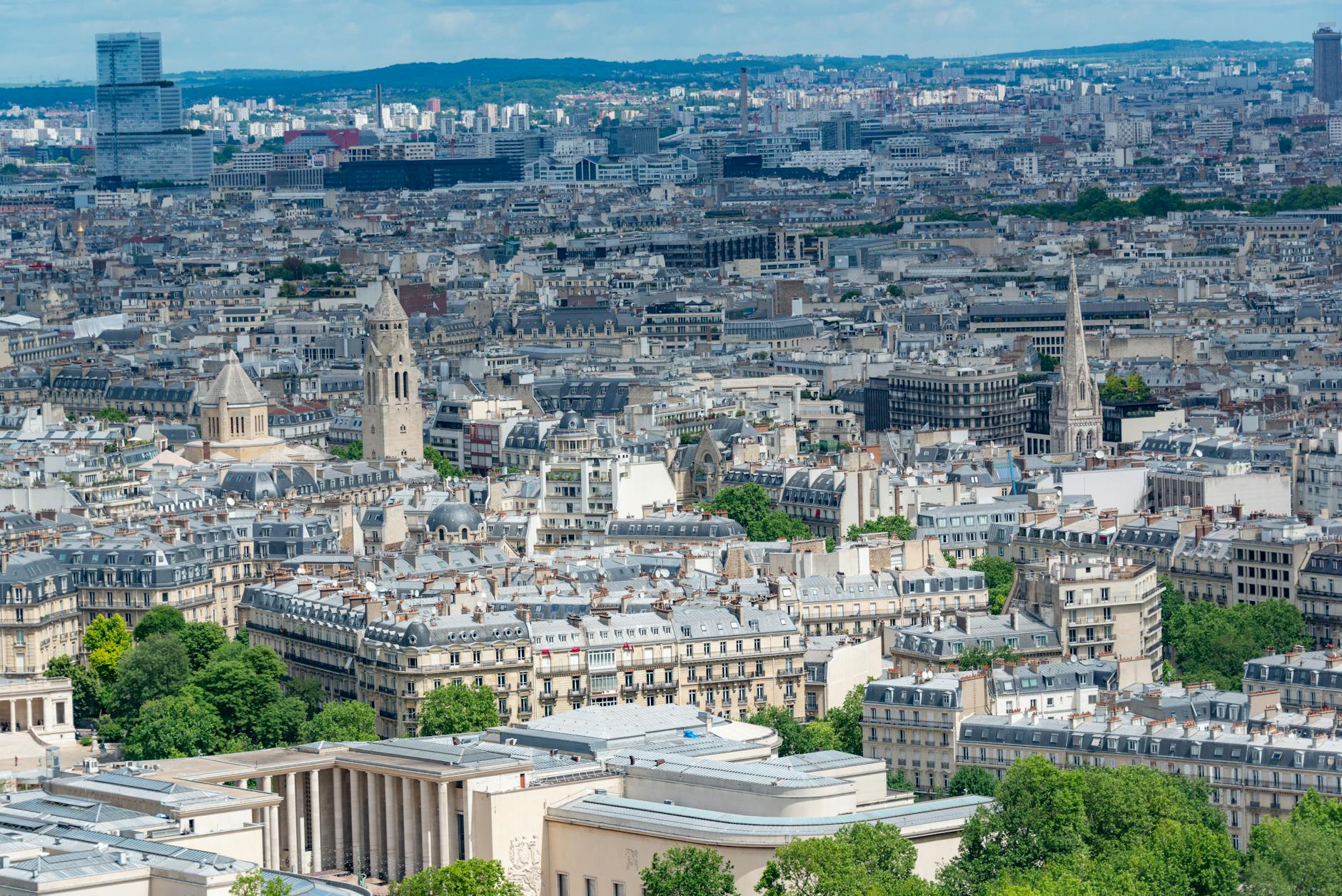
It’s 206 spiral steps, done in two stages with a mid-platform stop where you can get your breath back, read the panels on how the dome was built, and look down on the nave from above. The first level sits 33m up and opens onto the Latin Quarter rooftops, all slate and zinc and chimneys and antennae. The second level, the colonnade wrapping the outside of the dome, is 80m up, and that’s where it pays off: a panoramic 360-degree view of Paris from a height most visitors never reach.
From the colonnade you get the Eiffel Tower head-on to the west, the Sacré-Coeur dome over Montmartre to the north, the Notre-Dame towers along the Seine, the Sorbonne’s smaller blue-grey dome a few hundred metres off, the Luxembourg Gardens canopy directly south, the Seine snaking east toward the Bercy bend, and the La Défense skyline beyond the Bois de Boulogne on a clear day. Walk the full circuit, because the view changes at every quarter of the colonnade. You also get the Pantheon’s own dome from underneath, the outer drum, the lantern, the ribs, which you can’t see from anywhere else.
The climb is not wheelchair accessible; there’s no elevator. It also closes in bad weather: winds above 70 km/h, lightning, or heavy rain will shut the rooftop until things settle. If the sky looks marginal, check the daily-status board at the ground-floor desk before you pay for the supplement.
The best time to go up is 60-90 minutes before sunset, when the light turns golden and the eastward cityscape glows amber. Sunset itself is spectacular, but the crowd bunches up in the final 15 minutes, so arriving early hands you the magic hour to yourself. The Pantheon’s dome is far quieter than the Eiffel Tower summit or the Arc de Triomphe terrace, and in the off-season, November through March on a weekday morning, you might have the colonnade almost to yourself.
Order of operations matters. Do the nave and crypt first (60-90 min), then climb the dome (45 min including time on the colonnade). Don’t do it the other way round. Climb first and your tired legs will hurry you through the crypt, and the crypt is the reason you came.
History: From Church to Mausoleum and Back
Few buildings in Paris have swapped identities as often as this one. Church, mausoleum, church, mausoleum, church, mausoleum, all across one turbulent century, and its current job as a secular shrine to the Republic’s greats wasn’t settled until 1885. That whiplash history is why the place feels sacred and civic at the same time, and why its art puts Christian saints next to Enlightenment philosophers.
The hilltop under the Pantheon has been holy ground since the 5th century, when Sainte-Geneviève (c.422-512), the patron saint of Paris, was buried at the summit. The abbey church that grew around her tomb became a major medieval pilgrimage site and gave the hill its name, the Montagne Sainte-Geneviève. By the 18th century that medieval church was worn out and unsafe.
In 1744, gravely ill at Metz, King Louis XV vowed that if he pulled through he’d rebuild the church on a scale worthy of the saint. He pulled through, and in 1755 the architect Jacques-Germain Soufflot was hired to design a Greek-cross neoclassical replacement, drawing on St Peter’s in Rome and St Paul’s in London but with a structural lightness French Enlightenment engineering could finally pull off. Work started in 1758 and ground on for 32 years. Soufflot died in 1780, having seen only the foundation and lower walls go up; his pupil Jean-Baptiste Rondelet finished the building in 1790.
Then, in 1791, with the Revolution in full swing and the church still unconsecrated, the National Assembly grabbed its chance and turned the building into a secular mausoleum for great Frenchmen. Voltaire went in that April, and the entrance pediment was carved with Aux grands hommes, la patrie reconnaissante. It was the first of many flips. 1806: Napoleon, mending fences with the Catholic Church, restored it as a church while keeping the crypt as a mausoleum. 1830: the July Revolution swung it back to a mausoleum. 1851: Foucault ran his pendulum experiment here. 1873: the conservative Third Republic made it a church again. 1881: the moderate Third Republic switched it back to a mausoleum.
The conversion that finally stuck came in 1885, with the state funeral of Victor Hugo. Two million people lined the streets of Paris on June 1, 1885 to watch the catafalque pass, and the National Assembly used the moment to lock in the Pantheon’s identity as a mausoleum to the great men and women of France for good. The pediment motto was finalised, the cross came off the lantern, and the building has been a secular mausoleum ever since.
The 20th and 21st centuries have been the period of opening it up: 1995, Marie Curie, the first woman interred on her own merit; 2018, Simone Veil; 2021, Joséphine Baker; 2024, Missak Manouchian, the first immigrant; 2025, Robert Badinter. Each panthéonisation is a deliberate act of national memory, and each one tells you something about the kind of country France wants to be at that particular moment.
The Quarter Around the Pantheon: Latin Quarter Loop
The Pantheon sits in the thick of one of the densest cultural neighbourhoods in Paris, so the smart play is to fold it into a short loop with two or three stops on foot. Here’s the working route, with rough walking times from the entrance.
- Sorbonne University (5 min west) — oldest university in France, founded 1257; the main courtyard is partly open to visitors and the Sorbonne chapel is a fine piece of 17th-century classical architecture
- Musée National du Moyen Âge / Cluny (10 min walk) — medieval museum in a 15th-century mansion built over Roman baths; home of the Lady and the Unicorn tapestries; reopened 2022 after a major renovation
- Jardin du Luxembourg (10 min south) — the Senate gardens; toy sailboats on the octagonal pond, chess players in the orchard, the Medici Fountain tucked in a quiet corner
- Saint-Étienne-du-Mont (5 min, free) — gothic church right behind the Pantheon; holds Blaise Pascal’s tomb and the only surviving rood screen in Paris
- Saint-Séverin (10 min, free) — flamboyant gothic church with palm-vault columns near the Seine
- Shakespeare and Company (15 min, free entry) — the famous English-language bookstore opposite Notre-Dame, founded by George Whitman in 1951
- Rue Mouffetard market street (15 min south) — pedestrianised cobbled market street with bakeries, cheese shops, fishmongers, and falafel stands
- Place de la Contrescarpe — small square at the top of Rue Mouffetard; Hemingway lived at 74 Rue du Cardinal Lemoine, a block away
- Café Le Procope (15 min walk) — the oldest café in Paris, opened 1686, at 13 Rue de l’Ancienne Comédie; haunt of Voltaire, Rousseau, Diderot, Benjamin Franklin, and Napoleon
- Jardin des Plantes (15 min southeast) — the national botanical garden, with a small but historic zoo, the Grande Galerie de l’Évolution, and the Mosquée de Paris next door
A full Pantheon-plus-loop afternoon might go: 10am Pantheon (nave, crypt, dome, 2.5 hours), 12:30pm lunch on Rue Mouffetard, 2pm Cluny Museum (1.5 hours), 3:30pm Luxembourg Gardens (1 hour), 4:30pm coffee at Café Le Procope. For more structured routes, see our Paris walking tours and the Paris neighborhoods guide. If you’re pairing this with a Right Bank museum day, the Louvre Museum guide handles that loop separately.
Best Time to Visit & Crowd Notes
The Pantheon never sees Louvre-level crowds, and that’s its quiet practical advantage as a Paris attraction. Even at peak summer the entry queue is 5-15 minutes, and there are always quiet corners inside. There are still better and worse windows, though.
- Weekday mornings 10am-noon: the lowest crowds. In low season (November-March, holidays aside) a near-solo visit is possible
- Weekday afternoons 3-5pm: moderate crowds, and the late-afternoon light through the dome oculus is the best of the day
- Weekend afternoons: busier, Saturdays after 1pm especially; school groups cluster mid-morning on weekdays in term time
- Tuesday: closed
- First Sunday Nov-Mar: free entry; reckon on a 20-30 minute line, though the visit itself is unchanged
- National Heritage Days (3rd weekend of September): free entry plus special access to areas normally off-limits (the upper galleries, behind-the-scenes crypt chambers); very busy, but a rare chance
So: don’t let crowd worries scare you off the Pantheon. Even peak summer is manageable here. If you have any flexibility, aim for a Wednesday or Thursday morning between October and April.
Photography & What to Look For
You can shoot anywhere in the Pantheon, just no flash. Bring a wide-angle lens if you own one, because the nave is too tall for a standard 35-50mm to take in without serious cropping, and pack a small tripod for the dim crypt (tripods are allowed, but be ready to fold yours if staff ask).
- The pediment inscription: “Aux grands hommes, la patrie reconnaissante,” the iconic facade carving; shoot it from across the square in morning sun
- The 22-column Corinthian portico: the most photographed feature of the building, the columns framing the pediment
- The Greek-cross floor plan: visible from the dome colonnade, where the symmetry of the layout finally reads
- Wall murals by Puvis de Chavannes: shoot the Sainte-Geneviève cycle in order, from her childhood to her stand against Attila
- The Foucault pendulum: 67m wire, 28kg sphere, a slow swing creeping against the floor markers; a long exposure of 1-2 seconds catches the arc beautifully
- The cupola: the 83m-high inner painting from the nave floor; the outer dome shoots best from the southeast corner of the upper walk
- The crypt: photography allowed without flash; please respect the tombs and don’t pose for selfies in front of individual sarcophagi
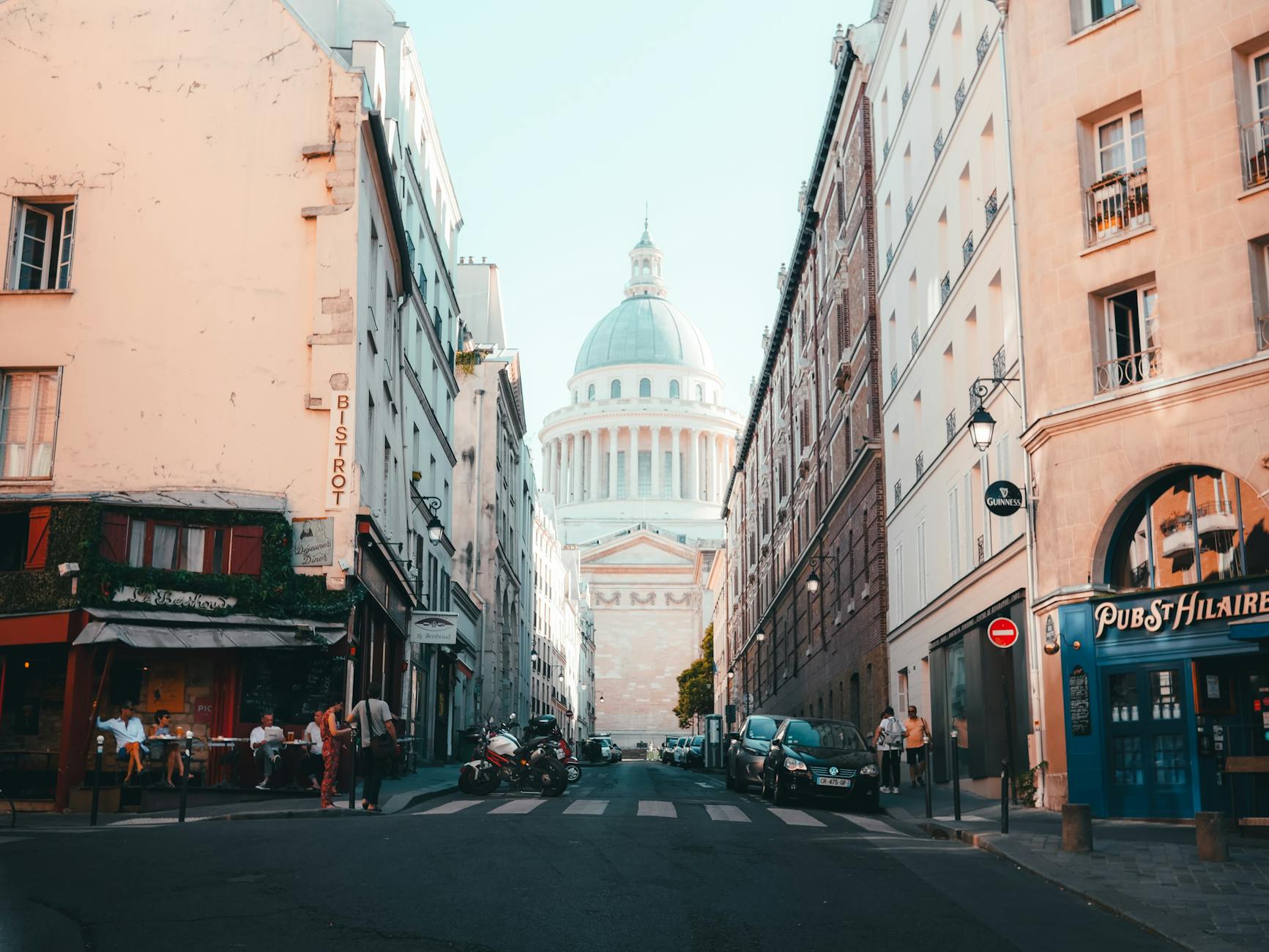
The best exterior spot for the facade is the Place du Panthéon straight across the square, ideally in morning light when the sun rakes the columns from the east. For the best exterior dome shot, stand on Rue Soufflot and look up the steep street toward the building; the road rises and the dome seems to float at the top. For more locations across the city, see Paris photo spots.
Visiting with Kids
The Pantheon works for families with kids of roughly 8 and up. Younger children may find the crypt slow and the murals abstract. Even so, the building has enough wow factor to hook a curious child of any age if you set them up for it.
- Foucault pendulum: the slow swing is hypnotic, and the physics is graspable for upper-primary kids; it runs continuously, no fixed showtime
- Crypt of famous figures: children who’ve heard of Marie Curie, Voltaire, or Alexandre Dumas (Three Musketeers fans) light up at standing a few feet from the actual tomb
- Dome climb: fitness allowing, ages 6 and up can usually handle the 206 steps with rest stops, and kids love the view
- Cost: FREE entry for under-18s means two parents and two kids pay just €26 (or €42 with the dome supplement for the adults)
- Restrooms: free WC inside near the nave entrance
- Visit length: cap it at 60-90 minutes with younger kids before restlessness sets in
- Pair with Luxembourg Gardens: playground, toy boats on the pond, weekend pony rides, the perfect reward 10 minutes south
For more family-tested itineraries, see our guide to Paris for families.
Practical Tips & Etiquette
A few logistical and behavioural notes that separate a smooth visit from an awkward one.
- Speak quietly in the nave and crypt. This is a working mausoleum, not a museum, and plenty of French visitors come to pay respects
- No flash photography in the crypt; standard photography is fine
- Bags x-rayed at the entrance; oversized bags and suitcases are not allowed
- Dress modestly: shoulders covered is a sensible rule; there’s no enforced dress code, but the building’s Catholic history means many visitors dress respectfully
- Free WC inside near the nave entrance
- Photography permission: allowed in all permanent areas; temporary exhibitions may restrict it
- Audio guide: €5 at the desk, recommended for first-timers
- Eat nearby first: there’s only a small snack stand inside; Rue Soufflot and Rue Mouffetard both have far better options
- Combine with Cluny + Luxembourg Gardens for a complete Left Bank afternoon (see Section 7 above)
- Cloakroom: free for coats and small bags, so arrive light
For a wider museum-day strategy across Paris, see our Paris museums guide.
Frequently Asked Questions
How much does it cost to visit the Pantheon Paris in 2026?
The standard adult ticket is €13 for the nave and crypt. The combined ticket with the dome rooftop climb is €21. Audio guides are €5. Entry is FREE for anyone under 18 worldwide, FREE for EU citizens aged 18-25 with ID, and FREE for everyone on the first Sunday of each month from November through March.
Who is buried in the Pantheon Paris?
More than 81 figures, among them Voltaire, Jean-Jacques Rousseau, Victor Hugo, Alexandre Dumas, Émile Zola, Marie and Pierre Curie, Louis Braille, Jean Moulin, André Malraux, Simone Veil, Joséphine Baker, Missak and Mélinée Manouchian, and most recently Robert Badinter (panthéonised October 2025). The list runs from Enlightenment philosophers and scientists to writers, Resistance fighters, and civil-rights advocates.
Can you climb the Pantheon dome?
Yes. The dome climb is a 206-step spiral staircase up to a colonnade 80m above ground with a 360-degree view of Paris. It costs an €8 supplement on top of the standard ticket (€21 combined). It’s not wheelchair accessible, and it closes in high winds, lightning, or heavy rain.
Is the Pantheon Paris free for under 18?
Yes. Entry is FREE for all visitors under 18, whatever their nationality. EU citizens aged 18-25 also get in free with photo ID showing nationality and date of birth. That makes a family visit cheap: two parents and two children under 18 pay only €26 for the standard ticket (or €42 including the dome supplement for the adults).
How long does it take to visit the Pantheon?
Allow 90 minutes for the nave and crypt at a normal pace, plus 45 minutes for the optional dome climb. A full visit with audio guide and dome comes to 2.5 hours. If you’re pressed and skip the dome, you can do it in 60 minutes.
When was the Pantheon converted to a mausoleum?
It first went from unconsecrated church to secular mausoleum in 1791, during the Revolution, when Voltaire was interred. It then flipped between church and mausoleum across the 19th century, back to a church in 1806, mausoleum again in 1830, church in 1873, mausoleum in 1881, before Victor Hugo’s state funeral in 1885 fixed its identity as a permanent mausoleum.
Is the Pantheon Paris worth visiting?
Yes, especially if you care about French history, Enlightenment philosophy, science, or a good city view. The Foucault pendulum alone justifies the trip for science-minded travellers, the crypt moves the literary ones, and the dome serves up one of the least-crowded great Paris panoramas. At €13 (or €21 with the dome) it’s one of the better-value major attractions in the city.
Is the Foucault pendulum at the Pantheon working?
Yes. A working replica swings continuously in the nave, demonstrating the Earth’s rotation just as Léon Foucault’s original did in 1851. The original 1851 pendulum is kept at the Musée des Arts et Métiers in the Marais. The Pantheon’s replica uses the same specs: a 28kg lead-coated copper sphere on a 67m brass wire from the dome.
Continue Exploring Paris
The Pantheon belongs to the larger story of Paris attractions and the Left Bank’s monumental heritage. From here you can fan out into the rest of our pillar guides: dining and bistro culture, Right and Left Bank neighbourhoods, museum strategy, day trips beyond the périphérique, family itineraries, photography routes, and seasonal events. Inside the attractions cluster specifically, pair this guide with our deep-dives on the Eiffel Tower, the Louvre, Notre-Dame, the Arc de Triomphe, Sainte-Chapelle, the Conciergerie, Sacré-Coeur, the Opéra Garnier, and the Centre Pompidou to map out a full week of major monuments.
For a working Latin Quarter day, walk the loop in Section 7: Pantheon, Saint-Étienne-du-Mont, Cluny Museum, Luxembourg Gardens, and Rue Mouffetard. For more structured routes, see Paris walking tours, the Paris neighborhoods guide, Paris photo spots, Paris with kids, and the Paris museums guide.
More to explore
Use these to round out your trip: