Paris Food Guide: The Ultimate Culinary Journey Through the City of Light
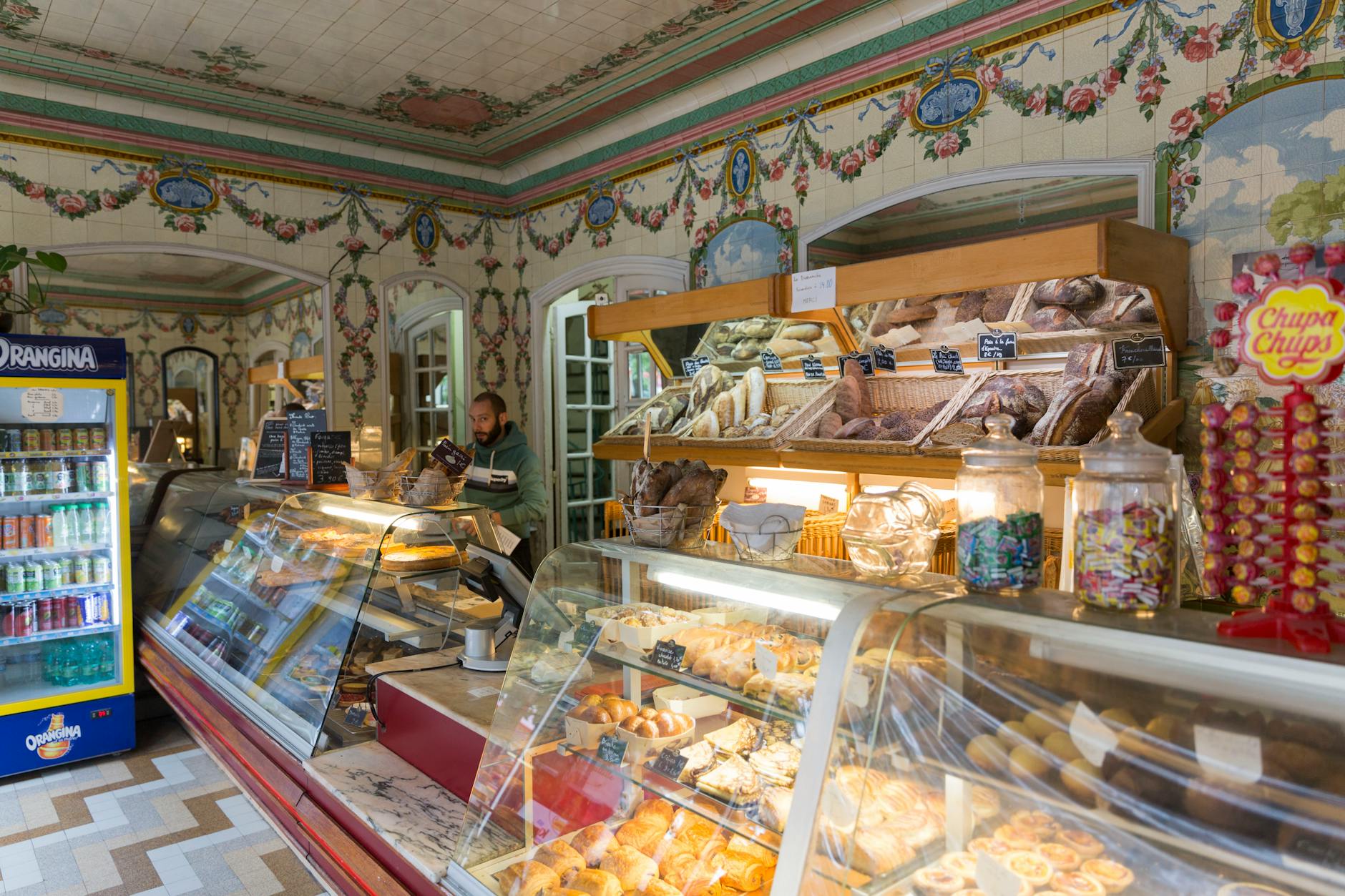
The first true restaurant opened in Paris in the 1760s, on a since-vanished street called Rue des Poulies. Two and a half centuries later the city counts over 130 Michelin-starred kitchens and roughly 9,000 cafés, and it still sets the rules everyone else cooks by. That is the thread this Paris food guide follows, from the croissant you tear apart standing at a counter at seven in the morning to the twelve-course tasting menu you sit down to at eight at night.
Maybe this is your first time and you just want to know what to actually order. Maybe you’ve been before and you’re hunting for the bistro nobody’s blogged about yet. Either way, what follows covers the dishes worth crossing town for, the neighborhoods that reward an empty stomach, the etiquette that gets you treated like a regular instead of a tourist, and the money-saving moves locals use without thinking. It’s organized so you can build meals around your budget and your appetite rather than reading it front to back.
The reputation wasn’t handed to Paris; it was earned slowly. French cuisine landed on UNESCO’s Intangible Cultural Heritage list in 2010, and the city remains the engine room of that tradition. What keeps it interesting now is the friction between the old canon and a younger crowd of chefs folding global influences into French fundamentals, often in dining rooms the size of a studio apartment.
Essential French Dishes Every Visitor Must Try in Paris
Before you start picking restaurants, it helps to know the dishes by name. These are flavors that have circled the globe, but they taste like a different food entirely at the source, and most of them better. Knowing what to order is half the battle in any Paris food guide, so start here.
Breakfast and Pastry Classics
The Parisian morning starts at the boulangerie, and the croissant is the thing to get right first. A good one is built from laminated butter dough that shatters when you bite it and gives way to an interior so soft it’s nearly custard. The dense, dry pastry passed off as a croissant abroad is a different object. One quick filter: look for the Artisan Boulanger certification in the window, which means everything is made on site from scratch rather than baked off from a frozen supplier.
The croissant has relatives worth meeting. Pain au chocolat folds dark chocolate batons into the same dough. Pain aux raisins spirals vanilla pastry cream around plump raisins. Chausson aux pommes is a half-moon apple turnover with edges that caramelize into something close to candy. When you want more than pastry, the croque monsieur stacks ham and gruyère between toasted bread under a layer of béchamel, the French rebuttal to grilled cheese, and the croque madame crowns it with a fried egg.
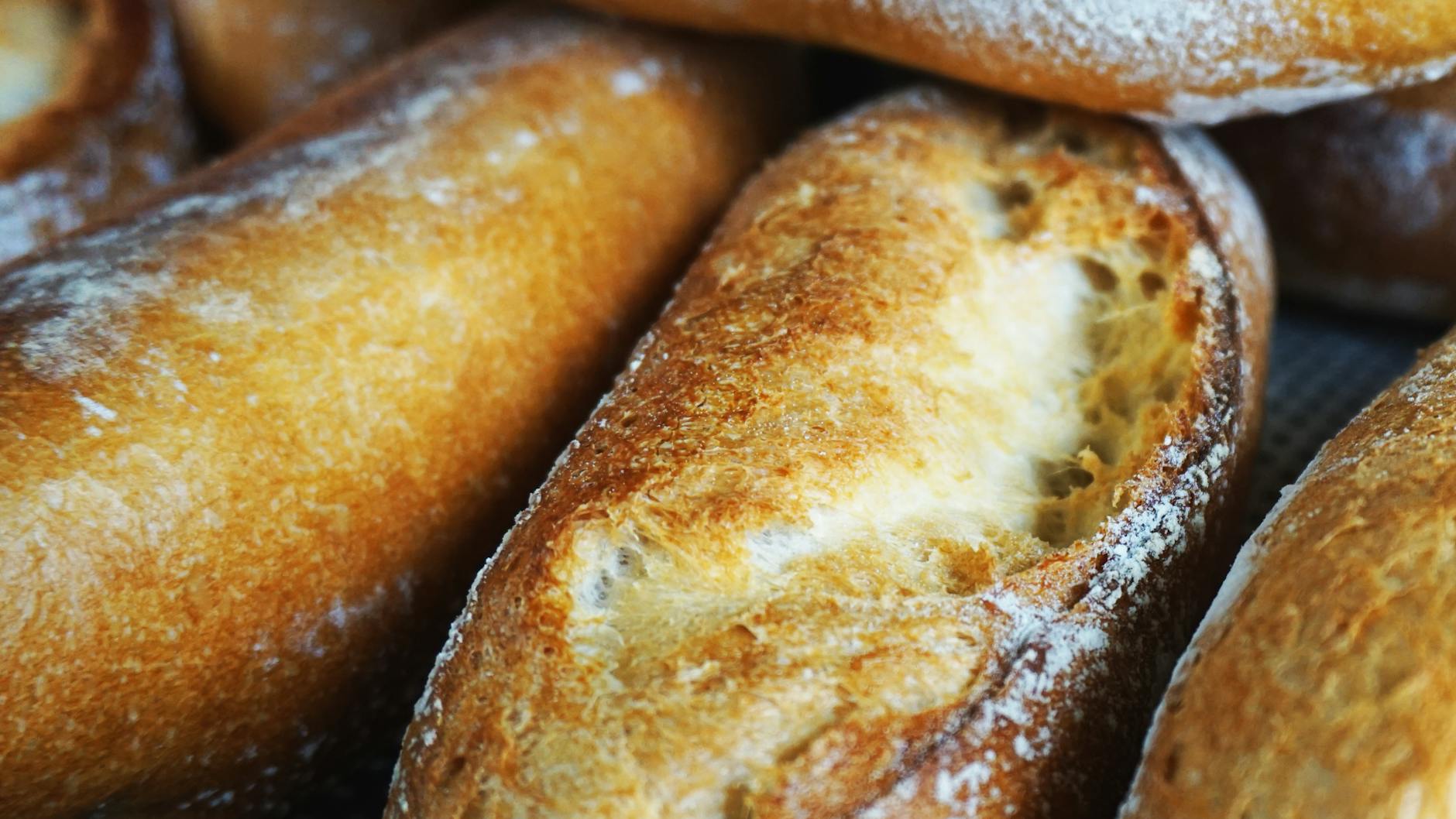
The baguette tradition earns its own paragraph. In 2022 the baguette itself joined the UNESCO Intangible Cultural Heritage list, and Paris takes it seriously enough to run an annual Grand Prix de la Baguette, where the winning baker supplies the Élysée Palace for a year. A real baguette tradition has a crust that crackles, an open and irregular crumb, and a wheaty, faintly sour flavor. Hold one next to supermarket bread and the supermarket loaf tastes like packaging.
Classic Main Courses
Steak frites is the dish I’d order to size up any bistro. A thick-cut entrecôte or bavette, seared exactly to the doneness you asked for, served with a heap of double-fried fries. The good versions arrive with sauce béarnaise or sauce au poivre on the side. A kitchen that nails this one plate is rarely bad at anything else.
Coq au vin turns a tough old rooster into a deep, winey braise with pearl onions, lardons, and mushrooms, built on red Burgundy. Boeuf bourguignon runs the same playbook with beef, slow-cooked in wine until it surrenders. Duck confit (confit de canard) came north from the southwest and is now a Parisian fixture: the leg gets salt-cured and cooked slowly in its own fat until the meat goes meltingly tender under a skin that crackles, usually plated with pommes sarladaises, potatoes fried in duck fat. It is not a light lunch.
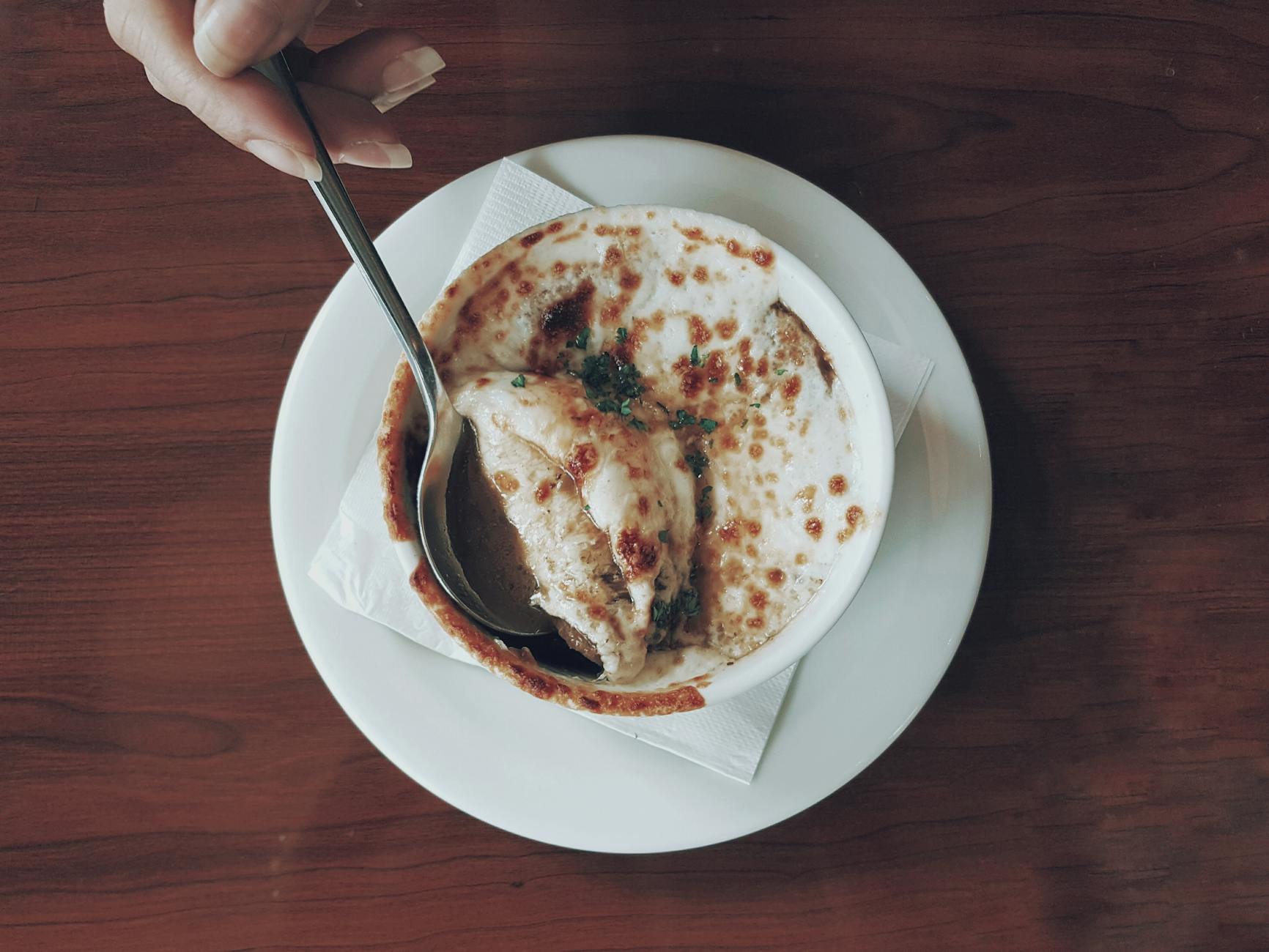
French onion soup (soupe à l’oignon gratinée) is Paris in a bowl. Onions caramelized for hours in rich beef broth, ladled over crusty bread, buried under gruyère, then broiled until the cheese blisters. It started as fuel for the market porters working the early shift at Les Halles, and on a cold January night it’s still one of the most comforting things in the city.
Appetizers and Small Plates
Escargots de Bourgogne, snails baked in their shells under a compound of parsley, garlic, and butter, are about as French as a starter gets. The snails are almost beside the point; the garlicky butter is the reason you ordered them, so keep bread on hand to wipe the dish clean. Foie gras holds its place at the center of French cooking too, whether it comes as a silky terrine with toast points and confiture de figues (fig jam) or seared (poêlé) and served warm, and it turns up everywhere around the holidays.
Tartare de boeuf, hand-chopped raw beef cut with capers, cornichons, shallots, and egg yolk, sits on nearly every bistro menu in the city. It’s a dish that lives or dies on the freshness of the beef, which is exactly why kitchens are proud to serve it. The raw theme carries over to the sea: oysters (huîtres) from Brittany, Normandy, or the Marennes-Oléron basin are a genuine Parisian obsession, sold at brasseries, market stalls, and dedicated écaillers (oyster bars) all over town.
Desserts and Sweet Traditions
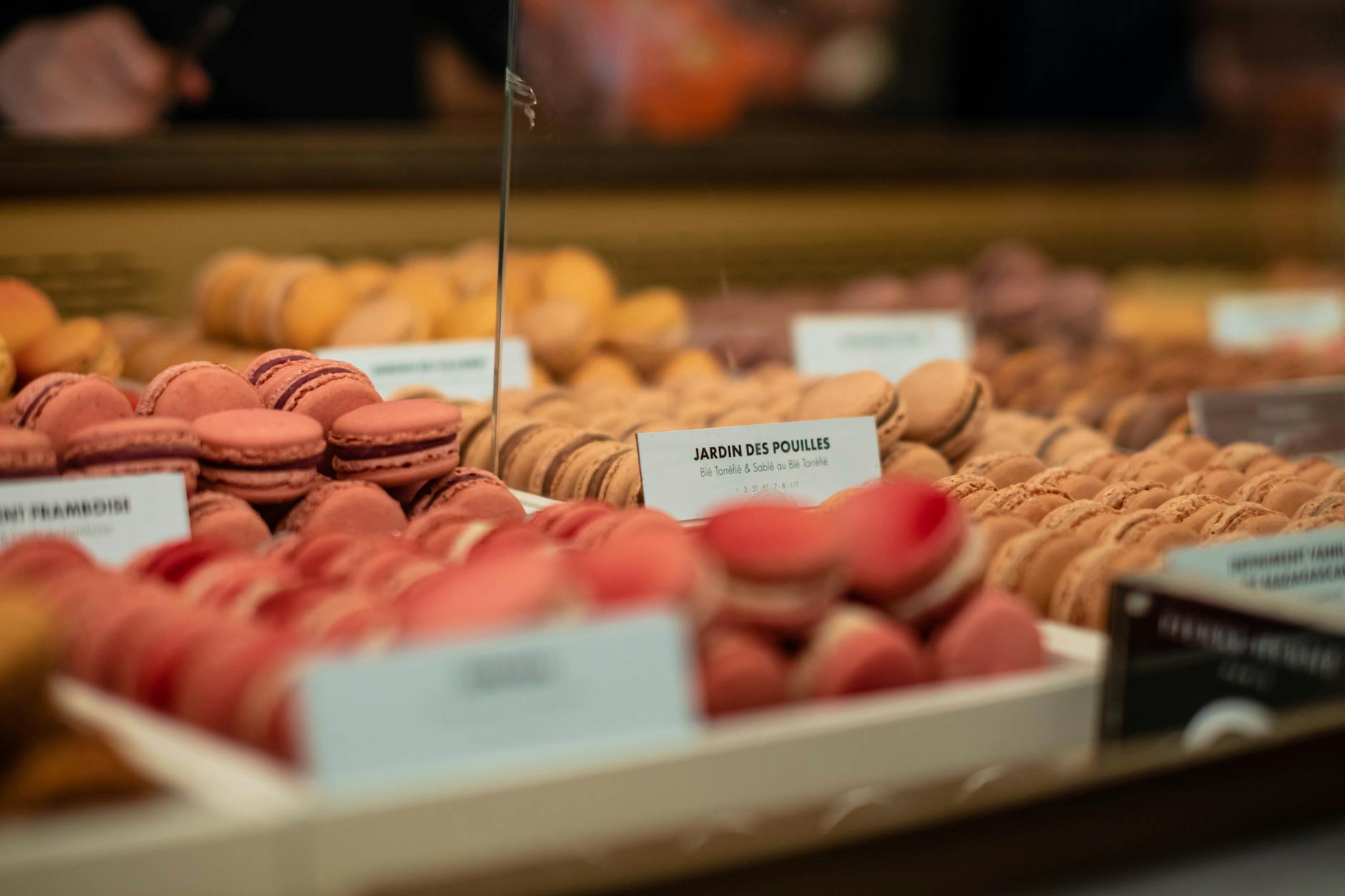
Macarons are the most photographed thing in any Paris pastry case: delicate almond meringue shells around ganache, buttercream, or jam, in flavors that run from the obvious to the absurd. Ladurée and Pierre Hermé get the press, but plenty of small neighborhood pâtisseries make versions just as good for less. Crème brûlée, vanilla custard under a torched sugar lid, and mousse au chocolat are bistro standards, while the tarte Tatin (upside-down caramelized apple tart) and the Paris-Brest (a choux ring filled with praline cream) show off what a serious pastry kitchen can do.
Éclairs have had a quiet revival, with shops like L’Éclair de Génie treating the choux tube as a canvas for inventive flavors. The mille-feuille (Napoleon), all those alternating layers of puff pastry and vanilla cream, is a precision test: the good ones crack cleanly under your fork instead of squashing out the sides. And if chocolate is your weakness, Paris has some of the best chocolatiers anywhere. Patrick Roger, Jacques Genin, and Alain Ducasse’s bean-to-bar Manufacture all justify the detour.
Best Neighborhoods for Food in Paris
Paris eats differently from one neighborhood to the next, and the fun is in how fast it changes. A ten-minute walk can carry you from falafel queues to natural wine bars to a 400-year-old market hall. This stretch of the Paris food guide maps the districts where it’s worth getting hungry on purpose.
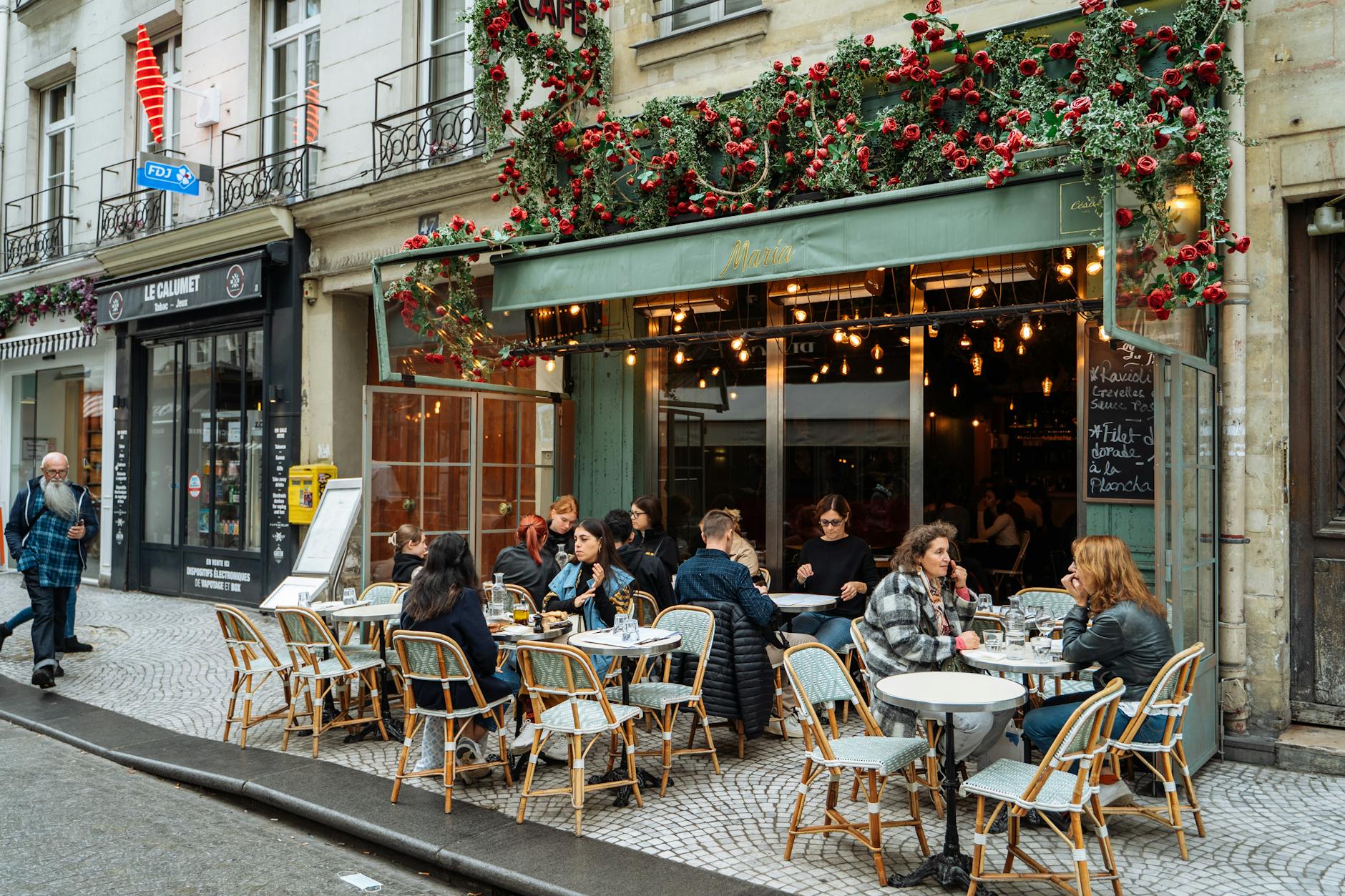
Le Marais (3rd and 4th Arrondissements)
Le Marais packs more food into its medieval lanes than seems reasonable. On Rue des Rosiers, the falafel shops are legendary, and the queue at L’As du Fallafel regularly snakes down the block. A few streets over you’ll find polished neo-bistros, natural wine bars, and some of the best brunch in the city. Don’t skip the Marché des Enfants Rouges, the oldest covered market in Paris, dating to 1615, where you can put away Moroccan tagine, a Japanese bento, fresh pasta, and a classic French crêpe without leaving the building.
Montmartre and South Pigalle (9th and 18th Arrondissements)
Get past the tourist traps ringing Sacré-Coeur and Montmartre turns into a genuinely good place to eat. South Pigalle, which locals shortened to “SoPi,” has become one of the city’s most interesting dining pockets. Rue des Martyrs is the spine of it, a food street lined with fromagers, bakers, wine shops, and bistros. The 18th is also one of the more multicultural parts of Paris, which means North African, West African, and South Asian cooking you simply won’t find in the center.
Saint-Germain-des-Prés (6th Arrondissement)
The Left Bank’s grand old food quarter still pulls people in. Café de Flore and Les Deux Magots anchor the boulevard, while the side streets hide some of the city’s finest fromageries, the legendary Laurent Dubois among them, plus chocolate shops and old-school restaurants. The Sunday Marché Biologique Raspail ranks among the best organic markets in Paris. And Poilâne, the world-famous bakery on Rue du Cherche-Midi, has been turning out its signature sourdough miche since 1932, which is a long time to be that good at one loaf.
Oberkampf and the 11th Arrondissement
If the 6th is old-guard Paris, the 11th is where the city is heading. This is neo-bistro country: small, personal rooms run by young chefs with Michelin résumés, serving inventive tasting menus at prices that don’t make you wince. The blocks around Oberkampf, Charonne, and Bastille hold more exciting restaurants per square meter than just about anywhere else in town. Pierre Sang, Septime, Le Chateaubriand, and a steady stream of newer arrivals make this the part of Paris to book if food is the whole reason you came.
Rue Montorgueil (2nd Arrondissement)
This pedestrian market street is where actual Parisians do their shopping. Rue Montorgueil hums from morning to evening with oyster stands, fromageries, boulangeries, fruit sellers, and cafés. It’s the place to assemble a picnic: grab a wedge of aged comté, a demi-baguette, some jambon de Bayonne, a couple of clafoutis from the patisserie, and walk it to the nearest park. The sit-down options run from straight-down-the-line bistros to modern Asian fusion.
Paris Food Markets: Where to Shop and Eat Like a Local
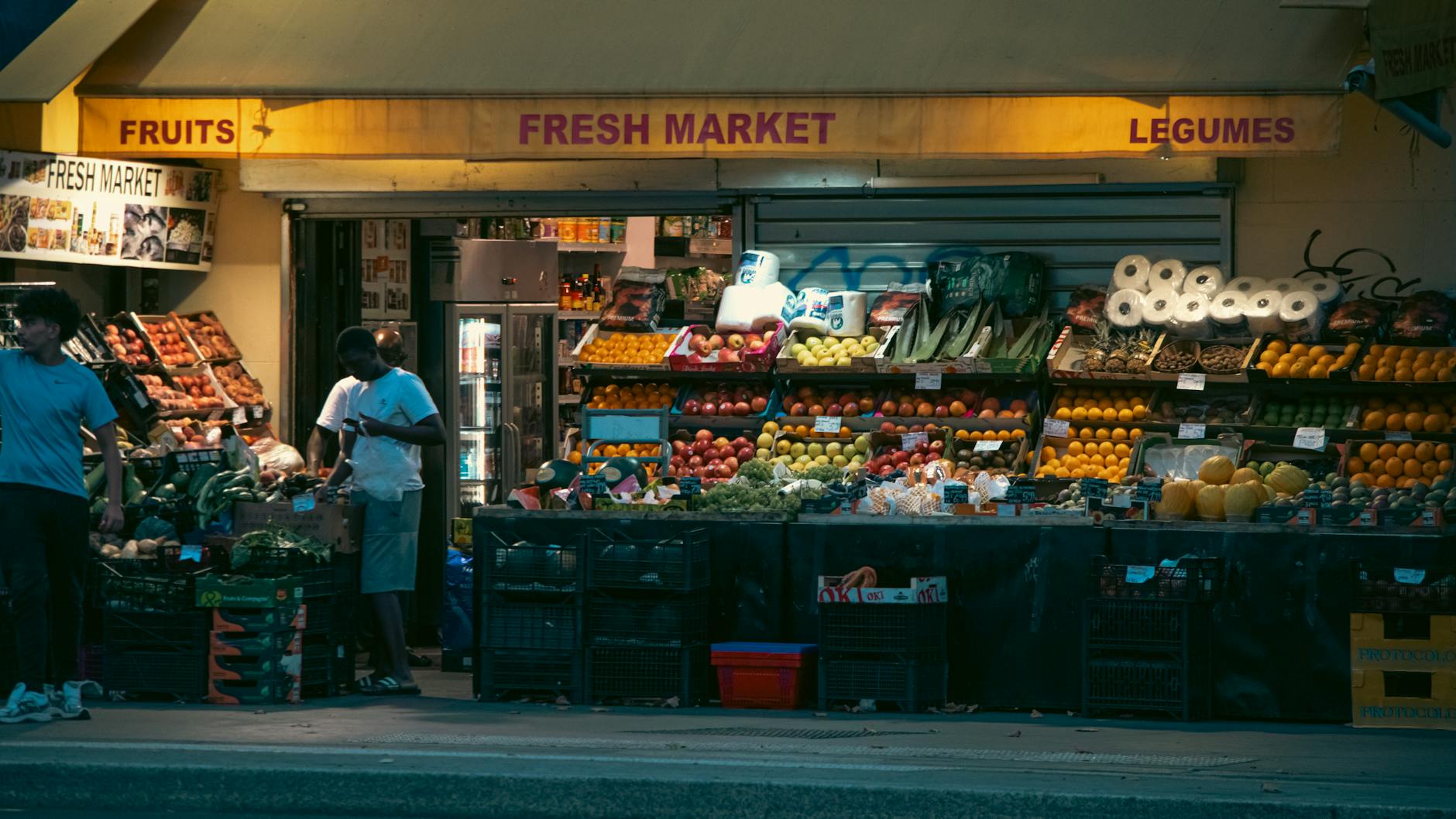
Skip the markets and you’ve missed half the story. Paris runs more than 80 open-air and covered markets across the week, and wandering one is the fastest way to understand how the city actually eats. This is where Parisians buy the day’s ingredients, and where you see the quality of produce, meat, fish, and cheese that French cooking quietly depends on.
Marché Bastille
Stretching along Boulevard Richard-Lenoir from the Bastille roundabout down to Métro Bréguet-Sabin, the Bastille market (Thursday and Sunday mornings) is one of the biggest and busiest in Paris. Neighborhood regulars shop here alongside working chefs, and the draw is the sheer range: superb produce, artisanal cheeses from every corner of France, fish landed that morning, rotisserie chickens turning on their spits, Lebanese mezze, Auvergnat sausages, and a lot more besides.
Marché des Enfants Rouges
The oldest covered market in Paris, hidden in the middle of Le Marais, reads more like a food court than a traditional market, though a few produce stalls hold the fort. The cooked food is the reason to come. The Moroccan stand’s tagines and couscous have a cult following, but there’s also excellent Japanese, pasta made to order, organic crêpes, and French comfort food. Show up hungry at lunch, and arrive before noon if you’d rather not eat standing in a crowd.
Marché d’Aligre
Ten minutes from Bastille in the 12th, Marché d’Aligre rolls a lively outdoor street market, the covered Marché Beauvau, and a small flea market into one stop. It’s among the most affordable markets in central Paris, and locals love it for the sprawling fruit and vegetable selection. Inside the covered hall you’ll find strong butchers, fishmongers, and an especially good run of artisanal cheese.
Marché Biologique Raspail
Every Sunday morning on Boulevard Raspail in the 6th, this organic market puts France’s best sustainable growers on display. Everything carries organic certification, from the heritage tomatoes to the raw-milk cheeses to the sourdough still warm from the oven. It costs more than a conventional market, no question, but the quality backs it up, and a Sunday spent here with Saint-Germain as the backdrop is about as Parisian as a morning gets.
Paris Cafés, Bakeries, and Wine Bars
Three institutions run daily food life in Paris: the café, the boulangerie, and, more and more, the bar à vin. Learn to use all three and you’ll eat well without ever booking a table or spending much. Between them, they cover some of the best food in the city, no reservation or budget required.
Café Culture
The Parisian café is part living room, part office, part social club, and only incidentally a place to drink coffee. The tradition goes back to the 17th century, and the city now holds over 9,000 of them. A café express (espresso) taken standing at the zinc counter runs roughly €1.50 to €2.50 and is the fastest caffeine in Paris. Take a terrace table instead, always pricier than the counter, and you’re buying the view and the right to nurse one drink for as long as you please. Nobody will hurry you. Plenty of cafés do simple, satisfying food too: tartines (open-faced sandwiches), croque monsieurs, salads, and the plat du jour (daily special), all at fair prices.
The Boulangerie Tradition
Paris has around 1,200 boulangeries, more than any other kind of business in the city. French law says a boulangerie has to bake all its bread on site, so every neighborhood gets genuinely fresh bread several times a day. Most locals stop in twice: once for breakfast pastries, once for the evening baguette on the way home. Many bakeries now double as cheap, excellent lunch counters, selling sandwiches, quiches, salads, and hot daily dishes for a fraction of what a sit-down restaurant charges.
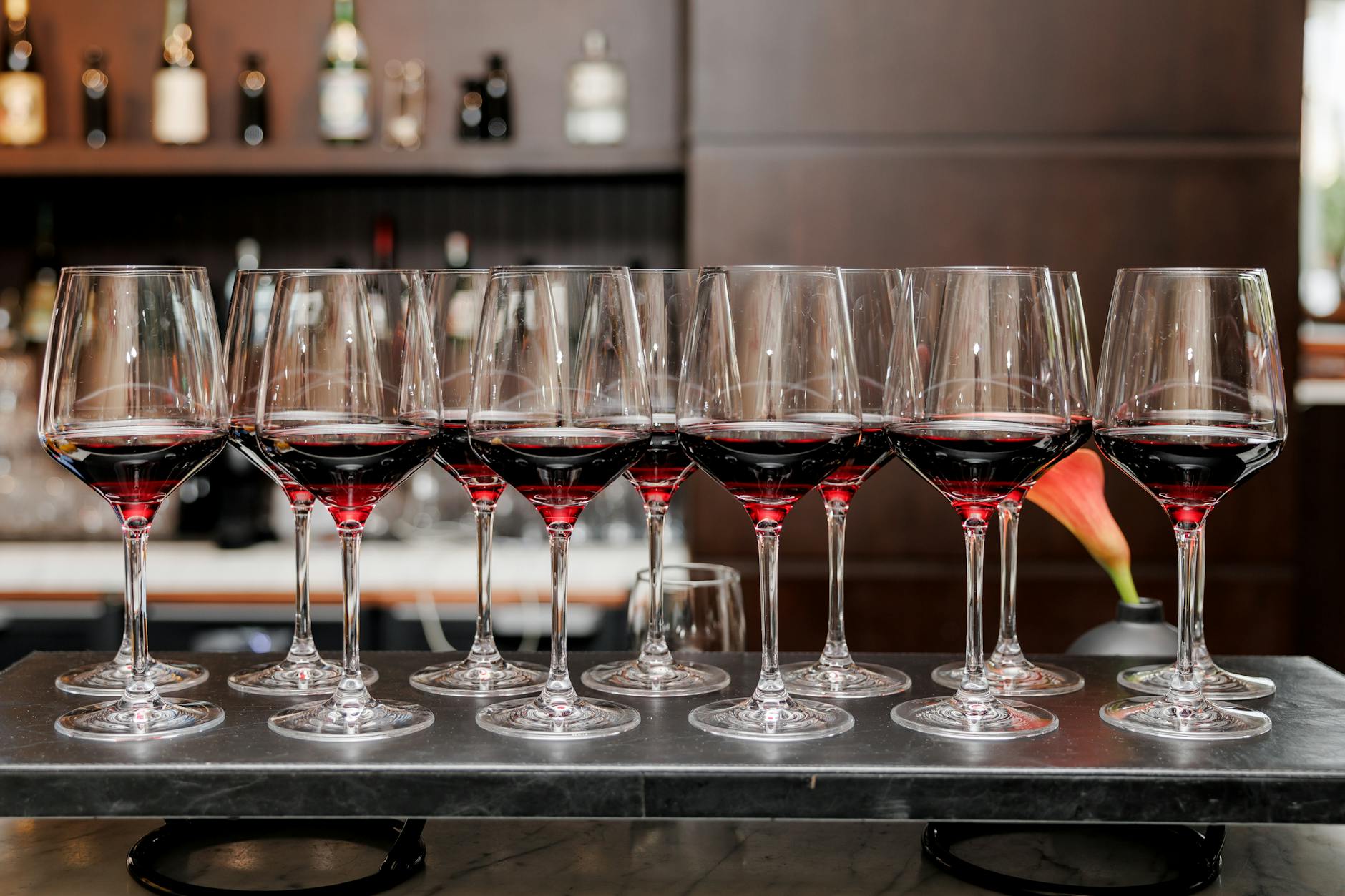
The Natural Wine Revolution
Paris has turned into the world capital of natural wine, and bars à vin naturel have opened in nearly every neighborhood. The format is consistent: small plates of very good charcuterie and cheese alongside wines made with minimal intervention, usually organic, often biodynamic, frequently unfiltered. The natural wine bar has become as central to how Paris eats as the bistro itself. The richest hunting grounds are the 10th and 11th (around Canal Saint-Martin and Oberkampf), Le Marais, and the 5th.
Fine Dining in Paris: From Bistros to Michelin Stars
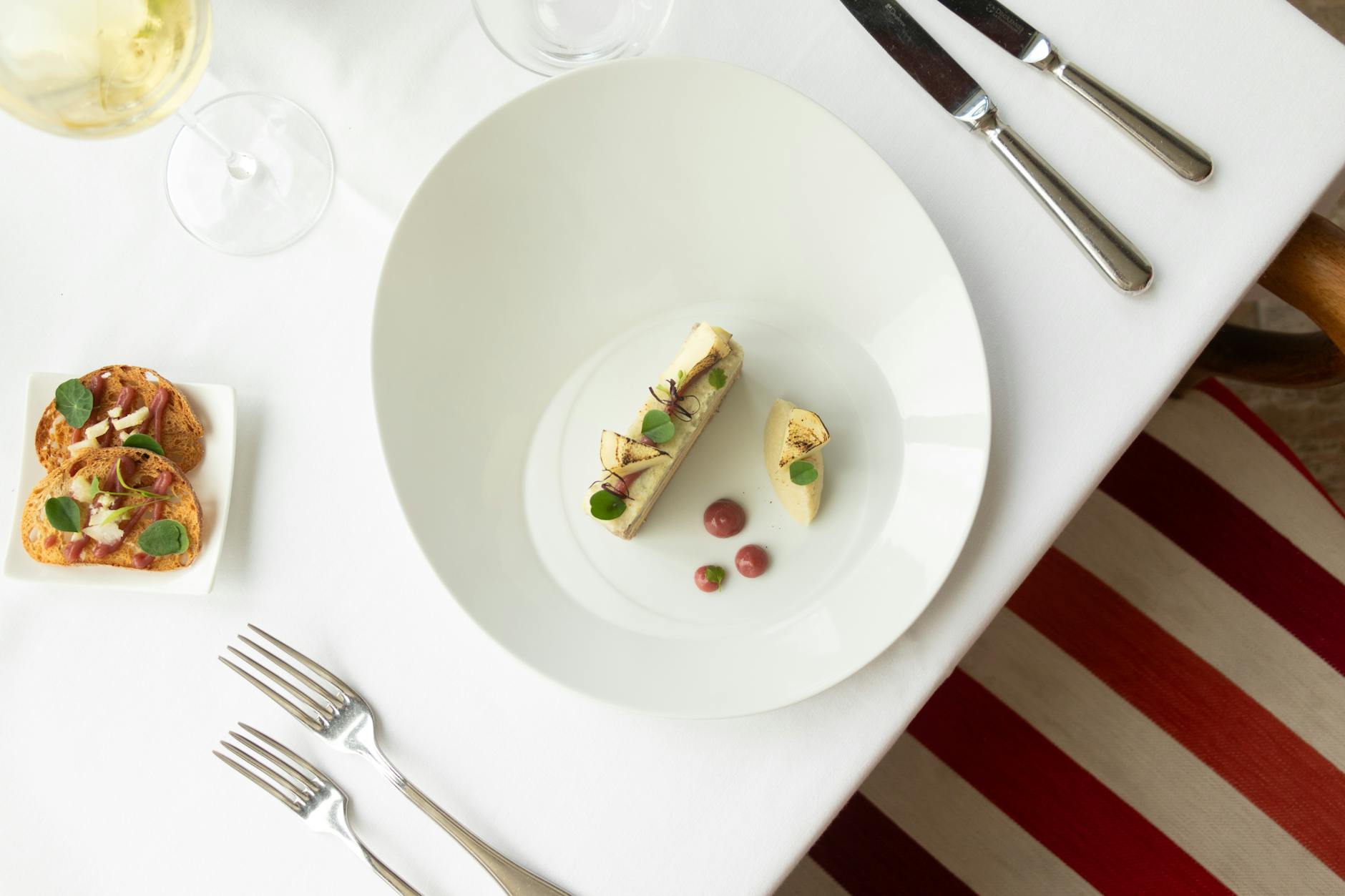
No city holds more Michelin stars than Paris. The 2026 Michelin Guide handed new stars to a clutch of Parisian restaurants, which tells you the scene never really sits still. The trick is matching the kind of formal meal to the kind of trip you’re taking, so it helps to understand the range first.
The Neo-Bistro Movement
The single best thing to happen to Paris dining in the last decade is the neo-bistro: classically trained young chefs who walked away from the formality and the eye-watering bills of traditional fine dining to open small, personal places with market-led menus, natural wine, and prices you can actually swallow. A multi-course dinner at a top neo-bistro might run €45 to €75, against €200 and up at a traditional starred restaurant. The cooking is Michelin-grade, the setting isn’t, and this is where Parisians themselves go to celebrate.
Michelin-Starred Experiences
When you want the full splurge, Paris’s starred restaurants deliver something you can’t get anywhere else. Three-star rooms like Alain Ducasse au Plaza Athénée, Le Cinq, and Arpège run multi-hour gastronomic marathons that pair extraordinary cooking with service that anticipates you, in settings built to impress. The smart-money play, though, is the one-star: world-class food at lunch menus that often start around €80 to €120. The 2026 guide awarded eight new first stars in Paris, several of them to a new wave of chef-owners cooking something deeply their own.
Classic Brasseries
Paris’s grand brasseries are living history: Bofinger (founded 1864), La Coupole (1927), Bouillon Chartier (1896). With their high ceilings and their Art Nouveau or Art Deco rooms, a meal in one lands somewhere between dinner and theater. Come for the things they do best, a towering plateau de fruits de mer (seafood platter), a dozen oysters, a proper choucroute garnie. Several of these institutions have been taken over and reworked in recent years, sharpening the food while leaving the spectacular rooms alone.
Street Food and Casual Eating in Paris
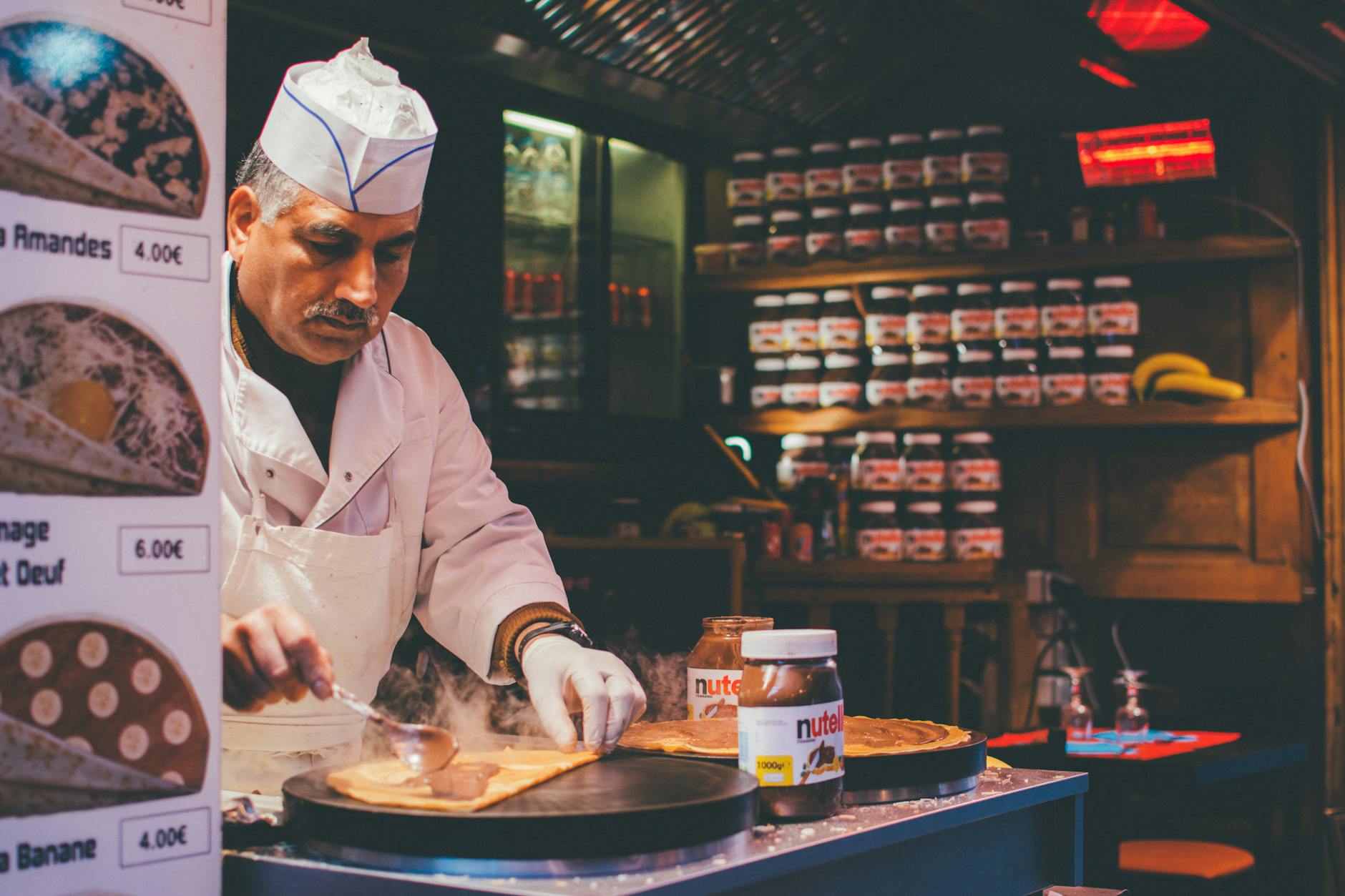
Paris has made room for street food without losing the thread of its traditions, and some of the best eating in the city asks for no reservation, no dress code, and almost no money. Eating casually is a perfectly legitimate way to work through this Paris food guide, especially when the budget is tight or you’d rather keep your plans loose.
Crêpes and galettes are the city’s favorite street food, full stop. Sweet crêpes (white flour) loaded with Nutella, sugar and lemon, or salted caramel are sold from stands everywhere, thickest on the ground in the Latin Quarter and Montmartre. Savory galettes (buckwheat flour) filled with ham, cheese, egg, mushrooms, or something more ambitious make a real meal for €8 to €12. The Breton crêperie is an institution here, and if you want the genuine article, find one run by actual Bretons.
Falafel on Rue des Rosiers in the Marais has reached something close to myth. L’As du Fallafel and Mi-Va-Mi trade blows for the title of best in Paris, and both hand over enormous, overstuffed pita wraps crammed with crisp falafel, fresh vegetables, hummus, and tahini for under €10. The queues look daunting but move fast, and the food earns the wait.
Jambon-beurre, a baguette with ham and butter and nothing else, is France’s most-eaten sandwich, with Parisians putting away over a billion of them a year. It sounds like nothing, but made with artisanal ham and a fresh baguette from a serious boulangerie, it’s a small revelation. Want something more involved? Boulangeries and traiteurs also turn out composed sandwiches, savory quiches, pan bagnat, and hot daily dishes that hold their own against sit-down kitchens.
Eating Well in Paris on a Budget
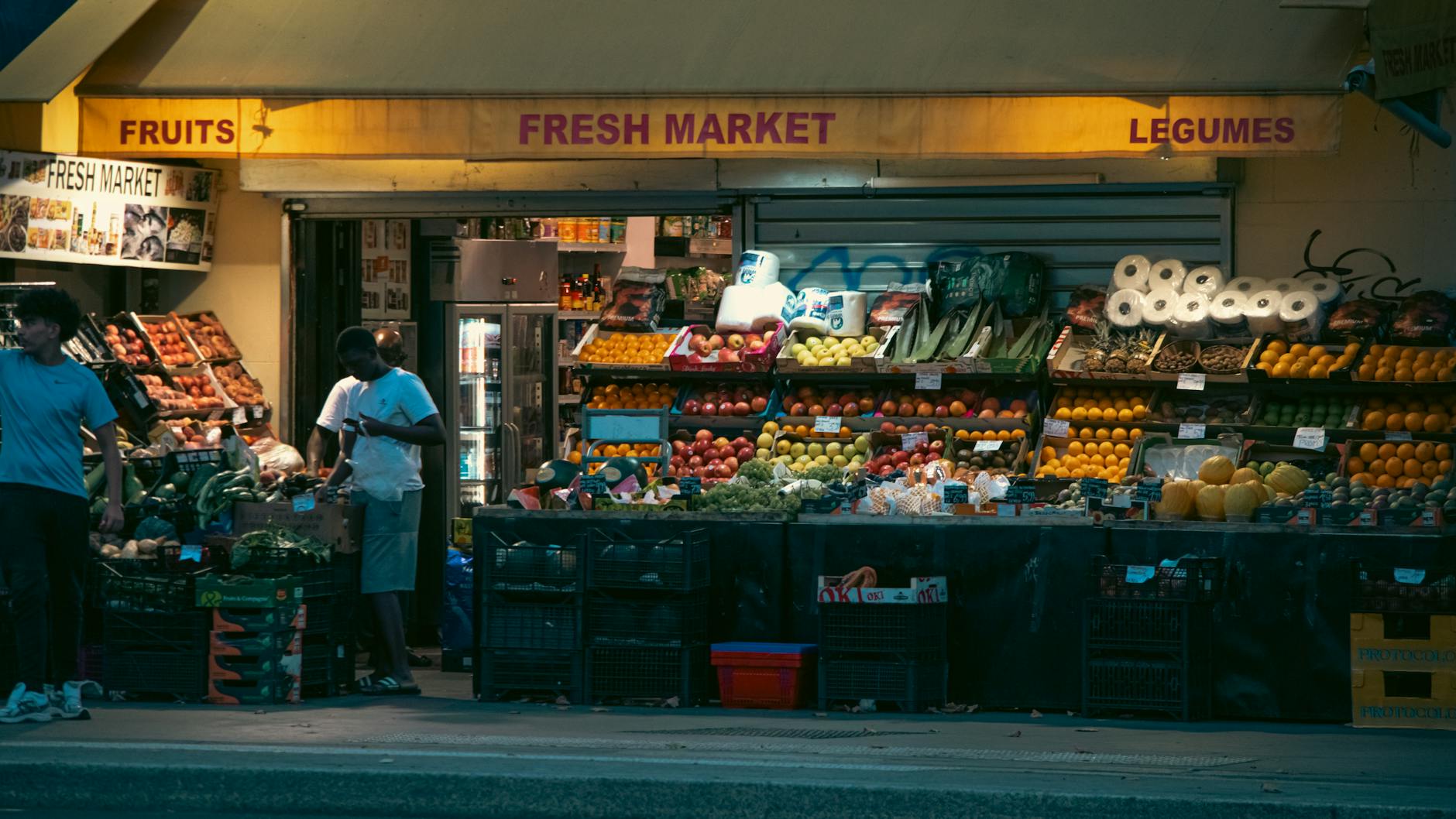
The notion that eating well in Paris means spending a fortune is simply wrong. Yes, fine dining can drain an account fast, but the city does extraordinary food at every price. Here are the moves people in the know use to eat like royalty without paying like it.
The formule lunch. Most Paris restaurants, plenty of starred ones included, run a fixed-price lunch (formule or menu du midi) that costs a fraction of dinner. A two-course lunch formule at a good bistro usually lands at €16 to €25, where the same kitchen charges €40 to €60-plus after dark. If you take one tip from this whole Paris food guide, take that one.
Bouillon restaurants. The bouillon, a 19th-century idea about serving honest French food cheap in grand rooms, has come roaring back. Bouillon Chartier (est. 1896), Bouillon Julien, Bouillon Pigalle, and Bouillon République plate classics like oeuf mayonnaise, leek vinaigrette, roast chicken, and crème caramel at prices that read like typos (starters from €2, mains from €8) inside gorgeous Belle Époque dining rooms.
Market picnics. You can build a world-class meal for pocket change: a fresh baguette (€1.20), some aged comté or brie (€3 to €5), charcuterie (€3 to €4), seasonal fruit (€2), and a bottle of wine (€5 to €10). Carry it down to the banks of the Seine, the Jardin du Luxembourg, or the Canal Saint-Martin. This is how a lot of Parisians eat on warm evenings, and it’s quietly one of the most romantic meals the city offers.
Ethnic restaurants. Paris’s immigrant communities cook some of the best cheap food in the city. Vietnamese phở and bánh mì in the 13th, North African couscous in Belleville, Indian and Pakistani food in the 10th, West African dishes in the 18th: all of it generous, all of it flavorful, most of it €8 to €15.
French Dining Etiquette: Essential Tips for Visitors
Learn a handful of Parisian dining customs and the whole experience shifts from tourist feeding to something closer to belonging. French dining runs on unwritten rules, and knowing them buys you better service and a better meal.
Greeting and Seating
Greet the staff the second you walk in: “Bonjour” before 6 PM, “Bonsoir” after. Treat this as non-negotiable; it’s the single most effective thing you can do to get good service. Then wait to be seated. The first question is usually “Vous avez réservé?”, meaning do you have a reservation. Never sit yourself down at a restaurant. At a café, on the other hand, pick whatever table you like.
Ordering and Meal Pace
French meals are built for lingering, not for speed. A proper dinner can run two hours or more, and that’s the intention, not a service failure. Order one course at a time, appetizer then main then dessert, rather than firing everything off at once. Bread comes free and goes straight on the table, not on a plate. Wine is ordered by the bottle or in pichet (carafe) measures of 25cl or 50cl. When you’re unsure, ask the server; most waiters know the list cold and take real pride in steering you right.
The Bill and Tipping
The bill won’t arrive until you ask for it, so “l’addition, s’il vous plaît” is how you say you’re done. Service is built into French restaurant prices by law (service compris), which means tipping isn’t required. That said, leaving €2 to €5 at a casual spot, or 5 to 10% at a fine dining room, is appreciated and increasingly the norm. Cash left on the table beats adding a tip to the card payment.
Reservation Culture
For the popular places, reservations aren’t optional, especially for dinner and double-especially on weekends. For top neo-bistros and starred restaurants, book at least two weeks out; some take bookings months ahead. A lot of Paris restaurants now run on TheFork (La Fourchette), an online platform that occasionally dangles discounts of 20 to 50% on slow nights. Lunch is generally easier, and at bistros and brasseries you can often walk in without one.
Seasonal Food Experiences in Paris
The Paris food scene swings hard with the seasons, and lining your visit up with the right ingredients or food event adds a whole layer to the eating.
Spring (March–May): White asparagus takes over menus across the city. Terraces reopen, and eating outside, along the Seine or in a park, becomes the obvious move. Spring lamb (agneau de printemps), fresh peas, and strawberries from Plougastel crowd the market stalls and the bistro specials.
Summer (June–August): Stone fruit, melons from Cavaillon, and heirloom tomatoes hit their peak. The city’s outdoor eating habit goes into overdrive, with terrasses spilling across the sidewalks everywhere you turn. Paris Plages turns the Seine banks into beach-style eating and drinking. Late summer brings mirabelle plums and the first figs.
Autumn (September–November): The best season if you take food seriously. Wild mushrooms, cèpes, girolles, chanterelles, show up on every menu. Game season puts venison, boar, and hare on the specials board. It’s oyster season too, the first Beaujolais Nouveau lands in November, chestnuts roast on the street corners, and the markets fill with squash, root vegetables, and everything you’d want for slow cooking.
Winter (December–February): Truffle season lifts dishes all over Paris. Christmas markets pour vin chaud (mulled wine) and serve raclette and tartiflette. Galette des Rois, a frangipane-stuffed puff pastry, fills every bakery window through January. And comfort food peaks: cassoulet, pot-au-feu, and French onion soup are never better than when it’s cold enough to see your breath.
French Cheese and Wine: A Paris Primer
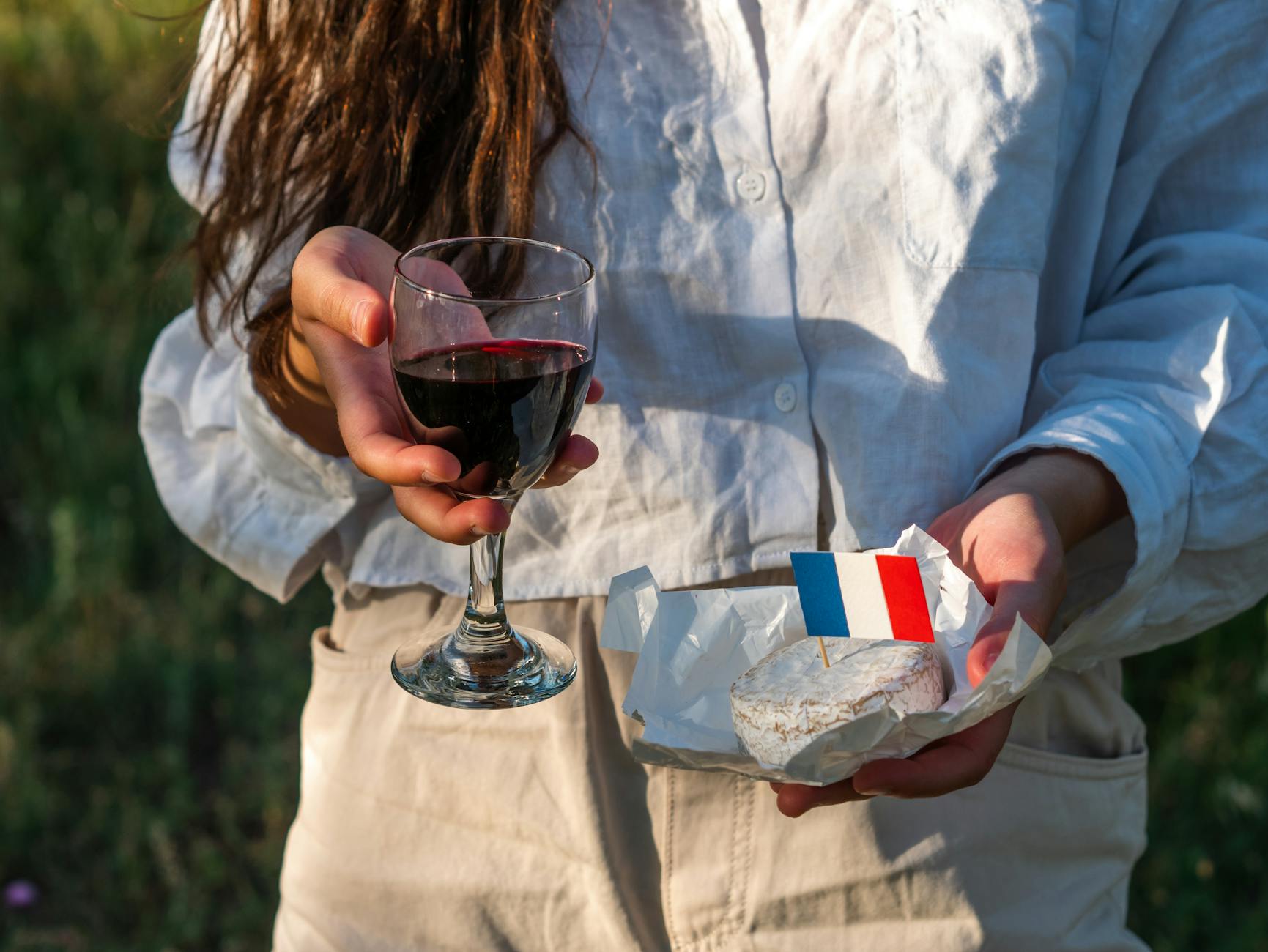
France makes over 1,200 distinct cheeses and lays claim to the most celebrated wine regions on earth. Paris elevates both, and no Paris food guide can skip past these twin pillars of French eating.
Navigating a Fromagerie
Walking into a fromagerie (cheese shop) engages every sense at once. The fromager (cheesemonger) is a trained professional who’ll steer you by taste, occasion, and whatever wine you’re planning to pour. There’s no reason to feel out of your depth. Just describe what you like, mild, strong, creamy, firm, and let them do the rest. The Parisian cheeses worth tasting include Comté (aged alpine), Brie de Meaux (the king of French soft cheeses), Roquefort (intense blue), Reblochon (creamy and mild), Époisses (a pungent washed-rind), and Chèvre (goat cheese in dozens of forms).
Wine for Non-Experts
Enjoying wine in Paris takes no expertise, only a bit of curiosity and a willingness to ask. The carte des vins can look like a wall at first, but servers are generally glad to point you to a bottle that fits your budget and your plate. For cheap and reliable, order the house wine (vin de la maison) by the carafe; at a decent bistro it’ll outdrink most of what you buy at home. Natural wine bars are the friendliest entry point of all, since the people pouring live to put a strange, delicious glass in front of a newcomer.
Food Tours and Cooking Classes
If you’d rather have a guide through the food scene, tours and classes hand you insider access and hands-on skills that pay off at every meal for the rest of the trip.
Walking food tours usually run 3 to 4 hours and stitch together a neighborhood walk with tastings at bakeries, fromageries, chocolate shops, and wine bars. The best are led by people in the trade, chefs, sommeliers, food writers, who hand you the cultural backstory along with the food. Count on 6 to 8 stops and enough sampling to add up to a full meal. Le Marais, Montmartre, Saint-Germain, and the Latin Quarter all suit this format especially well.
Cooking classes range from a relaxed croissant-making workshop (2 to 3 hours, from €80) to an intensive full-day course covering several techniques and courses (€150 to €300). Many start with a market run to source the ingredients before you head back to cook and then eat together. Most major schools teach in English and welcome every skill level. They make a particularly good outing for couples and for families with older kids.
Wine and cheese tastings walk you through French wine regions, grape varieties, and pairings. A session typically runs 1 to 2 hours, pours 5 to 7 wines, and costs €50 to €90 a head. Book one early in the trip, because the knowledge reshapes every restaurant visit that follows.
Practical Tips for Eating in Paris
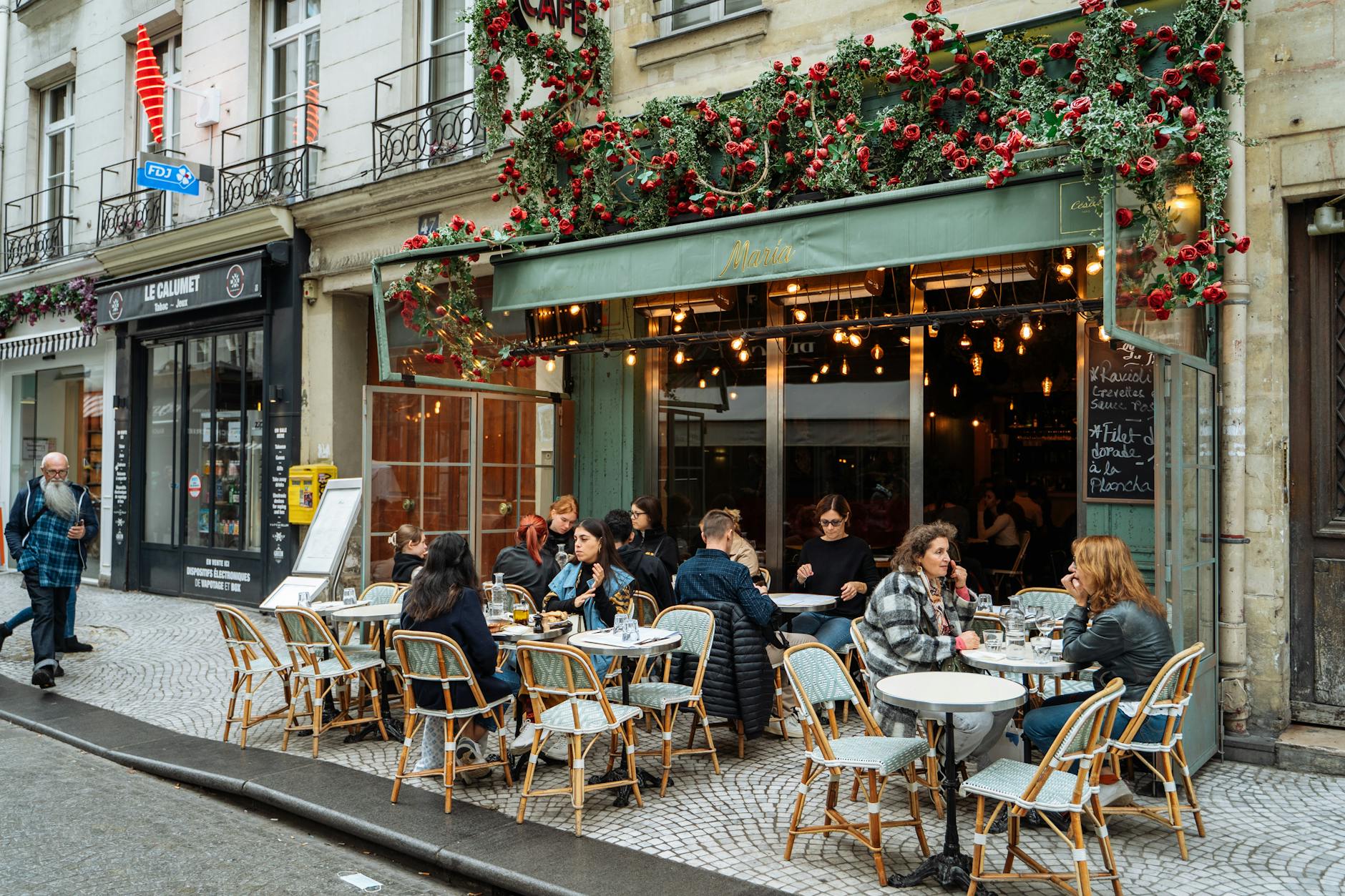
A few practical habits will keep you out of the tourist traps, save you money, and get more out of every meal.
Meal times matter. Lunch runs roughly 12:00 to 14:00, dinner from 19:30 to 22:00. Show up outside those windows and your options shrink fast. Plenty of restaurants shut down entirely between services (14:30 to 19:00). Cafés and brasseries usually serve all day, which makes them your fallback for an odd-hour meal.
Hunt for the plat du jour. The daily special, chalked on a board out front or rattled off by the server, is almost always the best value and the best plate on the menu. It’s cooked fresh that morning from whatever the chef scored at the market, and priced to sell. Following the plat du jour is exactly how Parisians eat well on a budget, day in and day out.
Steer clear of the monument restaurants. The blocks ringing the Eiffel Tower, the Champs-Élysées, and Notre-Dame are stocked with places built to feed tourists, not to cook well. Walk ten minutes in any direction from a big sight and the food gets noticeably better while the prices come down. Narrow side streets, handwritten menus, and a room full of locals are the signs to follow.
Load up on a few apps. TheFork (La Fourchette) for reservations and deals. Google Maps for saved restaurant lists and walking directions. Too Good To Go for cut-price end-of-day bakery bags and restaurant surplus.
Water and bread are free. You’re entitled to free tap water (une carafe d’eau, s’il vous plaît) and bread at any restaurant. Skip the bottled water unless you actually prefer it. That habit alone saves €5 to €10 a meal.
Dietary requirements. Paris has gotten a lot better at accommodating restrictions. Vegetarian options are standard at most restaurants now, and the city has over 90 fully vegan ones. Gluten-free has expanded fast, with dedicated bakeries and plenty of kitchens willing to adapt. For allergies, the phrase “Je suis allergique à…” (I am allergic to…) followed by the ingredient gets taken seriously, partly because French restaurants are legally required to supply allergen information.
Frequently Asked Questions About Food in Paris
What is the best area in Paris for food?
The 11th arrondissement (Oberkampf, Bastille, Charonne) has the densest run of exciting contemporary restaurants. Le Marais (3rd and 4th) mixes historic food shops with strong street food. Saint-Germain (6th) is the place for traditional French gastronomy. And for the best market crawl, head to Rue Montorgueil in the 2nd.
How much should I budget for food in Paris per day?
On a tight budget you can eat well for €30 to €50 a day by leaning on boulangeries, markets, and lunch formules. Mid-range eaters should plan on €60 to €100 for a mix of casual and sit-down meals. If fine dining is the goal, expect €150-plus a day, particularly with a starred dinner on the books. For reference: breakfast pastries run €2 to €5, lunch formules €16 to €25, and dinner at a good bistro €35 to €60.
Do I need to speak French to eat in Paris?
No, but a few basics, bonjour, bonsoir, s’il vous plaît, merci, l’addition, change the whole experience for the better. Most restaurant staff in central Paris handle functional English, and the effort in French always lands well. Venture outside the tourist core and menus may be French-only, but a translation app makes short work of that.
Is tipping expected in Paris restaurants?
Service is included in every French restaurant price by law. Tipping isn’t expected, though it’s appreciated: €2 to €5 at casual places, 5 to 10% at fine dining. Cash on the table is the preferred way to do it. Leaving nothing is completely fine and carries zero stigma.
What time do Parisians eat dinner?
Most Parisians sit down between 20:00 and 21:00. Restaurants open for dinner around 19:00 to 19:30, and the room peaks from 20:00 to 21:30. Arrive at 19:30 and you’ll get the pick of the tables and a more attentive server. Eating before 19:30 marks you as a tourist, which is no crime at all if it fits your day.
Are Paris food tours worth it?
Yes, and most of all early in the trip. A good one introduces you to neighborhoods, dishes, and dining customs that color every meal afterward. Budget €80 to €120 a head for a quality walking tour of 3 to 4 hours. The ones that fold in a market visit, tastings at several stops, and wine pairings give you the most for the money.
What is the one food I should not miss in Paris?
A croissant straight from an artisan boulangerie, eaten while it’s still warm. More than anything else, it captures what makes Paris food extraordinary: faultless technique, superb ingredients, and the conviction that even the simplest thing deserves to be made beautifully. After that, a plateau de fruits de mer (seafood platter) at a grand brasserie is the great Paris-specific splurge.
Plan Your Paris Culinary Adventure
Paris feeds a hungry traveler better than any city I know. Your perfect meal might be a warm croissant on a bridge at sunrise, a three-hour bistro dinner that dissolves into the small hours, or a once-in-a-lifetime tasting menu under a Michelin star. The city does all three, and it tends to change how you think about food long after you’ve flown home.
One last tip before you go: book your starred lunch and your top neo-bistro now, then leave the rest of the trip loose for markets, bakeries, and whatever you stumble into. Keep planning with our other guides: see how to plan your perfect Paris trip, work out where to stay in Paris by neighborhood, run through 101 things to do in Paris, and map out every must-see Paris attraction. Bon appétit.
Explore every food & dining guide
The in-depth guides in this section:
- Best Restaurants in Paris for Tourists
- Best Bakeries and Patisseries in Paris
- where Parisians buy their food
- 25 French Dishes You Must Try in Paris
- our cafe shortlist
- Best Paris Food Tours
- Where to Eat in Paris on a Budget
- Best Wine Bars in Paris
- Paris Michelin Star Restaurants
- Best Cooking Classes in Paris
Eating well in Paris is partly about knowing where to go and partly about knowing how to behave once you are there — bread on the table rather than a plate, both wrists visible, no substitutions asked for, and coffee after the dessert rather than alongside it. Our guide to Paris etiquette and customs sets out the conventions that the menu does not.