50 French Phrases for Travelers and When Parisians Actually Use Them
What you say matters far less than saying the right thing first. Six phrases will carry a whole trip.
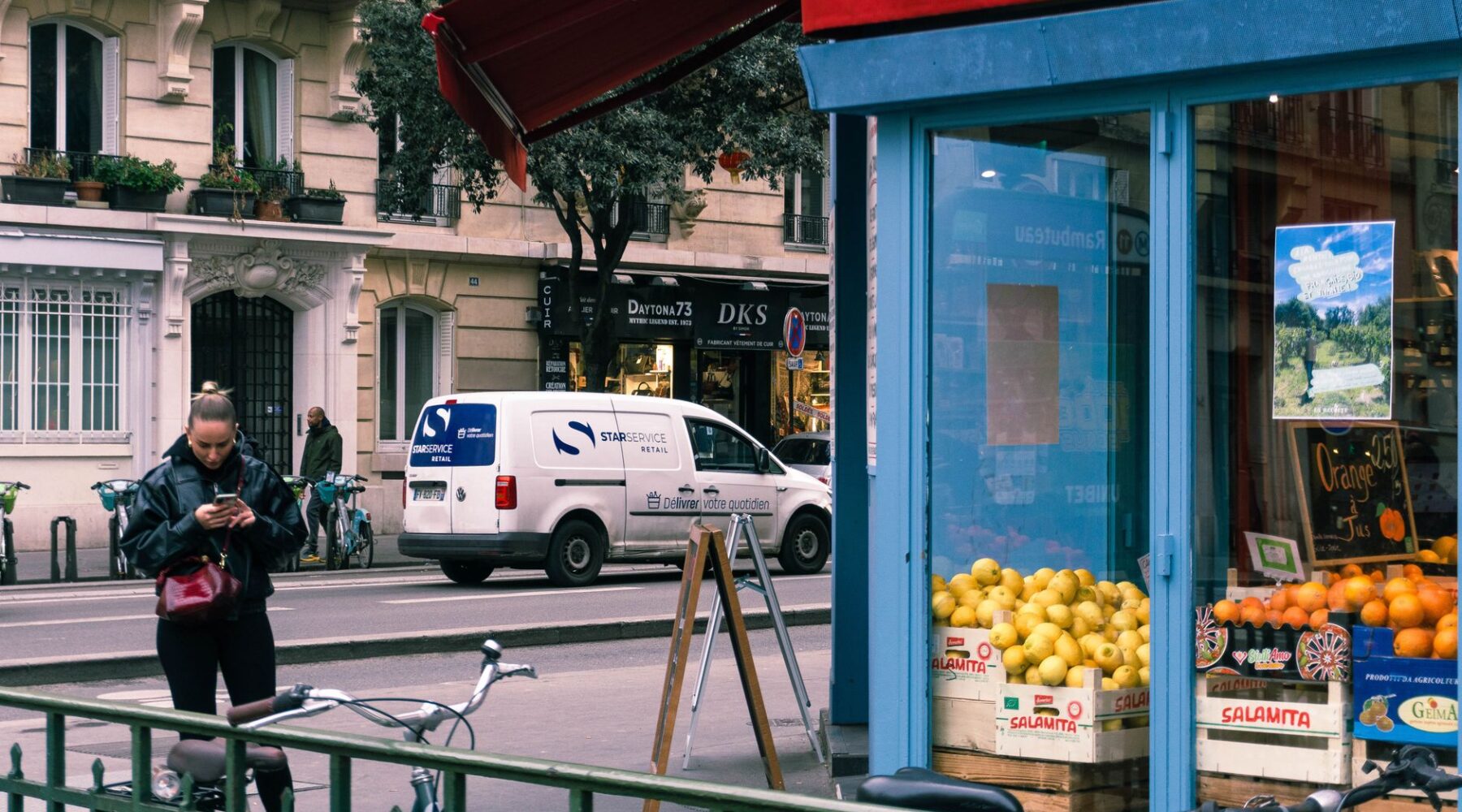
A friend of mine spent a fortnight learning French from an app before a trip to Paris, arrived able to conjugate three tenses, walked into a bakery on the Rue Montorgueil and said “je voudrais acheter une baguette traditionnelle, s’il vous plaît” in a single confident breath. The woman behind the counter looked at her, waited a beat, and said “bonjour ?” — with a rising inflection and a small, unmistakable pause. That is the entire lesson about french phrases for tourists compressed into one exchange: what you say matters far less than saying the right thing first.
Below are fifty phrases organised by the situation you will actually be in, each with a plain-English pronunciation, and — the part most lists leave out — a note on whether real Parisians use it, because a good third of what gets taught to travellers is either archaic, textbook-formal, or something no one has said out loud since 1974. There is also a short list of things to avoid saying. You do not need to learn all fifty. Six of them will carry a whole trip.
The six that carry a whole trip
If you learn nothing else, learn these. They are not the most useful in an informational sense — they will not get you directions — but they are the ones that change how you are treated, which is a much bigger prize.
| French | Say it roughly | What it does |
|---|---|---|
| Bonjour | bon-ZHOOR | Said on entering any shop, café, taxi or lift. Non-negotiable |
| Bonsoir | bon-SWAHR | The same, from about six in the evening |
| Merci, au revoir | mair-SEE, oh ruh-VWAHR | On the way out. Leaving silently is the real rudeness |
| S’il vous plaît | seel voo PLEH | Please, attached to every request without exception |
| Excusez-moi | ex-koo-zay MWAH | Opens any approach to a stranger |
| Parlez-vous anglais ? | par-lay voo on-GLEH | Asked, not assumed. This one sentence does most of the work |
The logic is worth understanding rather than memorising. In France, entering a shop is entering someone’s space, and the greeting is the acknowledgement that you have done so. Skipping it and going straight to your request reads roughly the way it would read at home to walk up to a stranger and begin mid-sentence. Almost the entire reputation Parisians have for coldness rests on this single misunderstanding — a point our guide to the practical things to know before you go returns to at length.
Greetings and politeness (1–8)
- Bonjour — bon-ZHOOR — hello. Used from waking until about six in the evening, to everyone, every time.
- Bonsoir — bon-SWAHR — good evening. There is no exact switching hour and nobody minds if you get it wrong.
- Salut — sa-LOO — hi. Informal, for friends. Do not use it with shopkeepers or waiters; it lands as over-familiar.
- Au revoir — oh ruh-VWAHR — goodbye. Always said on leaving a shop, even if you bought nothing.
- Bonne journée / bonne soirée — bun zhoor-NAY / bun swah-RAY — have a good day / evening. The warm version of goodbye, and Parisians use it constantly.
- Merci beaucoup — mair-see bo-KOO — thank you very much.
- Je vous en prie — zhuh voo zon PREE — you’re welcome, and also “after you” when holding a door. More useful than it looks.
- Pardon — par-DON — excuse me, for squeezing past someone on a pavement or in a carriage. Different from excusez-moi, which precedes a question.
Do Parisians say “comment allez-vous ?” Rarely. It is correct, and it is formal to the point of stiffness. Among people who know each other it is “ça va ?” (sa VA), which means both “how are you” and “I’m fine” depending on the inflection, and which you will hear forty times a day.
In a shop, a bakery or a market (9–15)
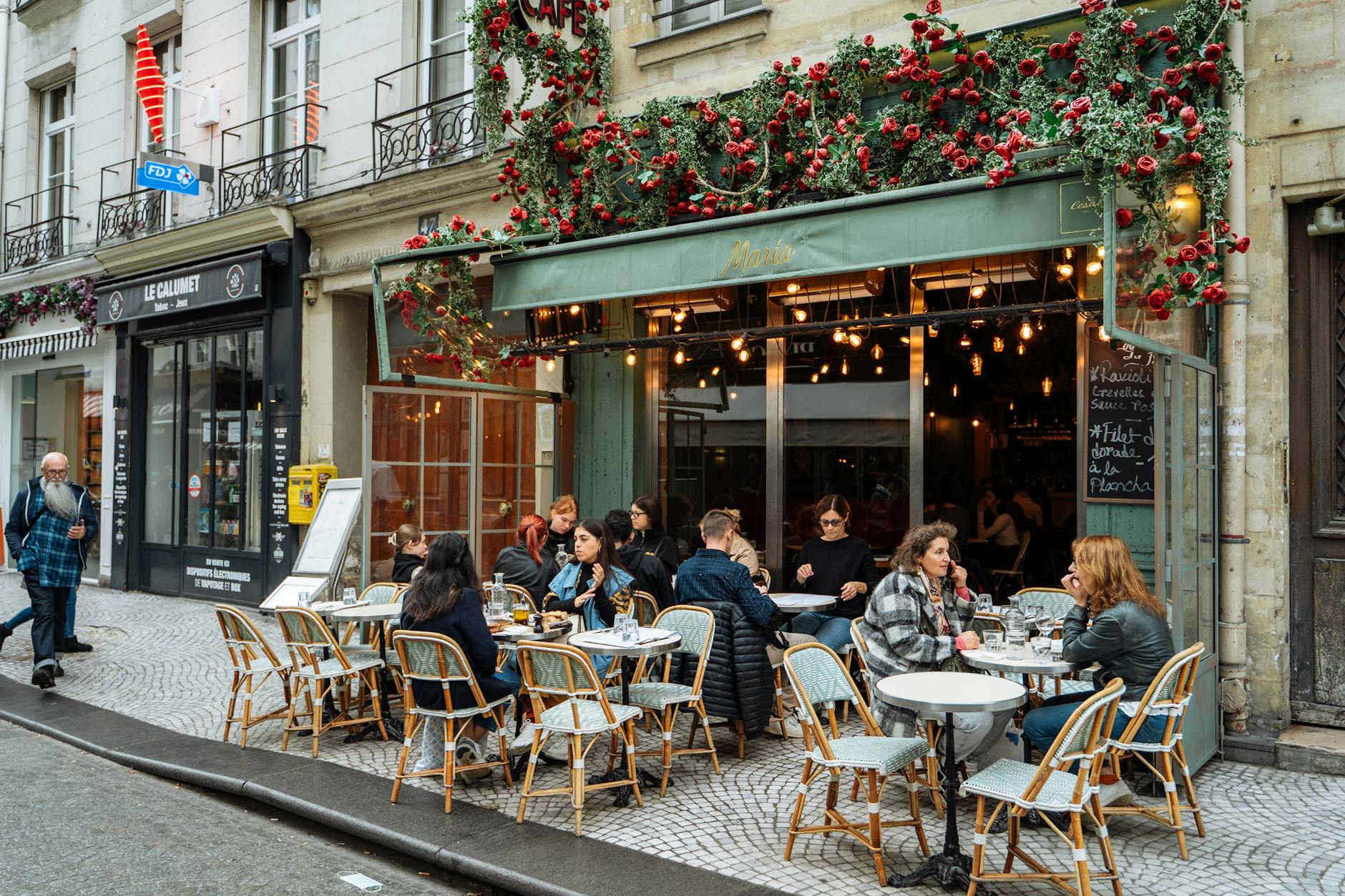
- Je voudrais… — zhuh voo-DREH — I would like. Politer than je veux (“I want”), which sounds blunt to the point of rude.
- Celui-ci, s’il vous plaît — suh-lwee SEE — this one, please. Combined with pointing, this handles most of a bakery.
- C’est combien ? — say kom-BYEN — how much is it?
- Une baguette tradition — oon ba-GET tra-dee-SYON — the better baguette, made to a legally defined recipe. Ordering this rather than a plain baguette is the single most useful piece of bakery knowledge in France, and our bakeries guide explains why.
- Un morceau de… — un mor-SO duh — a piece of. Useful at a cheese counter, followed by pointing.
- Je regarde, merci — zhuh ruh-GARD, mair-SEE — I’m just looking, thanks. The polite way to decline help in a clothes shop.
- Vous acceptez la carte ? — voo zak-sep-TAY la KART — do you take cards? Almost always yes now, including at market stalls.
One quiet rule at food markets and greengrocers: do not handle the produce. The stallholder picks for you. Point, say the quantity, and let them do it — reaching into the crate yourself is a small but real breach, and our markets guide covers the rest of the etiquette.
In a café or restaurant (16–25)
- Une table pour deux, s’il vous plaît — oon TAH-bluh poor DUH — a table for two, please. For one, pour une personne.
- La carte, s’il vous plaît — la KART — the menu. Note that le menu means the set meal, not the list of dishes. This trips up almost everyone.
- Une carafe d’eau, s’il vous plaît — oon ka-RAF DOH — a jug of tap water. It is free, restaurants are required to provide it, and asking is completely normal.
- Qu’est-ce que vous recommandez ? — kess-kuh voo ruh-ko-mon-DAY — what do you recommend? Genuinely welcomed, and usually answered honestly.
- Je prendrai le plat du jour — zhuh pron-DRAY luh PLA doo ZHOOR — I’ll have today’s dish. Frequently the best thing in the kitchen and the best value.
- Saignant / à point / bien cuit — sen-YON / a PWAN / byen KWEE — rare / medium / well done. Be warned that French à point is pinker than most visitors expect.
- Je suis végétarien / végétarienne — zhuh swee vay-zhay-ta-RYEN / RYEN-nuh — I’m vegetarian. Add sans viande et sans poisson (“no meat and no fish”) if you want to be certain, because in some kitchens fish and stock are not counted.
- Je suis allergique à… — zhuh swee za-lair-ZHEEK a — I’m allergic to… Worth writing on your phone as well as saying.
- C’était délicieux — say-TAY day-lee-SYUH — that was delicious. Said on leaving, and it lands well.
- L’addition, s’il vous plaît — la-dee-SYON — the bill, please. It will not come until you ask; that is courtesy, not neglect. A raised hand and eye contact works equally well.
Never say “garçon”. It means “boy”, it has not been acceptable for decades, and it appears in phrasebooks only because phrasebooks copy each other. To get a waiter’s attention: catch their eye and say “s’il vous plaît”, or “monsieur” / “madame”. Our restaurant guide and the guide to what to order cover the food itself.
On tipping, the phrase you may want is “gardez la monnaie” (gar-DAY la mo-NAY) — keep the change. Service is included by law in France, so this is a small gesture rather than an obligation.
Getting around (26–32)
- Où est… ? — oo EH — where is…? Follow with la station de métro, les toilettes, la sortie.
- Je cherche… — zhuh SHAIRSH — I’m looking for… Softer than a bare question.
- C’est loin ? — say LWAN — is it far?
- Un carnet / un ticket, s’il vous plaît — un kar-NAY / un tee-KAY — a book of tickets or a single. Worth knowing that the discount on buying ten at once was abolished in January 2026, so ten now simply costs ten times €2.55 — see our Navigo and tickets guide.
- Quelle ligne pour… ? — kel LEEN-yuh poor — which line for…? Our Metro guide covers the network itself.
- Je descends — zhuh day-SON — I’m getting off. Said to move through a crowded carriage towards the door.
- À l’aéroport Charles de Gaulle, s’il vous plaît — a la-ay-ro-POR sharl duh GOL — to Charles de Gaulle airport, please. The fare is fixed by law, so no negotiation is needed; our airport transfer guide has the flat rates.
When something goes wrong (33–39)
- Au secours ! — oh suh-KOOR — help! The one to shout.
- Appelez la police — ap-lay la po-LEES — call the police.
- J’ai besoin d’un médecin — zhay buh-ZWAN dun mayd-SAN — I need a doctor.
- On m’a volé mon sac / mon portefeuille — on ma vo-LAY mon SAK / mon port-FUY — my bag / my wallet has been stolen. The phrase you will want at a police station; our guide to pickpockets in Paris covers what to do next.
- Je voudrais porter plainte — zhuh voo-dreh por-TAY PLANT — I’d like to file a formal complaint. This is the specific wording insurers require, as opposed to a simple log entry.
- Je suis perdu / perdue — zhuh swee pair-DOO — I’m lost.
- Laissez-moi tranquille — lay-say mwah tron-KEEL — leave me alone. Said firmly, not apologetically. It works.
The emergency numbers, for the record: 112 for anything, EU-wide with English-speaking operators; 17 for police; 15 for medical; 114 by SMS. And when someone approaches you with a clipboard, a gold ring or a friendship bracelet, the correct phrase is no phrase at all — see our scams guide.
Getting on with people (40–45)
- Je ne parle pas bien français — zhuh nuh parl pa byen fron-SEH — I don’t speak French well. Said with a smile, this buys enormous goodwill.
- Vous pouvez répéter, s’il vous plaît ? — voo poo-VAY ray-pay-TAY — could you repeat that?
- Plus lentement, s’il vous plaît — ploo lont-MON — more slowly, please.
- Je ne comprends pas — zhuh nuh kom-PRON pa — I don’t understand. Better than nodding, which leads somewhere worse.
- C’est magnifique — say man-yee-FEEK — it’s beautiful. Deploy freely; it is meant and it is received well.
- Vous êtes très gentil / gentille — voo zet treh zhon-TEE / zhon-TEE-yuh — you’re very kind. The right thing to say to someone who has just helped you.
Numbers, days and the awkward bits (46–50)
- Un, deux, trois, quatre, cinq — un, duh, twah, KATR, SANK — 1 to 5, which covers most orders.
- Six, sept, huit, neuf, dix — sees, set, weet, nuhf, dees — 6 to 10.
- Soixante-dix, quatre-vingts, quatre-vingt-dix — swa-sont DEES, ka-truh VAN, ka-truh van DEES — 70, 80, 90. French builds these as “sixty-ten”, “four-twenties” and “four-twenties-ten”, which is exactly as confusing as it sounds and is the single hardest thing about French numbers.
- Aujourd’hui / demain / hier — oh-zhoor-DWEE / duh-MAN / ee-YAIR — today / tomorrow / yesterday.
- Ouvert / fermé — oo-VAIR / fair-MAY — open / closed. The two most important words on any door in Paris, particularly on a Sunday or in August.
The harder half: understanding what comes back
Every phrasebook teaches you to speak and none of them prepare you for the reply, which arrives fast, in a register you have not practised, and often as a question. These are the responses you will actually hear, and recognising six or seven of them removes most of the panic.
- “Je vous en prie” — zhuh voo zon PREE — you’re welcome / please go ahead. You will hear this more than any other reply.
- “C’est tout ?” — say TOO — is that everything? Asked at every counter in France. Answer “oui, c’est tout, merci” or “et aussi…” for one more thing.
- “Vous payez comment ?” — voo pay-YAY ko-MON — how are you paying? “Par carte” for card, “en espèces” for cash.
- “Sur place ou à emporter ?” — soor PLAS oo a om-por-TAY — eating in or taking away? A genuine price difference often follows, so it is not a formality.
- “Vous avez la monnaie ?” — voo za-VAY la mo-NAY — do you have change / anything smaller? Small shops dislike breaking fifties.
- “Ça marche” — sa MARSH — literally “that works”, meaning fine, agreed, will do. Extremely common and not in any phrasebook.
- “Bonne continuation” — bun kon-tee-nwa-SYON — enjoy the rest of it. A warm farewell with no English equivalent.
- “Je vous écoute” — zhuh voo zay-KOOT — I’m listening, i.e. go ahead with your order. Not impatience, though it can sound like it.
- “Désolé, on est complet” — day-zo-LAY, on ay kom-PLEH — sorry, we’re full. The one you least want at a restaurant door.
At the hotel, the pharmacy and the ticket desk
Three specific situations where a handful of words saves a great deal of gesturing.
Checking in
- J’ai une réservation au nom de… — zhay oon ray-zair-va-SYON oh NOM duh — I have a reservation under the name of…
- À quelle heure est le petit-déjeuner ? — a kel UHR ay luh puh-tee day-zhuh-NAY — what time is breakfast?
- Pouvez-vous garder mes bagages ? — poo-vay voo gar-DAY may ba-GAHZH — can you keep my luggage? Almost always yes, before check-in and after check-out, at no charge.
- La clé, s’il vous plaît — la KLAY — the key, please.
At the pharmacy
French pharmacists advise and dispense for a great deal that would need an appointment elsewhere, and the green cross is one of the more useful signs in the city.
- J’ai mal à la tête / au ventre / à la gorge — zhay MAL a la TET / oh VON-truh / a la GORZH — I have a headache / stomach ache / sore throat.
- Avez-vous quelque chose pour… ? — a-vay voo kel-kuh SHOZ poor — do you have something for…?
- C’est sans ordonnance ? — say son or-do-NONSS — is it available without a prescription?
- Une pharmacie de garde — oon far-ma-SEE duh GARD — the duty pharmacy, open overnight and on Sundays; the address is posted on the door of any closed one.
Buying a ticket
- Deux adultes, s’il vous plaît — duh za-DOOLT — two adults, please.
- Y a-t-il un tarif réduit ? — ya-teel un ta-REEF ray-DWEE — is there a reduced rate? Worth asking: under-18s are free at the national museums, as are EU residents under 26.
- À quelle heure fermez-vous ? — a kel UHR fair-may VOO — what time do you close? Last admission is usually 45 to 60 minutes before.
- Où est la sortie ? — oo ay la sor-TEE — where is the exit? The word sortie is everywhere in Paris and worth knowing on sight.
What not to say
The corrections that save the most embarrassment.
| Avoid | Why | Say instead |
|---|---|---|
| Garçon ! | Means “boy”. Long obsolete and faintly insulting | Catch their eye, “s’il vous plaît” |
| Salut to a shopkeeper | Over-familiar with someone you do not know | Bonjour |
| Je suis excité(e) | Means sexually aroused, not “excited” | J’ai hâte — I can’t wait |
| Je suis plein(e) | Means drunk, or pregnant of an animal | J’ai bien mangé — I’ve eaten well |
| Bonjour twice to the same person | Reads as not having registered them the first time | Re-bonjour, jokingly, or nothing |
| Voulez-vous coucher avec moi ? | It is a song lyric and it means exactly what you think | Genuinely, nothing |
| Haggling in an ordinary shop | Prices are fixed. It is not a bargaining culture | Only at flea markets and brocantes |
Why the greeting rule is so strict
It is worth a paragraph, because understanding the reason makes it stick better than memorising the word does.
In British or American retail culture, a shop is a public space you enter freely and the transaction begins when you speak. In France a shop is closer to a private space with a door in it, and the shopkeeper is a person standing in their own room. Bonjour is not a pleasantry attached to the transaction; it is the acknowledgement that a person is present before any business is done. Skipping it and opening with a request treats them as a vending machine, and the coolness that follows is not xenophobia — the same coolness is directed at French people who forget.
The corollary is generous. Once the greeting has been made, an enormous amount is forgiven. Mangled grammar, the wrong gender on a noun, a pronunciation that makes the word unrecognisable — none of it matters much, and people will meet you a long way. This is why the six phrases at the top of this page outperform a term of evening classes for the purposes of a one-week trip.
The rule extends further than shops. It applies in a lift with a stranger, at a doctor’s waiting room, when joining a queue at a counter, and when approaching anyone in the street. A useful habit for visitors: say bonjour reflexively whenever you make eye contact with someone whose space you have entered, and you will almost never get it wrong.
How to pronounce things well enough
You do not need a good accent. You need to be understood, and four rules get you most of the way.
- Final consonants are usually silent. Paris is “pa-REE”. Croissant ends in a nasal vowel, not a hard T. The main exceptions are C, R, F and L — a useful mnemonic being the word CaReFuL.
- The stress is even, or on the last syllable. English speakers instinctively stress the first syllable and it is the biggest single giveaway. Say ca-fé, not CA-fay.
- “R” comes from the back of the throat, closer to a soft gargle than to an English R. An approximation is fine; nobody will mind.
- “U” is not “oo”. Tu and tout are different words. Round your lips as if for “oo” and say “ee” instead — that is the sound.
And one practical point: a translation app with the camera function is genuinely transformative for menus, signs and pharmacy labels, and it does not undermine the effort you are making with the spoken phrases. Our roundup of Paris apps worth having covers which ones work offline.
The one-page version to screenshot
| Situation | Say this |
|---|---|
| Entering anywhere | Bonjour / Bonsoir |
| Leaving anywhere | Merci, au revoir. Bonne journée |
| Approaching a stranger | Excusez-moi, parlez-vous anglais ? |
| Ordering | Je voudrais…, s’il vous plaît |
| Water | Une carafe d’eau, s’il vous plaît |
| The bill | L’addition, s’il vous plaît |
| Price | C’est combien ? |
| Lost | Je suis perdu(e). Où est… ? |
| Not understanding | Je ne comprends pas. Plus lentement, s’il vous plaît |
| Trouble | Laissez-moi tranquille / Au secours ! |
Frequently asked questions
Do I really need French to visit Paris?
No. English is widely spoken in central Paris, in hotels, museums, and most restaurants that a visitor will use. What you need is the ritual — greeting first, asking rather than assuming — and that takes ten minutes to learn.
Are Parisians rude to people who don’t speak French?
Overwhelmingly no, and the reputation is largely a misreading of formality. What does get a cool response is opening in English without a greeting, which is read as a failure of manners rather than of language. Reverse that one habit and the city warms up noticeably.
Will people switch to English if my French is bad?
Often, yes, and it is not a rebuke. It is someone trying to make the exchange easier for you. If you would rather keep practising, say “je voudrais essayer en français” — I’d like to try in French — and most people will happily oblige.
What is the single most useful phrase?
“Bonjour”, by a distance. Nothing else you learn will change as many interactions.
Should I use “tu” or “vous”?
Vous, always, with everyone you meet as a visitor. Tu is for friends, family and children, and using it with a stranger is a small but noticeable overstep. Wait to be invited.
How do I say numbers when paying?
You rarely need to. Prices are displayed, terminals show the total, and contactless works nearly everywhere. Knowing one to ten is plenty for ordering quantities.
Is it worth learning phrases if I’m only there three days?
The six at the top of this page, yes — they take fifteen minutes and they will alter the tone of every transaction of your trip. The other forty-four are optional.
Do the same phrases work outside Paris?
Yes, and the greeting convention is if anything stronger in smaller towns, where walking into a shop without a bonjour is more conspicuous. Everything on this page works anywhere in France, which is useful on any of our day trips out of the city.
Words are only half of it. The other half is the behaviour the words sit inside — when to sit down and when to wait, why the bill never arrives unasked, how loudly to talk, what to wear into a church, and the handshake that has to happen twice. Our companion guide to Paris etiquette and the unwritten rules covers the conduct that goes with the vocabulary.