Paris Etiquette: The Unwritten Rules Visitors Keep Breaking
Most of what passes for Parisian rudeness is a collision of unwritten rules. Here they are, written down.
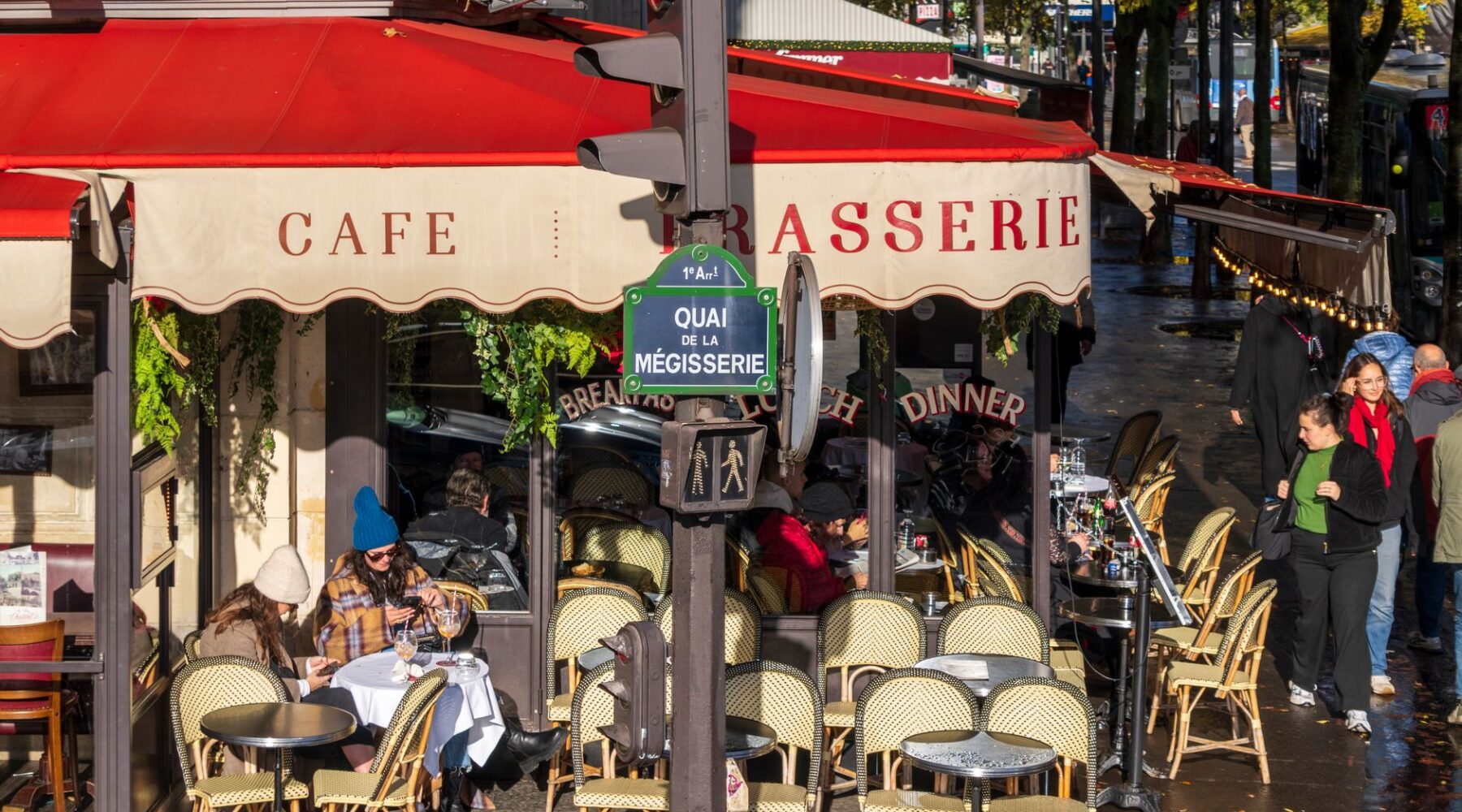
There is a particular sound that a Paris café makes when a group of visitors walks in, and it is a slight lowering of everything else. Not hostility — the room simply recalibrates, because the new arrivals are speaking at a volume that would be unremarkable at home and is roughly twice what the room was running at. Nobody says anything. The waiter is perfectly polite. And the group will leave two hours later with the impression that Parisians are a bit cold, without ever learning what happened. Most of what passes for rudeness in this city is a collision of unwritten rules, and paris etiquette customs are almost entirely a matter of things nobody thinks to tell you.
This guide sets them out: how the greeting works and why it is not optional, how to behave in a café without irritating anyone, the volume question, dress, queueing, the Metro, museums, churches, what to do if you are invited to someone’s home, and — just as usefully — a list of things visitors worry about that are not rude at all. It is a companion to our guide to French phrases for travellers, which handles the words; this one handles the behaviour. Prices, where they appear, were checked in September 2026.
The rules that matter most
| Rule | Why it matters | Cost of getting it wrong |
|---|---|---|
| Say bonjour on entering anywhere | It acknowledges a person, not a transaction | High. This single omission explains most “rude Parisian” stories |
| Match the room’s volume | French public spaces run quieter than Anglophone ones | High, and entirely invisible to the person doing it |
| Wait to be seated — or don’t, depending | Cafés: sit anywhere. Restaurants: wait | Low, but it marks you immediately |
| Never say garçon | It means “boy” and has been offensive for decades | Moderate. Use “s’il vous plaît” |
| Ask for the bill; it will not come | Bringing it unprompted would be hurrying you out | None, but you will wait a long time |
| Use vous, not tu | Familiarity is offered, not assumed | Moderate with anyone over about thirty |
| Cover shoulders and knees in churches | Actively enforced at Notre-Dame and Sacré-Cœur | You may simply be turned away |
The greeting, which is the whole game
If there is one thing to take from this page it is that in France a shop, a café, a lift, a waiting room and a taxi are all understood as spaces containing a person, rather than as public spaces containing a service. Bonjour is the acknowledgement that you have noticed the person. It comes before the request, always, without exception, and its absence is registered instantly.
The practical form:
- Entering: “Bonjour” — or “bonsoir” from around six in the evening. Say it towards whoever is behind the counter, even if they are busy.
- Then your request, in whatever language. “Bonjour — do you speak English?” is a completely successful sentence in Paris. “Do you speak English?” alone is not.
- Leaving: “Merci, au revoir”, and ideally “bonne journée”. Leaving a shop in silence, even one where you bought nothing, is the part visitors most often skip and the part that reads worst.
- In a lift, a stairwell, a small waiting room: the same. Strangers greet each other in enclosed spaces here.
The reward for doing this is disproportionate. Once the greeting has been made, mangled French, the wrong noun gender and an unrecognisable accent are all forgiven generously. It is not about language competence at all.
Cafés and restaurants
Sitting down
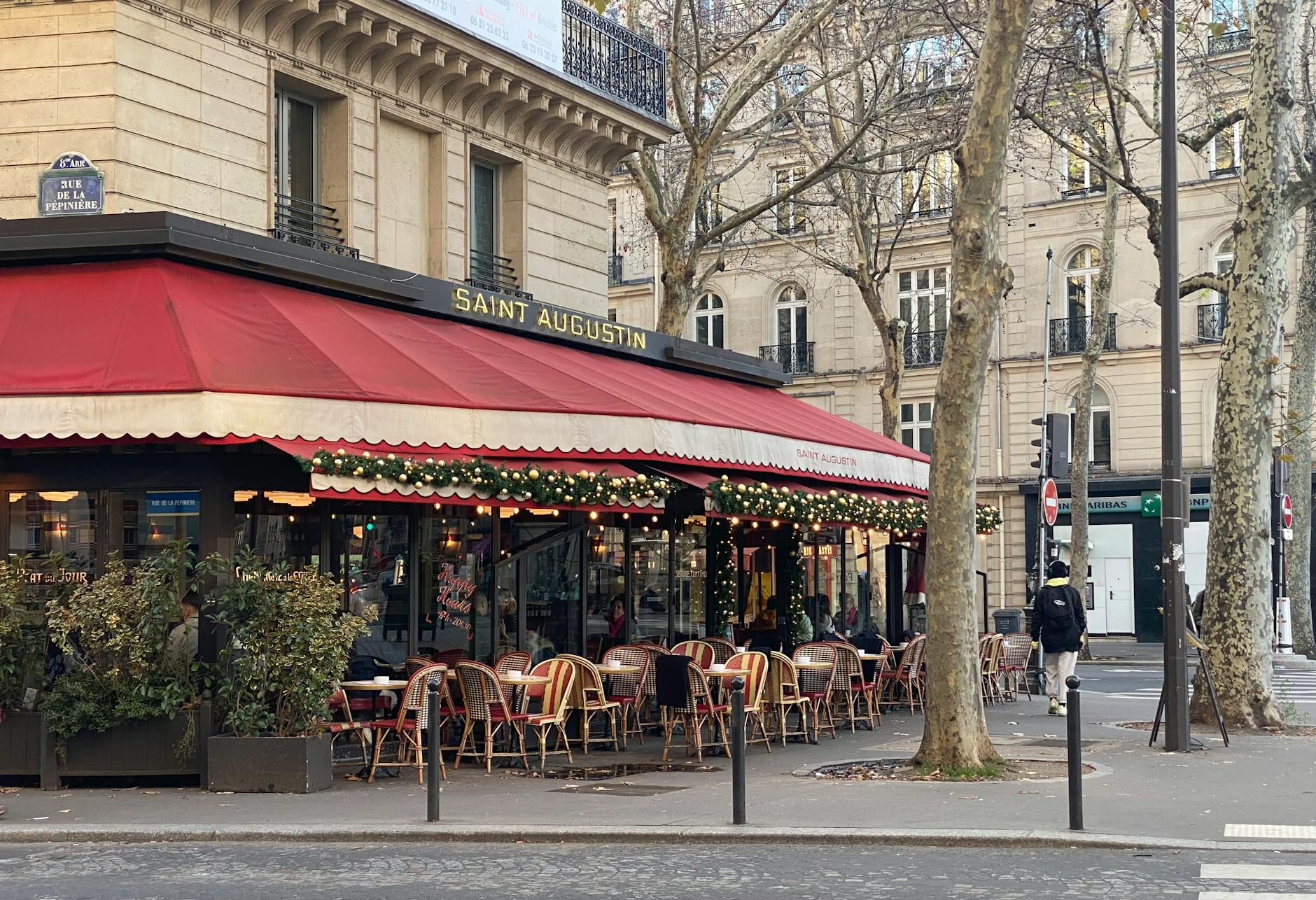
In a café or a brasserie, choose your own table and sit. Waiting by the door to be seated will get you a puzzled look. In a proper restaurant, particularly in the evening, wait at the entrance to be shown to a table. If you are unsure which sort of place you are in, a quick “bonjour, une table pour deux ?” from the doorway resolves it.
The pace is the point
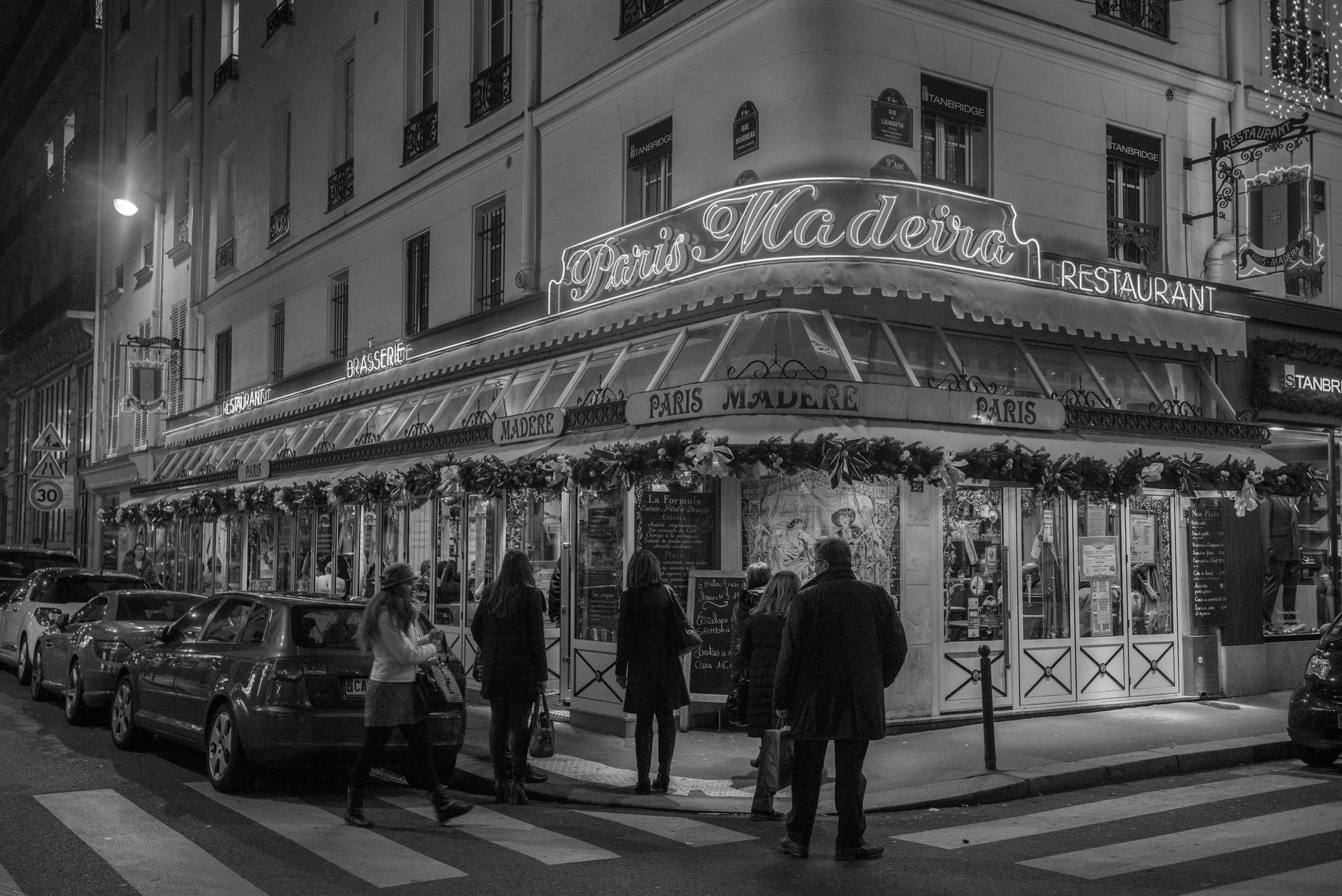
A French meal is not a transaction to be completed efficiently. The table is yours for as long as you want it, nobody will hurry you, and — the corollary that catches everyone out — nobody will bring the bill until you ask. “L’addition, s’il vous plaît” is the closing move, and until you make it, the waiter is being polite by leaving you alone.
By the same logic, service that feels slow is usually service that is deliberately unobtrusive. Waiting staff in France are trained professionals in a career job, not students working a shift, and the relationship is more formal and less chatty than in Britain or the United States. The waiter who does not ask how everything is going is not neglecting you.
The specific things visitors get wrong
- Do not call across the room, and do not click, whistle or wave a menu. Catch an eye and say “s’il vous plaît”, or “monsieur” or “madame”.
- Do not ask for substitutions. A French kitchen has decided how the dish goes; asking for the sauce on the side or the cheese left off is a bigger ask than it seems. Genuine allergies are, of course, taken seriously — say “je suis allergique à…”.
- Bread goes on the table, not on a plate, and it is for eating with the meal rather than before it. Using a piece to wipe the plate is entirely normal and quietly approved of.
- Keep both hands visible, wrists resting on the table edge rather than a hand in your lap. This is a real and old convention, and while nobody will comment, it is noticed.
- Don’t ask for a doggy bag by default. It is legal and increasingly accepted, but portions are sized for one person and it is not expected.
- Coffee comes after dessert, not with it, and a cappuccino after midday is a mild curiosity rather than an offence.
On tipping, briefly
Service is included in the price by law — service compris — so there is no obligation and leaving nothing is not an insult. What Parisians actually do is round up, or leave a euro or two in a café and perhaps five per cent after a good dinner. Adding twenty per cent will confuse rather than delight, and it is not a kindness to the local norm.
Volume, and the general question of taking up space
This is the least discussed and most consequential of the lot. French restaurants, trains, waiting rooms and shops run at a lower ambient volume than their British, American or Australian equivalents. A conversation that is normal at home is loud here, and it is the single most reliable way to be identified as a tourist — more than clothes, more than a camera, more than a map.
The same principle covers a cluster of related habits: not blocking a pavement while a group decides where to go, not stopping dead at the top of a Metro staircase, not spreading bags across a second seat on a busy train, not letting children run in a restaurant. None of this is unique to France, but the tolerance is narrower.
The Metro, the bus and the street
- Let people off before boarding. There is no signage; it is simply enforced by collective irritation.
- Stand on the right on escalators. The left is for walking, and Parisians walk.
- Give up the priority seats. They are marked, and for pregnant women, elderly and disabled passengers and those with small children — and people do actually stand up.
- Do not hold the doors. The chime is a warning, not a suggestion, and the doors close hard.
- Move down the carriage, and take your backpack off in a crowd — both for courtesy and because a bag on your back in a crush is exactly what pickpockets in Paris are looking for.
- Say pardon when squeezing past. It is expected and it is free.
- Greet the bus driver when you board. A small thing, universally done, and immediately marks you as someone paying attention.
Our Metro guide covers the mechanics of the network, and the wider transport guide the buses and trams.
Dress
Paris is less formal than its reputation and considerably less casual than most visitors assume, and the gap between those two facts is where people go wrong. Nobody will refuse you entry to a restaurant for wearing trainers. But there is a recognisable register — plain colours, clothes that fit, a jacket rather than a fleece — and standing outside it is conspicuous.
- Athletic wear outside a gym reads as odd rather than offensive. Leggings, running shoes and sports jerseys are the clearest tourist markers in the city.
- Shorts are fine in July and August and unusual otherwise.
- Churches enforce a dress code. Shoulders and knees covered at Notre-Dame, Sacré-Cœur and the Sainte-Chapelle among others, and staff do turn people away. A light scarf in a bag solves it.
- Smart restaurants and the opera expect an effort — a collared shirt, a dress, something other than what you walked around in all day. Our opera guide covers what people actually wear, which is less than the buildings suggest.
- Comfortable shoes win. You will walk a long way on uneven stone. Our packing list makes the case in detail.
La bise, handshakes and personal space
The cheek kiss is real, and as a visitor you will almost never need it. It is for friends and family, not for shopkeepers, waiters or people you have just been introduced to in a professional setting. If it happens: it is two kisses in Paris, right cheek first, and it is a touch of cheeks with a kissing sound rather than an actual kiss on the skin.
For everyone else, a handshake, and — the part visitors forget — the handshake happens on arrival and on departure, individually, with everyone present. A group goodbye waved from the door is the unfinished version.
On personal space: conversational distance in France is slightly closer than in Britain or North America, and stepping back to restore your usual distance reads as coldness. It is a small adjustment worth making consciously.
Museums, churches and monuments
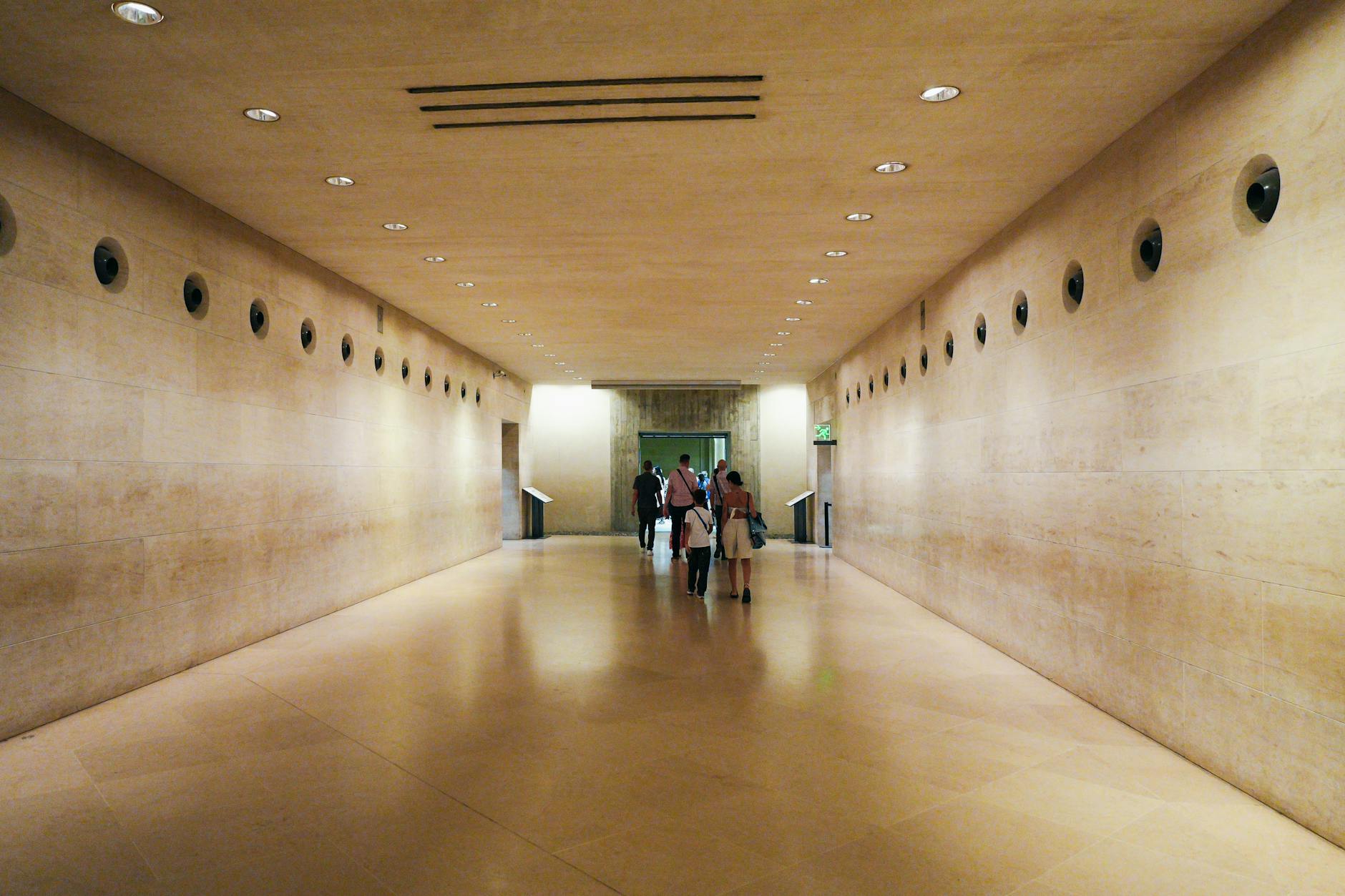
- Voices down, phones silenced. Museum galleries here are quiet rooms.
- No flash photography, essentially everywhere, and no photography at all in some temporary exhibitions — watch for the crossed-out camera.
- Step aside after your photograph. The most disliked behaviour in the Louvre is not photography; it is standing in front of a painting with a phone up for two minutes.
- Churches are working buildings. Mass may be in progress in a side chapel while you visit; walk round it, do not photograph it, and do not cross into a roped-off area of worship. Notre-Dame is free to enter and receives services daily — our Notre-Dame guide covers visiting since the reopening.
- Do not touch anything, including the frames, the plinths and the walls of the Sainte-Chapelle. This sounds obvious and is violated constantly.
- Bags get checked. Large ones must go to the cloakroom at most major museums, which is free but adds fifteen minutes at the busiest hours.
Shops and markets
- Greet, then browse. In a small boutique this matters more than anywhere.
- Do not handle the produce at a market or a greengrocer. Point and say the quantity; the stallholder picks. Our markets guide covers the rest.
- Prices are fixed. France is not a haggling culture, and attempting to negotiate in an ordinary shop is faintly embarrassing. The exceptions are flea markets and brocantes, where “c’est votre meilleur prix ?” is entirely expected — see our flea markets guide.
- Wait your turn properly. Small bakeries often have no visible queue but everybody knows the order. Watch for a moment before stepping forward.
- Say goodbye on the way out, whether or not you bought anything.
If you are invited to someone’s home
Unlikely on a short trip, but worth knowing, because the conventions are firm.
- Arrive ten to fifteen minutes late. Punctuality to the minute is for professional appointments; at a dinner it is slightly awkward, since the host will still be getting ready.
- Bring something. Good wine, flowers, or a patisserie box. Not chrysanthemums, which are for graves, and not red roses, which mean something else.
- Wait to be seated, and wait for the host to say “bon appétit” or to begin before eating.
- Do not pour your own wine before offering to fill others’ glasses, and never fill your own glass to the top.
- Compliment the food, and send a message the next day. Both are expected.
Where the “rude Parisian” reputation actually comes from
It is worth unpicking, because the stereotype is unusually persistent and unusually badly explained. Four separate things get bundled together under it, and only one of them is about anyone being unfriendly.
Formality read as coldness. French social life draws a much harder line between the public register and the private one. In public — with shopkeepers, waiters, officials, strangers — the mode is correct, contained and not personal. Warmth is reserved for people you know, and offering it to strangers is closer to presumption than to friendliness. Someone who is polite but not warm is behaving correctly, not disliking you.
Service as a profession, not a performance. Waiting tables in France is a career with training behind it, and the job is understood as competence rather than charm. The absence of “how is everything tasting?” is not indifference; it is a different definition of doing the job well. Once you stop reading for enthusiasm, most Paris service is quick, accurate and quietly good.
The greeting, again. A very large share of bad encounters in Paris are downstream of one missing word. From the shopkeeper’s side, someone has walked into their space and begun issuing requests without acknowledging them, which would be read as rudeness anywhere — it is simply that in most Anglophone countries the acknowledgement is optional and here it is not.
Genuine impatience, in genuinely busy places. The staff at the ticket window at Gare du Nord in August are brusque, and so would you be. This is Paris being a large working city rather than Paris being French, and it has an exact equivalent in London, New York and every other capital.
The test of all this is easy to run and consistently surprising: spend a day greeting everyone first, keeping your voice at the level of the room, and asking rather than assuming about English. The city that comes back is a noticeably different one.
Money, queues and small transactions
- Put money in the tray, not the hand. Many shops have a small dish on the counter; using it rather than passing cash directly is the local habit, and it is not a rejection of contact.
- Have something smaller than a fifty. Cash machines dispense them and small shops dislike them; “vous avez la monnaie ?” is a question you will be asked.
- Do not jump a queue that does not look like one. Bakeries and market stalls often have no visible line but a firmly understood order. Pause, work out who arrived before you, and step forward when it is your turn.
- Refuse the card terminal’s offer to charge you in your own currency. Not etiquette exactly, but the single most expensive habit visitors have — the rate is set by the terminal’s operator and is reliably worse than your bank’s.
- Do not tip taxi drivers a percentage. Round up to the nearest euro or two if you like. The airport flat fares are fixed by law and already include everything.
What is not rude, despite what you have heard
A useful counterweight, because visitors arrive tense about things that nobody minds at all.
- Asking for tap water. A carafe d’eau is free and restaurants are legally obliged to provide it. Ask every time.
- Speaking English — after the greeting. Nobody expects fluency. The greeting is the whole test.
- Eating alone. Entirely ordinary here, and cafés are built for it. Our guide to Paris on your own goes further.
- Not tipping twenty per cent. Service is included. Rounding up is generous.
- Sitting for two hours over one coffee. This is the intended use of a café terrace, and the price of the drink reflects it.
- Asking for the wine list, or ordering the cheapest wine on it. Neither is judged.
- Taking photographs of buildings. Fine everywhere outdoors. Photographing identifiable strangers without asking is the line, and it is a legal one in France as well as a social one.
- Splitting the bill. Normal, and most restaurants will take several cards without complaint.
Frequently asked questions
Are Parisians actually rude?
No, but they are formal, and formality read through an informal culture looks like coldness. The specific behaviours that generate the reputation — a flat greeting, an unsmiling waiter, no small talk — are markers of professional distance rather than dislike. Say bonjour first and the difference is immediate and obvious.
Do I need to speak French to be treated well?
No. You need to make the greeting and to ask rather than assume that English is available. Our guide to French phrases for travellers covers the small handful of words that do the work.
Should I smile at strangers?
Less than you would at home. The broad smile at a passing stranger, standard in much of the United States, reads in Paris as either odd or as an opening for a conversation you did not intend to have. In a shop or a café, absolutely smile; in the street, less so.
Is it rude to sit down at a café without ordering straight away?
Not at all. Sit, settle, and order when the waiter comes. What is impolite is occupying an outdoor table at a busy hour and ordering nothing at all.
How long can I stay at a table?
In a café, essentially indefinitely. In a restaurant at dinner, one sitting is yours for the evening in most places, though a small dining room with a second sitting may say so when you book.
What time do people eat in Paris?
Lunch between 12:00 and 14:00, dinner from 19:30, with 20:30 the more usual hour. Kitchens genuinely close between services, so a 15:30 arrival narrows your options to brasseries and cafés. Our practical guide to Paris has the full timings.
Is it rude to ask for ice, or for a to-go coffee?
Neither is rude, but both may simply not be available. Ice is used sparingly, and takeaway coffee, while now common in modern cafés, is not the default in a traditional one.
Do I say bonjour to everyone in a shop?
To whoever is working there, yes. Not to every other customer, though in a small bakery or a doctor’s waiting room a general “bonjour” to the room is normal and rather charming.
Money is the part of the etiquette people most want a number for. Ours: round up, or a euro or two in a café, or five per cent after a dinner that deserved it — and nothing at all is completely normal, because service is included in the price by law. The full breakdown, from housekeeping to walking-tour guides, is in our guide to tipping in Paris.