Sainte-Chapelle & Conciergerie: Paris’s Hidden Medieval Gems
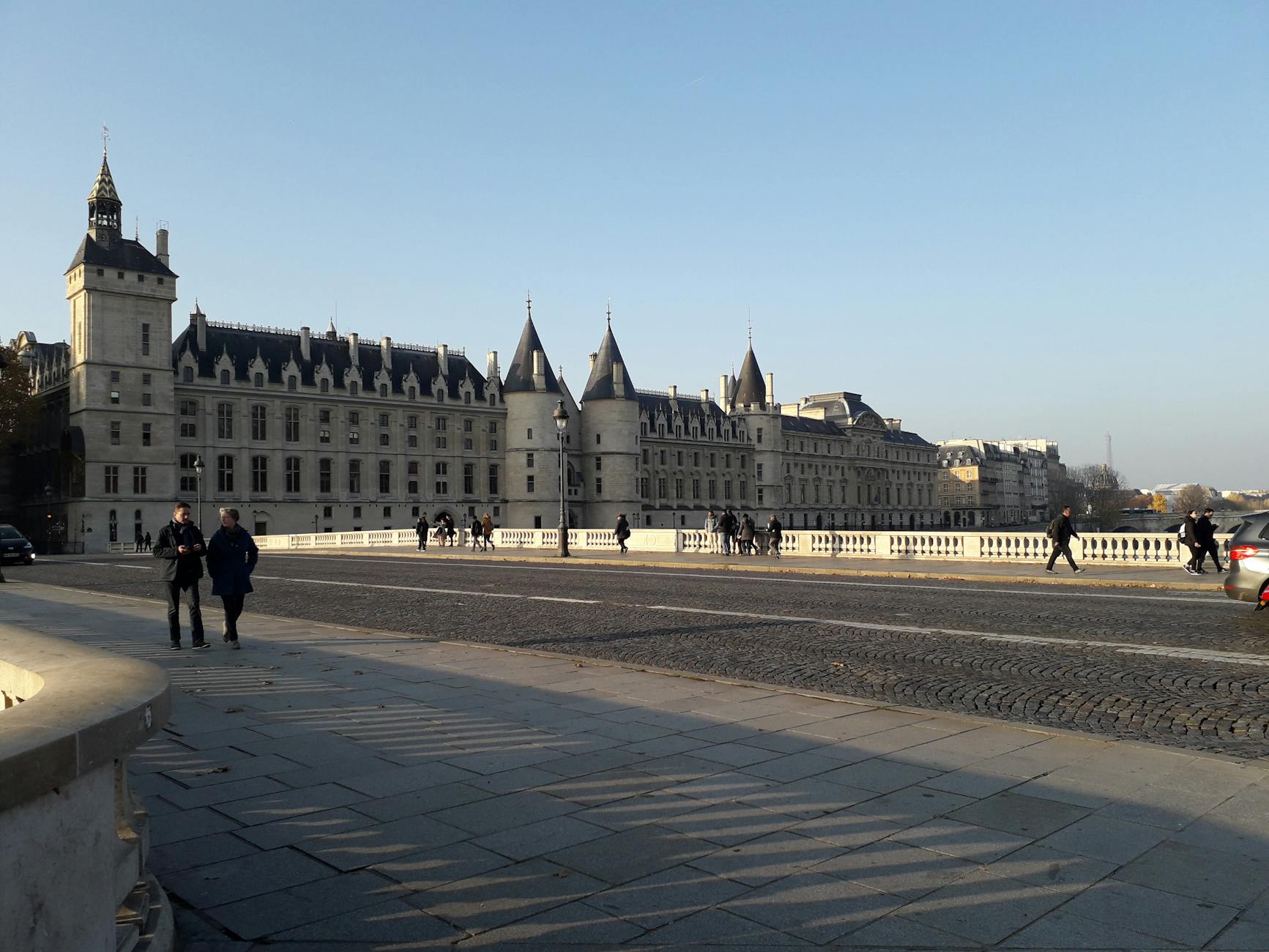
Most visitors walk straight past two of the most important medieval buildings in Europe on their way to Notre-Dame. The sainte chapelle conciergerie pairing sits on the Île de la Cité, a few steps from the cathedral, and stays oddly under-visited for what it is. Sainte-Chapelle’s 15-metre stained-glass walls carry 1,113 thirteenth-century scenes, and the room tends to shut people up the moment they step into it, faith or no faith. Next door, the Conciergerie’s gothic halls held Marie-Antoinette before her execution in 1793. One combined ticket runs €19, the pair takes two to three hours, and together they pack 800 years of French history into a single afternoon.
The Île de la Cité Setting: Why These Two Together
Here’s the thing the combined ticket quietly tells you: these aren’t two buildings. They’re the surviving fragments of one. Both are leftovers of a single enormous medieval complex, the Palais de la Cité, which served as the main royal residence of the French kings from the sixth century until 1364, when Charles V gave up on the cramped island palace and moved the court to the Louvre. For roughly 800 years, every decision that mattered in the kingdom was made inside the walls that now hold these two monuments, along with the present-day Palais de Justice that swallowed most of the original.
Inside that complex, Sainte-Chapelle was the king’s private chapel, a royal-grade building meant to house the most sacred relics in Christendom and to be entered only by the monarch, his family, and his closest courtiers. The Conciergerie, running along the Seine on the north side, did double duty. It was the administrative seat where the king’s steward (the concierge, who gave the building its name) ran the daily business of the palace, and it was the kingdom’s most important prison, holding high-status prisoners awaiting royal justice. The two shared kitchens, courtyards, walls, and staff. Treating them as separate attractions barely makes historical sense, and the combined ticket just stitches back together what 800 years of accidents pulled apart.
On the practical side, both are run today by the Centre des Monuments Nationaux, the French state heritage agency, which is why one combined ticket exists and why your €19 covers both. The two entrances sit about a four-minute walk apart, separated only by a wedge of the Palais de Justice. Notre-Dame is five minutes east on the same island, the Crypte Archéologique lies beneath the cathedral parvis, and the Île Saint-Louis (with its famous Berthillon ice cream) is one footbridge away. Plan it well and you can do all four before lunch and still fit in a walk along the river. Our top Paris sights guide shows how this island slots into a wider city itinerary.
Sainte-Chapelle: What to Expect
Louis IX commissioned Sainte-Chapelle in 1238, and it was consecrated on April 26, 1248. That’s six or seven years of construction, which is absurdly fast for a Gothic building this complex and ambitious. For scale: Notre-Dame took roughly 180 years from groundbreaking to finish, and Chartres about 60. The speed was political. Louis, later canonised as Saint Louis and the only French king the Catholic Church ever recognised as a saint, had just acquired the single most prestigious relic in medieval Europe and needed somewhere royal-grade to put it, fast.
The relic was Christ’s Crown of Thorns, bought in 1239 from Baldwin II, the bankrupt Latin Emperor of Constantinople, who was so short of cash he was effectively liquidating his treasury. Louis paid 135,000 livres tournois for the crown alone, a genuinely staggering figure, more than the entire cost of building Sainte-Chapelle. He soon added other passion relics, including a piece of the True Cross, the Holy Lance, and the Holy Sponge. The chapel was, in effect, an enormous reliquary built around its contents, and the blazing stained-glass interior was the setting Louis and his court thought the most sacred objects on earth deserved.
The building has two levels, which catches most first-timers off guard. You enter through the Lower Chapel, which served the palace servants, household staff, and lower-ranking courtiers. It’s lovely on its own terms: deep-blue vaults strewn with gold fleurs-de-lis, walls worked with medallions and arcading, a ceiling that glows in a way that reads intimate rather than grand. Most people give it about ten minutes before heading up the tight spiral staircase.
The Upper Chapel is the reason you came, and it has a fair claim to being the single greatest interior in Gothic architecture. Fifteen stained-glass windows climb 15 metres from floor to vault, each one built from dozens or hundreds of narrative panels. Add them up and you get 1,113 individual scenes, running through Old Testament stories, the Passion of Christ, the book of Revelation, and, uniquely, the story of how the Crown of Thorns travelled from Jerusalem to Paris. The trick of it is that the walls have effectively been dissolved into coloured light, propped up by stone tracery so thin the building looks like it shouldn’t stand. Walk in on a sunny day and the whole room becomes a shifting mosaic of red, blue, and gold thrown across the floor and the walls.
A €10 million restoration between 2008 and 2015 cleaned all 5,000-plus stained-glass panels and the stonework around them. The chapel reopened fully in 2014, and the result was a brighter interior than anyone living had ever seen, with centuries of soot, candle smoke, and pollution lifted away to bring back the saturation of the original thirteenth-century palette. If you saw it before 2014, go back; it’s a different building now. Budget 60 to 90 minutes. One note for 2026: the Crown of Thorns itself went back to Notre-Dame in 2024, after the cathedral’s post-fire restoration, so Sainte-Chapelle no longer holds the relic it was built for. The architecture and the glass were always the real reason to come anyway.
The Conciergerie: What to Expect
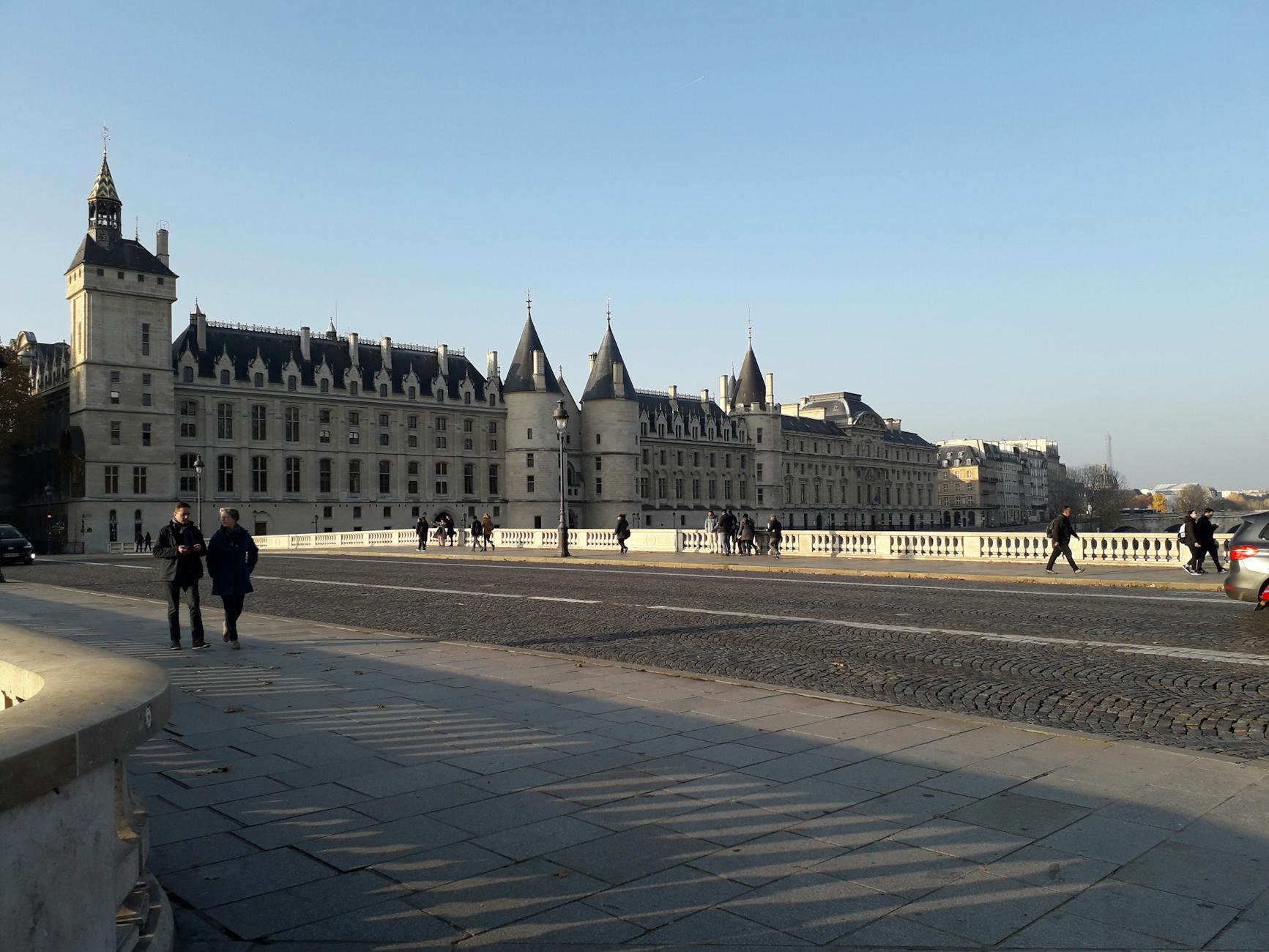
If Sainte-Chapelle is small, vertical, and devotional, the Conciergerie is its opposite: sprawling, horizontal, political. Built in the fourteenth century as part of the same royal complex, it started as the administrative and service quarter of the household, then, after Charles V left for the Louvre, slid into a second life as the kingdom’s top high-security prison. From the late fourteenth century it held the most important prisoners awaiting royal justice. But its real infamy comes much later. Between 1789 and 1795, during the Revolution, it became the holding pen of the Revolutionary Tribunal, and roughly 2,780 prisoners passed through its cells on the way to the guillotine.
The most famous of them was Marie-Antoinette. The queen was moved here on August 1, 1793, and held for 76 days before her execution at Place de la Révolution (now Place de la Concorde) at 12:15pm on October 16, 1793. A reconstructed version of her cell is one of the main stops. It has to be a reconstruction: the original was demolished and replaced in 1815 by a memorial chapel, the Chapelle Expiatoire, which Louis XVIII built on the spot to honour his executed sister-in-law. The chapel is part of the tour, and it’s one of the quietest, most affecting spaces in Paris.
The architectural showpiece, though, is the Salle des Gens d’Armes, the Hall of the Men-at-Arms. At 64 metres long, 27 wide, and 8 high, it’s the largest surviving medieval secular hall in Europe. Rows of stone pillars split it into four naves under elegant rib vaults, and in the fourteenth century it fed the 2,000 staff who ran the palace. Stand inside it now, in the cool stone half-light, and you get an immediate physical read on the scale medieval French kingship operated at. Next to it is the Salle des Gardes, a smaller but equally impressive vaulted chamber, and the Cuisines, the medieval kitchens, whose four monumental fireplaces could each roast an ox and together turn out meals for the full 2,000-person household.
Other stops worth your time: the Cour des Femmes, the women’s courtyard where female prisoners (Marie-Antoinette among them) got brief exercise; the Galerie des Prisonniers, the long corridor where prisoners waited to be hauled before the Tribunal; a recreated version of the Tribunal courtroom, prosecutors’ chairs and all; and the Tour Bonbec, one of three surviving thirteenth-century corner towers, long reputed to be where torture was carried out in the early medieval period. Its name translates roughly as the “good beak” tower, gallows humour about how prisoners would sing under interrogation.
The Conciergerie also runs one of the best uses of museum tech in Paris: the Histopad, a handheld iPad-style augmented-reality tablet handed to every visitor for free at the ticket desk. Hold it up in any hall and the screen lays a three-dimensional reconstruction of the original royal apartments (tapestries, furniture, courtiers in period dress) over the bare stone in front of you. It’s the rare gimmick that genuinely earns its place, turning what would otherwise be a string of empty rooms into a living medieval palace. Allow 60 to 90 minutes; you can move faster if you have to, but the Histopad will happily eat any spare time you hand it. For more on the city’s wider museum scene, see our Paris museums guide.
Combined Tickets: Pricing for 2026
By Paris standards, the pricing here is refreshingly sane. The same agency runs both buildings, and the combined ticket is the obvious choice for almost everyone except the genuinely time-starved who only want one of them.
| Ticket | Adult Price | Notes |
|---|---|---|
| Sainte-Chapelle only | €13 | Free under 18 worldwide; free EU residents 18-25 |
| Conciergerie only | €13 | Free under 18 worldwide; free EU residents 18-25 |
| Combined ticket (both) | €19 | Best value — saves €7; valid two consecutive days |
| Combined + Tower | €25 | When Conciergerie tower reopens after restoration |
| Sainte-Chapelle concert | €40-60 | Evening classical concerts; separate booking |
| Paris Museum Pass 2-day | €70 | Includes both monuments plus 50+ others |
| Paris Museum Pass 4-day | €85 | Best value for a full Paris week |
| Paris Museum Pass 6-day | €105 | Long-stay option |
The combined ticket saves €7 against buying separately and stays valid for two consecutive days, so you don’t have to do both in one afternoon if you’d rather split them. Both monuments are also free for everyone, no booking needed, on the first Sunday of each month from November through March, a programme called the Premier Dimanche du Mois. And if you’re already buying a Paris Museum Pass for the Louvre or Orsay, both are folded in at no extra cost, which is usually the smartest play for anyone hitting four or more major sites.
Tickets sell on the official Centre des Monuments Nationaux site (monuments-nationaux.fr) and at the ticket desks of both buildings, which take cash and card. Both now require mandatory time-slot reservations, pass-holders included, so book at least a few days ahead in high season (April through October). Sainte-Chapelle concerts are handled separately by the chamber-music groups that hire the chapel in the evenings, and run €40 to €60 depending on the programme.
Sainte-Chapelle: Best Time to Visit for the Stained Glass
The most underrated fact about Sainte-Chapelle is that no two visits are the same. The chapel is basically a coloured-light instrument, and its tone depends entirely on what the sky is doing. Pick your window with a bit of care and you’ll have a far better visit than someone who shows up at random.
The ideal is a sunny day at midday. The chapel’s axis runs roughly east-west, with the apse on the east and the rose window on the west, and the long south wall catches the most direct sun for the longest part of the day. In summer (May through August), the best stretch runs about 11am to 3pm, when the south windows flood with direct light and the floor of the Upper Chapel turns into a kaleidoscope of red, blue, and gold. In winter (November through February), the equivalent window is shorter and earlier, roughly 11am to 2pm, because the sun sits lower in the southern sky.
Don’t write off a cloudy day, though. The glass diffuses light rather than simply passing it through, so an overcast sky gives an even, gentle glow across the whole chapel that some photographers and architects actually prefer. The windows read more uniform, the colours less violent, the mood more meditative. The one combination to dodge is an overcast winter morning before about 10am, when the glass can look genuinely dim and the room falls flat. The last hour of the day, especially on a clear evening, opens another small piece of magic: low golden-hour sun rakes through the south windows at a steep angle and turns the upper glass into something close to gold leaf.
The catch is that peak light and peak crowds are the same hours. From 11am to 3pm in summer the queues can wrap around the Palais de Justice gates. The smart trade is to come for the 9am opening (quieter, with the light still building) or after 4pm (light fading, but the chapel close to empty). The evening classical concerts, usually two or three nights a week between March and October, are a different beast entirely: the chapel is candle-lit rather than daylit, and the music (typically Vivaldi, Pachelbel, or Bach for chamber strings) is staged in the Upper Chapel itself, with the audience seated beneath the dark glass. Concert tickets run €40 to €60 and are sold separately.
History: Louis IX, Crown of Thorns, the Revolution
Louis IX, who reigned from 1226 to 1270, was an odd king well before he became a saint. He took the throne at 12, fought two crusades and died of dysentery on the second, in Tunis, reformed royal justice by letting subjects petition him directly under an oak tree at Vincennes, and was canonised just 27 years after his death, the only French monarch the Catholic Church has ever made a saint. Sainte-Chapelle was his masterstroke of religious diplomacy. By acquiring and housing the Crown of Thorns and the other Passion relics, he turned Paris into the spiritual centre of Christendom and cast the French crown as the temporal protector of Christianity itself.
The 1239 acquisition was pure medieval political theatre. Baldwin II, the last Latin Emperor of the short-lived crusader state of Constantinople, was technically the relic’s custodian but so broke he’d been pawning relics to Venetian bankers for years. Louis effectively redeemed the pawn ticket, paying 135,000 livres tournois, roughly half the French crown’s annual revenue at the time and more than the later cost of building Sainte-Chapelle itself. The relic reached Paris on August 18, 1239, in a great procession. Louis met it five leagues outside the city, took off his crown, his shoes, and his royal robes, and walked the rest of the way into Paris barefoot in a penitent’s tunic, carrying the relic himself. The chapel to house it was begun within months.
For the next 550 years, Sainte-Chapelle was the religious heart of the French monarchy, the setting for coronations, royal marriages, and the most important state religious ceremonies. Then came 1789. The Revolution went after both buildings precisely for their royal associations. Sainte-Chapelle was deconsecrated and turned, with deliberate insult, first into a grain warehouse and then a flour store. Most of the medieval decoration was stripped or destroyed, and the great fleurs-de-lis vaults were whitewashed. The Passion relics were pulled out by the revolutionary government and moved to Notre-Dame, and from there to Saint-Denis Basilica.
The Conciergerie’s fate was darker. It became the principal prison of the Revolutionary Tribunal during the Reign of Terror (1793-1794), and roughly 2,780 prisoners passed through its cells in those eighteen months. About half, perhaps 1,300 people, went on to the guillotine. Marie-Antoinette was the most famous, held from August 1 to October 16, 1793, tried over two days on October 14-15, and executed at 12:15pm the next day. But the prison’s roll of victims also includes Madame Élisabeth (Louis XVI’s sister), Charlotte Corday (who assassinated the radical journalist Marat in his bath), the poet André Chénier, the revolutionary firebrand Louis Antoine de Saint-Just, and, in a final twist, Maximilien Robespierre himself, briefly held here after his Thermidorian fall before his own execution on July 28, 1794.
Both buildings came back into public use during the nineteenth century, when the architect Eugène Viollet-le-Duc, who also restored Notre-Dame, led the first major restoration of Sainte-Chapelle’s glass and stonework and brought the chapel back toward its medieval splendour. The second, far more scientific restoration between 2008 and 2015 cleaned more than 5,000 panels and stripped away two centuries of grime, leaving the chapel brighter and more vivid than it had been in at least 300 years. For more on the city’s revolutionary geography, see our Paris walking tours guide.
What to See in Sainte-Chapelle Window by Window
The Upper Chapel windows run as a continuous biblical narrative, reading clockwise from the entrance, each window given over to one book or theme of scripture. Read them in order (or just walk a careful clockwise circuit) and the chapel turns from a beautiful blur into a visible library of medieval thought. Here is the full sequence, and what to look for in each.
- Window 1 (north wall, first): Genesis — the Creation across seven days, the Fall of Adam and Eve, and Cain’s murder of Abel. The bottom panels read more easily; look for the deep blue of the Creation skies.
- Window 2: Exodus — the burning bush, the plagues of Egypt, the crossing of the Red Sea, and the Ten Commandments on Mount Sinai. Moses wears red throughout.
- Window 3: Numbers and Deuteronomy — the wandering in the wilderness, the golden calf, the brazen serpent. Notice the desert palette of yellow and ochre.
- Window 4: Joshua and Ruth — the conquest of Canaan, the fall of Jericho, and the gentler story of Ruth gleaning in the fields of Boaz.
- Window 5: Judges — the heroic cycle of Israelite warriors, including Gideon, Samson, and the rebellion against the Philistines.
- Window 6: Isaiah and the prophet Jeremiah — visionary scenes set against elaborate architecture.
- Window 7: The Tree of Jesse (Christ’s descent from King David) paired with Saint John the Evangelist — one of the most distinctive windows, thanks to its symmetrical tree composition.
- Window 8 (south apse, centre): The Passion of Christ — the most theologically loaded window, since the chapel was built to hold the Crown of Thorns. Some panels are original thirteenth-century glass.
- Window 9: Saint John the Baptist with the prophets Daniel and Ezekiel — three Old Testament figures read as foreshadowings of Christ.
- Window 10: Judith and Esther — two Old Testament heroines, Judith beheading Holofernes and Esther interceding with King Ahasuerus.
- Window 11: The Book of Tobit — the journey of Tobias with the angel Raphael, an unusually narrative cycle.
- Window 12: The Books of Kings — the reigns of David and Solomon and the building of the Temple in Jerusalem.
- Window 13: The Story of the Crown of Thorns — the only window depicting the relic the building was made for, tracing the crown from Jerusalem to Constantinople to Paris and Louis IX’s barefoot reception of it in 1239.
- Window 14: Esther and Daniel — a continuation of the heroic Old Testament cycle.
- Window 15 (rose window, west wall): The Apocalypse and the Last Judgment, 86 scenes from the Book of Revelation. This rose is later (15th century), added under Charles VIII, and its palette is noticeably brighter and more golden than the thirteenth-century glass around it.
Below the great windows, the lower walls of the Upper Chapel carry painted blue-and-gold fleurs-de-lis (the symbol of the French royal house) and arcaded niches holding twelve carved statues of the Apostles, six to a side. Many are nineteenth-century copies (the originals live in the Musée de Cluny for conservation), but a handful of original heads survive and reward a closer look for their thirteenth-century craft.
What to See in the Conciergerie Hall by Hall
The Conciergerie has a natural flow that runs most people about an hour to ninety minutes, and the Histopad (collected at the ticket desk, free with admission) paces you through the major rooms on its own. Here’s the typical route, in the order most visitors take it.
- Salle des Gardes (Hall of the Guards): the entrance hall, cathedral-like rib-vaulted ceiling over squat stone columns. The Histopad fills in the original wall tapestries and the seated guards.
- Salle des Gens d’Armes (Hall of the Men-at-Arms): the architectural heart of the place. 64 metres long, 27 wide, 8 high. Give it ten minutes and just take in the scale.
- Cuisines (Medieval Kitchens): four monumental stone fireplaces, each big enough to roast an ox, where the staff prepared meals for 2,000. The Histopad brings back the spits, the cauldrons, and the kitchen crew at work.
- Galerie des Prisonniers (Prisoners’ Gallery): the long corridor linking the cells, where the wealthy bought slightly better quarters and the poor lay on straw. Display panels list the 2,780 Revolutionary Tribunal prisoners.
- Cour des Femmes (Women’s Courtyard): the small outdoor court where female prisoners, Marie-Antoinette included, took their daily exercise. The central fountain survives.
- Marie-Antoinette’s Cell and the Chapelle Expiatoire: a reconstructed version of the queen’s last cell beside a 19th-century memorial chapel built by Louis XVIII on the exact spot of the original. The most emotionally charged room in the building.
- Salle de la Révolution (Revolutionary Tribunal courtroom): a recreated version of the courtroom where the Tribunal passed judgment, with the prosecutor’s chair, the defendants’ bench, and the wall behind the judges all rebuilt from period accounts.
- Tour Bonbec (when accessible): the thirteenth-century corner tower, one of three left from the original medieval palace. Sometimes closed for conservation, so check on arrival.
- Garden of the Conciergerie: the small garden along the western flank, a quiet place to decompress at the end.
Visiting with children, the Histopad turns the Conciergerie from a potentially gloomy prison tour into something closer to a video game, and kids tend to love it. The one thing to weigh is the Marie-Antoinette section. The cell, the chapel, and the list of execution dates aren’t softened, so use your judgment with sensitive kids. The Salle des Gens d’Armes wins everyone over on scale alone.
Best Photo Opportunities
The two monuments hand you very different photographic problems. Sainte-Chapelle’s is purely technical: you’re trying to capture a 15-metre vertical interior with brutal dynamic range between the brilliant glass and the dim stone. The Conciergerie’s best shots are mostly exterior, taken from across the Seine.
Inside Sainte-Chapelle, the shot everyone wants is the Upper Chapel from the southwest corner, near the entrance, looking diagonally across to the apse. From there the full sweep of the south and east windows lands in one frame, the rose window is behind you, and the column lines pull the eye toward the altar. It works best vertical, since the chapel is far taller than it is wide, and a wide-angle lens in the 24-35mm equivalent range captures the most without distortion. Tripods aren’t allowed, so brace against a column or shoot a fast lens; smartphones with night mode do remarkably well in the dim interior.
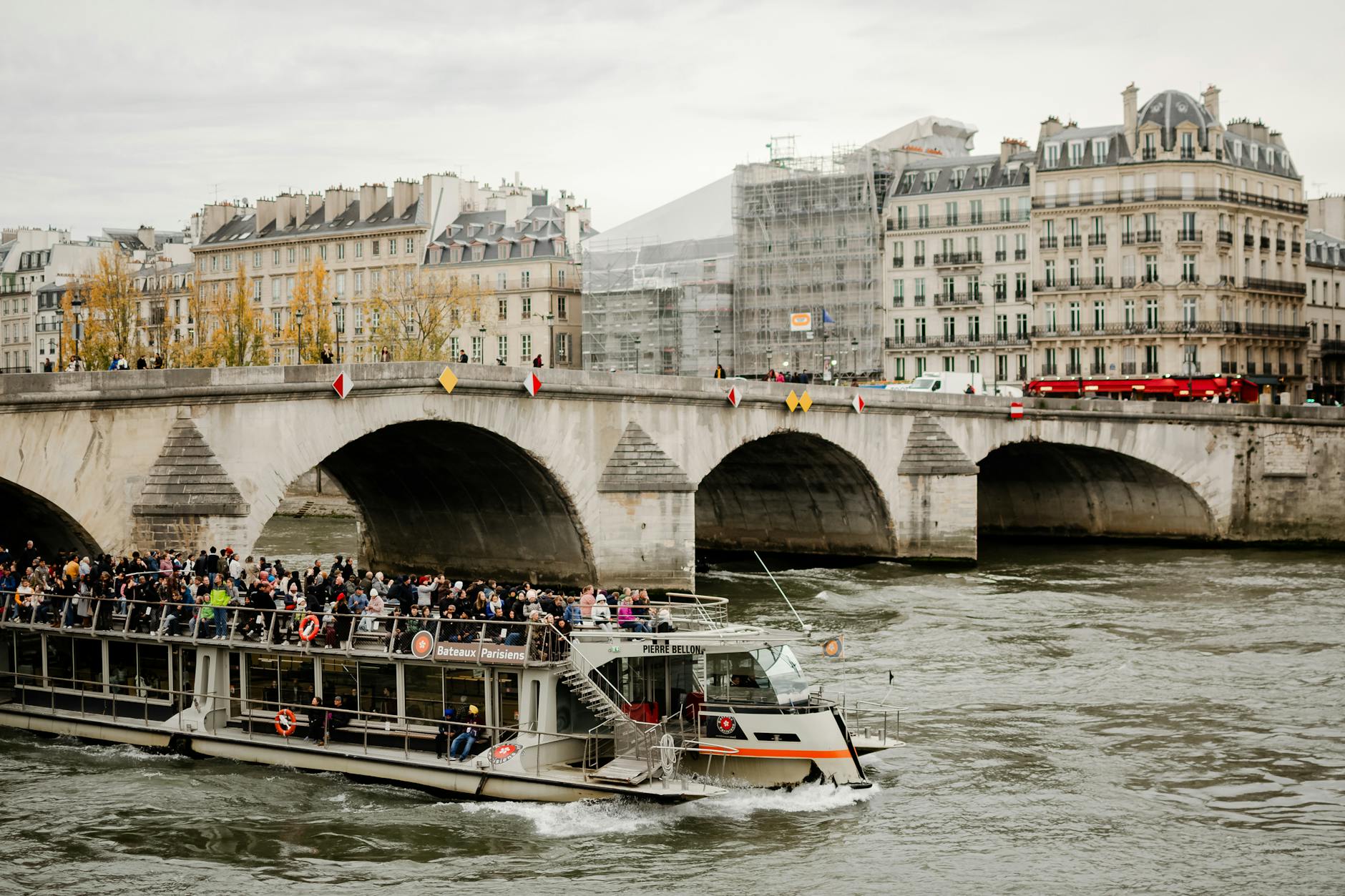
The Conciergerie’s best exterior is from Pont au Change, the bridge just east of the building, which gives you the full Seine-side facade including all three surviving medieval towers (Tour Bonbec, Tour d’Argent, and Tour César) plus the 1370 Tour de l’Horloge, which carries the oldest public clock in Paris and still runs. At night the facade is theatrically lit and mirrored in the river; Pont Saint-Michel just downstream offers a similar reflection. For something different, a Seine cruise from any nearby dock delivers the most flattering angle of all, slightly raised above the water and moving slowly enough to compose with care.
Practical Visit Tips and Etiquette
A handful of practical details will smooth the day. Sainte-Chapelle sits inside the same security perimeter as the Palais de Justice, an active French law court, so the entrance screening feels like an airport: bags through X-ray, a metal detector for visitors, no large items. Allow ten minutes for it on a busy day.
- Bag size: large suitcases, backpacks over roughly 35 litres, and oversized camera bags aren’t permitted. There’s no cloakroom, so leave the big bags at your hotel.
- Photography in Sainte-Chapelle: allowed without flash. Tripods and monopods are not.
- Voice level: the Upper Chapel is small and stone-walled, so voices carry. Keep it quiet; it’s technically still a consecrated chapel.
- Histopad in the Conciergerie: free with admission. Ask at the desk if it isn’t offered automatically; it makes the visit.
- Accessibility: both are wheelchair accessible. Sainte-Chapelle has a lift to the Upper Chapel, and the Conciergerie is largely ground-floor with step-free routes to all the major halls.
- Time required: 60-90 minutes each, 2-3 hours combined including the walk between them.
- Toilets: at both ticket entrances; nothing inside the monuments.
- Food and drink: not allowed inside either; water bottles must stay closed.
If you’ve got the time and the legs for it, the most rewarding day pairs Sainte-Chapelle and the Conciergerie with Notre-Dame (fully reopened after the 2024 post-fire restoration) and the free Musée Carnavalet in the Marais, which runs the history of Paris from Roman Lutetia to now. That gives you medieval Paris in the morning, revolutionary Paris in the afternoon, and the broader urban story by close of day. Our Paris neighborhoods guide has ideas for pushing the day on into the Marais.
What’s Around: Île de la Cité Half-Day Plan
The most efficient way to take in the Île de la Cité in a day is the four-stop run below. It goes from 9am to early evening and ties together Sainte-Chapelle, Notre-Dame, the Crypte Archéologique, and the Conciergerie, with a proper lunch in the middle.
- 9:00am, Sainte-Chapelle. Arrive at opening, when the chapel is quietest and the morning light is just starting to build through the south windows. 75 minutes inside.
- 10:30am, walk to Notre-Dame. Five minutes on foot through the Palais de Justice gates and across the parvis. Entry’s free since the December 2024 reopening; reserve a timed slot in advance via the official app or take your chances in the standby queue.
- 12:00pm, lunch. Café Saint-Régis on the Île Saint-Louis (cross the Pont Saint-Louis footbridge) for a proper sit-down meal, or Berthillon for a quick ice cream plus a baguette sandwich from a nearby boulangerie.
- 1:30pm, Crypte Archéologique. The underground archaeological crypt right beneath the Notre-Dame parvis, €9, showing Roman Lutetia foundations and the medieval layers stacked above them. 45 minutes, and an excellent primer.
- 2:30pm, Conciergerie. Free Histopad at entry. 75 minutes inside.
- 4:00pm, sunset at Square du Vert-Galant. The small triangular park at the western tip of the island, beneath the equestrian statue of Henri IV, with the best ground-level sunset over the Pont Neuf and the Seine.
FAQ
How much does it cost to visit Sainte-Chapelle and the Conciergerie in 2026?
Adult admission to each is €13. The combined ticket, which is the obvious value play, is €19 for both buildings and stays valid for two consecutive calendar days. Admission is free for everyone under 18 and for EU residents aged 18 to 25 with valid ID. Both are also included in the Paris Museum Pass (€70 for two days, €85 for four, €105 for six), usually the smartest move if you’re also doing the Louvre or Musée d’Orsay. And both are free for everyone on the first Sunday of each month from November through March.
Is Sainte-Chapelle worth visiting?
Emphatically, yes. Architectural historians widely rate the Upper Chapel as one of the supreme interiors of European medieval art, and standing inside those 15-metre stained-glass walls is unlike anything else in Paris. The visit runs about 75 minutes including security. Even people who swear they have no interest in Gothic religious architecture tend to go quiet in there. If you’re on the Île de la Cité at all, skipping it is a real mistake.
Where did Marie-Antoinette stay before her execution?
Marie-Antoinette was held in a cell inside the Conciergerie from August 1 to October 16, 1793, a total of 76 days. A reconstructed version of the cell is one of the main stops on the modern tour, next to the Chapelle Expiatoire, a 19th-century memorial chapel built by Louis XVIII on the exact location of the original cell. She was executed at Place de la Révolution (now Place de la Concorde) at 12:15pm on October 16, 1793, after a two-day trial before the Revolutionary Tribunal held within the Conciergerie itself.
How long does it take to visit Sainte-Chapelle?
Most people spend 60 to 90 minutes inside, plus another ten for security at the entrance in busy season. The Lower Chapel usually takes 10 to 15 minutes and the Upper Chapel the rest, 45 to 75. Giving the Upper Chapel more time always pays off. On a sunny day, the visit genuinely improves if you sit a few minutes on one of the side benches and watch the projected colour shift across the floor.
Is the Conciergerie kid-friendly?
Yes, with one caveat. The free Histopad tablet handed to every visitor is genuinely engaging for children roughly 7 and up, turning the empty stone halls into a three-dimensional reconstruction of medieval palace life. The caveat is the Marie-Antoinette section, which includes the reconstructed cell, a memorial chapel, and a list of execution dates; sensitive kids may find it heavy. The huge Salle des Gens d’Armes and the medieval kitchens go over well with everyone.
When is the best time to see Sainte-Chapelle’s stained glass?
The light peaks on a sunny day between 11am and 3pm in summer (May-August) or 11am to 2pm in winter (November-February), when direct sun pours through the south-facing windows and turns the Upper Chapel floor into a moving mosaic of colour. Cloudy days give a softer, more diffuse glow that some visitors prefer for its calm. The one window to avoid is an overcast winter morning before 10am, when the glass looks comparatively muted. For the fewest people, aim for the 9am opening or the last hour of the day.
Is the Sainte-Chapelle combined ticket good value?
Yes, no argument. Each monument is €13 on its own; the combined ticket for both is €19, saving €7 (roughly 27%). It’s valid for two consecutive days, so you don’t have to do both in one afternoon. The only people who should buy single tickets are those genuinely pressed for time and sure they won’t return, and even then the Conciergerie’s Histopad alone is usually worth the extra €6 over seeing Sainte-Chapelle on its own.
Can you attend a concert at Sainte-Chapelle?
Yes, and it’s one of the most atmospheric concert experiences in the city. Sainte-Chapelle hosts evening chamber-music concerts, typically Vivaldi’s Four Seasons, Pachelbel’s Canon, Bach concertos, and Mozart string works, in the Upper Chapel itself, with the audience beneath the stained glass and the players on a small platform near the altar. They run year-round, usually two or three evenings a week, at €40 to €60 depending on the programme, and are sold separately from the daytime ticket. Be clear on one thing: the chapel is candle-lit during performances, so the glass doesn’t glow the way it does in daylight. This is a music experience, not a visual one.
Related Paris Guides
- Paris attractions — the parent guide to every major Paris monument and landmark.
- Notre-Dame Paris guide — five-minute walk; reopened December 2024.
- Paris museums guide — the Louvre, Orsay, Carnavalet and 50+ more.
- Paris neighborhoods guide — the Marais, Latin Quarter, Saint-Germain, and beyond.
- Paris walking tours — self-guided and guided routes across central Paris.
- Eiffel Tower guide — the other essential Paris monument.
- Louvre Museum guide — the former royal palace Charles V moved to in 1364.
- Arc de Triomphe guide — the Champs-Élysées monument.
- Montmartre and Sacré-Coeur — the basilica on the hill.
- Versailles day trip — the palace that succeeded the Louvre.
- Paris river cruises — the best Conciergerie facade view.
- Paris 3-day itinerary — how to fit it all together.
- Paris food guide — what to eat between monuments.
- Paris hotels guide — where to stay near the Île de la Cité.
- Paris transport guide — getting to the Île de la Cité by métro and RER.
Related Paris guides
Use these to round out your trip: