Latin Quarter Paris: Bohemian Heart of the Left Bank
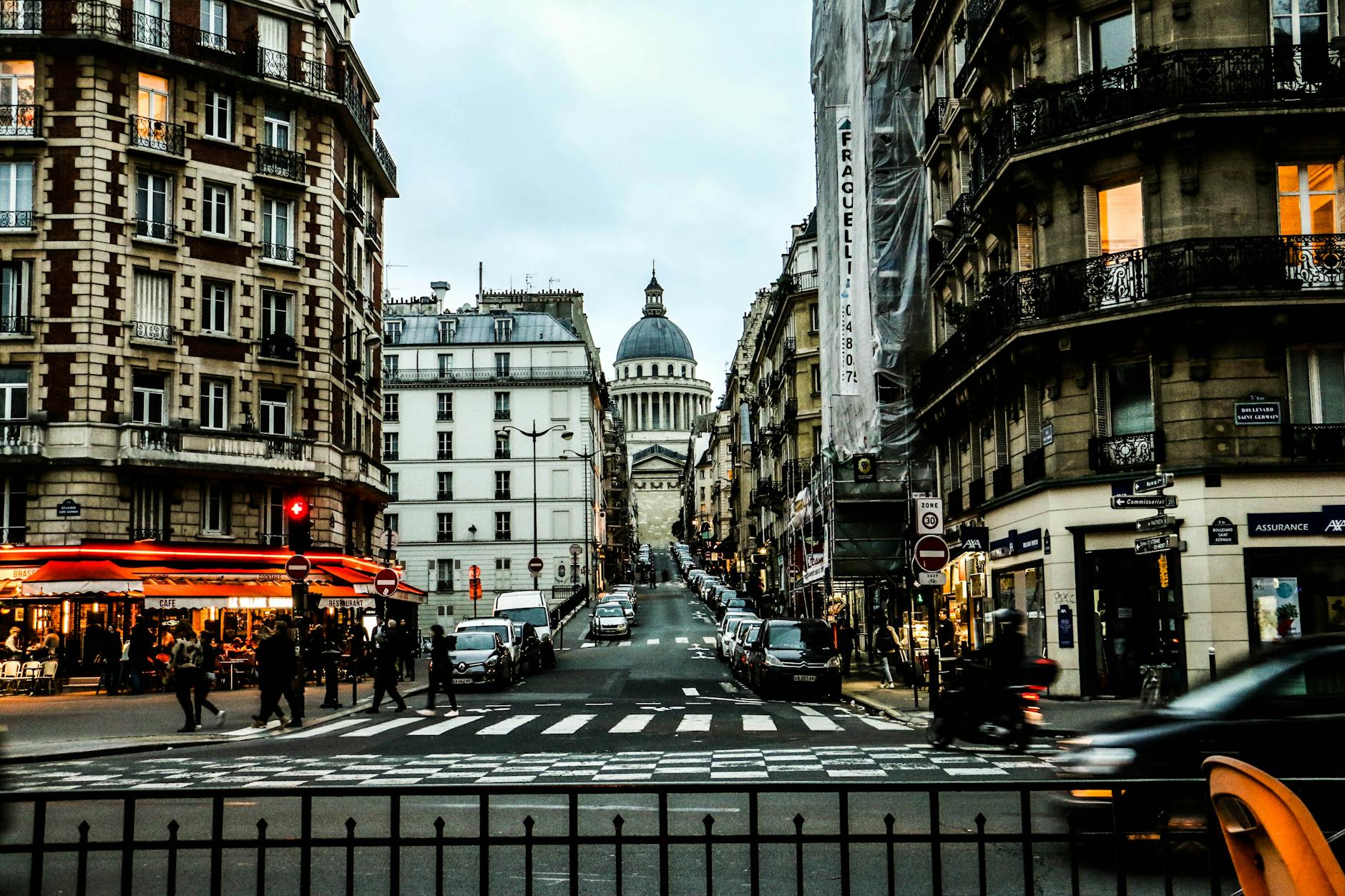
Walk uphill from the Seine toward the Pantheon and you are following a Roman road, paved over a city the Romans called Lutèce. That is the Latin Quarter (Quartier Latin), the 5th arrondissement, the oldest Left Bank neighborhood in Paris. The name comes from the Latin that students spoke in its medieval university right up until the 1789 Revolution. Today the quarter holds the Sorbonne, three of the city’s most important medieval churches (Saint-Severin, Saint-Etienne-du-Mont, and Saint-Julien-le-Pauvre, the oldest in Paris), the Cluny medieval museum, the Pantheon, the Rue Mouffetard market street, the Mosque of Paris with its Moorish tea salon, and the Jardin des Plantes with its paleontology gallery. Across the river you have the Notre-Dame and Sainte-Chapelle approach; on this side, the latin quarter paris is the most concentrated tourist neighborhood on the Left Bank, medieval cobbles laid straight on top of Roman foundations. For the wider picture, start with our Paris neighborhood guide.
Where is the Latin Quarter
The Latin Quarter is the 5th arrondissement, a wedge of the Left Bank pushed up against the Seine opposite Notre-Dame. Its edges run the Seine to the north, Boulevard Saint-Marcel to the east, Boulevard Edgar-Quinet to the south, and Boulevard Saint-Michel, one of Haussmann’s 1850s cuts, to the west. You can walk corner to corner in about forty minutes, and nearly every major sight sits within ten minutes of a Métro stop.
Seven Métro stations ring the neighborhood. Saint-Michel-Notre-Dame (RER B/C and line 4) drops you on the riverbank opposite the cathedral, the busiest entrance and the right one if you’re opening with Notre-Dame, Shakespeare and Company, or Rue de la Huchette. Cluny-La Sorbonne (line 10) is the academic gateway, two minutes from the Cluny museum. Maubert-Mutualité (line 10) is the under-used middle door. Cardinal Lemoine (line 10) sits at Hemingway’s old front step on the way up to Mouffetard. Place Monge (line 7) is closest to the Mosquée and the Arènes de Lutèce. Censier-Daubenton (line 7) lands at the southern foot of Mouffetard, and Jussieu (lines 7 and 10) serves the Jardin des Plantes.
Brief History
Long before any Latin, the quarter was Roman. The amphitheater on Rue des Arènes belonged to Lutèce, a city the Romans founded in the first century AD. The main north-south Roman street ran almost exactly along the line of today’s Rue Saint-Jacques, so when you climb from the river toward the Pantheon, you are walking the Roman road. The forum stood near Rue Soufflot, and the public baths survive inside the ground floor of the Cluny museum.
By the twelfth century the medieval city had outgrown the Île de la Cité, and the first university masters set up on the Left Bank around 1150. Robert de Sorbon founded his college for poor theology students in 1257, and the University of Paris took shape soon after. Latin ran every lecture and dormitory argument for the next five centuries, not because anyone spoke it at home, but because students arrived from across Christendom and Latin was the one tongue they all shared. That bilingual world gave the quarter its name, and the name outlasted the Revolution’s abolition of the Latin requirement in 1793.
In the nineteenth century Haussmann drove three great straight boulevards through the quarter, Saint-Michel, Saint-Germain, and Saint-Marcel, but left most of the medieval grid on the upper slopes alone. The 1968 student protests kicked off on this hill, with barricades on Rue Gay-Lussac. The Sorbonne still works out of the same buildings it used in 1900, and the medieval lanes that Pascal, Voltaire, and Marie Curie all walked are still right there under your feet.
Top 10 Must-See Sights
The quarter is dense enough that ten landmarks barely scratch it, but the ten below hit every theme that matters here: Roman, medieval, religious, royal, literary, and gastronomic.
Pantheon
The neoclassical monument crowning the hill started life as a church for Saint Geneviève and now serves as France’s national mausoleum. Voltaire and Rousseau lie facing each other in the crypt, joined by Victor Hugo, Zola, the Curies, and Jean Moulin. Foucault’s pendulum swings from the dome, and the colonnade climb (mid-April through October) gives you the best ground-level view of Les Invalides. See our Pantheon Paris guide for the full visit.
Musée de Cluny / Musée National du Moyen Age
The best medieval museum in the world, set in a fifteenth-century townhouse built over the Roman public baths. The headline act is the six Lady and the Unicorn tapestries, woven around 1500. Past the unicorns you get the heads of the kings of Judah, hacked off Notre-Dame in 1793, the Limoges enamels, and the cool stone caverns of the Roman bath itself. It reopened in 2022 after a long renovation, and it’s as good as ever yet rarely crowded.
Sorbonne University
France’s oldest university, founded in 1257 by Robert de Sorbon and rebuilt by Cardinal Richelieu in the 1620s. The chapel facing Place de la Sorbonne holds Richelieu’s tomb, and the inner courtyard sometimes opens during European Heritage Days in September. The rest of the year, peer through the gate, take a coffee on the square, and watch France’s philosophy students roll in for the morning lecture.
Saint-Etienne-du-Mont
Tucked behind the Pantheon, Saint-Étienne-du-Mont keeps the only surviving rood screen in Paris, a delicate Renaissance bridge of carved stone of the kind that was ripped out of every other Paris church during the Counter-Reformation. The church also holds the reliquary of Saint Geneviève, patron of Paris, and the tomb of Blaise Pascal. Film buffs will recognize the facade as the time-travel pickup spot in Midnight in Paris.
Saint-Severin
Flamboyant gothic at its best, two minutes from Saint-Michel. The double ambulatory behind the choir centres on a famous twisted column, a palm tree carved in stone. The glass mixes thirteenth-century fragments with modern work by Jean Bazaine from 1970.
Saint-Julien-le-Pauvre
The oldest church in Paris, older even than Notre-Dame, built between 1165 and 1220. Since 1889 it has belonged to the Melkite Greek Catholic community, so the interior follows the Byzantine plan with an iconostasis. The whole setting is small and intimate.
Jardin des Plantes + Muséum National d’Histoire Naturelle
France’s national botanical garden, started by Louis XIII in 1626 as the royal medicinal plant collection. At the western end stands the Galerie de Paléontologie, a nineteenth-century iron-and-glass cathedral crammed with dinosaur skeletons in mid-fight and a blue whale slung from the ceiling. One of the great science museums in Europe, and an easy win with kids.
Mosquée de Paris
Built between 1922 and 1926 to honor the Muslim soldiers from French North Africa who died in the First World War. It’s a Moroccan-style ensemble of prayer hall, minaret, cedar-shaded patio, hammam, restaurant, and courtyard tea salon. The main prayer area is closed to non-Muslim visitors, but the gardens, hammam, restaurant, and tea room are open daily.
Rue Mouffetard
The pedestrianized medieval market street running downhill from Place de la Contrescarpe to Saint-Médard. The market works Tuesday through Saturday plus Sunday morning, with bistros and bars filling the upper half. Hemingway, who lived a hundred metres east, called it “that wonderful narrow crowded market street.”
Shakespeare and Company
Technically across the river, but Latin Quarter in every way that counts. The current shop opened in 1951, taking its name from Sylvia Beach’s 1919 original, the one where Hemingway, Pound, and Joyce all loitered, and it still puts writers up overnight in exchange for two hours of shopkeeping a day. The view of Notre-Dame from the doorstep is one of the great free sights in central Paris.
The Sorbonne Quarter
The tight block around the Sorbonne, hemmed in by Boulevard Saint-Michel, Rue Cujas, Rue Saint-Jacques, and Rue des Écoles, is the academic core of the Latin Quarter. Place de la Sorbonne is the main social square, a paved terrace in front of the chapel with half a dozen cafés around it. This is where the May 1968 protests began, and where French undergraduates still come to argue about Foucault between lectures.
The streets here are thick with student bars, cheap restaurants, independent cinemas, and academic bookshops. One tip: skip the tourist traps on Rue de la Huchette to the north and head south to Rue de la Harpe for honest cheap French food instead. Rue Champollion packs three of the best art-house cinemas in Paris into a single block. Two minutes east stands the Collège de France, founded by François I in 1530 as a free public alternative to the medieval university. Every lecture there is open to the public, no fee, no enrollment, just walk in.
Religious Heritage
No other Paris quarter packs in medieval churches like this one. Three of the city’s most important early gothic buildings stand within a five-minute walk of each other here, with the great twentieth-century Mosque rounding it out.
Saint-Etienne-du-Mont (Place Sainte-Geneviève)
Directly behind the Pantheon. The rood screen leaps across the nave on twin spiral staircases, a Renaissance flourish carved between 1525 and 1545 that somehow dodged the Counter-Reformation. Blaise Pascal lies behind the choir, and the stone reliquary of Saint Geneviève stands in the south chapel, still the focus of an annual pilgrimage in early January.
Saint-Severin (Rue des Pretres-Saint-Severin)
The parish church of the medieval Left Bank, rebuilt in flamboyant gothic between 1450 and 1520. The twisted central column at the east end of the double ambulatory is the most photographed detail; the modern stained glass by Jean Bazaine is the most surprising. Free organ concerts every Sunday afternoon.
Saint-Julien-le-Pauvre (1 Rue Saint-Julien-le-Pauvre)
Built between 1165 and 1220, the oldest religious building in Paris. The body of the church barely reaches twenty metres, but the proportions are perfect, and the Byzantine iconostasis from 1889 settles comfortably into the early gothic shell. There are chamber concerts most evenings: cheap tickets, intimate acoustics.
Mosquée de Paris
The 1926 mosque on Place du Puits de l’Ermite, built in Moroccan style by craftsmen from the Maghreb. The hammam (separate days for men and women), restaurant, tea room, and gift shop are all open to non-Muslim visitors; the prayer hall is not. Modest dress is required for the guided tour, which runs every afternoon for about €3.
Notre-Dame: the Latin Quarter approach
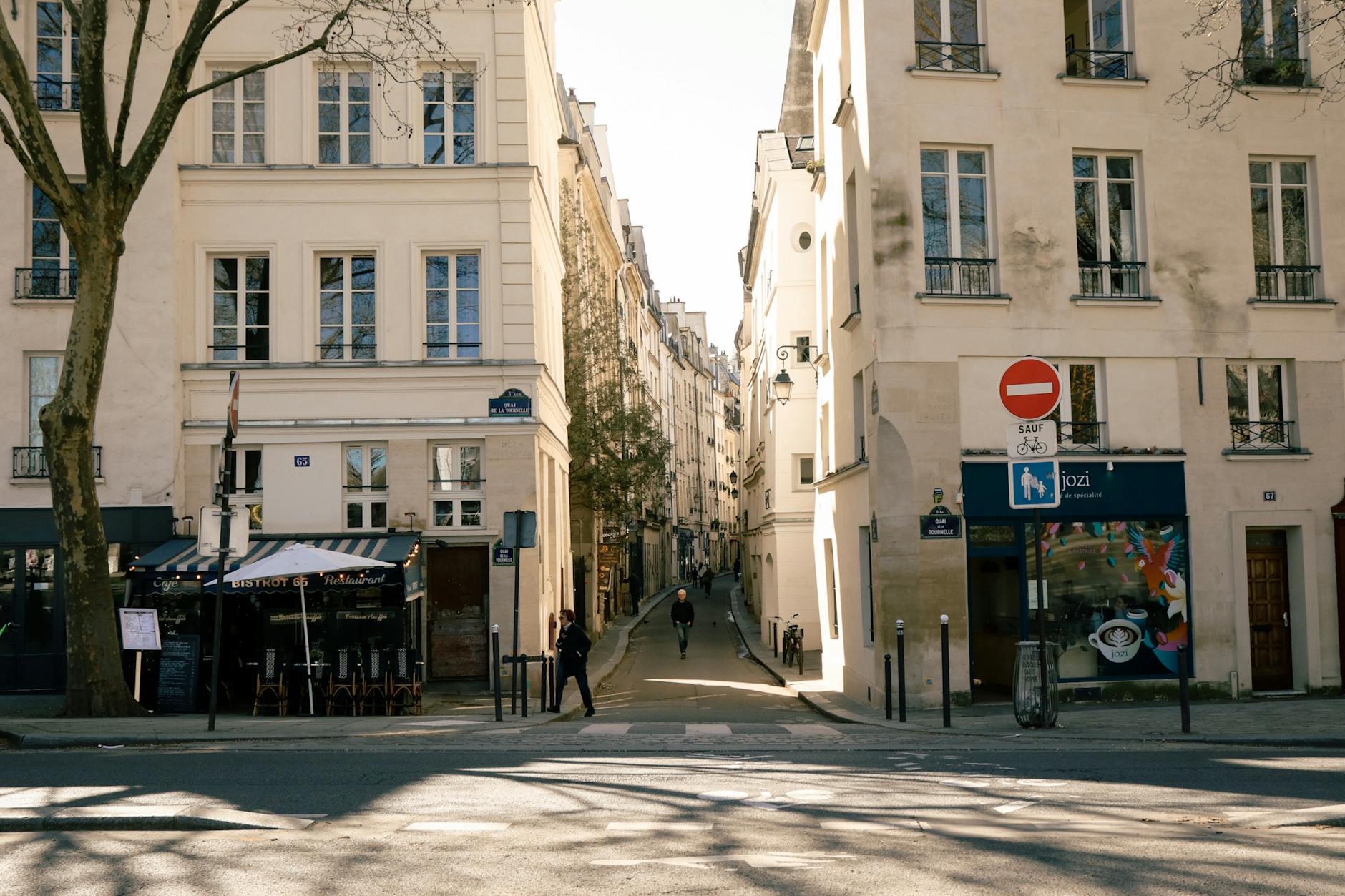
Notre-Dame stands on the Île de la Cité, but the best view of it comes from the Latin Quarter side: from Square René Viviani next to Saint-Julien-le-Pauvre, or from Pont de la Tournelle a few hundred metres east. Cross Pont au Double from Square Viviani and you get the most photographed angle of the south facade. For visiting the cathedral itself, see our Notre-Dame Paris guide.
Rue Mouffetard Deep Dive
Of all the market streets in central Paris, Rue Mouffetard has held out best against turning into a postcard of itself. Neighborhood residents still do the daily shop here, and the cheese counters still wrap your purchase in waxed paper. The lower half, between Saint-Médard and Rue Ortolan, is the working market, open Tuesday through Saturday roughly 8am-1pm and 4pm-7.30pm, plus Sunday morning. Sunday morning is the one to catch, with a live accordion player at the foot of the church around 11am. Mondays everything shuts.
The street climbs about four hundred metres from Saint-Médard up to Place de la Contrescarpe. The cheese specialists are at 134 and 116; the best bakery is Le Fournil de Mouffetard at 123; the falafel stand Au P’tit Grec at the top is a student late-night favorite, open until 2am. Hemingway lived around the corner at 74 Rue du Cardinal Lemoine from 1922 to 1923, and his descriptions of the market in A Moveable Feast still hold up. Verlaine died at number 39.
Place de la Contrescarpe at the top is the social anchor: a small triangular square with a stone fountain and four café terraces, perfectly placed for a slow drink before the walk up to the Pantheon. Café Delmas on the corner is the classic spot.
Best Restaurants in the Latin Quarter
The 5th runs two parallel restaurant economies: the tourist machine on Rue de la Huchette, which you should mostly avoid, and the genuine neighborhood scene that stretches from the Sorbonne up to Mouffetard. Eight that locals still use:
Le Coupe-Chou
9-11 Rue de Lanneau, hidden between the Pantheon and the Sorbonne. The building dates to the sixteenth century, and the dining rooms thread through three connecting houses with low beams and stone fireplaces. Classic French done at a high level: foie gras, duck confit, old-school onion soup. Set menus €35-45; book ahead. About as romantic as a Paris restaurant gets before it tips into theme-park territory.
Polidor
41 Rue Monsieur le Prince. The oldest bistro in Paris still in business, open since 1845: marble floors, mirrored walls, communal tables. Verlaine, Rimbaud, Joyce, and Hemingway all ate here. The menu is proudly old-fashioned, bœuf bourguignon, blanquette de veau, tarte Tatin, €15-30. No credit cards. Queue at 7pm or 9pm.
Brasserie Balzar
49 Rue des Écoles. The Sorbonne’s unofficial canteen since 1898, with Camus, Sartre, and Beauvoir among the regulars. Classic Parisian brasserie food (choucroute, steak tartare, sole meunierère), brisk waiters, white tablecloths. It serves continuously from noon to midnight, which makes it ideal for a 3pm late lunch.
La Mosquée restaurant
Inside the Grand Mosque on Place du Puits de l’Ermite. Moroccan and Algerian classics in a high-ceilinged Moorish dining room: pastilla, couscous royale, tagines of lamb with prunes. Two courses with mint tea run €25-35. Order the lamb tagine for two. No alcohol, since you’re eating inside a mosque.
Le Procope
13 Rue de l’Ancienne-Comédie. Open since 1686, the oldest café in Paris still running. Voltaire reputedly drank forty cups of coffee a day at the same table; Diderot plotted the Encyclopédie in the back room; Benjamin Franklin talked over the US Constitution upstairs. Solid French brasserie food in eighteenth-century paneled rooms. Pricey, but there’s nowhere else like it.
Sola
12 Rue de l’Hôtel Colbert. A Michelin-starred French-Japanese tasting menu served in a tiny vaulted medieval cellar, where chef Hiroki Yoshitake weds kaiseki tradition to French luxury produce. The tasting menu runs around €120; book three to four weeks ahead.
Le Pre Verre
8 Rue Thénard, a few steps from the Cluny. A modern bistro run by the Delacourcelle brothers, who pair classical French technique with Asian spice work. Lunch around €15, dinner around €35-40. Honest, inventive, and seriously well priced.
Cafe Delmas
2 Place de la Contrescarpe, at the very top of Rue Mouffetard. A Parisian corner café doing exactly what corner cafés should, on one of the most lived-in squares in the quarter. Burgers, salads, eggs, a long wine list. Come for the square as much as the food.
Cafes and Tea Salons
The Left Bank invented the literary café, and the Latin Quarter still has more good ones per acre than anywhere in Europe. Four worth knowing:
Cafe de la Mosquée
39 Rue Geoffroy Saint-Hilaire, inside the Grand Mosque courtyard. The Moorish mosaic patio, all fountains, fig trees, sparrows, and white-clothed tables under a tiled colonnade, serves mint tea (€3-5) and trays of small north African pastries. One of the great cheap pleasures in Paris. Open 9am to about 11pm, no reservations.
Shakespeare and Company Cafe
37 Rue de la Bûcherie, two doors from the bookshop. A vegetarian menu, organic coffee, and the best free view of Notre-Dame in the quarter. The terrace seats only half a dozen people in good weather, and it’s worth the wait.
Le Reflet
6 Rue Champollion. The cinephile haunt across from the Reflet Médicis cinema. Film posters cover the walls, the menu is honest bistro fare at student prices, and the room hums with cinema students dissecting whatever they’ve just watched.
Cafe Delmas
2 Place de la Contrescarpe. The classic upper-Mouffetard terrace, sat right where Mouffetard meets Rue Lacepède. Coffee in the morning, rosé in the afternoon, cocktails after dark. The terrace stays heated all winter.
Hidden Latin Quarter Spots
Past the headline monuments, the quarter is full of small, slow places. Seven the day-trip itineraries almost never include:
Place de la Contrescarpe
The small triangular square at the top of Rue Mouffetard, four café terraces around a stone fountain. The pleasantest spot to sit and write a postcard between the Sorbonne and the Mosque. Hemingway crossed it every morning.
Rue Galande
Behind Saint-Julien-le-Pauvre. One of the oldest surviving streets in Paris, with the medieval bas-relief of Saint Julien ferrying Christ across the river still set above the doorway at number 42. Almost no tourists, despite being thirty seconds from the cathedral.
Square René Viviani
Tucked between Saint-Julien-le-Pauvre and the Seine. The robinia at its centre was planted in 1601 by the royal botanist Jean Robin and is now the oldest tree in Paris. The view of Notre-Dame from the northeast corner is the one that ends up on most postcards.
Rue Mouffetard
The market street, taken as one living organism rather than a list of shops. Walk it top to bottom one morning, then bottom to top the next afternoon, and you get a full cross-section of central Paris life.
Arènes de Lutèce (Rue des Arènes)
The second-century Roman amphitheater, partly excavated in the 1860s and now an open public garden. Free, no signage, no ticket booth: you slip in through a narrow passage and find yourself in a half-oval stone bowl where local kids play football against tiered Roman seating. Two thousand years old, hidden behind apartment buildings, and almost tourist-free.
Square Paul Langevin
Off Rue Monge. A small terraced garden with stone fragments from the demolished Hôtel de Ville, a view down toward Notre-Dame, and benches among the lime trees. Quiet at almost any hour.
Rue Saint-Severin and Rue de la Huchette
The medieval narrow lanes between the cathedral and the Cluny. Rue de la Huchette is tourist-heavy and its restaurants are best skipped, but the street itself has real history: the Caveau de la Huchette jazz cellar at number 5 has been open since 1946, and the Théâtre de la Huchette has run the same two Ionesco one-act plays without a break since 1957, the longest theatrical run in the world. Walk through it. Just don’t eat on it.
Walking the Latin Quarter
The quarter is small enough to cover in one ninety-minute self-guided loop. Here’s the route locals point first-timers toward. Start at Saint-Michel-Notre-Dame and finish at the Mosquée or the Jardin des Plantes.
From Saint-Michel, cross the parvis and turn east along the riverbank for the south view of Notre-Dame. Cut south into Rue Saint-Julien-le-Pauvre for Shakespeare and Company and the church of Saint-Julien. Loop through Square René Viviani to see the oldest tree in Paris, then head west on Rue Galande to Saint-Séverin. Cut north through Rue de la Huchette (walk it, don’t eat on it), then south on Boulevard Saint-Michel to the Cluny museum.
From Cluny, cross to Place de la Sorbonne for a coffee. Keep south up Rue Soufflot to the Pantheon at the summit. Behind it, duck into Saint-Étienne-du-Mont for the rood screen and Pascal’s tomb. From the church, walk east down Rue Descartes to Place de la Contrescarpe, then take Rue Mouffetard down slowly. At the foot of Mouffetard turn east along Rue Daubenton to the Mosque for mint tea on the courtyard tiles, and finish at the Jardin des Plantes gate.
Reckon on about three kilometres total, and anywhere from ninety minutes to a full day depending on how often you stop. For more structured options, including guided walks, see our Paris walking tours roundup.
Latin Quarter Safety
By every measure, the Latin Quarter is one of the safest tourist neighborhoods in Paris: low violent crime, no aggressive begging, well-policed boulevards, streets busy until late. The real risks come down to two specific nuisances, nothing more dramatic.
The first is pickpocketing on Métro line 4 between Châtelet and Saint-Michel-Notre-Dame, one of the most heavily worked stretches of public transport in Europe. Keep your wallet in a front pocket, your phone zipped away, your bag closed and across your chest. The same goes for the RER B from Gare du Nord. Once you’re out of the Métro and on the streets, the risk drops off fast.
The second is the tourist-trap restaurants on Rue de la Huchette. The signboards push three-course €15 menus with glossy photos of the food; what lands on your table is microwaved low-grade product, often barely edible. The local rule is simple: if the menu has photographs and the host is out on the pavement waving you in, keep walking. See our safest areas in Paris piece for the broader context.
Where to Stay in the Latin Quarter
The 5th makes a strong base for a first trip to Paris: central, walkable to half the major sights, well served by Métro, and quieter in the evenings than the Right Bank. Four properties across the range. Hôtel des Grands Hommes on Place du Panthéon is the classic upper-mid pick, an eighteenth-century townhouse with Pantheon-dome views (€250-320). Hôtel Henriette is a small design-led place at an intimate scale (€180-240). MIJE Maubuisson, technically in the 4th but a five-minute walk over Pont au Double, is the city’s flagship youth hostel in a seventeenth-century mansion (dorm beds from €40). Familia Hotel on Rue des Écoles is the budget choice, family-run since 1958 (€130-170). For the bigger picture, see our guide to where to stay.
Best Photo Spots
Five locations that reliably give you the best Latin Quarter shots:
- Notre-Dame from Pont de la Tournelle. The south approach, with the apse and flying buttresses in profile. Best at sunset and the blue hour.
- Cluny museum exterior, at the corner of Boulevard Saint-Michel and Rue du Sommerard. Best in late afternoon, when the west light catches the stone.
- Rue Galande, the cobbled medieval street behind Saint-Julien-le-Pauvre. Best wide-angle from the Saint-Julien end, with the spire of Notre-Dame above the rooftops.
- Mosquée de Paris white minaret, from Place du Puits de l’Ermite. Shoot mid-morning, with the sun coming from the east.
- Pantheon dome from Rue Soufflot. The western axis frames the dome between the buildings of the street. Best at golden hour.
For composition advice and more spots across the city, see our Paris photo spots guide.
Combining the Latin Quarter with Other Neighborhoods
The 5th sits at the geographic centre of touristic Paris, so it pairs naturally with nearly every neighborhood next to it. Saint-Germain-des-Prés is five minutes west across Boulevard Saint-Michel, which makes for the classic Left Bank afternoon: medieval university first, literary cafés after. The Marais is ten minutes northeast; cross Pont au Double from Square Viviani, pass Notre-Dame, cross Pont Saint-Louis, and you’re at the Hôtel de Ville. Doing the two back to back, Latin Quarter in the morning, Marais in the afternoon, gives you a complete picture of pre-Haussmann Paris. Notre-Dame itself is two minutes from Saint-Michel via Pont au Double, and the Luxembourg Gardens are ten minutes west of the Pantheon, perfect for an afternoon stroll that ends with a chair at the central fountain.
Frequently Asked Questions
Why is it called the Latin Quarter?
Because Latin was the working language of the University of Paris from its twelfth-century founding right up to the Revolution of 1789. Students arrived from across Christendom with no shared vernacular, so Latin became the lingua franca of every lecture. The name outlived the abolition of the Latin requirement in 1793.
Is the Latin Quarter worth visiting?
Without question. The 5th holds three of the city’s most important medieval churches, the best medieval museum in the world, France’s national mausoleum, a working medieval market street, a Roman amphitheater, and the southern approach to Notre-Dame, all inside a fifteen-minute walking radius.
How long should I spend in the Latin Quarter?
A focused day, six to seven hours, covers the headline sights: Cluny, Sorbonne, Pantheon, Saint-Étienne-du-Mont, Rue Mouffetard, the Mosque. Stretch it to two days and you add the Jardin des Plantes paleontology gallery and some unhurried time around Saint-Julien-le-Pauvre.
Is the Latin Quarter safe at night?
Yes. The boulevards stay busy until late, and the student bars around the Sorbonne and the top of Mouffetard run well into the small hours. The two specific risks are pickpocketing on the Métro (line 4 above all) and the tourist-trap restaurants on Rue de la Huchette. Violent crime is rare.
Can I visit the Sorbonne?
Partly. The main quadrangle is open only to students and staff for most of the year, but the chapel opens during European Heritage Days every September. The usual compromise is to take a coffee on Place de la Sorbonne and soak up the exterior.
What is the best time of year to visit?
Late September through October. The students are back, so the quarter feels alive; tourist numbers have come off the summer peak; and the rentrée literary season stocks the bookshops with new releases. Avoid August, when half the small restaurants close for the month.
Are there guided tours of the Latin Quarter?
Plenty. Free walking tours meet at Saint-Michel daily, and small-group paid tours (€25-40) with neighborhood historians cover a lot more ground. Specialist tours zero in on the medieval churches, Hemingway’s Paris, or Roman Lutetia. See our Paris walking tours page for vetted operators.
How do I get to other Paris sights from the Latin Quarter?
Métro line 10 from Cluny-La Sorbonne reaches the Musée d’Orsay in ten minutes. Line 4 from Saint-Michel reaches Montparnasse in twelve minutes and Châtelet (transfer for the Louvre) in two. The RER B from Saint-Michel-Notre-Dame runs to the Gare du Nord in ten minutes and Charles de Gaulle airport in forty-five. See our Paris attractions guide.
Plan the rest of your trip
Use these to round out your trip:
- the Paris arrondissements guide
- the 6th arrondissement
- the Champs-Elysees
- the two Seine islands
- Best Boutique Hotels in Le Marais Paris
- covered and street markets
At the eastern edge of the quarter, the Jardin des Plantes makes the perfect change of pace from churches and bookshops: free gardens, tropical glasshouses and one of the best natural history galleries in Europe, with mint tea at the Grande Mosquée across the road afterwards. Our Jardin des Plantes guide has the prices and a route.