Opera District & 9th Arrondissement: Paris’s Cultural Center
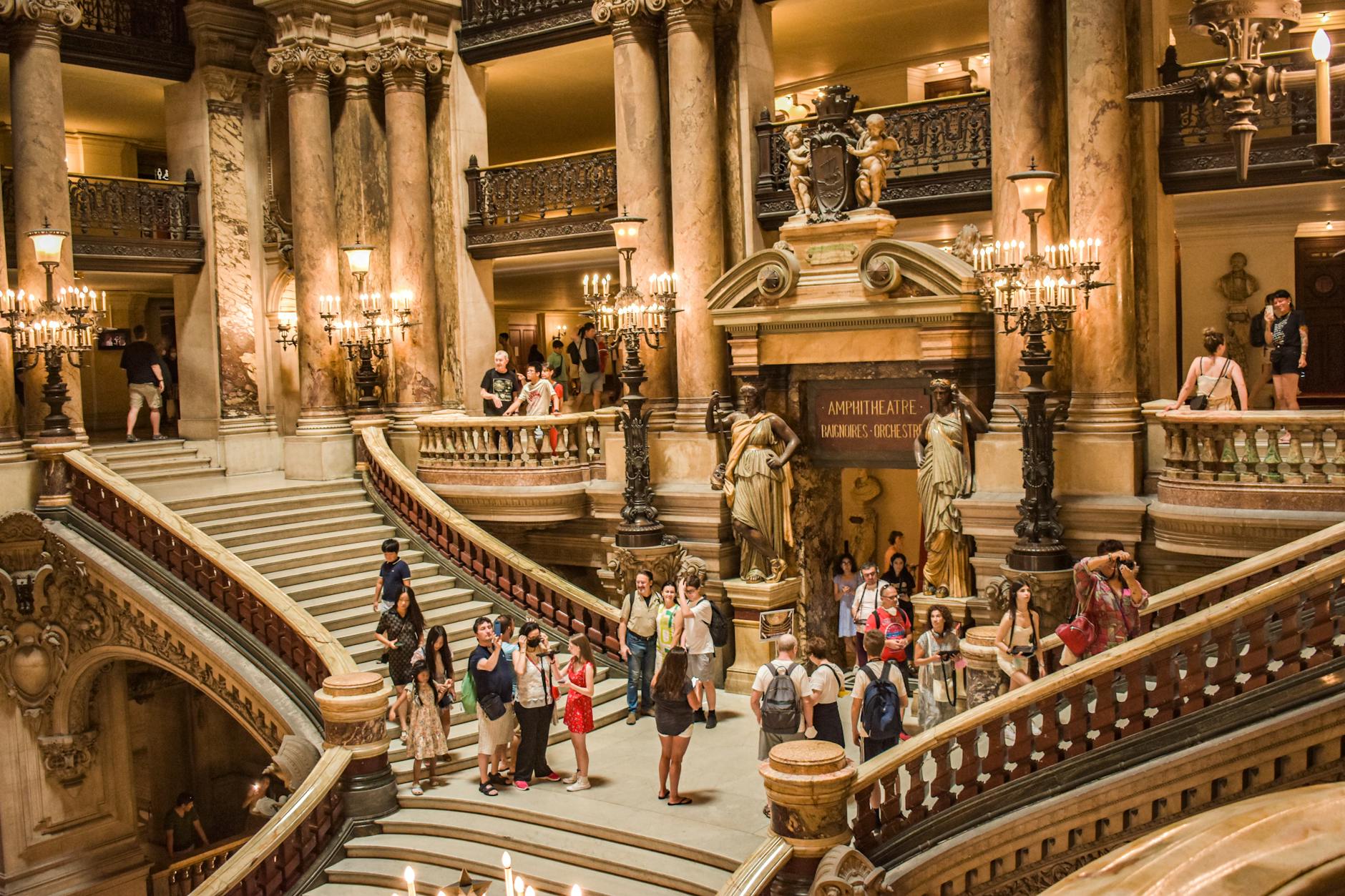
The opera district paris, meaning the 9th arrondissement clustered around the Opéra Garnier, is the cultural and commercial engine of the Right Bank. Inside a ten-minute walk of Place de l’Opéra you can stand under Galeries Lafayette’s stained-glass cupola, climb to Printemps Haussmann’s rooftop terrace, wander the old covered passages (Galerie Vivienne, Passage des Panoramas, Passage Jouffroy), tour Charles Garnier’s gilded 1875 opera house, eat at the Bouillon Chartier brasserie (going since 1896), and graze your way through the South Pigalle, or “SoPi,” restaurant boom that has turned the southern edge of the 9th into one of the best places to eat in the city. This guide takes the Opéra Garnier itself, the department-store strip, the covered-passages walk, the SoPi food scene, the Musée de la Vie Romantique, and where to eat and sleep in the 9th.
For wider context, see our Paris neighborhood guide, the top Paris sights guide, and the Paris shopping roundup for full department-store coverage.
Where is the Opera District?
The 9th arrondissement runs about 2.18 km², from Boulevard Haussmann at its southern edge up through Pigalle at the north, hemmed by Rue Lafayette to the east and Rue Taitbout and the Chaussée d’Antin to the west. You are spoiled for Métro stops: Opéra (Lines 3, 7, 8), Chaussée d’Antin-La Fayette (Lines 7, 9), Havre-Caumartin (Lines 3, 9), Pigalle (Lines 2, 12), Notre-Dame-de-Lorette (Line 12), Saint-Georges (Line 12), Trinité-d’Estienne d’Orves (Line 12), and Le Peletier (Line 7). On foot you are 15 minutes south of the Louvre, 20 minutes east of the Pompidou, and 5 minutes west of Saint-Lazare station.
Brief History of the 9th Arrondissement
Most of the 9th went up during the Second Empire under Haussmann (1853-1870), when Boulevard Haussmann and the Grand Boulevards were cut through the old medieval street pattern. Napoleon III commissioned Charles Garnier’s opera house in 1861; it opened on January 5, 1875, and gave the whole neighborhood its identity. Galeries Lafayette followed nearby in 1893, though Printemps had got there first, in 1865. The covered passages, built in the 1820s and 1840s, hung on to become the city’s last dense pocket of early-19th-century retail architecture. South Pigalle, the SoPi everyone now refers to, gentrified fast in the 2010s, turning from a tired red-light district into one of the most interesting food neighborhoods in Paris.
Opéra Garnier: The Centerpiece
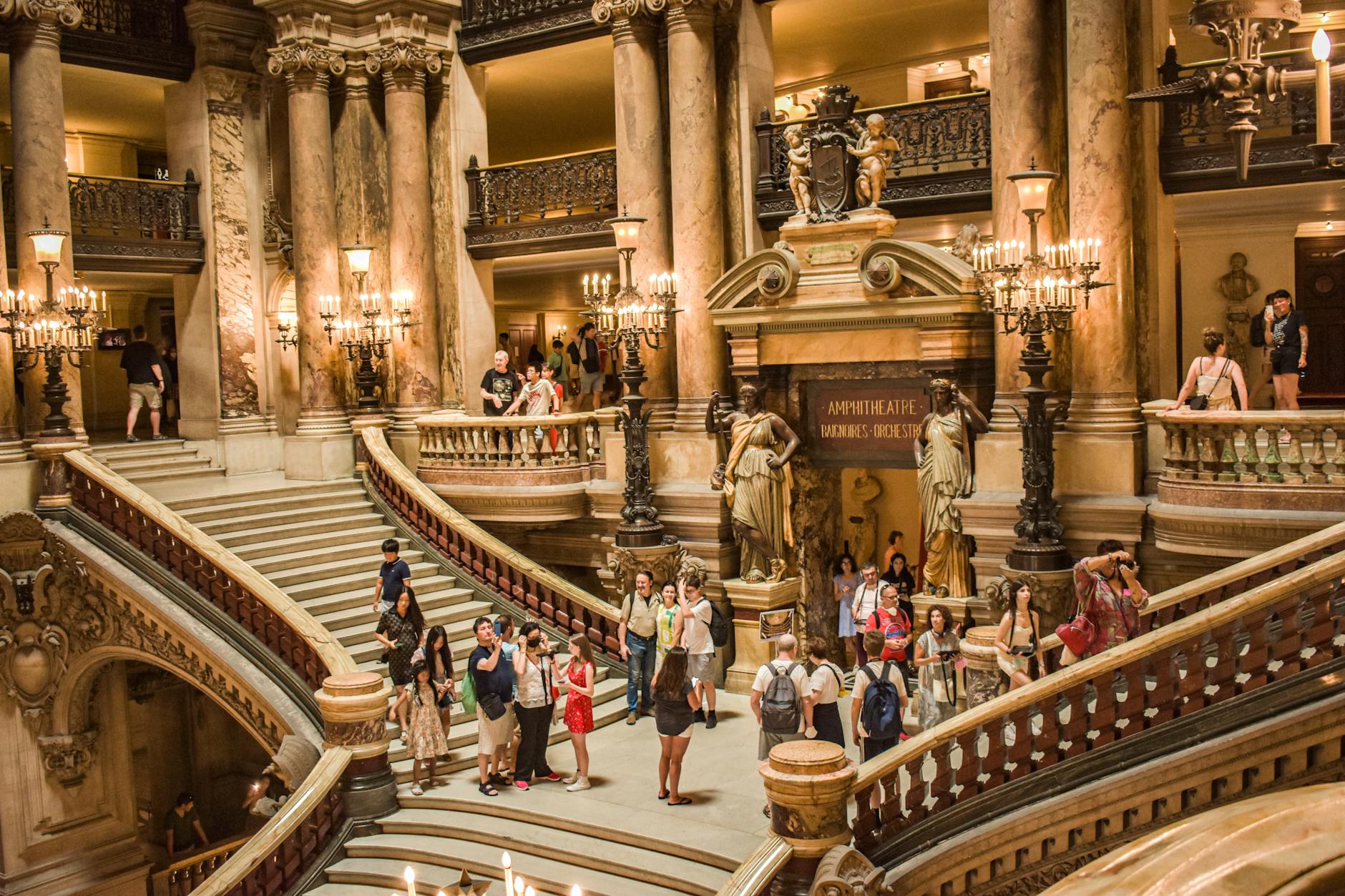
The Palais Garnier is the most ornate 19th-century opera house anywhere. Napoleon III commissioned it, Charles Garnier designed it, and it opened on January 5, 1875 after fourteen years of building. The architectural set pieces are the Grand Staircase (Grand Escalier), the Grand Foyer, and the auditorium crowned by Marc Chagall’s 1964 ceiling. It is also the building that gave Gaston Leroux his “Phantom of the Opera” in 1910.
Daytime self-guided tour: €15 for adults, 60 to 90 minutes, with access to the Grand Staircase, the foyer, the library, and, when there is no rehearsal, the auditorium. Daily 10am-5pm, closed Mondays in summer.
Performance tickets: €15-200+ depending on the seat and the production. The season runs September to July, with the Paris Opéra Ballet, opera, and the legendary Christmas Nutcracker on the bill. The cheapest way in is a last-minute loge ticket at €15-30.
Guided tour: €25 for 90 minutes, with English-language tours daily at 11am and 2:30pm, and access to areas the self-guided route keeps closed.
Galeries Lafayette & Printemps: The Belle Époque Department Stores
Boulevard Haussmann holds the most famous concentration of department stores in the world. Galeries Lafayette Haussmann (40 Boulevard Haussmann) opened in 1893, and its 1912 stained-glass cupola is the Belle Époque at full tilt, best seen from the 4th-floor atrium. Entry is free, and so is the 7th-floor rooftop terrace, which gives you a panoramic view over the Opéra Garnier. The Gourmet food hall is the most ambitious supermarket-restaurant hybrid in the city.
Printemps Haussmann (64 Boulevard Haussmann) opened earlier, in 1865, with equal Belle Époque opulence and a smaller stained-glass dome. Its Bow Tie restaurant on the 9th floor comes with a panoramic Paris view of its own. Both stores open Monday-Saturday 9:30am-8:30pm and Sunday 11am-7:30pm. They are the most-shopped tourist destinations in Paris, and they feel it, especially during the soldes each January and July.
The Covered Passages: 19th-Century Retail Architecture
The 9th holds the last great cluster of 19th-century covered shopping arcades in Paris, most of them just south of Opéra. Here are the four most beautiful.
Galerie Vivienne (2nd-9th border)
Built in 1823 and restored in the 1970s, this is the most beautiful covered passage in Paris, full stop. The original 1823 mosaic floors were laid by Italian artisans, the roof is glass and iron, and the tenants run to antique books and tea. Free to walk, and it connects to Galerie Colbert next door.
Passage des Panoramas (2nd, near 9th boundary)
The oldest covered passage in Paris, dating to 1800. Stamp shops, postcard dealers and a string of bistros line it. Free, and open daily.
Passage Jouffroy (9th, 10-12 Boulevard Montmartre)
Opened in 1845 as the first heated passage in Paris. The Musée Grévin wax museum has its entrance here, and the boutique Hotel Chopin is tucked inside. Free to walk.
Passage Verdeau (9th, opposite Passage Jouffroy)
From 1846, and the place for antiquarians: old maps, manuscripts, vintage cameras. The least touristy of the four and, to my mind, the most atmospheric.
A 90-minute self-guided walk loops all four passages plus the smaller Passage Choiseul. Our walking tours page has the full covered-passages itinerary.
South Pigalle (SoPi): The Food Boom
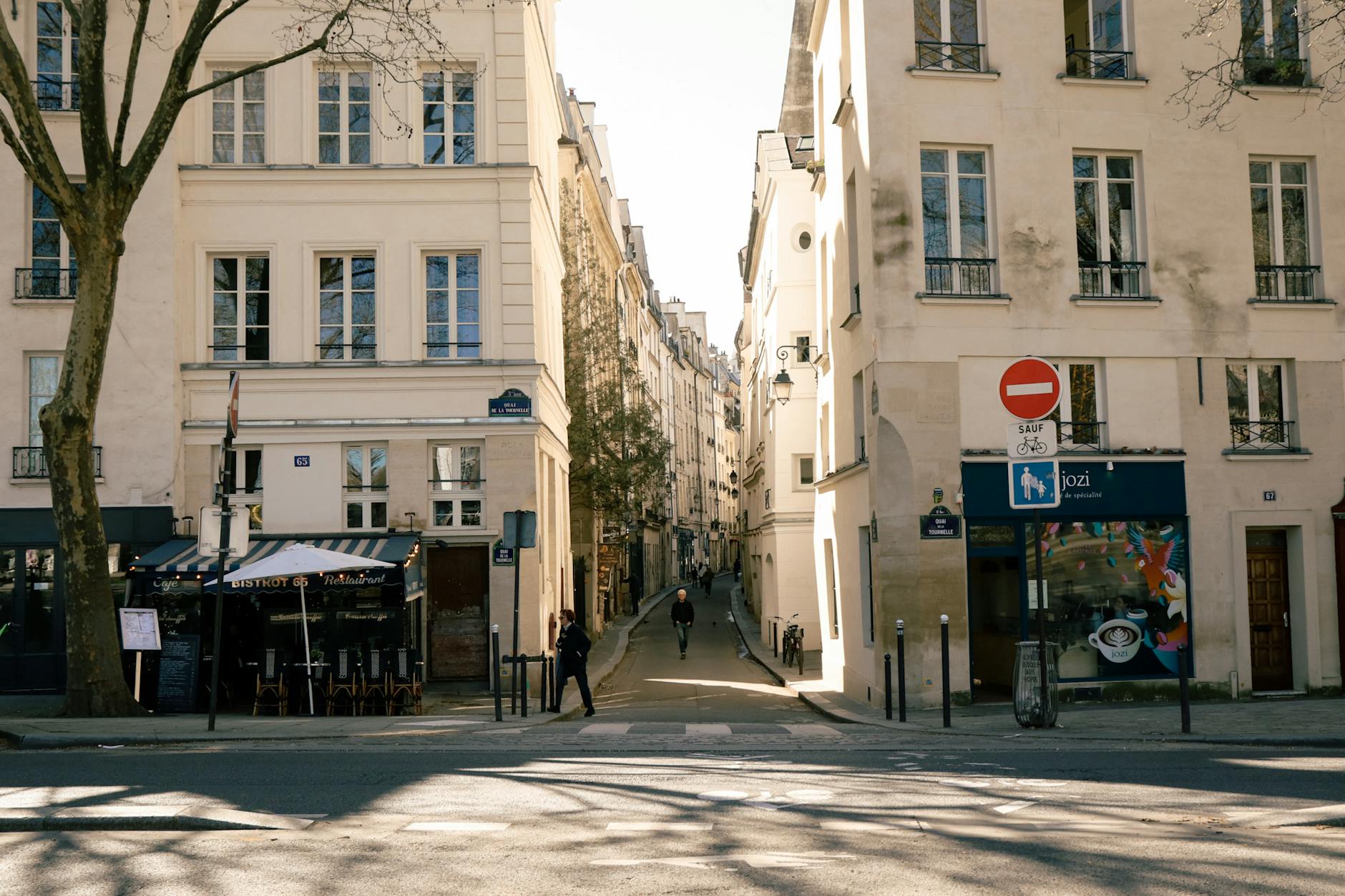
The southern edge of the 9th, around Rue des Martyrs and Rue Henri Monnier, went from tired red-light district to one of the most exciting food scenes in the city between 2010 and 2025. Locals call it SoPi, a play on South Pigalle by way of SoHo. The places to know:
- Buvette (Henri Monnier) — a tiny natural-wine bar.
- Pink Mamma (20 Rue de Navarin) — the Big Mamma group’s Italian; book weeks ahead.
- Bouillon Pigalle (22 Boulevard de Clichy, technically the 18th but the SoPi reference) — a €15-20 three-course working-class brasserie.
- Maison Aleph (Rue Henri Monnier) — Levantine patisserie.
- Mamiche (Rue Condorcet) — a modern boulangerie.
- Sébastien Gaudard (Rue des Martyrs) — classical patisserie.
- Hardware Society SoPi — Australian-style brunch.
- Rue des Martyrs — the spine of SoPi, with cheesemongers, bakeries and chocolatiers along a 600m stretch.
For SoPi in its wider context, see our best restaurants in Paris and best cafes in Paris guides.
Bouillon Chartier: The 9th’s Most Iconic Restaurant
Bouillon Chartier at 7 Rue du Faubourg Montmartre has been serving working-class three-course French meals since 1896. There are 1,000 seats, brass coat racks, a painted-tin ceiling, and paper tablecloths the waiters scrawl your order on directly. Three courses run €18-22: oeuf mayo at €1.90, bourguignon at €13, ile flottante at €5. No reservations, so expect to queue 30-60 minutes at 7-8pm, less at the 1pm lunch. Cash and card both work. It is the single most atmospheric cheap meal in central Paris. Our cheap eats in Paris guide maps the full bouillon landscape.

Musée de la Vie Romantique
One of the quieter pleasures of the 9th sits at 16 Rue Chaptal, on the SoPi border: the former house of the painter Ary Scheffer, where George Sand and Frédéric Chopin came to salons in the 1830s. It is now a free museum in the Paris Musees city collection, with Sand mementos and 19th-century Romantic-period paintings. The garden tea room is one of the most peaceful summer-afternoon spots in Paris. Entry to the permanent collection is free; the small tea room is paid. Open Tue-Sun 10am-6pm, closed Monday.
Musée National Gustave Moreau
Another under-visited 9th museum: the former studio of the Symbolist painter Gustave Moreau (1826-1898) at 14 Rue de La Rochefoucauld, holding more than 1,300 paintings and over 4,000 drawings in the original studio. It is free on the first Sunday from November to March, and €7 otherwise. Open Wed-Mon 10am-5pm, closed Tuesday. A serious detour for art lovers, well off the standard Paris route. See our Paris museums guide.
Place de la Concorde + Madeleine + Lower 9th
The southern edge of the 9th runs into the 8th at Place de la Madeleine, with the Madeleine church and the Fauchon and Hédiard food temples, a 5-minute walk south. Place de la Concorde is another 8-10 minutes beyond. The lower 9th is the seamless hinge between Opéra and Galeries Lafayette on one side and the 8th-arrondissement luxury corridor on the other.
Place Sainte-Trinité & Northern 9th
The northern 9th around the Trinité-d’Estienne d’Orves Métro is mostly residential. Square de la Trinité is a small park, and the neighborhood shades into Pigalle nightlife once you hit Boulevard de Clichy.
Best Cafes in the 9th
- Café de la Paix (5 Place de l’Opéra) — an 1862 Belle Époque institution with a mosaic ceiling and an Opera Garnier view from the terrace; coffee €6-8.
- Café Pouchkine (Place de la Madeleine, on the 8th edge) — for the Russian-style hot chocolate.
- Hardware Society SoPi — Australian-style brunch and specialty coffee.
- Mamiche bakery — coffee and a croissant in SoPi.
- Cafe Verlet (1st, 10 minutes south) — a coffee roaster since 1880.
Where to Stay in the 9th
The 9th is the most-booked tourist neighborhood after the 1st through 4th, and for good reason: excellent transit and hotel pricing that stays within reach.
- Hotel des Grands Boulevards (17 Boulevard Poissonnière) — a stylish boutique pick.
- Hotel Chopin (10 Boulevard Montmartre) — inside Passage Jouffroy, and a genuinely unusual place to stay.
- Mama Shelter Paris West — modern budget-boutique.
- InterContinental Paris Le Grand (next to Opéra Garnier) — classic luxury.
- Hotel Scribe Paris (next to Opéra Garnier) — a historic Sofitel.
- Generator Paris (in the 10th, 5 minutes east) — a hostel-meets-boutique hybrid.
Best Walking Route in the 9th
Here is a two-hour self-guided walk through the 9th. Start at Opéra Garnier (Métro Opéra) and take in the exterior, then head south on Avenue de l’Opéra to Boulevard Haussmann. Stop at Galeries Lafayette for the stained-glass cupola and the rooftop terrace, then walk over to the Printemps rooftop. Go east on Boulevard Haussmann to Boulevard Montmartre and duck into Passage Jouffroy on the north side, through to Passage Verdeau, then down Passage des Panoramas on the south side of the boulevard. Carry on to Place des Victoires in the 1st, cut through Galerie Vivienne back toward the Palais Royal, and finish in the Louvre courtyard, about 15 minutes south. Our walking tours guide has more routes like it.
Photo Spots in the Opera District
- Opéra Garnier facade (Place de l’Opéra) — the classic shot from across the square.
- Galeries Lafayette rooftop terrace — Opéra Garnier framed by chimneys.
- Galeries Lafayette stained-glass cupola — shoot it from the 4th-floor atrium.
- Galerie Vivienne mosaic floor — go vertical to catch the glass ceiling too.
- Passage Jouffroy — the view down from the second-floor balcony.
- Café de la Paix terrace — Opéra Garnier framed over a coffee.
Best Time to Visit the 9th
Come in the morning (9-11am) for empty boutiques and soft light on the Belle Époque facades. Afternoons (2-5pm) are shopping at full energy. Late afternoon (5-7pm) catches the Opéra Garnier exterior at golden hour. Saturdays and Sundays are the busiest days for the department stores, with queues at both Galeries Lafayette and Printemps. Winter Sundays bring the Christmas illuminations on Boulevard Haussmann and the animated store windows, which pull crowds from mid-November into early January.
Christmas Season in the 9th
November to January is the high season for the 9th. Galeries Lafayette and Printemps unveil elaborate animated Christmas windows that draw crowds two-deep on the pavement. The Christmas tree under the Galeries Lafayette cupola is the most-photographed in Paris. The Boulevard Haussmann illuminations run from late November to early January, and the 9pm light show on the Galeries cupola is the standout free evening event of December. See our things to do in Paris in winter guide.
Frequently Asked Questions
Is Opéra Garnier worth visiting?
Yes. It is the most ornate 19th-century opera house in the world. The €15 daytime tour gets you the Grand Staircase, the Grand Foyer, the library, and, when no rehearsal is on, the auditorium with Chagall’s 1964 ceiling. Allow 60 to 90 minutes.
Can you tour Opéra Garnier without seeing a performance?
Yes. The daytime self-guided tour is €15 (10am-5pm daily, closed Mondays in summer), and the guided English tour is €25 (11am and 2:30pm). The architecture is the main draw whether or not you catch a show.
Where is the South Pigalle (SoPi) district?
SoPi is the southern edge of the 9th, centered on Rue des Martyrs and Rue Henri Monnier, between Place Saint-Georges and Boulevard de Clichy. The handiest Métro stops are Saint-Georges (Line 12) and Notre-Dame-de-Lorette (Line 12).
Are Bouillon Chartier reservations possible?
No. Bouillon Chartier takes no reservations. You queue 30-60 minutes at the 7-8pm dinner rush, less at the 1pm lunch, and the line moves quickly.
Is the Galeries Lafayette rooftop free?
Yes. The 7th-floor rooftop terrace is free during store hours (Monday-Saturday 9:30am-8:30pm, Sunday 11am-7:30pm). The view over Opéra Garnier is one of the best free panoramas in central Paris.
How do I see Opéra Garnier’s Chagall ceiling?
Three ways: the daytime €15 self-guided tour (when no rehearsal is in progress), the €25 English guided tour, or by attending a performance (€15-200+).
Where are the covered passages in Paris?
They cluster along the 9th-2nd boundary. The most beautiful are Galerie Vivienne, Galerie Colbert, Passage des Panoramas, Passage Jouffroy, Passage Verdeau, and Passage du Grand Cerf. All are free to walk and weatherproof, and a 90-minute self-guided loop will hit five or six of them.
Is the 9th arrondissement safe?
Mostly very safe. The central 9th and SoPi are well-policed and tourist-friendly. The northern edge near Boulevard de Clichy and Pigalle gets sketchier after midnight, so stick to the central blocks. See our safest areas to stay in Paris guide.
Plan the Rest of Your Paris Trip
Pair the 9th with our guide to Paris’s quarters (the pillar) and the neighbouring quarters: Le Marais, Montmartre (just north), the Latin Quarter, Saint-Germain, the Champs-Élysées, Île de la Cité, and Belleville & Oberkampf. For the bigger picture, the pillar reads worth your time: Paris attractions, the Paris museums guide, the guide to shopping in Paris, the Paris dining guide, things to do in Paris, where to stay in Paris, getting around Paris, Paris on a budget, the best season to visit Paris, things to do in Paris in winter, romantic Paris, Paris with kids, the Paris nightlife guide, and day trips from Paris.
Keep reading
Use these to round out your trip: