Trains From Paris: The Complete Guide to Getting Anywhere by Rail
Six stations, a dozen operators and one of the best rail networks on earth, untangled.
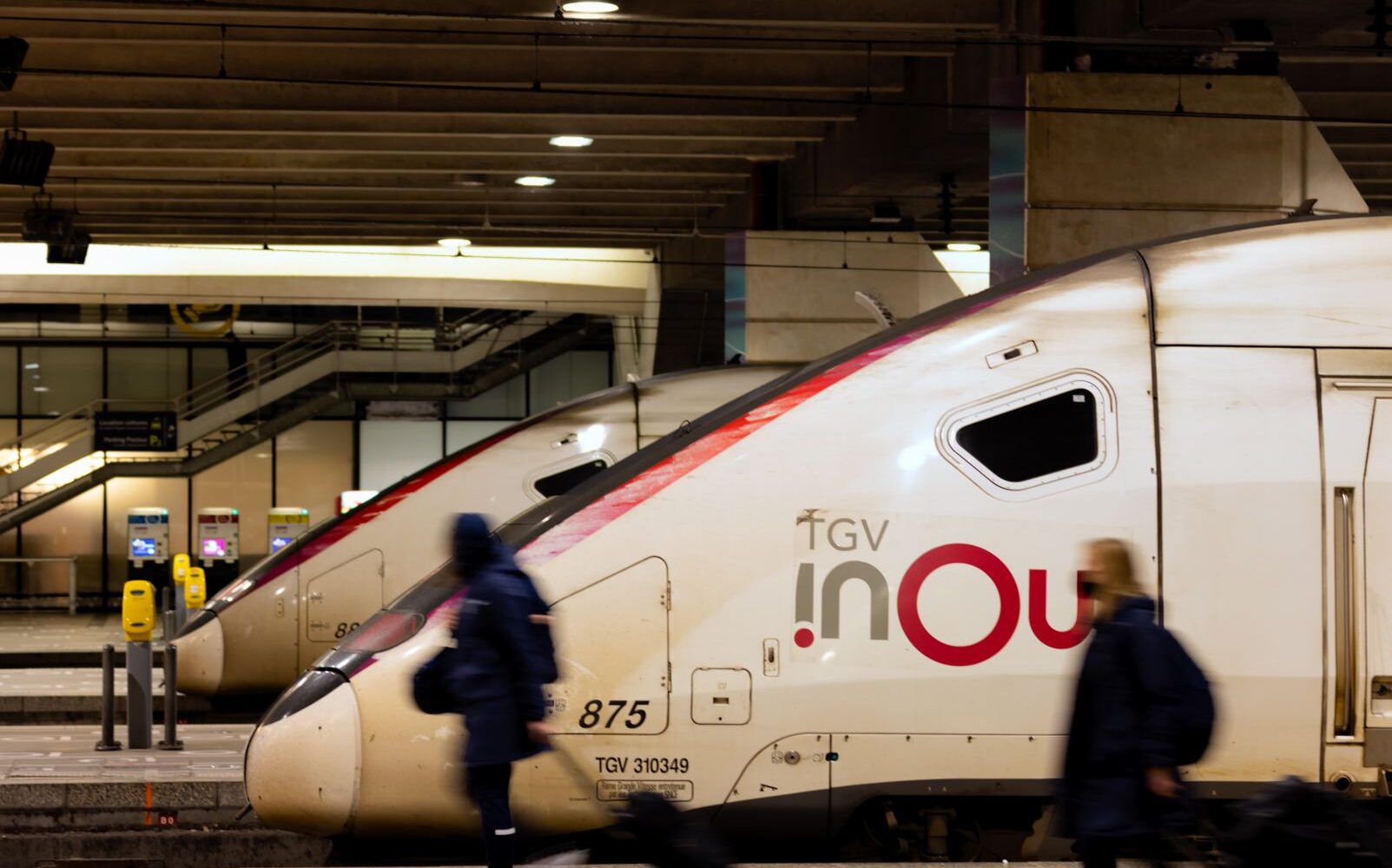
You can have breakfast near the Canal Saint-Martin, board a train at Gare de Lyon at nine, and be eating lunch on the Vieux-Port in Marseille before one o’clock. From the same city you can reach London, Brussels, Bordeaux, Strasbourg or the Alps in a morning, and Amsterdam, Geneva or Barcelona in the time it takes to get to an airport, clear security and wait for a delayed flight. Paris is the hub of one of the best rail networks in the world, and for most journeys within France and to its neighbours, the train is faster door to door, calmer and far lower in carbon than flying. This guide to trains from paris travel france by train explains how it all works: which station you need, the difference between TGV INOUI and OUIGO, what tickets cost and how to pay less, the international routes that have changed in 2026, and the day trips that are easiest by rail.
We’ll start with the six mainline stations, move through the types of train and how to book, then cover the main routes in France and abroad with journey times, before finishing with practical advice on luggage, strikes and the mistakes that catch visitors out. Fares and timetables were checked in September 2026. Rail fares in France change with demand, and engineering works shift timetables through the year, so treat prices as the right order of magnitude and check your specific train when you book.
Trains from Paris at a glance
| Destination | Fastest journey | Station in Paris | Main operators |
|---|---|---|---|
| London | About 2h20 | Gare du Nord | Eurostar |
| Brussels | About 1h22 | Gare du Nord | Eurostar |
| Amsterdam | About 3h20 | Gare du Nord | Eurostar |
| Lille | About 1h | Gare du Nord | TGV INOUI, OUIGO |
| Reims (Champagne) | About 45 min | Gare de l’Est | TGV INOUI |
| Strasbourg | About 1h50 | Gare de l’Est | TGV INOUI, OUIGO |
| Lyon | About 2h | Gare de Lyon | TGV INOUI, OUIGO |
| Marseille | About 3h15 | Gare de Lyon | TGV INOUI, OUIGO |
| Nice | About 5h45–6h | Gare de Lyon | TGV INOUI, OUIGO; seasonal night train from Austerlitz |
| Geneva | About 3h10 | Gare de Lyon | TGV Lyria |
| Bordeaux | About 2h05 | Montparnasse | TGV INOUI, OUIGO |
| Rennes (for Mont-Saint-Michel) | About 1h30 | Montparnasse | TGV INOUI, OUIGO |
| Rouen and Normandy | About 1h15 to Rouen | Saint-Lazare | Nomad regional trains |
Journey times are for the fastest direct trains; many services are slower and stop more often. Checked September 2026.
The six Paris stations: which one do you need?
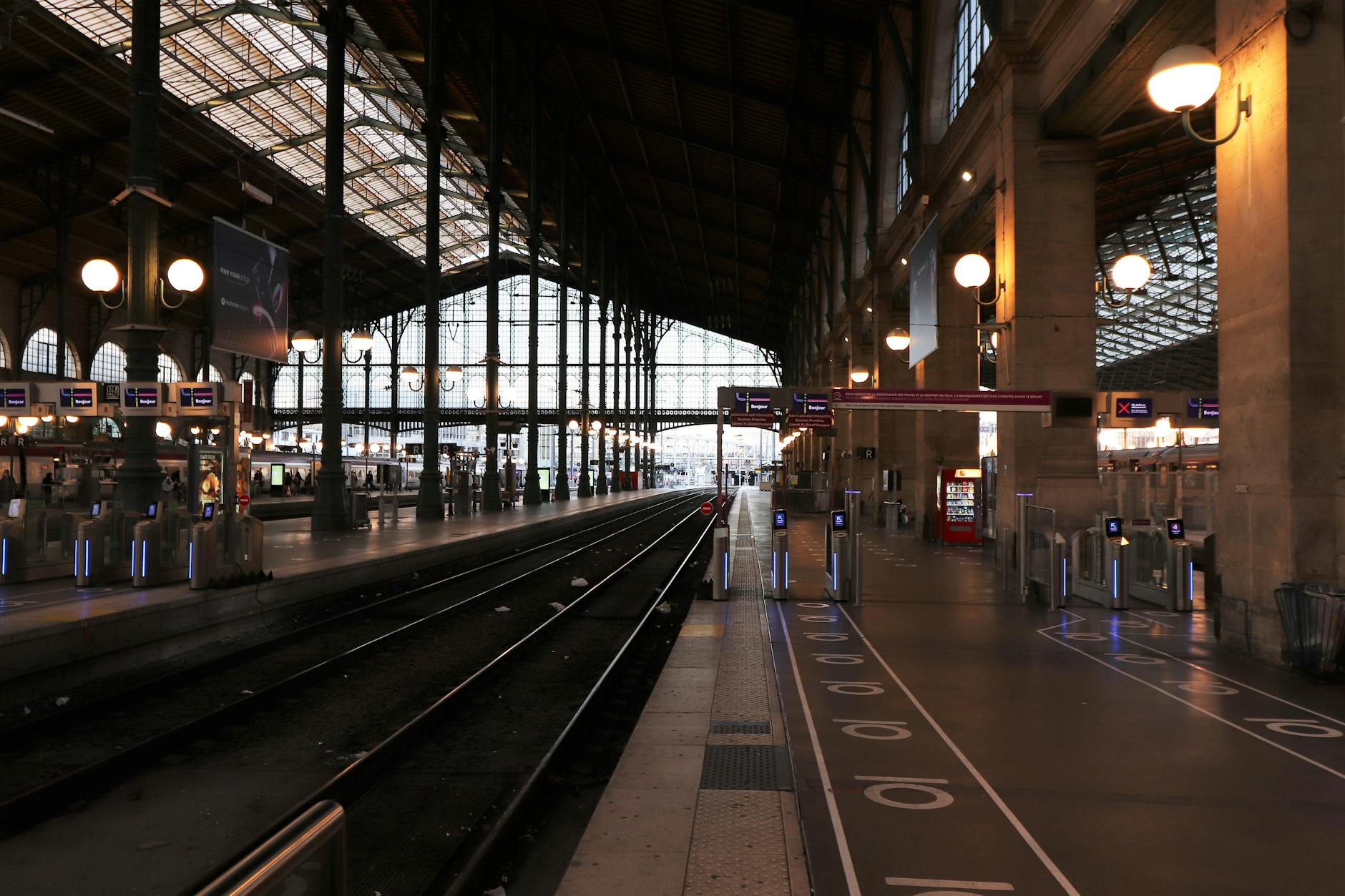
Paris has no single central station. Instead, six mainline termini ring the centre, each built by a different 19th-century railway company to serve its own slice of France. The station you need depends on where you’re going, and it’s the single most important thing to check on your ticket. Every year, visitors turn up at Gare de Lyon for a train that leaves from Bercy, or at Gare du Nord for a train from Gare de l’Est, 10 minutes’ walk away but still a missed train if you arrive with five minutes to spare.
| Station | Serves | Metro and RER |
|---|---|---|
| Gare du Nord | London, Brussels, Amsterdam and Germany via Belgium; Lille and northern France; Chantilly | Metro 4, 5; RER B, D (and RER E at Magenta) |
| Gare de l’Est | Reims and Champagne, Strasbourg, Metz, Nancy; Luxembourg; Germany (Frankfurt, Stuttgart, Munich); Provins | Metro 4, 5, 7 |
| Gare de Lyon | Lyon, Marseille, Nice, Provence, the Alps, Montpellier; Switzerland; Italy; Barcelona; Fontainebleau | Metro 1, 14; RER A, D |
| Paris-Bercy | Some slower services to Burgundy and central France, and some low-cost trains | Metro 6, 14 |
| Gare d’Austerlitz | Orléans, Limoges, Toulouse by Intercités; most night trains | Metro 5, 10; RER C |
| Gare Montparnasse | Bordeaux, Brittany, Nantes, Tours and the Loire, the south-west; Chartres | Metro 4, 6, 12, 13 |
| Gare Saint-Lazare | Normandy: Rouen, Le Havre, Caen, Deauville; Vernon for Giverny | Metro 3, 12, 13, 14; RER E at Haussmann–Saint-Lazare |
Some high-speed trains also call at stations outside central Paris: Charles de Gaulle Airport 2 TGV, Marne-la-Vallée–Chessy (for Disneyland Paris) and Massy TGV to the south. These are useful for connecting straight from a flight or from Disneyland, and some low-cost OUIGO trains use them. Double-check the station name on your booking before you set off.
How long to allow between stations
If you’re changing trains in Paris between two stations, allow at least an hour, and more with luggage. Gare du Nord and Gare de l’Est are a 10-minute walk apart. Gare de Lyon and Gare d’Austerlitz are either side of the Seine, 15 minutes’ walk or a short Metro ride. Gare de Lyon to Montparnasse, or Gare du Nord to Gare de Lyon, takes 25–40 minutes by Metro or RER, plus the walk to the platforms. Our guide to getting around Paris and the Paris Metro guide cover the connections, and a taxi is worth considering with heavy bags.
The trains: TGV INOUI, OUIGO, Intercités and regional
France’s national rail operator, SNCF, runs several brands, and understanding the difference will save you money and confusion.
TGV INOUI
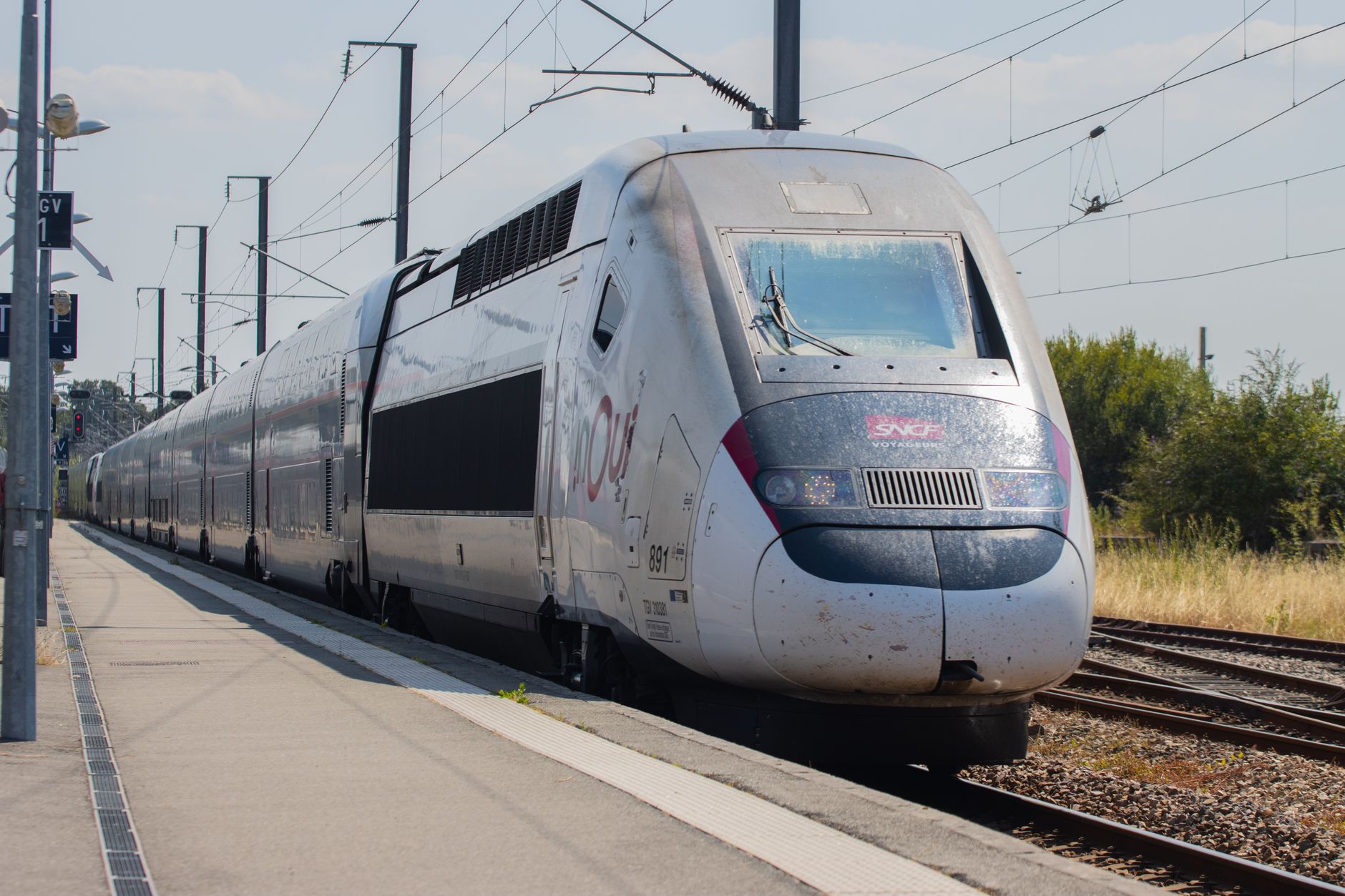
TGV INOUI is SNCF’s main high-speed service. Trains run at up to 320 km/h on dedicated lines, have first and second class, a bar-buffet car, power sockets and, on most routes, Wi-Fi. Fares are dynamic: cheap if booked early, expensive at the last minute on busy trains. Tickets are flexible to varying degrees depending on the fare, and luggage is not strictly limited. This is the default choice for most visitors.
OUIGO
OUIGO is SNCF’s low-cost high-speed brand, with fares from €10. The trains are the same double-decker TGVs, painted bright blue and pink, running at the same speeds on many of the same routes. The savings come from stripped-back service:
- Luggage is limited. A standard ticket includes one cabin bag and one small bag. Larger suitcases, extra bags and pushchairs cost extra, and it’s much cheaper to add them when you book than at the station.
- No bar car. Bring food and water.
- Extras cost extra, including seat selection, plugs and flexibility.
- Boarding closes early, typically 30 minutes before departure, with a ticket check at the platform. Arrive late and you won’t board.
- Some trains use stations outside central Paris.
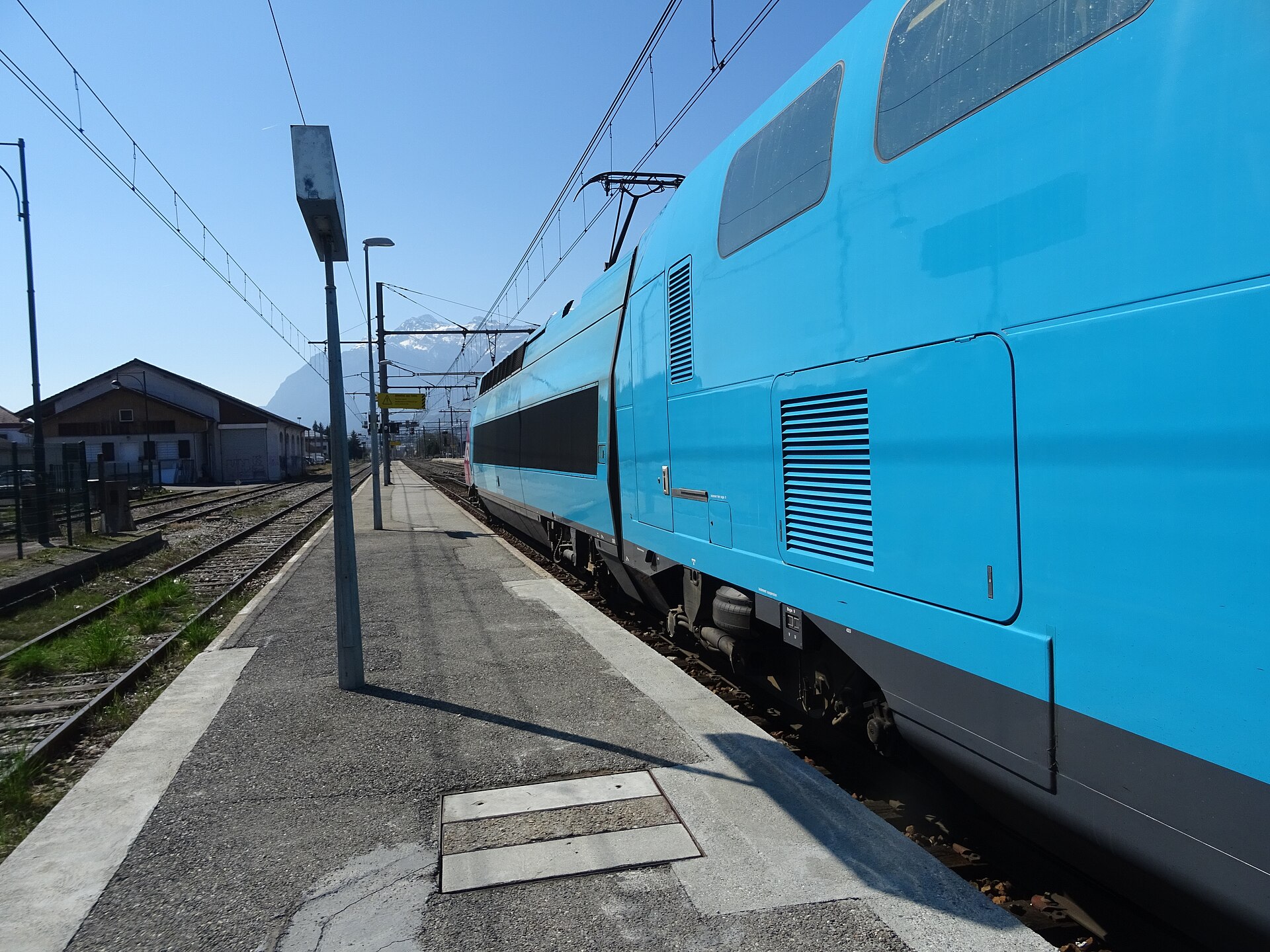
SNCF also runs OUIGO Train Classique, slower trains on conventional lines, with fares between €10 and €49. A new Paris–Bordeaux route started in April 2026. These take considerably longer than the high-speed trains, but they’re very cheap for travellers with time.
Our verdict: OUIGO is excellent value if you travel light, book the luggage you need in advance and arrive early. For a family with suitcases who books late, the difference from TGV INOUI can shrink or disappear once extras are added. Always compare the total price.
Intercités
Intercités are SNCF’s long-distance conventional trains, serving routes without high-speed lines, such as Paris to Orléans, Limoges and Toulouse from Gare d’Austerlitz, and Paris to Clermont-Ferrand. They’re slower than TGVs but comfortable, and they also include most of France’s domestic night trains.
TER and regional trains
Regional trains, known as TER in most regions, run shorter routes and stop at smaller stations. In Normandy the regional network is branded Nomad. You’ll use them for many day trips: to Chartres, Rouen, Vernon for Giverny, or Chantilly. Fares are usually fixed and don’t need to be booked far in advance.
International operators
- Eurostar: London, and since the merger with Thalys, Brussels, Amsterdam, Cologne and other Belgian, Dutch and German cities.
- TGV Lyria: Switzerland, including Geneva, Lausanne, Basel and Zurich.
- Trenitalia Frecciarossa: Lyon, Turin and Milan.
- Deutsche Bahn ICE and TGV INOUI: Germany, via Strasbourg or Saarbrücken.
- TGV INOUI to Barcelona.
- European Sleeper: night train to Brussels and Berlin.
Booking tickets
Where to buy
- SNCF Connect (website and app) sells SNCF domestic tickets, including OUIGO, and many international routes. It’s in English and takes foreign cards.
- Operators’ own sites: Eurostar, OUIGO, TGV Lyria, Trenitalia and others sell their own tickets, sometimes with fares or seat choices not available elsewhere.
- Trainline and other resellers combine multiple operators in one app, which is convenient for multi-country trips, though they may add a booking fee.
- Station ticket machines and offices: useful for regional trains and last-minute purchases. Queues at the ticket offices of the big stations can be very long in summer.
Our guide to the best Paris travel apps covers the SNCF Connect and Trainline apps.
When to book
High-speed fares work like airline fares: the cheapest seats sell first. For TGV INOUI, OUIGO and Eurostar, booking weeks or months ahead can cut the price dramatically, especially on Friday and Sunday afternoons, around French school holidays and in July and August. Sales for most domestic high-speed trains open a few months before travel, and SNCF announces the opening dates for each holiday period. Regional trains are fixed-price and can be bought on the day.
E-tickets
Most tickets are now issued as e-tickets with a QR code on your phone, checked by staff on the train or at automatic gates on some platforms. Download your tickets to the app or save them offline, because mobile data can be patchy in stations and tunnels. Keep your ID handy, as some tickets and discount cards are checked against it.
What train tickets cost
| Journey | Advance fare | Last-minute on a busy train |
|---|---|---|
| OUIGO, any route | From €10 | Can rise to €80–100+ on long routes |
| TGV INOUI, Paris–Lyon | Often €25–50 | Can exceed €100 in second class |
| TGV INOUI, Paris–Marseille or Nice | Often €30–70 | Can exceed €120 |
| Eurostar, Paris–Brussels | From about €30 | Much higher at peak times |
| Eurostar, Paris–Amsterdam | From about €29–35 | Much higher at peak times |
| European Sleeper, Paris–Berlin | From €49 | Depends on berth type |
| Regional trains (e.g. Paris–Chartres) | Fixed fare | Same |
These ranges are indicative, based on fares seen in September 2026. SNCF said its average fares would rise by around 1% in 2026, less than inflation.
How to pay less
- Book early, especially for Fridays, Sundays and holidays.
- Travel midweek and mid-morning, when fares are lower.
- Compare OUIGO and TGV INOUI on the same route, including luggage.
- Consider slower trains: Intercités and OUIGO Train Classique can be much cheaper for travellers with time.
- Buy a discount card if you’re making several trips.
The Carte Avantage
SNCF’s Carte Avantage costs €49 a year and gives 30% off TGV INOUI and Intercités fares. It also caps second-class fares on TGV INOUI: no more than €49 for journeys under 1h30, €69 for 1h30 to 3 hours and €89 for longer journeys, however late you book. There are versions for young people, adults and seniors, with slightly different conditions, so check which one applies to you.
Is it worth it for visitors? If you’re making two or more long high-speed journeys in France, often yes: a single last-minute Paris–Nice ticket capped at €89 can pay for the card on its own. For a single return trip booked early, probably not.
Rail passes
Eurail (for non-European residents) and Interrail (for European residents) passes cover trains in France. They can be good value for long trips across several countries, but on French high-speed trains and international routes you must also pay for a seat reservation, which can be limited on busy trains. For a trip based in Paris with a handful of day trips and one or two long journeys, point-to-point tickets booked in advance are usually cheaper.
Main routes in France
The south-east: Lyon, Provence and the Riviera
From Gare de Lyon, high-speed trains run to Lyon in about two hours, then fan out to Avignon (about 2h40), Marseille (about 3h15), Montpellier (about 3h20) and along the coast to Nice, which takes around 5h45–6h. The line south of Marseille isn’t high-speed, which is why Nice takes so much longer than the distance suggests. Trains also serve the Alps, including Grenoble and, in winter, ski resorts in the Tarentaise.
For Nice, there is also a seasonal night train from Gare d’Austerlitz. In summer 2026 it ran Monday to Friday from 6 July to 28 August, leaving Paris at 21:25 and arriving in Nice at 09:09, with couchettes. Night train timetables change with engineering works, so check before you plan around one.
The east: Champagne, Alsace and Lorraine
From Gare de l’Est, TGVs reach Reims in about 45 minutes, making the heart of Champagne an easy day trip, and Strasbourg in about 1h50, with its Christmas market in December. Trains also serve Metz and Nancy. See our Champagne day trip guide.
The west: Brittany, Normandy’s coast and the Loire
From Montparnasse, TGVs run to Rennes in about 1h30, the gateway to Brittany and the best rail route to Mont-Saint-Michel, which is a bus ride from Rennes. Trains also serve Nantes, Saint-Malo and Tours for the Loire Valley châteaux. See our guides to Mont-Saint-Michel and the Loire Valley.
The south-west: Bordeaux and beyond
The high-speed line to Bordeaux cut the journey to around 2h05, making a long weekend in the wine capital easy. Trains continue to Biarritz, the Basque coast and Toulouse, which can also be reached by Intercités from Austerlitz.
The north: Lille
From Gare du Nord, TGVs reach Lille in about an hour, with its Flemish architecture, great food and art museums.
Normandy
From Saint-Lazare, regional trains run to Rouen in about 1h15, Caen in about 2 hours (for the D-Day beaches), Le Havre, Deauville and Vernon, the station for Monet’s garden at Giverny. See our Giverny day trip guide.
International trains from Paris
London
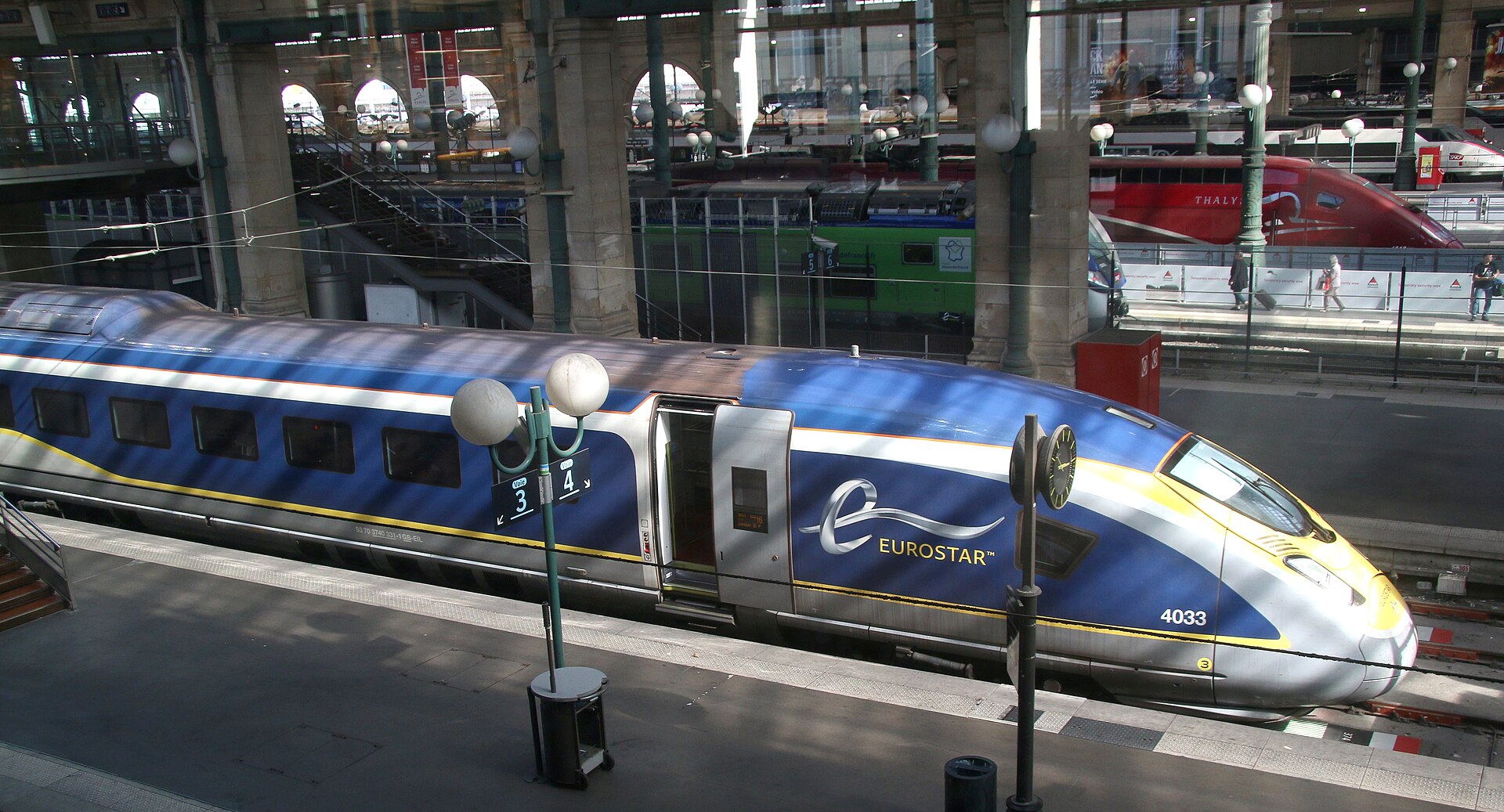
The Eurostar from Gare du Nord takes about 2h20 to London St Pancras, through the Channel Tunnel. You must arrive in time for security and passport checks, and check-in closes before departure. Our Paris to London Eurostar guide covers everything you need.
Brussels, Amsterdam and Cologne
Eurostar (formerly Thalys) trains from Gare du Nord reach Brussels in about 1h22 and Amsterdam in about 3h20, with advance fares from around €29–35. Some trains continue from Brussels to Cologne and other German cities. Unlike the London Eurostar, there are no passport checks on these routes, and boarding is much quicker. Brussels is also the gateway to Bruges; see our Bruges day trip guide.
Germany
High-speed trains from Gare de l’Est serve Frankfurt, Stuttgart and Munich, operated jointly by SNCF and Deutsche Bahn. For Berlin, Deutsche Bahn launched a direct daytime ICE in December 2024 taking around eight hours. In 2026 that direct train was suspended from early August until at least the end of October, with passengers using one-change connections through Frankfurt or Mannheim instead, which take roughly 8h30–9h. Check the current situation before booking.
Night trains to Berlin and beyond
The night train map from Paris has changed a lot. The Austrian operator ÖBB ended its Nightjet sleepers from Paris to Berlin and Vienna in December 2025, after French subsidies ended. In March 2026 the Dutch-Belgian operator European Sleeper started a new Paris–Brussels–Berlin night train, three times a week, with fares from €49. There is currently no night train from Paris to Vienna. Night train services are fragile and change often; always check the latest before planning a trip around one.
Switzerland
TGV Lyria trains from Gare de Lyon reach Geneva in about 3h10, Lausanne in about 3h40, and Basel and Zurich in around 3 and 4 hours respectively.
Italy
Trenitalia’s Frecciarossa and SNCF’s TGV INOUI connect Paris with Turin and Milan through the Alps, with Milan around seven hours away. From April 2026, Frecciarossa ran two trains a day in each direction, leaving Paris at 07:30 and 15:20. Important: because of work in the Mont-Cenis tunnel, there are no direct Paris–Milan trains between 11 September and 9 October 2026. Check alternatives via Switzerland if you’re travelling in that window.
Spain
TGV INOUI trains from Gare de Lyon run to Barcelona in about 6h30, via Montpellier and Perpignan. Direct departures are limited, so book early. Some Spanish operators also run trains from Lyon and Marseille towards Barcelona and Madrid.
Day trips from Paris by train
Many of the best day trips from Paris are easiest by train. The main ones:
| Destination | Station | Journey | Guide |
|---|---|---|---|
| Versailles | RER C, or Saint-Lazare or Montparnasse | 35–45 min | Getting to Versailles |
| Giverny | Saint-Lazare to Vernon, then shuttle | About 50 min to Vernon | Giverny |
| Fontainebleau | Gare de Lyon | About 40 min | Fontainebleau |
| Reims | Gare de l’Est | About 45 min | Champagne |
| Provins | Gare de l’Est | About 1h30 | Provins |
| Chartres | Montparnasse | About 1h–1h15 | — |
| Rouen | Saint-Lazare | About 1h15 | — |
| Lille | Gare du Nord | About 1h | — |
| Loire Valley | Montparnasse to Tours | About 1h15 | Loire Valley |
| Auvers-sur-Oise | Gare du Nord or Saint-Lazare | About 1h | Auvers-sur-Oise |
| Bruges | Gare du Nord via Brussels | About 2h30–3h | Bruges |
For the short hop to Versailles, Fontainebleau or Provins, you’ll need regional or suburban tickets rather than high-speed tickets, and some journeys within the Île-de-France region are covered by the Navigo weekly pass. See our Navigo and Paris tickets guide and the complete list of day trips from Paris.
At the station and on board
How long before departure to arrive
- TGV INOUI and Intercités: 20–30 minutes is usually enough. Platforms are announced about 20 minutes before departure on the departure boards.
- OUIGO: at least 30 minutes, as boarding closes before departure.
- Eurostar to London: check-in closes well before departure because of security and passport controls. Follow Eurostar’s current advice, and allow more time in summer.
- Eurostar to Brussels and Amsterdam: no passport checks, but allow 20–30 minutes.
- Regional trains: 10–15 minutes, plus time to buy a ticket.
Finding your platform and seat
Departure boards show your train number, destination and platform (voie) or hall (hall). At Gare de Lyon, check whether your train leaves from Hall 1 or Hall 2, which are some distance apart. TGVs are long, and your coach number is on your ticket; boards on the platform show where each coach stops. Double-decker TGVs have seats on both levels, and big bags usually go on racks at the end of the carriage.
Luggage
Except on OUIGO, luggage isn’t strictly limited on SNCF trains, but you must be able to carry it yourself, and it must be labelled with your name. Space is limited on busy trains, so board promptly. If you have a gap between checkout and your train, our guide to luggage storage in Paris covers the station lockers and nearby options.
Food and drink
TGV INOUI trains have a bar car selling sandwiches, snacks and drinks at fairly high prices. OUIGO and regional trains have nothing. Picking up a sandwich, a pastry and a drink from a bakery before you get to the station is cheaper and better; the big stations also have supermarkets and food halls. At Gare de Lyon, Le Train Bleu, the lavishly decorated Belle Époque restaurant above the concourse, is worth a look even if you only stop for a coffee.
Strikes, delays and disruption
French rail strikes (grèves) do happen, and they usually come with advance notice. When they do, SNCF publishes a reduced timetable, often the evening before, and tickets on cancelled trains can be exchanged or refunded without fees.
- Check the news and the SNCF Connect app in the days before travel.
- Have a plan B for essential journeys, such as a flight or a train the day before.
- Know your rights: SNCF compensates for significant delays on high-speed trains, with a claim made online after the journey.
- Engineering works, particularly at weekends and in summer, can change routes and journey times. Always check your specific train.
Common mistakes to avoid
- Going to the wrong station. Paris has six, plus Bercy and the airport and Disneyland stations. Read the ticket.
- Booking OUIGO without luggage. Adding a large bag at the station costs much more than at booking.
- Arriving at the last minute for OUIGO or Eurostar. Boarding and check-in close early.
- Waiting for the high-speed fares to drop. They almost never do.
- Assuming a rail pass covers everything. High-speed trains need paid reservations, and some operators limit pass holders.
- Forgetting about closures. In 2026, the direct Paris–Milan and Paris–Berlin daytime trains were both suspended for part of the autumn.
- Buying from people offering “help” at ticket machines. Use the machines yourself, or go to the ticket office. Our guide to Paris scams explains the tricks.
First class: is it worth paying for?
On TGV INOUI, first class gets you wider seats in a two-plus-one layout on most trains, more legroom, a quieter carriage and, usually, a better chance of a power socket and a table. It doesn’t include a meal on domestic routes. On OUIGO there is no first class at all; on Eurostar the equivalent is Eurostar Plus, which adds a light meal.
Whether it’s worth it depends almost entirely on the price gap on your particular train, and that gap moves constantly. Booked early, first class on a TGV can cost only a few euros more than second, and occasionally less when second class has sold out its cheap seats. Booked late, it can cost twice as much. Our rule of thumb: always look at both. On a two-hour journey to Lyon or Bordeaux, second class is perfectly comfortable. On a six-hour run to Nice or Barcelona, if first class is within €15–20, take it.
One tip for second class on the double-decker TGVs: the upper deck is quieter and has better views, and it keeps you away from the doors and the traffic of people heading to the bar car. You can often choose it when you book.
Travelling with children, bikes, pets and reduced mobility
Children
On SNCF trains, very young children travelling on a parent’s lap go free, and older children pay reduced fares; the exact age bands and prices depend on the operator and fare, so enter each child’s age when booking. On OUIGO, children pay a flat low fare. Pushchairs are free on TGV INOUI but count as extra luggage on OUIGO, so add them when you book. Family-friendly carriages with more space are available on some TGV routes.
Bikes
Folded bikes, or bikes dismantled and packed in a cover of limited size, travel as luggage on high-speed trains. Some TGV INOUI and Intercités trains also have spaces for assembled bikes that must be reserved, for a small fee, and they sell out on popular summer routes. Regional trains generally accept bikes for free outside peak hours, space permitting.
Pets
Small pets in a carrier can travel for a modest fee on most SNCF trains, and larger dogs need their own ticket and must be muzzled and on a lead. The rules differ on Eurostar and other international operators, some of which don’t accept pets other than assistance dogs at all. Check before you book.
Reduced mobility
SNCF runs a free assistance service for travellers with reduced mobility, bookable through SNCF Connect or by phone, which arranges for staff to meet you, help you through the station and onto the train, and meet you at the other end. Book it in advance, ideally at least 48 hours before travel. Most TGVs have dedicated wheelchair spaces, often located in first class and sold at second-class prices. Paris stations are large and busy, with long walks between the Metro and the platforms, so allow plenty of time.
Three classic rail journeys from Paris
Paris to the Riviera
Take the TGV from Gare de Lyon south through Burgundy and the Rhône Valley, past the vineyards and the lavender country of Provence, then along the coast from Marseille to Toulon, Saint-Raphaël, Cannes, Antibes and Nice. The last two hours, when the line runs right beside the Mediterranean with red rocks and blue water out of the window, are one of the loveliest rail journeys in France. Sit on the right-hand side heading south. Stop for a night in Avignon or Marseille to break up the trip.
Paris to Alsace
From Gare de l’Est, the TGV reaches Strasbourg in under two hours. From there, regional trains run to the half-timbered wine villages of the Alsace wine route and the canals of Colmar in about half an hour. In December, with the Christmas markets, it’s one of the most popular rail trips in the country; book early.
A three-country loop
Paris to Brussels in 1h22, Brussels to Bruges for a day, Brussels to Amsterdam, then back to Paris direct in about 3h20. Every leg is short, the stations are central, and there are no passport checks on the Brussels and Amsterdam routes. It’s an easy week, and with advance fares it can cost less than a single short-haul flight.
Useful French at the station
Announcements at the big Paris stations are made in French and usually English, and the departure boards are easy to read once you know a handful of words. These are the ones that matter:
| French | Meaning |
|---|---|
| Départs / Arrivées | Departures / Arrivals |
| Voie | Platform (track) |
| Hall | Departure hall (Gare de Lyon has more than one) |
| Voiture | Carriage or coach number |
| Place | Seat number |
| Retard | Delay |
| Supprimé | Cancelled |
| Quai | Platform (the physical platform) |
| Correspondance | Connection |
| Composter | To validate a paper ticket |
| Grève | Strike |
| Aller simple / aller-retour | One-way / return |
For more, see our list of French phrases for travellers.
Why the network looks the way it does
The shape of French rail explains a lot of its quirks. In the 19th century, private railway companies each built their own line out of Paris, and each built its own terminus on what was then the edge of the city. Paris never joined them up, which is why you still cross the city by Metro to change trains, and why nearly every long journey from one French region to another still passes through the capital.
The TGV, launched between Paris and Lyon in 1981, built on that star-shaped pattern rather than replacing it. New high-speed lines radiated out towards Lille and the Channel Tunnel, Strasbourg, Marseille, Bordeaux and Rennes, cutting journey times so dramatically that flights between Paris and Lyon, Marseille or Bordeaux shrank or disappeared. The trade-off is that cross-country routes that avoid Paris, say Bordeaux to Lyon, remain slow. For visitors based in Paris, it means almost everywhere is fast.
Train or plane?
For most journeys under about four hours by train, the train wins. City centre to city centre, without airport transfers, security queues or boarding gates, the TGV to Lyon, Bordeaux, Strasbourg or Marseille is faster door to door than flying, and its carbon footprint is a fraction of a flight’s. France has even banned some short domestic flights where a train alternative of under two and a half hours exists.
Flying makes more sense for Nice if you’re short of time (though the train is scenic and comfortable), and for Corsica, Toulouse or Biarritz if you find a cheap fare. For London, Brussels and Amsterdam, the train is the obvious choice. Our guide to cheap flights to Paris covers the airports if you’re arriving from further away.
Frequently asked questions
What is the best website to book trains from Paris?
SNCF Connect for trains within France, including OUIGO, and many international routes. Eurostar’s own site for London, Brussels and Amsterdam. Trainline is convenient for comparing multiple operators or countries in one app.
Which Paris station do trains to the south of France leave from?
Most high-speed trains to Lyon, Provence, Marseille, Montpellier and Nice leave from Gare de Lyon. Some low-cost trains use other stations, and the seasonal night train to Nice leaves from Gare d’Austerlitz.
How far in advance should I book French trains?
For high-speed trains and Eurostar, as early as possible, ideally several weeks or months ahead, especially for weekends and holidays. Regional trains don’t need to be booked in advance.
What’s the difference between TGV INOUI and OUIGO?
Both are SNCF high-speed trains. TGV INOUI is the standard service with first class, a bar car and generous luggage. OUIGO is the low-cost version, with fares from €10, strict luggage limits, no bar car and paid extras.
Is there a night train from Paris?
Yes. SNCF’s Intercités de Nuit run domestic sleeper trains, including a seasonal Paris–Nice service, mostly from Gare d’Austerlitz. Internationally, European Sleeper has run a Paris–Brussels–Berlin night train three times a week since March 2026. The ÖBB Nightjets to Berlin and Vienna ended in December 2025.
Is the Carte Avantage worth buying?
It costs €49, gives 30% off TGV INOUI and Intercités, and caps second-class TGV INOUI fares at €49, €69 or €89 depending on journey length. It pays for itself if you’re making two or more long journeys in France, especially if you book late.
Can I use my Navigo pass on trains out of Paris?
Only within the Île-de-France region, which includes Versailles, Fontainebleau, Provins, Disneyland Paris and the airports. High-speed and long-distance trains need separate tickets.
Do I need to validate my train ticket in France?
E-tickets on your phone don’t need validating. Follow the instructions printed on any paper ticket, and check whether regional tickets need to be scanned at the platform gates.
Each of the stations has its own quirks, from the lettered and numbered halls at Gare de Lyon to the Vaugirard platforms at Montparnasse, which are a 300-metre walk from the rest of the station. Our guide to the Paris train stations goes through them one by one, with layouts, left luggage, safety tips and realistic transfer times between them.
Nice is the long one. The high-speed line gives out near Marseille, so the last stretch along the coast takes nearly as long as everything before it, and the choice between TGV INOUI, OUIGO and the overnight sleeper from Austerlitz really matters. Our Paris to Nice train guide compares all three, with fares, couchette prices and the seats with the sea view.
Amsterdam is the easiest international trip on the network after London, and easier in one respect: there’s no passport control or security queue, just a red train from the main platforms at Gare du Nord. Our Paris to Amsterdam train guide explains what changed when Thalys became Eurostar, which class is worth paying for, and the cheaper split-ticket route via Brussels.
Lyon is the shortest of the big runs and the easiest to turn into a day out: about two hours from Gare de Lyon, with TGV INOUI, OUIGO and Trenitalia’s Frecciarossa all competing on the line. Our Paris to Lyon train guide compares the operators and fares, explains why Perrache often beats Part-Dieu for sightseers, and lays out a day in Lyon that still gets you back to Paris for the night.
Related Paris Guides
- Getting Around Paris
- Paris to London by Eurostar
- The Best Day Trips From Paris
- How to Get From Paris to Versailles
- Paris Airport Transfers
- Luggage Storage in Paris
- Navigo Passes and Paris Tickets
- The Paris Metro Guide
Photo Credits
A OUIGO train at the platform: Avant-ouigo-albertville1 by Remontees, CC BY-SA 4.0, via Wikimedia Commons.
Eurostar e320 at Gare du Nord: Eurostar e320 4033 Gare du Nord by kitmasterbloke, CC BY 2.0, via Wikimedia Commons.