Sacre-Coeur & Montmartre: Complete Visitor’s Guide
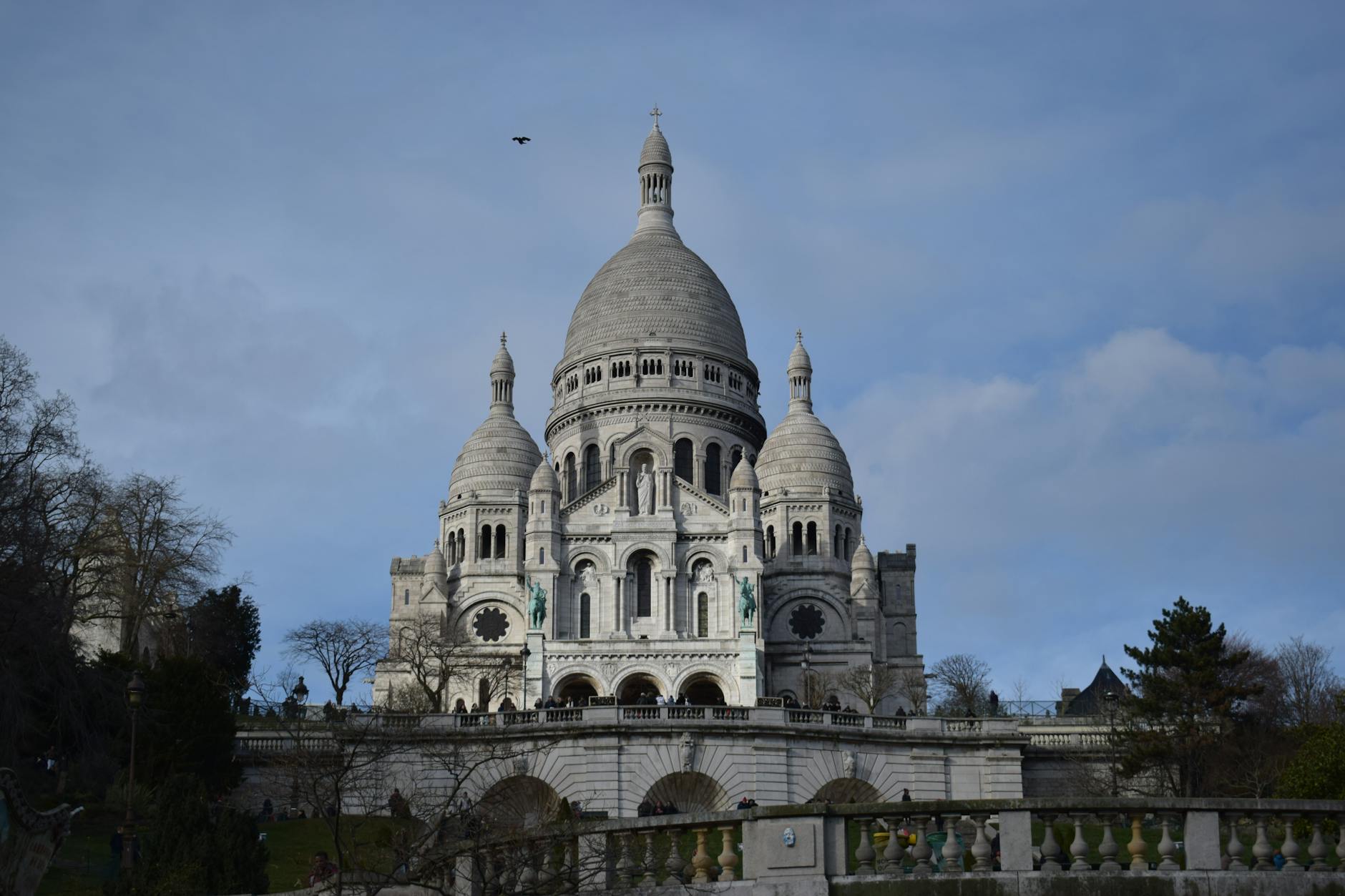
Almost everyone gets Sacre coeur montmartre wrong on the first visit, and the mistake is usually made before they even reach the top of the hill. They climb out of the wrong metro, get a string bracelet tied to their wrist by a man who then demands twenty euros, and end up paying twenty-five for a sad croque-monsieur on Place du Tertre. None of that is necessary. Sacré-Coeur Basilica sits on the 130m butte of Montmartre, the highest natural point in Paris, and the village that climbs up to meet it is one of the most rewarding corners of the city if you know which streets to take. This guide sorts the genuine Montmartre (the apse mosaic, the dawn-quiet streets, Le Mur des Je T’aime, sunrise on the steps) from the parts engineered to separate you from your money. Which metro stop, when to climb the dome, where to actually eat: it is all here.
Keep one thing in mind and the whole neighborhood opens up: Montmartre is a place people live. Families occupy the apartments above the souvenir shops, and a couple of the bakeries up here have won the city-wide baguette prize, tucked down lanes the tour buses can’t physically reach. Treat it as a real arrondissement rather than a theme park. Arrive early, walk slowly, and pick your streets on purpose.
Sacre-Coeur Basilica: What to Expect
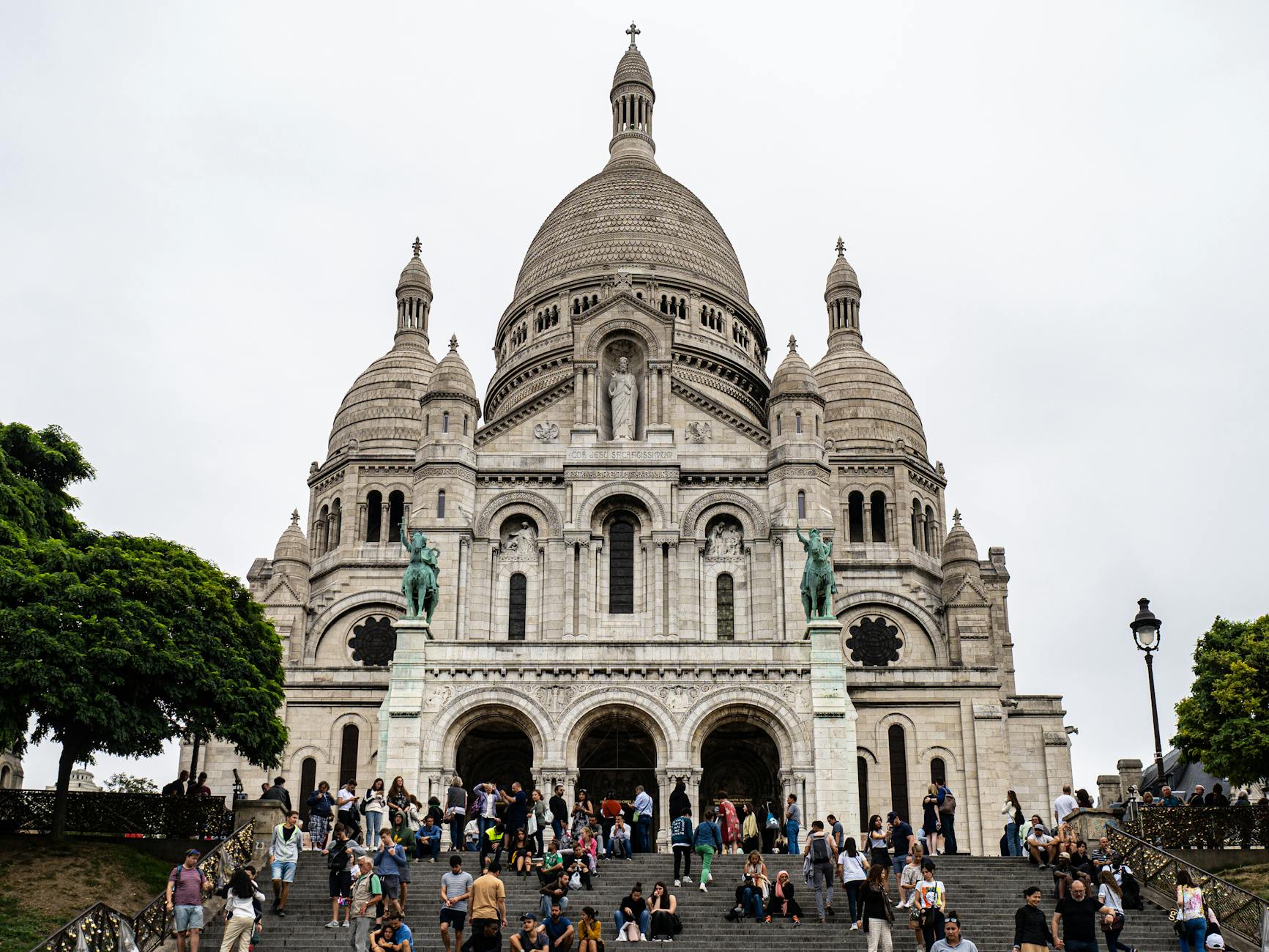
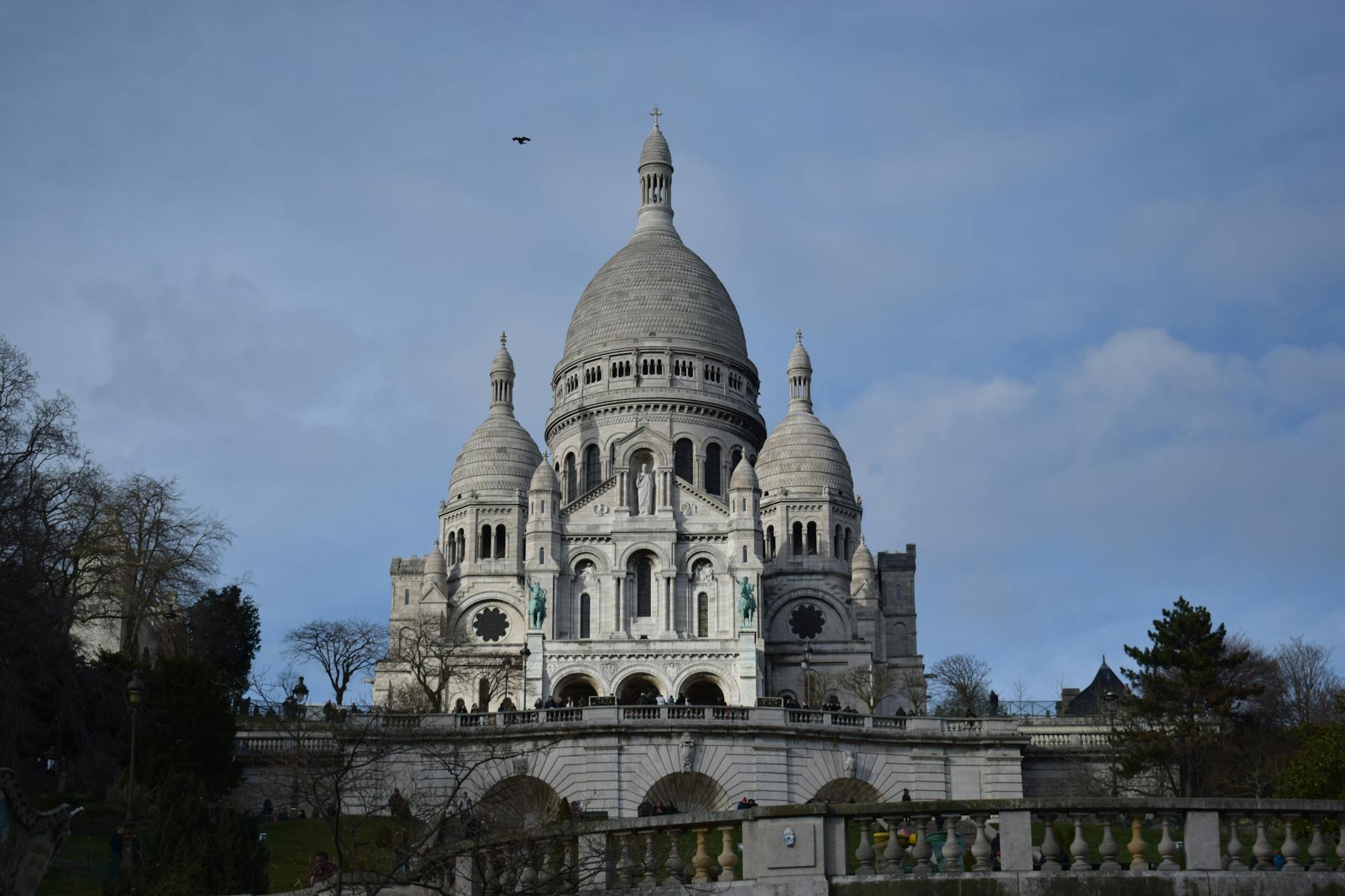
Construction ran from 1875 to 1914, in a deliberately old-fashioned Romano-Byzantine style, and the building wasn’t consecrated until 1919 because the First World War got in the way of the dedication. Architect Paul Abadie borrowed his silhouette from Saint-Front de Périgueux and Hagia Sophia: four corner domes around a central one, a tall campanile rising behind. Here is the detail nobody mentions. The exterior is faced in travertine from Château-Landon, a stone full of calcite that secretes a white film whenever it rains. So while every other monument in Paris turns greyer with age, Sacré-Coeur gets whiter with every storm.
The basilica went up as an act of penance. After the Franco-Prussian War (1870-71) and the Paris Commune (1871), a group of Catholic laymen vowed to atone for what they considered France’s moral failings, and this was the result. They chose the hill on purpose: the Commune had started on Rue des Rosiers (now Rue du Chevalier de la Barre), where two French generals were shot by the communards. People have argued about the politics of the place since the first stone was laid, and some still do.
At 83m, the building puts the top of its dome at the second-highest point in Paris, behind only the Eiffel Tower. Step inside and your eye goes straight up to the apse mosaic, «Christ in Glory,» designed by Luc-Olivier Merson and finished in 1923. It covers 475 square meters, one of the largest mosaics anywhere, and the central Christ figure, flanked by the Virgin Mary, Archangel Michael, Joan of Arc and a personified France, looms over you from almost any spot in the nave.
Walking into the nave costs nothing; the doors are open 6:30am to 10:30pm daily. Look toward the chapel behind the high altar and you will find the perpetual adoration of the Blessed Sacrament, a Catholic vigil that has run unbroken since 1885, with the Eucharist exposed around the clock. Pilgrims book hour-long shifts ahead of time, but the chapel stays open to silent visitors through the day.
Two paid add-ons round out the visit. The dome climb (seven euros) sends you 270 steps up to a viewing platform circling the central cupola, and the panorama is beaten only by the summit of the Eiffel Tower. The crypt (five euros, or eleven combined with the dome) opens onto three levels of chapels, relics and construction history. Most people walk straight past it, which is exactly why it’s the calmest part of the complex. If you have a spare thirty minutes, take the detour.
How to Get to Sacre-Coeur (Without Falling for the Funicular Scam)
There’s no single best way up the hill. There is, however, a clearly worst one, and most first-timers march straight into it. Here are the four real options.
The funicular (Funiculaire de Montmartre) climbs from Place Saint-Pierre to the terrace just below the dome for 2.15 euros each way, the price of a single Metro ticket, paid with a t+ ticket or a Navigo card. Calling it a «scam» misses the point. What actually catches people out is that the ride lasts roughly 90 seconds and dumps you out with a couple of stair flights still to climb. It runs 6am to 12:45am. Treat it as an accessibility feature, because walking up the hill is half the experience.
Abbesses station (Metro Line 12) is the one we send people to. It’s the deepest station in the Paris network, 36m down, with one of the surviving Art Nouveau Guimard entrances at street level. From there it’s a five-minute walk through Place des Abbesses and up Rue Tholozé to the basilica, which sidesteps the lower staircase scam zone almost completely.
Anvers station (Metro Line 2) looks like the obvious pick on the map, dropping you a few blocks south of the basilica at the foot of a direct uphill staircase. That staircase happens to be the single most concentrated patch of friendship-bracelet and clipboard scammers in Paris. The details are below; if you can use a different stop, use it.
Walking from central Paris takes about 30-40 minutes from Opéra Garnier, and the route up through South Pigalle (SoPi) along Rue des Martyrs is one of the prettier neighborhood walks in the city. Good weather makes this the most rewarding approach by a distance.
The route we’d actually walk: Line 12 to Abbesses, then out through Place des Abbesses with a stop at Le Mur des Je T’aime, up Rue Tholozé (the postcard street that frames a windmill at the top), across Rue Lepic, right onto Rue des Saules and into the cobbled lanes, arriving at Place du Tertre (look, then skip the restaurants) before approaching Sacré-Coeur from the side rather than head-on. Done in this order, you see the genuinely interesting Montmartre first and the basilica as the payoff, which is the right way round.
The Sacre-Coeur Dome Climb: Worth It?
Of everything you can pay for at Sacré-Coeur, the dome climb is the one that reliably beats expectations. You buy the seven-euro ticket separately, at a small kiosk to the left of the main facade. Cash or card, and the kiosk itself rarely has much of a line.
It’s 270 steps up a tight spiral, no elevator and no wheelchair access. The stairway runs one way (up one of the smaller domes, down through the central one), which keeps the traffic flowing. Two landings give you a chance to breathe, and the views start paying off around the halfway mark. The platform is fully exposed, so pack a jacket on a windy day.
The arithmetic is simple. Add 130m of hill to 83m of basilica and you get the highest observation deck in Paris by raw elevation. From up there you can pick out the Eiffel Tower to the west, Notre-Dame and the Panthéon to the south, Tour Montparnasse slicing the skyline, and La Défense on the horizon. On a clear day the basilica of Saint-Denis appears to the north.
The dome opens 10am to 7pm in summer (May through September) and 10am to 5pm the rest of the year, closing in heavy weather. Two windows are worth targeting: the 10am opening, when the light is still soft and the queue thin, and the hour before sunset, when central Paris goes gold and the rooftops stack up in shadow. Summer midday queues can hit 30 to 60 minutes; off-season you’ll usually wait under 15.
If your knees are up to it, this is one of the best seven euros you can spend in Paris. You get a panorama in the same league as the Eiffel Tower for about a third of the price, with shorter queues and a better foreground, because you’re looking at the Eiffel rather than staring down from inside it.
The Staircase Scam Zone: What to Watch For
The southern staircase below Sacré-Coeur, the one you hit coming from Anvers on Line 2, is the densest scam cluster in Paris. Nothing here is physically dangerous, but it can cost you ten to forty euros and put a sour edge on an otherwise good morning. The ones to recognize:
- Friendship-bracelet scammers, usually young men working the lower steps in groups. They come over smiling, ask where you’re from, then grab your wrist before you can pull back and start knotting a string bracelet onto it. Once it’s tied, they want ten to twenty euros and turn aggressive if you say no. Keep your hands in your pockets and don’t break stride.
- Petition scammers, often posing as deaf-mute, pushing a clipboard at you with a sheet to sign «for charity.» The signature isn’t the scam, the distraction is. While your eyes are on the page, an accomplice is in your pocket. Say no, keep walking.
- Picture-for-money photographers, who offer to snap a group shot on your phone and then refuse to hand it back until you pay five to ten euros. Take your own, or ask a fellow tourist.
- Fake parking attendants, men in safety vests who wave you into legitimate paid street spots and then demand cash. Real Paris parking is paid at a meter or through an app, never to a guy in a vest.
The counter-play is unglamorous and effective: hands in pockets, walk like you have somewhere to be, skip the eye contact, and don’t stop on the lower stairs to take photos. Once you reach Square Louise-Michel or the basilica level, the scammers thin right out. The Abbesses approach barely has any.
Police are out in force roughly 11am to 6pm, and the scammers tend to vanish at dawn and after dusk, when there are fewer easy marks. Pickpockets are a separate problem on Line 2 at Anvers and Pigalle, especially in rush hour. For the wider picture of where to relax and where to stay sharp, see our guide to the safest areas of Paris.
Best Things to Do in Montmartre (Beyond Sacre-Coeur)
The basilica gets top billing, but the streets around it are where the neighborhood actually lives. Here are the stops worth your time, roughly in the order you’d meet them walking up from Abbesses.
Le Mur des Je T’aime
Set into Square Jehan-Rictus just off Place des Abbesses, the «I love you wall» is a 40-square-meter panel of dark blue enameled lava tiles, hand-lettered by calligrapher Fédéric Baron with the phrase «I love you» written 612 times in 250 languages and dialects. The scattered red fragments, designed by Claire Kito, stand for a broken heart the wall is trying to piece back together. Free, five minutes, and best photographed in mid-morning light.
Place du Tertre
Once the village center of Montmartre before the city annexed it, this old artists’ square now runs as a working portrait market, with painters and caricaturists turning out a likeness in 20 minutes for twenty to forty euros. The artists are regulated by the city and assigned one-square-meter pitches by lottery. The corners still have real charm, especially the western and northern edges; the middle, by midday, is a tourist scrum you can barely walk through. Come at 8am instead, when the artists are setting up and the cobbles are still wet from the morning hose.
Bateau-Lavoir
On Place Émile Goudeau at 13 Rue Ravignan, the Bateau-Lavoir is where Pablo Picasso painted «Les Demoiselles d’Avignon» in 1907, the canvas usually credited with kicking off Cubism. The original burned down in 1970; today’s building is a 1978 reconstruction, still used as artists’ studios. There’s a plaque and a window onto the modern interior. A five-minute pilgrimage, no more.
Espace Dalí
At 11 Rue Poulbot, this small museum covers Salvador Dalí’s Montmartre period, with around 300 sculptures, etchings and illustrations on permanent show. Eighteen euros is a lot for the square footage, but the place is often near-empty even at peak hours. If you want a quiet half-hour off your feet surrounded by genuinely odd art, it does the job.
Musée de Montmartre + Renoir Garden
At 12 Rue Cortot sits the neighborhood’s sleeper hit: a small museum in Renoir’s old studio, three buildings opening onto the Renoir gardens, where the painter sat to work on «Le Bal du Moulin de la Galette» in 1876. Thirteen euros covers an audio guide and the gardens, a genuinely peaceful spot with views down over the Clos Montmartre vineyard. If you only have time for one Montmartre museum, make it this one over Espace Dalí.
Clos Montmartre Vineyard
On the corner of Rue Saint-Vincent and Rue des Saules, the Clos Montmartre is the last working vineyard inside the Paris city limits. Planted in 1933 on a city-owned slope, it turns out around 600 bottles a year from roughly 1,800 vines. It’s closed to casual visitors most of the year, but it opens to the public during the Fête des Vendanges in mid-October, when the harvest comes with a parade, food stalls and music. The rest of the time you peer at it through the railings from Rue des Saules.
Cimetière de Montmartre
Entered from 20 Avenue Rachel, this is the third-largest cemetery in Paris and far less trafficked than Père-Lachaise. Among the graves: François Truffaut, Edgar Degas, Hector Berlioz, Vaslav Nijinsky, Stendhal, the original tomb of Émile Zola (later moved to the Panthéon), and Dalida, whose grave draws the most visitors.
Moulin de la Galette
At the corner of Rue Lepic and Rue Girardon stands one of the last two windmills left in Montmartre, the very structure Renoir painted in 1876 in «Le Bal du Moulin de la Galette,» now wrapped into a restaurant of the same name. The nearby Moulin Radet gets photographed by mistake as «the» Moulin de la Galette all the time; you can see it too from Rue Lepic.
La Maison Rose
At 2 Rue de l’Abreuvoir, the pink-painted corner restaurant La Maison Rose counted Picasso and Maurice Utrillo among its regulars (Utrillo’s 1908 painting of it now hangs in the Musée d’Orsay). The food won’t change your life, but the building is one of the most photographed corners in Paris. Come mid-morning, when the light hits the pink walls cleanly.
Rue de l’Abreuvoir
The cobbled lane behind La Maison Rose, dropping down toward Avenue Junot, is one of the most-photographed streets in the city. Curved cobblestones, ivy spilling over the walls, the basilica dome appearing at the far end: it’s a near-cliche, and the cliche earns it.
Le Moulin Rouge
At the foot of Montmartre on Boulevard de Clichy in the 18th arrondissement, the Moulin Rouge has been running as a cabaret since 1889. The current show, Féerie, plays nightly, with dinner-and-show packages from 220 to 450 euros depending on your seat and menu. It’s among the most-booked cabaret experiences in the world. For context and a few alternatives, see our guide to things to do in Paris at night.
Sacre-Coeur Mass & Religious Programs
Sacré-Coeur is a working parish basilica, and the daily rhythm of worship decides when the building is busy. The schedule:
Daily Mass: 7am, 8am, 9am, 11am, 6pm and 10pm. Sunday Mass adds 9:30am and 12:30pm. The Sunday 11am Solemn Mass brings out the Schola Sacré-Coeur choir, and the nave is kept for worshippers during that hour, so time your visit before or after.
The Perpetual Adoration of the Blessed Sacrament has gone on without a break since August 1, 1885, with the Eucharist exposed around the clock in the chapel behind the high altar. Pilgrims take one-hour slots, and the overnight hours (11pm to 6am) are reservation-only. During the day, the chapel is open to anyone who wants to sit quietly.
Confession runs daily 11am to 12:30pm and 3pm to 6:30pm, usually with English-speaking priests on hand; the side chapels mark their available languages on the doors. Entry and services are free. Modest dress is requested, and bare shoulders or very short shorts may get you asked to cover up; wraps are sometimes on offer at the door.
Best Times to Visit Sacre-Coeur and Montmartre
Timing counts for more here than almost anywhere else in Paris. The same hill at 8am and at 2pm is the difference between a sleepy village and a crowded carnival.
6:30 to 8am (sunrise) is the hour that matters. The basilica opens at 6:30am, the steps are nearly empty, and the white travertine soaks up the gold of the rising sun. This is when the postcard shots actually happen, rather than when people imagine they do.
8 to 10am is the artists setting up in Place du Tertre, the bakeries pulling their second batch of croissants, and the cobbles still glistening from the overnight cleaning. Soft light, thin crowds, the neighborhood acting like itself.
10am to 5pm is the crush. The dome opens, the tour buses roll in, the staircase scammers come out, and Place du Tertre turns into a shuffle. The light goes harsh and the facade washes out in photos.
5 to 7pm brings the light back down to something flattering. Square Louise-Michel fills with people drinking wine on the grass and watching the sun drop over central Paris. It’s the most sociable hour on the hill.
After 8pm the crowds clear out, but the lower streets around Anvers and Barbès can feel rougher, so stick near the basilica or take the funicular back down to Abbesses rather than walking the southern staircases in the dark. Tuesdays and Wednesdays are the quietest days of the week. And steer clear of Sunday around 11am if you want the run of the nave, because it’s reserved for Mass-goers then.
Best Photo Spots in Montmartre
Just about every street here photographs well, but a handful of spots produce the shots people actually keep:
- Square Louise-Michel and the front steps, the classic head-on Sacré-Coeur frame with the lawn dropping away below. Sunrise is best, because the basilica takes the light squarely.
- Rue de l’Abreuvoir at the La Maison Rose corner, with mid-morning light soft on the pink walls and cobbles.
- Rue Saint-Rustique, the oldest street in Montmartre, narrow and cobbled, ending on a glimpse of the basilica apse. The village feel is more intact here than anywhere else in the neighborhood.
- Place du Tertre corners (not the center), early in the morning, when the artists are propping easels against the building edges.
- Le Mur des Je T’aime, which works any time of day; afternoon shade actually suits the dark blue tiles.
- From the dome platform, the only 360-degree panorama up here. Wipe your phone lens first.
- Rue du Chevalier de la Barre behind the basilica, for the rear shot of apse and central dome, well away from the front-of-house crowds.
- Rue Lepic at the windmills, where the right angle gets both Moulin de la Galette and Moulin Radet into one frame.
- Top of Rue Tholozé, the well-known frame of Sacré-Coeur rising at the end of the climbing street, a windmill silhouette off to one side.
For locations beyond this neighborhood, see our guide to the best Paris photo spots.
Where to Eat in Montmartre (Skip the Tourist Traps)
Montmartre’s food reputation takes a beating it half deserves, because the restaurants you see first, the ones lining Place du Tertre and the main drag, are openly built for tourists. The real eating sits a few streets back. These are the places locals genuinely use.
- Le Coq Rico (98 Rue Lepic), Antoine Westermann’s rotisserie-chicken temple. Whole birds for two to share, around sixty euros for a lunch you’ll remember. Book ahead, it’s essential.
- Bouillon Pigalle (22 Boulevard de Clichy, at the base of the hill), the old working-class brasserie format done at scale. Three courses for fifteen to twenty euros, no reservations, brisk service.
- Pink Mamma (20 Rue de Navarin in South Pigalle), the Big Mamma group’s flagship trattoria, four floors plus a rooftop. Book through their app well ahead.
- Le Relais Gascon (6 Rue des Abbesses), a classic neighborhood bistro known for giant salads topped with hot garlic potatoes. Informal, fairly priced, right on the walking route.
- Le Refuge des Fondus (17 Rue des Trois Frères), cheese and meat fondue with house wine served in baby bottles, thanks to an old law about glasses. Gimmicky, but fun and cheap.
- Buvette (Rue Henri Monnier), a small natural-wine bar with sharing plates, ideal for an aperitif before the climb.
- Hardware Société (10 Rue Lamarck), Australian-style brunch with proper coffee, ricotta hotcakes and a weekend queue that never seems to end.
- La Boîte aux Lettres (108 Rue Lepic), a beloved tiny bistro near the top of the hill, twelve tables, French classics done right.
- Soul Kitchen (33 Rue Lamarck), bowl food with gluten-free and vegan options, handy if you’re eating around restrictions.
What to avoid: the restaurants directly on Place du Tertre give you the worst price-to-quality ratio in Montmartre, and most of the tourist-aimed menus on Rue Saint-Rustique fall into the same hole. The tell is consistent. Photo menus out front, several languages with English on top, a host trying to coax you in: keep walking. The bistros locals use look quiet from the street and post a French-only chalkboard.
Sacre-Coeur with Kids
Montmartre is one of the easier central-Paris neighborhoods to do with kids. The climb turns into a game, and most of the highlights are short, visual and outdoors. A solid kid-friendly half-day starts at Abbesses: walk up Rue Tholozé hunting for the windmill at the top, detour to Le Mur des Je T’aime, and stop at the carousel at Place Saint-Pierre (two euros a ride, the classic double-decker). For younger ones, the funicular is a small thrill in itself.
The dome climb works from about age six up, assuming they can handle stairs and tight spaces; the 270 steps break into manageable sections and the platform is an obvious payoff. Espace Dalí is a surprise hit with kids who like the strange. Place du Tertre is good for ten minutes of watching artists work, and a portrait makes a decent souvenir as long as you settle the price first.
Public toilets are thin on the ground. There are facilities in the basilica crypt during opening hours and a public restroom at Place Saint-Pierre below the basilica. For a fuller plan of family-friendly central Paris, see our guide to Paris with kids.
Practical Info: Hours, Tickets, Accessibility
| Item | Detail |
|---|---|
| Basilica entry | Free, 6:30am to 10:30pm daily |
| Dome climb | Seven euros, 10am-7pm summer / 10am-5pm winter; 270 steps; not wheelchair accessible |
| Crypt | Five euros, or eleven euros combined with dome |
| Funicular | 2.15 euros each way, same as a Metro t+ ticket |
| Recommended Metro | Abbesses (Line 12) — safer than Anvers (Line 2) |
| Restrooms | Basilica crypt; Place Saint-Pierre below the steps |
| Wheelchair access | Ramp to the basilica nave; no dome access |
| Photography | Allowed in the nave (no flash); restricted in the crypt during services |
| Mass schedule | Daily 7am, 8am, 9am, 11am, 6pm, 10pm; Sundays add 9:30am and 12:30pm |
| Time needed | 90 minutes basilica only; 3 hours basilica plus a Montmartre walk; full day with restaurants |
You don’t need to book the basilica, even at peak season, though the dome queue rewards turning up at opening or an hour before sunset. Bags may be checked at the entrance, and there’s no cloakroom, so travel light. To string this together with other sights on foot, see our Paris walking tours guide.
FAQ
Is Sacre-Coeur free to enter?
Yes. The basilica nave is free, 6:30am to 10:30pm every day of the year. Only the dome climb (seven euros) and the crypt (five euros) carry a charge. There are donation boxes near the entrance if you want to support the parish, but no ticket is required.
How much does it cost to climb the Sacre-Coeur dome?
Seven euros a person, bought at the small kiosk to the left of the main facade, cash or card. The combined dome-plus-crypt ticket is eleven euros. There’s no online booking and no skip-the-line option, but the queue moves through the kiosk fairly quickly.
Is Montmartre safe?
Yes, for normal tourist activity through the day and into the evening. The main risks are scams (friendship bracelets, fake petitions, picture-for-money) and pickpockets on the southern staircase below the basilica and on Line 2 around Anvers and Pigalle. Use the Abbesses (Line 12) approach, keep your hands in your pockets on the lower steps, and you’ll dodge most of it. Late at night, the area right around Pigalle and Barbès feels rougher than the upper streets.
What time of day is best for Sacre-Coeur?
Sunrise (6:30 to 8am) for photography and an empty nave, or the hour before sunset for the dome climb and golden-hour views. Midday is the window to avoid: harsh light, peak crowds, and scammers working the lower steps.
Can you take the funicular to Sacre-Coeur?
Yes. The Funiculaire de Montmartre runs from Place Saint-Pierre to the terrace below the basilica for 2.15 euros each way (a regular Metro ticket or Navigo covers it), 6am to 12:45am. The ride is short, about 90 seconds, but worth it if you have mobility limits or you’re climbing with very young children.
How long should I spend in Montmartre?
Give it 90 minutes minimum for the basilica alone (nave, dome, a look around the terrace). Allow three hours for the basilica plus a walking loop through Place des Abbesses, Le Mur des Je T’aime, Place du Tertre and Rue de l’Abreuvoir. A full day is justified once you add a museum (the Musée de Montmartre is our pick), a long lunch, the cemetery, and an evening drink at Square Louise-Michel.
Are there scams around Sacre-Coeur?
Yes. The lower staircase reached from Anvers Metro is the highest-density scam zone in central Paris. Friendship-bracelet scammers, clipboard «petitions,» picture-for-money photographers and fake parking attendants all work it. They aren’t violent, but they can be aggressive. Take the Abbesses approach (Line 12) and you’ll skip the area almost entirely.
Is Montmartre walkable?
Walkable, yes, but steep. The hill climbs 130 meters and nearly every street tilts uphill. Comfortable shoes aren’t optional, and anyone with knee trouble should take the funicular for the final ascent rather than the southern staircases. The cobblestones are uneven in spots, which makes them poor going for anything on wheels, strollers and rolling luggage included.
Related Paris Attraction Guides
Sacré-Coeur sits inside our broader Paris attractions guide. Natural pairings include the Eiffel Tower, the Louvre, Notre-Dame, the Arc de Triomphe, Sainte-Chapelle and the Conciergerie, the Panthéon, the Catacombs, and day trips like Versailles and Disneyland Paris.
Montmartre pays back the people who treat it as a neighborhood instead of a checklist. Get off at Abbesses early, take Rue Tholozé at a stroll, climb the dome if your knees are willing, and wander the lanes behind the church before you head down toward dinner. The crowds and the scams are real, but they stay packed into a few narrow strips. Step one street over and the village Paris that drew the painters here is still, for the most part, right where they left it.
More to explore
Use these to round out your trip:
- our Paris attractions guide
- Arc de Triomphe
- Palace of Versailles Guide
- Sainte-Chapelle & Conciergerie
- What to Do in Paris When It Rains
- Centre Pompidou
The steps below the basilica are where the friendship-bracelet operation works, and it relies entirely on getting hold of your wrist. Our guide to Paris scams and how to shut them down explains the approach and the one-second response that ends it.