Paris Parks and Gardens: The Complete Guide to the City’s Green Spaces
Parisians treat their parks as a second living room. Here is how to use them the same way.
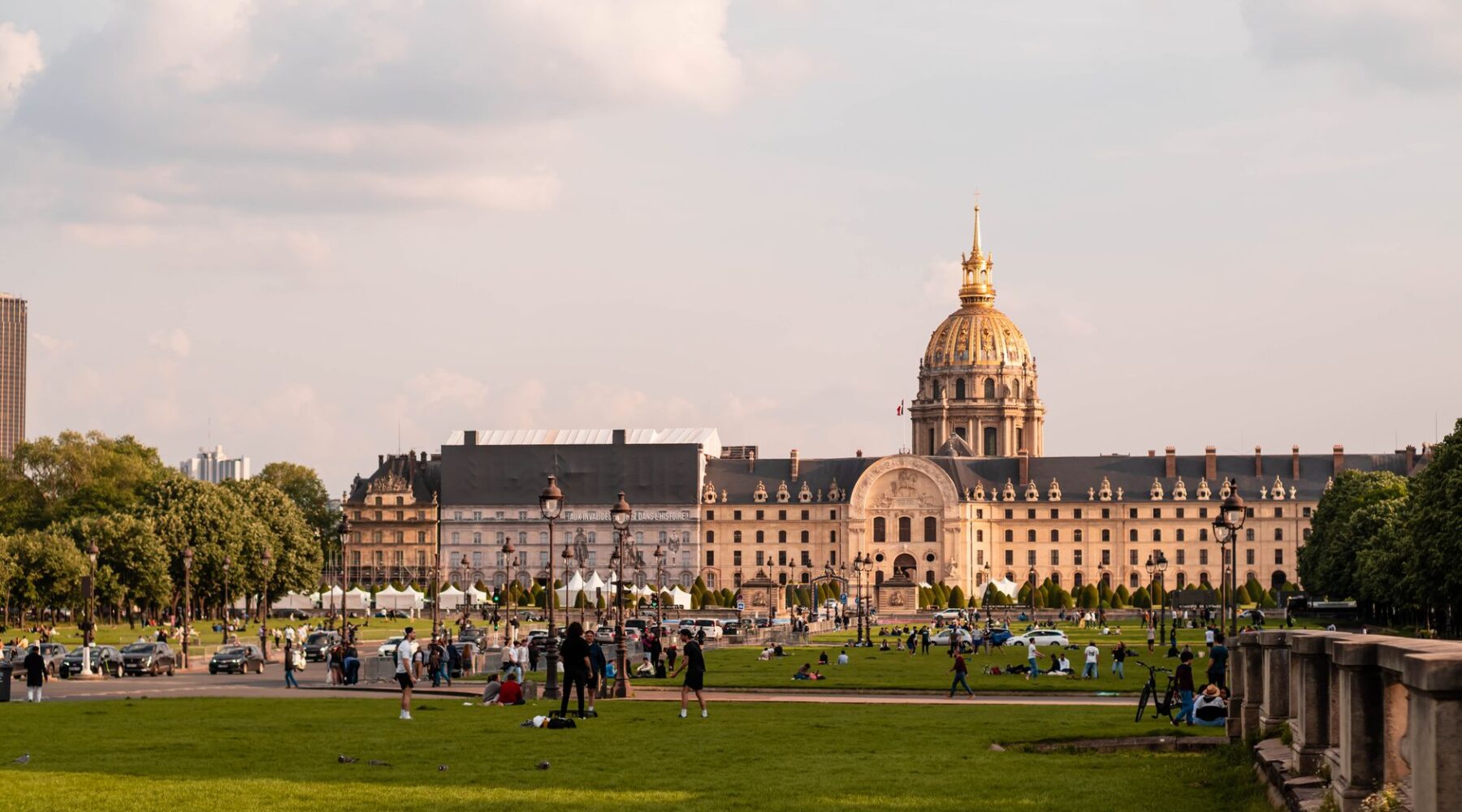
At about six on a warm evening, Paris empties out of its offices and fills its lawns. Office workers sit on the rim of the Grand Bassin with their shoes off, students spread a tablecloth on the slopes of the Buttes-Chaumont, and someone at the Place des Vosges is uncorking a bottle under the lime trees. Visitors tend to think of the city’s green spaces as things to cross on the way to a museum. Parisians treat them as a second living room. This guide to paris parks and gardens is about using them the way the city does: when to go, which ones are worth a detour, what they cost (usually nothing), and the rules that catch out first-time picnickers.
We cover the formal gardens in the centre, the wilder neighbourhood parks, the two great woods on the city’s edges, the specialist botanical gardens, the linear parks built on old railway lines, and the grand estates a short train ride out. Entry fees and hours were checked in September 2026. They change by season and sometimes by year, so treat them as the right order of magnitude and check the posted times at the gate.
Paris parks at a glance
| Park or garden | Arrondissement | Entry | Best for | Nearest Metro / RER |
|---|---|---|---|---|
| Jardin du Luxembourg | 6th | Free | The quintessential Paris garden; chairs, fountains, toy sailboats | RER B Luxembourg; Odéon (4, 10) |
| Jardin des Tuileries | 1st | Free | A break between the Louvre and the Orangerie | Tuileries (1); Concorde (1, 8, 12) |
| Parc des Buttes-Chaumont | 19th | Free | Dramatic cliffs, a lake, views and a local crowd | Buttes Chaumont, Botzaris (7bis) |
| Jardin des Plantes | 5th | Free grounds; paid glasshouses, zoo and galleries | Botany, families, a rainy-day fallback | Jussieu (7, 10); Gare d’Austerlitz |
| Parc Monceau | 8th | Free | An elegant, eccentric garden in a smart district | Monceau (2) |
| Place des Vosges | 3rd / 4th | Free | A picnic in the oldest planned square in Paris | Saint-Paul (1); Chemin Vert (8) |
| Coulée verte René-Dumont | 12th | Free | An elevated walk on a former railway viaduct | Bastille (1, 5, 8) |
| Père Lachaise Cemetery | 20th | Free | A wooded hillside of famous graves | Père Lachaise (2, 3); Gambetta (3) |
| Parc Floral | 12th, Bois de Vincennes | €2.80 from April to September; free October to March | Flower displays, summer concerts, big playgrounds | Château de Vincennes (1) |
| Parc de Bagatelle | 16th, Bois de Boulogne | €2.70 in the paid season; otherwise free | The rose garden in June | Bus from Porte Maillot |
Prices checked September 2026. Almost every park inside the city is free; the handful that charge do so only in the growing season and still cost less than a coffee.
How Paris parks work: hours, rules and lawns
Before the individual parks, a few things that apply almost everywhere. They explain most of the confused faces you’ll see at closing time.
Opening hours follow the sun
City parks don’t keep fixed hours. Most open around 7 or 8am on weekdays and a little later at weekends, then close at a time that shifts through the year with the daylight: as early as late afternoon in December and well into the evening in June and July. The exact times are posted on a sign at each gate. About a quarter of an hour before closing, park wardens walk the paths blowing whistles, and they mean it. Gates are locked behind them.
During summer heatwaves the city has opened some parks through the night so residents can escape overheated flats. That is a temporary measure, announced at the time, and not something to plan a trip around.
The lawn question
This is the rule that surprises visitors most. In the formal gardens, the grass is often decorative rather than for sitting on. At the Luxembourg and the Tuileries, most lawns are off limits and wardens will politely move you on. Instead, those gardens are famous for their free metal chairs, which you can pick up and carry to wherever you like.
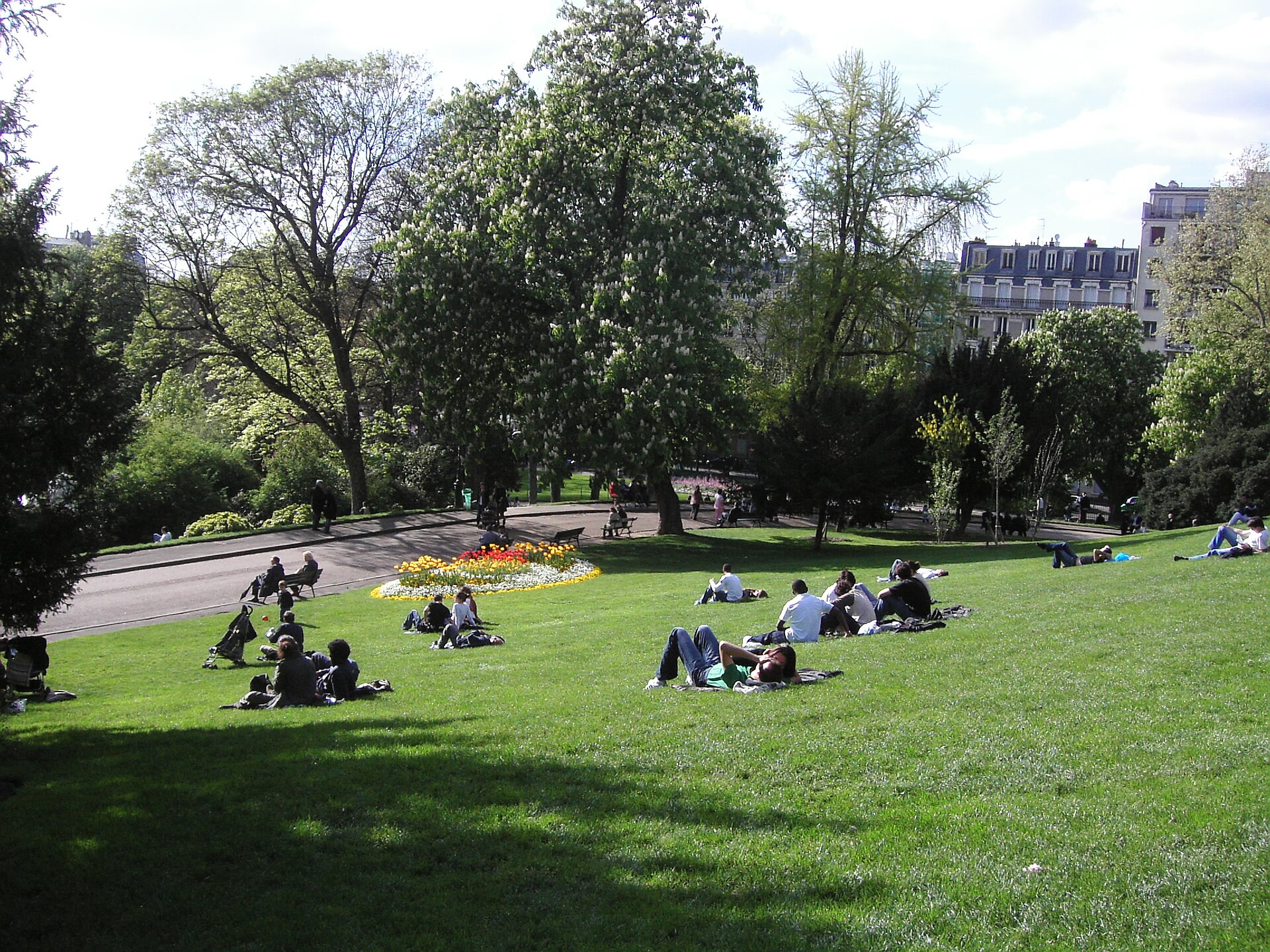
In the neighbourhood parks the picture is different. The Buttes-Chaumont, Parc de Belleville, Parc Montsouris, the Parc de la Villette and the Champ de Mars all have large lawns open to the public. Many other parks open theirs in the warmer months only, marked by a sign reading pelouse ouverte (lawn open) or pelouse au repos (lawn resting). If the sign says it’s resting, keep off.
Picnics, drinks and dogs
- Picnics are welcome almost everywhere you’re allowed to sit. Take your rubbish with you or use the bins; the wardens notice.
- Alcohol is generally tolerated with a picnic, in moderation, in most parks. Some parks and some areas ban it by local order, and glass bottles are unpopular. If you see a sign, follow it.
- Dogs are banned from many parks and restricted to marked areas in others. The formal gardens are the strictest.
- Barbecues are not allowed in city parks.
- Cycling is generally not allowed in the gardens except on marked routes, though the woods have dedicated paths. Children on small bikes and scooters are usually fine.
Toilets and water
Most larger parks have public toilets, and the city’s free automatic sanisettes are dotted around their edges. Many parks also have drinking fountains, including the green cast-iron Wallace fountains, some of which the city keeps running year-round. Fill up a bottle instead of buying one from a kiosk.
The central classics
If you only have time for one or two green spaces, these are the ones most visitors will pass, and they reward a longer stop than a quick walk-through.
Jardin du Luxembourg
The Luxembourg is the garden people mean when they talk about a Paris garden. It was laid out in the 17th century for Marie de’ Medici around the palace that now houses the French Senate, and the Senate still runs it. Around 23 hectares hold a formal French garden, an English-style wooded area, tennis courts, beehives, an orchard, chess tables and more than a hundred statues.
The things to do are small and pleasant. Pull two of the famous green chairs up to the edge of the Grand Bassin, the octagonal pond in front of the palace, and watch children push rented toy sailboats across the water with sticks. Find the Medici Fountain, a long shaded pool in the north-east corner that is one of the most romantic spots in the city. Wander over to the chess players under the trees, or stop at the puppet theatre if you have children in tow.
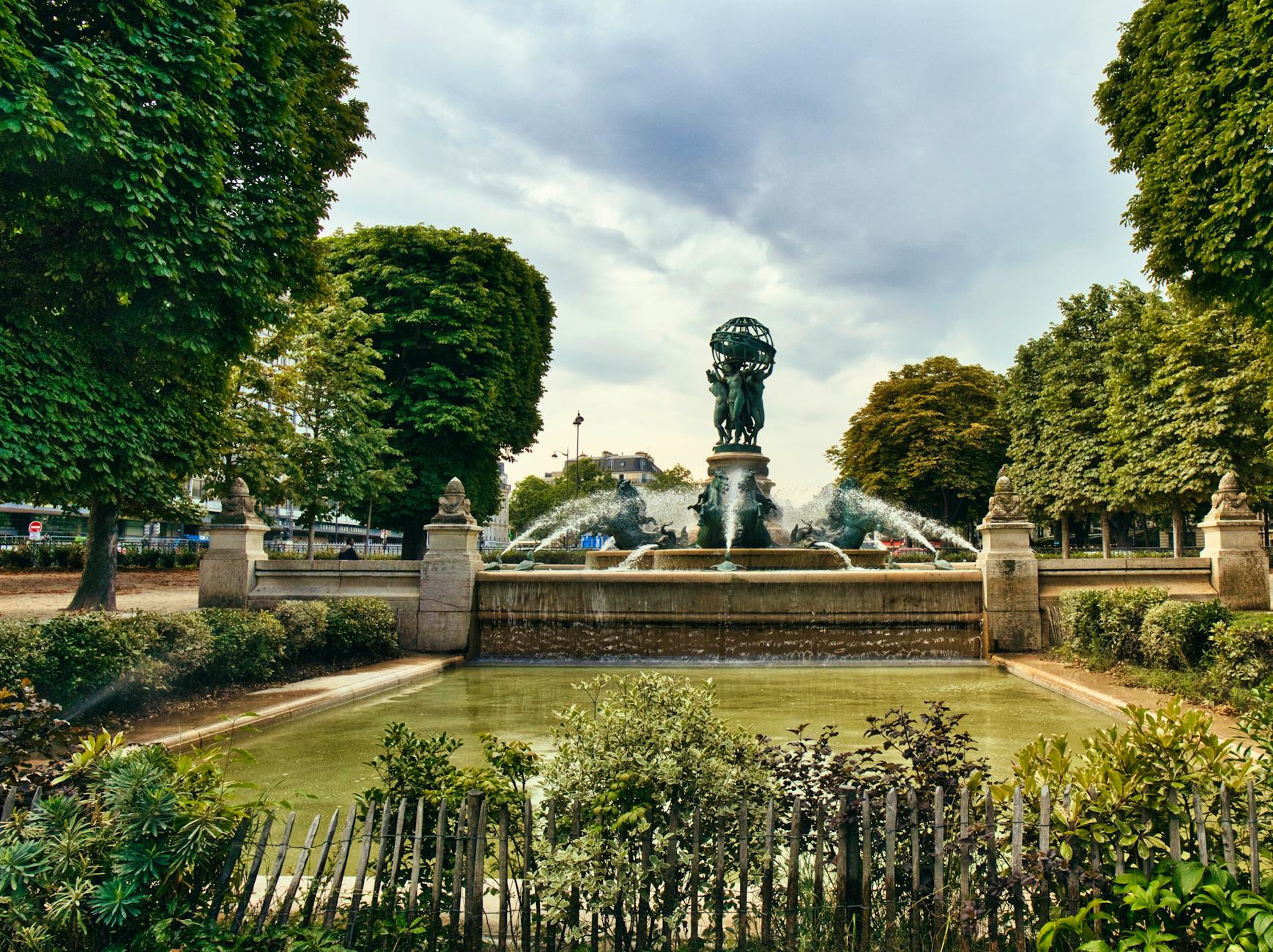
Our verdict: essential, and better in the morning or on a weekday evening than at weekend lunchtime, when every chair is taken. It’s a natural pause between the Latin Quarter and Saint-Germain; see our guides to the Latin Quarter and Saint-Germain-des-Prés for what’s around it.
Jardin des Tuileries
The Tuileries stretch from the Louvre to the Place de la Concorde, a formal garden designed by André Le Nôtre, the man behind the gardens at Versailles. Its long gravel avenue lines up with the Champs-Élysées and the Arc de Triomphe, and its two round ponds are ringed with the same movable green chairs as the Luxembourg.
Honestly, the Tuileries is more of a corridor than a destination. The main avenue is wide, dusty in summer and exposed to the sun, and the snack kiosks are priced for tourists. It’s lovely for twenty minutes with a coffee after the Louvre, and it holds two excellent museums at its western end: the Musée de l’Orangerie, home to Monet’s Water Lilies, and the Jeu de Paume photography gallery. In summer a funfair sets up along the Rue de Rivoli side, with a big wheel that gives a good view over the garden and the Louvre.
Our verdict: use it, don’t plan a day around it. The shadier side paths under the chestnut trees are much nicer than the central avenue. Our Louvre guide covers the museum at its eastern end.
Jardin du Palais-Royal
Tucked behind the Comédie-Française, a short walk north of the Louvre, the Palais-Royal garden is a long rectangle of clipped lime trees and flowerbeds enclosed by 18th-century arcades. The arcades hold old-fashioned shops selling medals, gloves and vintage fashion, and the first courtyard is filled with Daniel Buren’s black-and-white striped columns, which people climb on for photographs.
It’s one of the calmest places in central Paris, with benches in the shade, and it is almost always less crowded than the Tuileries ten minutes away. A good place to sit with a pastry; our guide to the best bakeries in Paris has some nearby candidates.
Place des Vosges
Built in the early 17th century, the Place des Vosges is the oldest planned square in Paris: a perfect square of red brick and stone townhouses above vaulted arcades, with a garden of lime trees, fountains and a statue of Louis XIII in the middle. Victor Hugo lived at number 6, which is now a museum.
On a sunny weekend the lawns fill with picnics, and on a weekday morning it’s close to silent. It sits at the heart of the Marais, so it’s easy to combine with falafel from the Rue des Rosiers or a browse through the neighbourhood’s galleries.
Square du Vert-Galant
Down a flight of steps from the middle of the Pont Neuf, this tiny triangular garden sits at the western tip of the Île de la Cité, almost at water level, with a weeping willow and views of the Louvre and the Pont des Arts. It is one of the best places in the city to watch the sun go down over the Seine. Our guide to sunset spots in Paris has others, and the Île de la Cité guide covers the rest of the island.
The neighbourhood parks Parisians love
These are the parks where you’ll hear more French than English. Most were built in the 19th century under Napoleon III and Baron Haussmann, who wanted every quarter of the growing city to have somewhere to breathe, and their engineer Jean-Charles Alphand designed several of them.
Parc des Buttes-Chaumont
If we had to pick one park for a visitor who has already seen the Luxembourg, it would be this one. The Buttes-Chaumont was built in the 1860s on the site of old gypsum quarries in the north-east of the city, and Alphand turned the scarred ground into something close to theatre: steep lawns, winding paths, a waterfall inside an artificial grotto, a lake, and a rocky island rising some 50 metres with a small Roman-style temple on top. Reaching the Temple de la Sibylle takes a suspension bridge and a climb, and from the top you look across north-east Paris to the Sacré-Cœur.
The lawns are open for sitting on, and on summer evenings the park is one of the most sociable places in the city. The Rosa Bonheur guinguette, an open-air bar and dance hall inside the park, draws a long queue at weekends.
Practical: the park is hilly, so wear decent shoes and allow two hours to see it without rushing. Combine it with an afternoon in Belleville, a short walk south.
Parc de Belleville
Just south of the Buttes-Chaumont, the Parc de Belleville climbs a steep hillside in terraces and cascades. It’s modern, built in the 1980s, and less beautiful close up than the older parks. The reason to come is the view: from the belvedere at the top of Rue Piat you get a long panorama over the rooftops to the Eiffel Tower, and it’s free, rarely crowded and superb at sunset. Metro Pyrénées (11) or Couronnes (2).
Parc Monceau
Parc Monceau is the well-dressed cousin of the family. Laid out in the late 18th century for the Duke of Chartres as a garden of follies, it still has some of its oddities: a Dutch windmill, a small Egyptian pyramid and, best of all, a moss-covered Corinthian colonnade curving around an oval pond. It’s surrounded by gilded gates and grand private mansions, one of which houses the Musée Nissim de Camondo.
The lawns are open in season, the playground is good, and the jogging loop is one of the most popular in western Paris. Monet painted the park several times. Metro Monceau (2).
Parc Montsouris
In the far south of the city, near the Cité Universitaire campus, Parc Montsouris is an English-style landscape park with a lake, rolling lawns, big old trees and a relaxed student crowd. It’s the best choice if you’re staying in the 14th and want space rather than sights. RER B Cité Universitaire.
Parc André-Citroën
Built in the 1990s on the site of the old Citroën car factory in the 15th, Parc André-Citroën is a modern park with a huge central lawn sloping towards the Seine, two large glasshouses, a set of themed gardens and fountain jets set into the paving, which children run through on hot days. A tethered helium balloon rises from the park on calm days for a view over the west of the city; check its current operation and prices before you go. Metro Javel (10) or Balard (8); RER C Javel.
Parc de la Villette
La Villette is the largest park inside the city limits, built on the site of the old slaughterhouses in the 19th. It’s less a garden than a cultural campus: bright red pavilions scattered across open lawns, the Cité des Sciences science museum, the Philharmonie de Paris concert hall and a string of themed children’s gardens. In summer the park usually hosts an open-air cinema on its main lawn. Metro Porte de la Villette (7) or Porte de Pantin (5).
Champ de Mars
The long lawn running from the foot of the Eiffel Tower to the École Militaire is the obvious place for a picnic with the view. It’s also the busiest, the most hassled by souvenir sellers, and the park where you’re most likely to be offered overpriced wine and champagne from a bucket. Go early, pack your own food and keep an eye on your bags. Our Eiffel Tower guide covers the best viewpoints, and the guide to Paris scams explains the tricks worked on the lawns around it.
For a calmer view of the tower, walk across the river to the Trocadéro gardens, whose lawns slope down towards the Seine. They are just as photogenic in the early morning.
Gardens with a purpose: botany, roses and glasshouses
Jardin des Plantes
Founded in 1635 as a royal garden of medicinal plants, the Jardin des Plantes is France’s main botanical garden and part of the National Museum of Natural History. The main grounds are free: long avenues of plane trees, formal flowerbeds planted by season, an alpine garden, a rose garden and an old cedar of Lebanon planted in the 18th century.
The paid attractions inside are what make it a half-day out, especially with children:
| Attraction | Price | Hours |
|---|---|---|
| Grandes Serres (glasshouses) | €9 / €7 reduced | 10am–6pm, closed Tuesdays |
| Ménagerie (zoo) | €13; under-3s free | 10am–6pm until 25 October 2026; closes at 5pm from 26 October |
| Grande Galerie de l’Évolution | Separate ticket; combined tickets available | Check before you go |
The Ménagerie is one of the oldest zoos in the world and small by modern standards, which is exactly why young children like it. The Grande Galerie de l’Évolution, with its parade of stuffed animals marching down a vast iron-and-glass hall, is one of the most striking museum spaces in Paris and a strong rainy-day plan. See our guide to kid-friendly museums in Paris for more like it.
Parc de Bagatelle
Deep in the Bois de Boulogne, Bagatelle is a small château surrounded by a landscaped park, and home to one of the finest rose gardens in Europe: roughly 10,000 rose bushes of around 1,200 varieties. The peak is June, when the city holds its international new rose competition here and the arches and beds are at their fullest. Peacocks wander the lawns, there’s a Chinese pagoda, a grotto and a waterfall, and the whole place feels much further than 20 minutes from the Champs-Élysées.
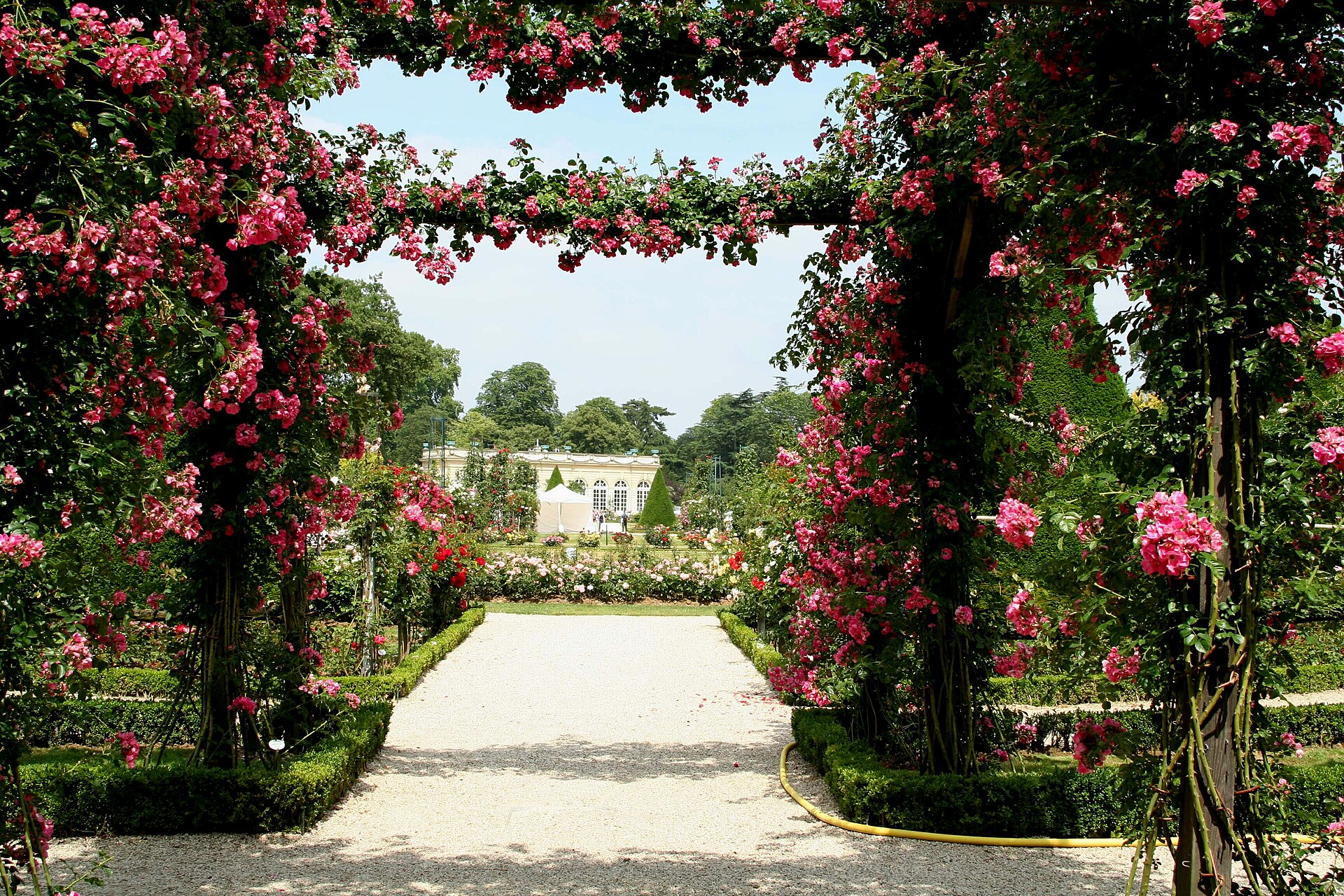
Entry costs €2.70 (€1.55 reduced) during the paid season, roughly May to October, and is free the rest of the year. A €25 annual pass also covers the other three sites of the city’s botanical garden: the Parc Floral, the Serres d’Auteuil and the Arboretum. Bagatelle is awkward to reach without a car: take the bus from Porte Maillot, or walk from the Pont de Neuilly through the woods.
Our verdict: in June, it’s one of the most beautiful places in Paris and worth the trek. In November, it’s a nice park a long way from anything.
Parc Floral de Paris
Inside the Bois de Vincennes, next to the château, the Parc Floral is a large modern garden built for the 1969 flower show: seasonal beds of tulips, irises, dahlias and camellias, a pine forest, water gardens and a butterfly garden. It also has some of the best playgrounds in the city, and a summer programme of free concerts, including jazz and classical, is traditionally held at its open-air stage.
| Season | Entry | Hours |
|---|---|---|
| 1 April – 30 September | €2.80; €1.60 reduced; under-7s free | 9.30am–8pm (from the clock change to 30 September) |
| 1 October – 31 March | Free | 9.30am–6.30pm in October and March; 9.30am–5pm in winter |
Metro Château de Vincennes (Line 1), then a ten-minute walk past the château.
Serres d’Auteuil
On the edge of the Bois de Boulogne, next to the Roland-Garros tennis stadium, the Serres d’Auteuil are a set of elegant late-19th-century glasshouses full of tropical plants, arranged around a formal garden. They are free, rarely busy and a lovely surprise if you’re in the 16th. Metro Porte d’Auteuil (10).
Walks on old railways
Coulée verte René-Dumont
Long before New York’s High Line, Paris turned an abandoned railway into a park. The Coulée verte René-Dumont, also known as the Promenade plantée, opened in 1993 on the line that once ran from Bastille to the eastern suburbs. It runs for about 4.7 kilometres from near the Opéra Bastille towards the Bois de Vincennes.
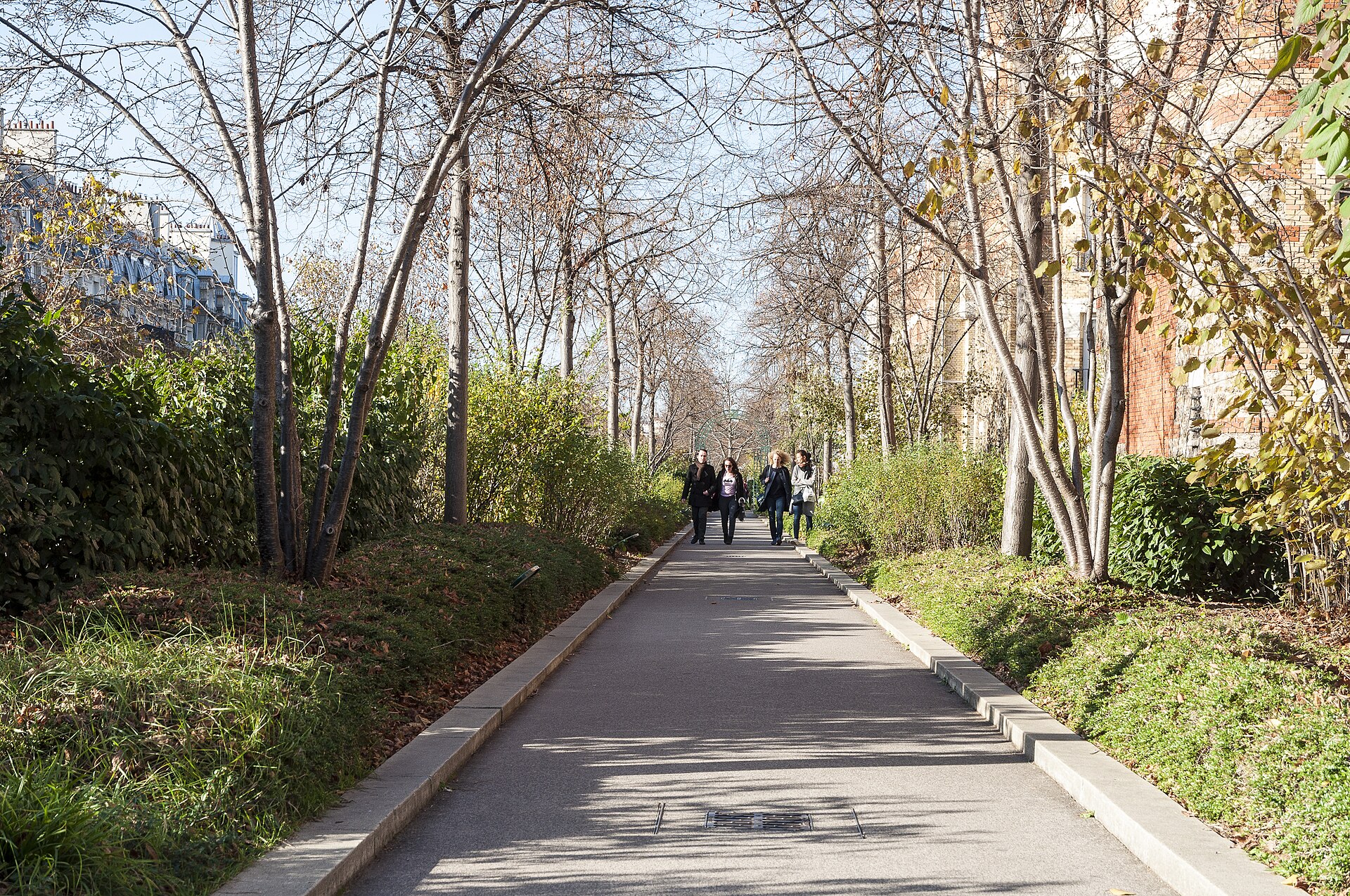
The first stretch is the best: an elevated walk along the top of the Viaduc des Arts, whose brick arches below now house craft workshops and design studios. You walk among roses, bamboo and lime trees at first-floor window height, looking into the apartments of the 12th. Further east, the path drops to street level and passes through gardens, a short tunnel and a sunken cutting.
Tips: join it from Avenue Daumesnil near Bastille (look for the staircases), walk east for 20–30 minutes to the Jardin de Reuilly, then decide whether to continue. Our guide to walking in Paris and romantic walks have more routes like it.
La Petite Ceinture
The Petite Ceinture is an old railway that once circled Paris inside the city walls. Most of it has been abandoned for decades, but the city has opened several sections as public walks, where you can stroll along the old tracks through cuttings full of wild plants. The open sections are mainly in the 12th, 13th, 14th, 15th and 16th arrondissements. Opening times vary by section, and they are best treated as a curiosity for a second or third visit.
The great woods: Boulogne and Vincennes
On the western and eastern edges of the city sit two huge woods, each far larger than all the central parks put together. They were royal hunting grounds, landscaped under Napoleon III into public parks with lakes, paths and pleasure gardens.
Bois de Boulogne
The Bois de Boulogne covers roughly 845 hectares on the western side of Paris. Its best parts for visitors:
- The lakes. The Lac Inférieur has rowing boats for hire in the warmer months and an island reached by a small ferry.
- Parc de Bagatelle and the Serres d’Auteuil, described above.
- The Jardin d’Acclimatation, a 19th-century amusement park for children, with rides, animals and playgrounds. Entry is paid; check prices before you go.
- Fondation Louis Vuitton, the Frank Gehry-designed art museum whose glass sails rise above the trees next to the Jardin d’Acclimatation.
- The Pré Catelan and Shakespeare Garden, a quieter corner with a garden planted with species mentioned in Shakespeare’s plays.
The Bois is best enjoyed by bike: Vélib’ stations sit around the edges and there are long cycle paths inside. Our cycling and Vélib’ guide covers the practical side. One honest warning: parts of the Bois are known for sex work along the roads at night, and it’s not a place to wander after dark. By day, it’s perfectly fine.
Bois de Vincennes
The Bois de Vincennes, slightly larger at around 995 hectares, sits on the south-eastern edge. It’s more of a family day out than Boulogne:
- Lac Daumesnil, with rowing boats in summer and a Buddhist temple nearby.
- The Parc Floral, described above.
- The Château de Vincennes, a medieval fortress with one of the tallest keeps in Europe, just outside the wood.
- The Parc Zoologique de Paris, the city’s modern zoo, with paid entry.
- The Cartoucherie, a former munitions factory now home to several theatres including the Théâtre du Soleil.
Metro Château de Vincennes (Line 1) for the château and Parc Floral, or Porte Dorée (8) for Lac Daumesnil and the zoo.
Cemeteries as parks
Parisians have always treated the big cemeteries as places to walk. They are free, peaceful, full of trees and sculpture, and hold the graves of some of the most famous people in history.
Père Lachaise
The largest and most visited is Père Lachaise, a wooded hillside of cobbled lanes and moss-covered tombs in the 20th arrondissement. Jim Morrison, Oscar Wilde, Édith Piaf, Chopin, Molière and Proust are all buried here. Pick up a map at the main entrance on Boulevard de Ménilmontant or download one before you go, because the layout is confusing and phone signal can be weak under the trees. Allow at least two hours. Metro Père Lachaise (2, 3) for the main gate, or Gambetta (3) to start at the top and walk downhill.
Montmartre and Montparnasse
The Cimetière de Montmartre, in a hollow below the hill, holds Degas, Stendhal and Dalida; it’s an atmospheric shortcut on a day spent in Montmartre. The Cimetière du Montparnasse, flat and laid out in a grid, holds Sartre and de Beauvoir, Baudelaire, Serge Gainsbourg and Susan Sontag, and is easier to navigate.
Parks for children
Paris is a surprisingly good city for children with energy to burn, largely because of its parks. The highlights:
- Jardin du Luxembourg: the toy sailboats on the Grand Bassin, pony rides, an old-fashioned carousel, a large paid playground and the puppet theatre.
- Jardin d’Acclimatation: rides, farm animals and a small train from the edge of the Bois de Boulogne.
- Parc Floral: some of the best free-to-use climbing frames and slides in the city, once you’ve paid the small summer entry.
- Jardin des Plantes: the Ménagerie and the Grande Galerie de l’Évolution.
- Parc de la Villette: themed playgrounds, including a long dragon slide, and the Cité des Sciences.
- Tuileries: trampolines and the summer funfair.
Our dedicated guide to Paris parks and playgrounds for children covers these in detail, and Paris with kids has the wider picture.
How to picnic like a Parisian
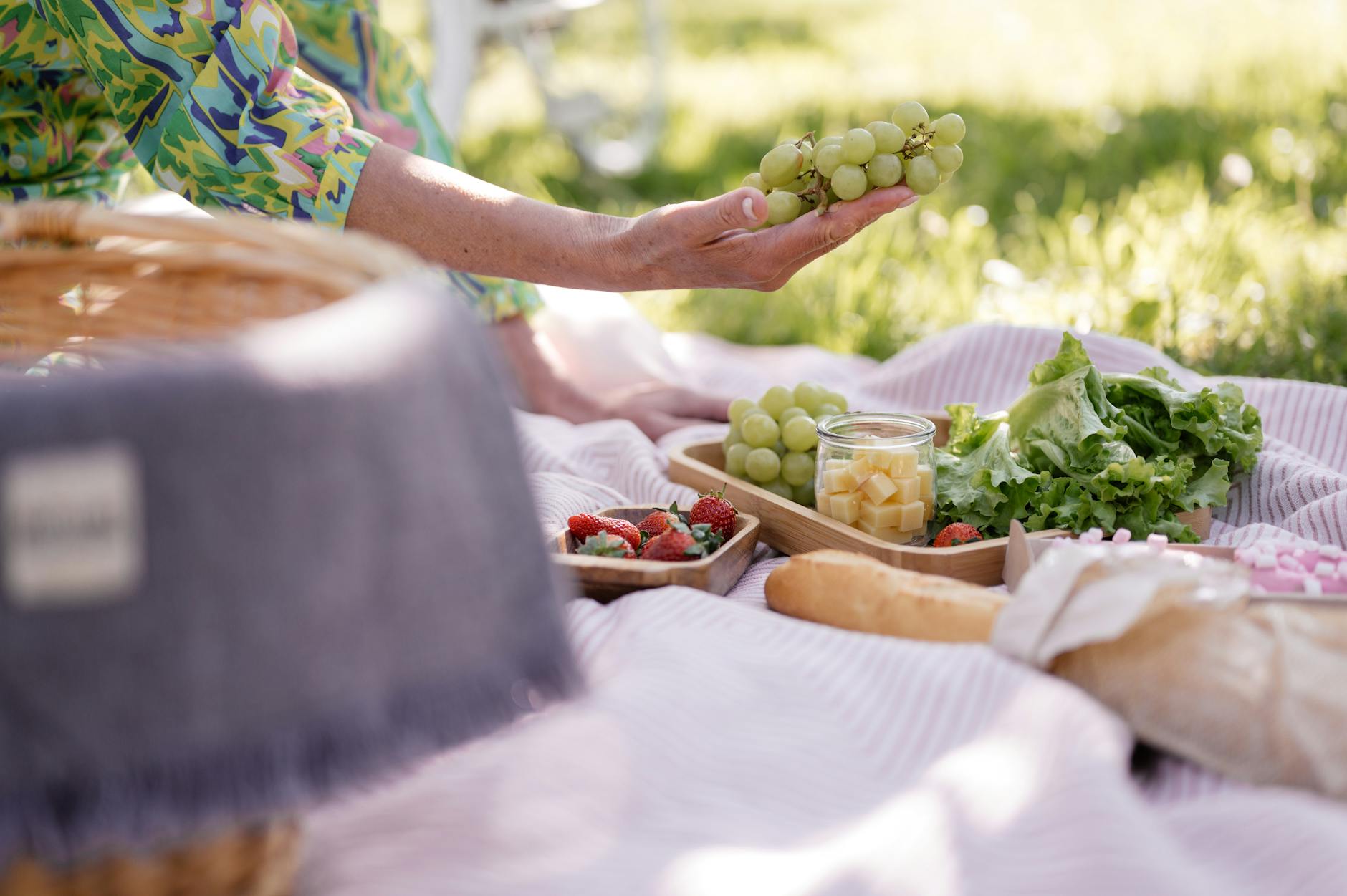
A picnic in a park is one of the best meals you can have in Paris, and one of the cheapest. The trick is doing the shopping properly.
- Buy bread last. A baguette is at its best within a couple of hours of baking. Pick one up from a good bakery on your way to the park.
- Visit a market or a fromagerie for the cheese. Ask for something ripe to eat today, and let them cut it. Our guide to Paris food markets lists the best.
- Add charcuterie, fruit and something sweet. A slice of pâté or a few slices of jambon, whatever fruit is in season, and a tart or a few macarons.
- Bring the kit. A cloth or blanket, a knife (in checked baggage only, or buy a cheap one in Paris), a corkscrew if you’re bringing wine, napkins and a bag for rubbish.
- Pick a park with open lawns. The Buttes-Chaumont, the Place des Vosges, the Champ de Mars, Parc Montsouris or the quays of the Seine.
A good picnic for two costs €20–30 with a decent bottle of wine, about what a single main course costs in a brasserie. See our guides to Paris on a budget and cheap eats for more ways to eat well for less.
Paris parks through the seasons
| Season | What’s happening | Where to go |
|---|---|---|
| Spring (March–May) | Cherry and magnolia blossom, tulips, lawns reopen | Jardin des Plantes, Parc Floral, the Luxembourg orchard, the Champ de Mars |
| Early summer (June) | Roses at their peak, long evenings | Bagatelle, the rose garden at the Jardin des Plantes, the Buttes-Chaumont at sunset |
| High summer (July–August) | Open-air cinema and concerts, funfair, heat | La Villette, the Parc Floral, shady paths in the Luxembourg, the woods |
| Autumn (September–November) | Golden chestnuts and plane trees, fewer crowds | Père Lachaise, the Luxembourg, the Bois de Vincennes |
| Winter (December–February) | Short days, bare trees, parks close early | The glasshouses at the Jardin des Plantes and Auteuil; the Palais-Royal on a bright day |
For more on what each season brings, see our guides to Paris in spring, summer in Paris and Paris in autumn.
Grand gardens beyond the city
Some of the most spectacular gardens in the region lie just outside Paris, and make easy half-day or day trips.
Versailles
The gardens of Versailles are the model for every formal French garden in the world: 800 hectares of terraces, fountains, parterres and the Grand Canal, designed by Le Nôtre for Louis XIV. The gardens are free on most days, but a ticket is charged on days when the Musical Fountains or Musical Gardens shows are running, generally at weekends and on selected days from spring to autumn. The ticket gives you the fountains playing to Baroque music, which is worth seeing. Hire a bike or a rowing boat on the Grand Canal to get the scale of it. Our Versailles guide covers tickets for the palace and estate, and getting from Paris to Versailles has the trains.
Giverny
Claude Monet’s garden at Giverny, with the water-lily pond and the Japanese bridge he painted over and over, is about an hour from Paris. It’s open from spring to autumn only and very busy in May and June. Our Giverny day trip guide covers timing and transport.
Fontainebleau, Saint-Cloud and Sceaux
The château of Fontainebleau sits inside a vast forest popular with walkers and climbers, and its gardens include an English garden and a long canal; see our Fontainebleau day trip guide. Closer in, the Domaine national de Saint-Cloud has terraces with one of the best views back over Paris, and the Parc de Sceaux, south of the city, has formal gardens by Le Nôtre and a famous cherry blossom grove in April.
What’s not worth the detour
Not every green space deserves a place in a short trip. Our honest view:
- The Champs-Élysées gardens between the Concorde and the Rond-Point are pleasant but forgettable, a place to walk through rather than stop.
- Jardin d’Acclimatation without children is hard to justify: the entry is paid and most of the appeal is the rides.
- The Petite Ceinture is fascinating to urban explorers but, for most short-stay visitors, the Coulée verte gives the same idea with less effort.
- Bagatelle out of season: lovely in June, a long trek for a quiet park in winter.
- A sit-down lunch at the park kiosks in the Tuileries and Luxembourg: convenient, but you pay a big premium for an average sandwich. Bring a picnic instead.
Frequently asked questions
Are Paris parks free?
Almost all of them. The Luxembourg, Tuileries, Buttes-Chaumont, Parc Monceau, the grounds of the Jardin des Plantes and the big cemeteries are all free. The exceptions are a few specialist gardens that charge a small fee in the growing season: the Parc Floral charges €2.80 from April to September and Bagatelle €2.70 in its paid season. Prices checked September 2026.
What is the most beautiful park in Paris?
For a classic Paris garden, the Jardin du Luxembourg. For drama and a local atmosphere, the Parc des Buttes-Chaumont. For flowers, Bagatelle’s rose garden in June. The best answer depends on whether you want formal elegance or somewhere to lie on the grass.
What time do Paris parks close?
It depends on the season. Most city parks close in the late afternoon in winter and late evening in summer, with the exact time posted at each gate. Wardens start clearing the park about 15 minutes before closing.
Can you sit on the grass in Paris parks?
In many parks, yes, especially in the warmer months. Look for a sign saying pelouse ouverte. In the formal gardens, including most of the Luxembourg and the Tuileries, the lawns are generally off limits, and you use the free movable chairs instead.
Can you drink wine in Paris parks?
A glass of wine with a picnic is generally tolerated in most parks, but some parks and areas have local bans on alcohol. Follow any posted signs, avoid glass where you can, and don’t be the loud group at closing time.
What is the largest park in Paris?
The Bois de Vincennes, at about 995 hectares, just ahead of the Bois de Boulogne at around 845 hectares. Inside the ring road, excluding the woods, the Parc de la Villette is the largest.
Which Paris park is best for a picnic?
The Buttes-Chaumont for atmosphere, the Place des Vosges for setting, the Champ de Mars for the Eiffel Tower view, and Parc Montsouris for space and calm. Avoid the Luxembourg if you want to sit on the grass, as most lawns are closed.
When are the roses in bloom in Paris?
June is the peak, particularly in the rose garden at Bagatelle and the rose garden of the Jardin des Plantes, though many varieties flower again into September.
The Luxembourg rewards far more than a walk-through, from the queens’ terrace and the little Statue of Liberty to the orchard, the apiary and the photography hung on the railings. Our complete Luxembourg Gardens guide has the twice-monthly opening hours, what the sailboats and playground cost, and a relaxed half-day route.
The Tuileries deserves more than the dash most visitors give it between the Louvre and the Concorde, but it also has real weak spots, from the unshaded central avenue to the overpriced kiosks. Our Tuileries guide is candid about both, with the sculpture worth finding and two routes through the garden.
Père Lachaise is big and confusing enough to deserve its own plan. Our Père Lachaise guide lists more than twenty famous graves by division number, from Chopin and Wilde to Piaf and Modigliani, with a mostly downhill route from the Gambetta gate and the memorials near the Communards’ Wall that most visitors walk straight past.
The Jardin des Plantes is really three or four attractions sharing one garden, and they are not equally worth the money. Our Jardin des Plantes guide sorts the free parterres, labyrinth and botany school from the paid galleries, glasshouses and zoo, with current prices and the news that the Palaeontology Gallery stays closed until 2027.
Related Paris Guides
- Things to Do in Paris
- Free Things to Do in Paris
- Paris Parks and Playgrounds for Children
- The Best Food Markets in Paris
- Walking in Paris
- The Versailles Guide
- Giverny Day Trip
- Paris in Spring
Photo Credits
Lawns in the Parc des Buttes-Chaumont: May 2005 Parc des Buttes Chaumont by Syced, CC0, via Wikimedia Commons.
Rose arches at Parc de Bagatelle: Bagatelle roseraie classique01 by Spedona, CC BY-SA 3.0, via Wikimedia Commons.
The Coulée verte René-Dumont: Coulée verte René-Dumont – Paris by André Alliot, CC0, via Wikimedia Commons.